

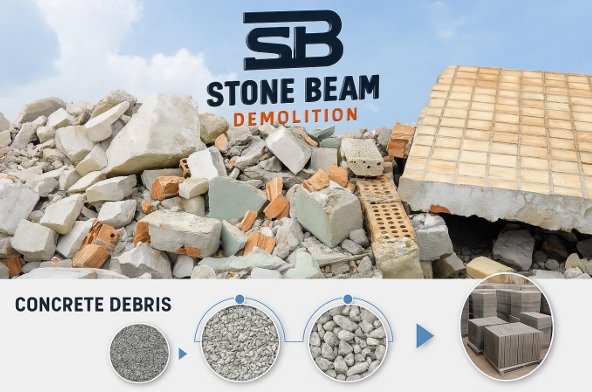
استخدام الركام المعاد تدويره من مخلفات الهدم في الخرسانة الإنشائية
Use of Recycled Concrete Aggregate from Demolition Waste in Structural Concrete in Dubai & UAE
1. Introduction: From Demolition Rubble to Structural Concrete
Dubai and the wider UAE are in a new phase of construction: build, demolish, rebuild – but sustainably. Construction and demolition (C&D) waste can account for around 70–75% of total solid waste in the UAE, driven by constant renovations, demolitions and new mega-projects.wasterecyclingmag.com
At the same time, the UAE is tightening regulations on waste and pushing hard toward a circular economy:
- Federal Law No. 12 of 2018 on Integrated Waste Management obliges authorities to segregate construction and demolition waste at source and send it to recycling facilities.UAE Legislation
- MOCCAE Ministerial Resolution No. 21 of 2019 allows up to 40% of material requirements in public and private projects to be met using recycled aggregates from C&D waste, provided they meet UAE standards and pass lab testing.UAE Ministry of Climate Change+1
In parallel, research from UAE Universities shows that concrete using recycled aggregates can match or even outperform conventional concrete, and that in many cases full replacement of natural aggregate is technically possible when properly designed and tested.MDPI
For developers, consultants and contractors, this raises a crucial question:
Can recycled aggregate from demolition waste be safely used in structural concrete – not just backfill and sub-base – in Dubai and the UAE?
The answer is yes, when you:
- Select and process demolition waste correctly.
- Apply proper quality control and laboratory testing.
- Design mixes with realistic replacement levels and durability performance.
- Work with a demolition contractor that understands circular economy, engineered demolition and DM/MOCCAE requirements.
This is exactly where Stone Beam Demolition comes in – not just as a demolition contractor in Dubai, but as a circular resource partner that can turn your old structures into certified, structural-grade aggregates for new ones.sbdemolition.ae+1
In this guide, we’ll walk through – step by step – how to use recycled concrete aggregate (RCA) from demolition waste in structural concrete (الخرسانة الإنشائية) in Dubai and the UAE.
2. What Is Recycled Concrete Aggregate (RCA)?
2.1 Basic definition
Recycled Concrete Aggregate (RCA) is aggregate produced by crushing and processing:
- Old reinforced concrete from demolished buildings, bridges, pavements and foundations.
- Sometimes blended with masonry or other mineral-based demolition materials (depending on required standards).
It is usually divided into:
- Coarse RCA: typically > 4.75 mm (e.g., 10, 20 mm).
- Fine RCA: < 4.75 mm, sometimes partly replacing natural sand.
When produced from clean, high-quality structural concrete and crushed under controlled conditions, RCA can reach mechanical properties suitable for structural concrete, not only sub-base or backfilling.
2.2 Key physical and mechanical characteristics
Compared with natural aggregates from quarries, RCA typically shows:
- Lower density (due to adhered mortar).
- Higher water absorption (more porous microstructure).
- Slightly lower stiffness (elastic modulus).
- Similar or slightly reduced strength, depending on source quality and replacement ratio.
Studies in the UAE using life cycle assessment (LCA) confirm that RAC (recycled aggregate concrete) can achieve compressive strengths comparable to natural aggregate concrete when mixes are correctly proportioned, while significantly reducing environmental impacts.MDPI
For structural applications, this means:
- You must adjust mix design (especially water content and admixtures) to account for higher absorption and different grading.
- Quality of the source concrete (strength class, contamination) becomes critical.
- Laboratory testing and ongoing QC are non-negotiable.
3. Regulatory and Standards Context in the UAE
Before specifying RCA in structural concrete, clients and consultants want clarity on regulations.
3.1 Waste and recycling regulations
Key regulatory pillars:
- Federal Law No. 12 of 2018 on Integrated Waste Management
- Requires construction and demolition wastes to be segregated at the source and transported to the nearest waste facility for recycling.UAE Legislation
- Emphasises reuse, recycling and proper disposal, with substantial penalties for non-compliance.
- MOCCAE Ministerial Resolution No. 21 of 2019 (Recycled Aggregates from C&D Waste)
- Sets environmental prerequisites for recycling concrete, bricks, steel and other C&D materials into new high-value materials.
- Allows public and private contractors to meet up to 40% of material needs using recycled aggregates (for roads and infrastructure) if the aggregates pass lab testing and comply with UAE standards and LEED/BREEAM requirements.UAE Ministry of Climate Change+1
- Dubai & other local municipality rules
- Dubai Municipality and other Emirates have progressively tightened C&D waste segregation, landfill diversion targets and requirements for using approved recycling facilities.sbdemolition.ae+1
These regulations do not force structural use of RCA, but they clearly encourage high-value recycling and make low-grade landfilling increasingly unattractive and expensive.
3.2 Concrete and aggregate standards
Concrete in Dubai typically complies with:
- Local adaptations of international standards (BS EN / ASTM) for aggregates and concrete.
- Dubai Sustainable Concrete Baseline (DSCB) and DM’s sustainable concrete calculator, which promote lower-carbon and more sustainable mix designs.Dubai Municipality+1
Recycled aggregates must meet criteria for:
- Particle size distribution
- Los Angeles abrasion value (LAA)
- Water absorption
- Sulphate and chloride content
- Total contamination (wood, plastics, gypsum, etc.)
For structural concrete, consultants usually specify:
- Upper limits for RCA replacement, often:
- 20–40% replacement of coarse aggregate for standard structural elements.
- 0–20% for critical elements (columns, heavily loaded beams).
- Stricter control on:
- Chloride content (especially in coastal projects).
- Alkali reactivity.
- Carbonation and freeze–thaw (less of an issue in the UAE, more relevant in cold climates).

4. Why Use Recycled Concrete Aggregate in Structural Concrete?
4.1 Environmental and ESG benefits
Using RCA in structural concrete directly supports:
- Reduced landfill – C&D waste in the UAE is a major part of total solid waste; recycling it into aggregates significantly reduces burden on landfills and illegal dumping.wasterecyclingmag.com+1
- Lower CO₂ footprint – LCA studies show that replacing natural aggregate with recycled aggregate can cut global warming potential, especially when combined with cement replacement (GGBS, fly ash, microsilica).MDPI+1
- Circular economy targets – The UAE Circular Economy Policy 2021–2031 explicitly promotes reuse and recycling of building materials.sbdemolition.ae+1
For developers, this translates into:
- Better ESG metrics and sustainability reporting.
- Easier compliance with LEED, Estidama and Dubai Green Building Regulations, which reward C&D waste diversion and recycled content.sbdemolition.ae+1
4.2 Cost and supply-chain resilience
Dubai imports large volumes of aggregate and cementitious materials. Using recycled aggregates:
- Reduces dependence on imported virgin aggregates and quarrying in environmentally sensitive areas.FM Middle East
- Can lower material cost for certain applications, especially where recycled aggregates are produced closer to the project than distant quarries.Concept Zone LLC.+1
Combined with modern demolition practices, this can create project-level economic value: demolition waste becomes a partial material source for the new project.
4.3 Technical feasibility
Recent UAE research shows that:
- Concrete with 100% recycled aggregates can match target compressive strength when mix design is optimized, although cost may increase if steel fibers or special additives are used.MDPI
- For many standard structural elements, partial replacement (20–50%) of coarse aggregate is a technically safe and economical sweet spot – especially in mid-rise buildings and infrastructure where extremely high strengths are not required.
5. Structural Performance of Recycled Aggregate Concrete (RAC)
5.1 Fresh concrete properties
Typical impacts of RCA on fresh concrete:
- Workability:
- RCA’s rough texture and higher absorption can reduce slump.
- Solutions:
- Pre-soak RCA or account for absorption in mix water.
- Use high-range water-reducing admixtures (superplasticizers).
- Density:
- Slightly lower density due to adhered mortar and higher void content.
For ready-mix producers in Dubai, these effects are manageable with proper mix design and QC.
5.2 Hardened properties
Key aspects for structural concrete:
- Compressive strength
- With properly graded RCA and adjusted mix design, strength loss is often marginal for replacement levels up to ~50% of coarse aggregate.
- UAE studies show that target strengths (e.g., 30–50 MPa) are achievable with full or partial RCA replacement when mixes are carefully engineered.MDPI
- Modulus of elasticity (E)
- Lower than natural aggregate concrete at high RCA contents.
- For typical structural elements, this is addressed by:
- Using conservative design values.
- Limiting RCA ratio in high-serviceability members where deflection is critical.
- Tensile strength and bond
- Generally comparable to natural aggregate concrete when RCA quality is high.
- Proper compaction and curing remain critical.
5.3 Durability in the UAE environment
Dubai and UAE structures face:
- High temperatures and thermal cycles
- Marine exposure (chlorides) in coastal projects
- Sulfate-bearing soils in some areas
RCA-related durability concerns and mitigation:
- Chloride ingress and reinforcement corrosion
- If source concrete has high chloride contamination (e.g., marine structures), RCA might carry residual chlorides.
- Mitigation:
- Source selection: avoid marine-exposed structural elements as RCA feedstock, or strictly test chloride content.
- Increase cover or use corrosion inhibitors where needed.
- Combine RCA with low-permeability mixes (GGBS, microsilica).
- Sulfate attack
- Ensure RCA complies with limits on sulfate content.
- Use sulfate-resisting cement/SCMs where soil or groundwater conditions require.
- Shrinkage and creep
- RCA concrete can have higher shrinkage and creep due to old mortar.
- Design measures:
- Limit replacement ratios in long-span/high-serviceability elements.
- Provide suitable reinforcement and joint detailing.
- Alkali–silica reaction (ASR)
- Evaluate original aggregates’ ASR potential; follow standard tests before using RCA in critical structures.
In practice, Durability = Source Control + Lab Testing + Conservative Design.
6. Stone Beam Demolition’s Role: Engineering Demolition for Structural-Grade RCA
Most structural concrete specifications fail not because RCA is inherently weak, but because demolition waste is treated as garbage, not a resource.
Stone Beam Demolition solves this by re-engineering the demolition phase.
6.1 Phase 1 – Pre-demolition material audit
Before any breaking starts, Stone Beam:
- Reviews structural drawings and as-built information.
- Conducts on-site surveys to map:
- Slabs, beams, columns, cores and foundations.
- Age and strength of concrete where possible (e.g., cores, tests).
- Uses GPR concrete scanning to:
- Locate reinforcement, post-tension cables, and embedded services.
- Plan selective cutting sequences so concrete can be removed in controllable blocks instead of random rubble.sbdemolition.ae
The goal: identify “clean” structural concrete zones suitable for high-quality RCA, separate from contaminated or mixed waste.
6.2 Phase 2 – Engineered and selective demolition
Stone Beam applies a combination of:
- الهدم الآلي (الروبوتي) for basements and sensitive areas.
- High-reach excavators for tall structures.
- Diamond wire, wall and floor saws for cutting cores, beams and thick slabs.
- Controlled blasting only where permitted and absolutely necessary.sbdemolition.ae+1
This approach:
- Reduces uncontrolled cracking and contamination of concrete with soil, debris and non-concrete waste.
- Produces larger, cleaner concrete blocks ideal for crushing into RCA.
- Minimizes vibration and protects adjacent structures – critical in dense Dubai locations.
6.3 Phase 3 – On-site segregation & logistics
Stone Beam designs the Site Waste Management Plan (SWMP) around circular economy and DM segregation rules:
- Dedicated skips for clean concrete and masonry.
- Separate skips for metals, wood, gypsum, plastics and mixed waste.sbdemolition.ae+1
- Color-coded signage in Arabic and English.
- Weighbridge tickets, digital manifests and traceability reports.
Clean, segregated concrete is:
- Transported to DM/MOCCAE-approved recycling plants (e.g., facilities that crush C&D waste into certified aggregates for roads and building materials).sbdemolition.ae+1
- Crushed, screened and tested to produce recycled aggregates UAE suitable for structural or non-structural use depending on performance.
6.4 Phase 4 – Lab testing and quality documentation
For structural-grade RCA, Stone Beam works with specialized labs to test:
- Gradation (sieve analysis)
- Specific gravity and absorption
- Los Angeles abrasion (LAA)
- Chloride and sulfate contents
- Contamination (fines, organics, gypsum)
Documentation typically provided to clients/consultants:
- Test reports and compliance with relevant standards.
- Source traceability: which building, which elements, demolition dates.
- Alignment with MOCCAE Resolution 21/2019 and local authority requirements.
7. Case Example 1 – High-Rise Redevelopment in Dubai Marina (Illustrative Scenario)
Scenario (conceptual):
- 30-year-old multi-storey building in Dubai Marina to be demolished and replaced with a new high-rise.
- Client wants to enhance ESG credentials and reduce material imports.
Stone Beam’s approach:
- Pre-demolition survey & GPR:
- Identified strong structural concrete in slabs and columns, with no major chloride contamination.
- Selective demolition with high-reach excavator and robots:
- Concrete was broken in controlled sizes and segregated from finishes and soil.
- On-site segregation and tracking:
- Clean concrete sent to a certified facility, which produced RCA 10–20 mm with acceptable absorption and abrasion.
- Structural concrete application:
- Ready-mix supplier developed a C40 mix using 30% coarse RCA combined with GGBS to improve durability.
- Mix used for podium slabs, cores above ground and shear walls not in direct marine spray zone.
Outcome:
- Achieved structural performance comparable to natural aggregate mix (confirmed by cube tests).
- Reused a significant percentage of demolition waste from the same plot.
- Contributed to project’s LEED Materials & Resources and Waste Management credits.

8. From Demolition to Structural Concrete: Technical Workflow
This section gives a practical step-by-step roadmap for consultants and contractors.
8.1 Step 1 – Source assessment & classification
- Identify feedstock structure (age, type, exposure) – e.g., residential tower vs. marine jetty.
- Avoid using RCA from:
- Marine structures with high chloride contamination (unless thoroughly tested and approved).
- Concrete exposed to severe chemical attack.
- Very low-strength or heavily deteriorated concrete.
8.2 Step 2 – Crushing and processing
Key operations:
- Primary and secondary crushing to desired aggregate sizes.
- Magnetic separation to remove rebar.
- Screening to meet gradation requirements.
- Removal of contaminants (wood, plaster, plastics).
Quality targets (typical):
- Water absorption within accepted limits.
- Abrasion resistance suitable for structural use.
- Chlorides & sulfates under specified thresholds.
8.3 Step 3 – Mix design for structural concrete
General principles when designing structural concrete with recycled aggregates:
- Define the exposure class
- Inland, moderate, marine, sulfate-bearing soil, etc.
- This determines w/c ratio, cement type and cover.
- Choose replacement level
- Start with 20–30% replacement of coarse aggregate for primary structural elements.
- You can increase to 40–50% for less sensitive elements (e.g., ground slabs, beams with moderate spans), based on testing.
- Adjust water and admixtures
- Account for higher absorption by:
- Pre-saturating RCA.
- Increasing mixing water while keeping effective w/c constant.
- Use plasticizers/superplasticizers to maintain workability.
- Account for higher absorption by:
- Use SCMs for durability
- Combine RCA with:
- GGBS (slag)
- Fly ash (where available)
- Silica fume / microsilica
- These reduce permeability and improve resistance to chlorides and sulfates, essential for sustainable concrete Dubai.MDPI+1
- Combine RCA with:
- Trial mixes & performance testing
- Prepare trial batches with varying RCA ratios.
- Test:
- Compressive strength
- Slump and workability
- Durability indicators (rapid chloride permeability, absorption, shrinkage) where required.
8.4 Step 4 – Production, placement & curing
On-site best practices:
- Consistent moisture control of RCA stockpiles.
- Correct batching sequence to avoid rapid slump loss.
- Proper vibration and compaction around reinforcement.
- Adequate curing, especially in hot and windy UAE conditions (curing compounds, water curing, covering).
8.5 Step 5 – Ongoing quality control
- Routine cube/cylinder tests.
- Periodic verification of RCA quality from recycling facility.
- Monitoring of density and slump to detect variability.
9. Where to Use RCA in Structural Concrete – And Where to Be Cautious
9.1 Suitable structural applications
When designed and tested correctly, recycled aggregates UAE can be suitable for:
- Foundations and ground beams in non-aggressive soils.
- Raft slabs, especially with SCMs for durability.
- Columns and beams in mid-rise buildings (with moderate spans and loads).
- Structural walls and cores not in direct marine splash zone.
- Precast elements (e.g., boundary walls, non-prestressed elements) where tight QC is possible.
For many developers, a phased strategy works well:
start with sub-structures and secondary members, then move gradually into more critical elements as confidence and data grow.
9.2 Cautious or limited applications
More conservative approaches are recommended for:
- Prestressed or post-tensioned concrete elements with very tight serviceability criteria.
- Highly aggressive environments (e.g., direct marine splash/piles, desalination plants, chemical plants) unless extensive durability testing is done.
- Very high-strength concretes (e.g., > 60–70 MPa) where mix designs are already optimized and sensitive to aggregate variability.
In such cases, consultants might:
- Limit RCA replacement to small percentages.
- Use RCA only in selected zones (e.g., inner core, non-marine faces).
- Require advanced testing before approval.
10. Case Example 2 – Infrastructure & Roads in the UAE (Illustrative)
MOCCAE’s Ministerial Resolution 21/2019 specifically promotes recycled aggregates for:UAE Ministry of Climate Change+1
- Paving roads
- Grading dirt roads and parking areas
- Earth filling at construction sites
Illustrative scenario:
- A mixed-use development in Dubai requires new internal roads, parking decks and retaining walls.
- Stone Beam demolishes an old warehouse complex on the same site.
Implementation:
- Clean demolition concrete is crushed to produce graded RCA.
- Designers specify:
- RCA sub-base layers for internal roads.
- Structural concrete with 30–40% coarse RCA for retaining walls and parking decks, verified through trial mixes and testing.
Benefits:
- Shorter haul distances and fewer imported aggregates.
- Clear circular story: demolition waste becomes the backbone of new access roads and structures.
11. Sustainability, Cost & Brand Positioning for Developers
11.1 Quantifying benefits
Based on UAE LCA studies and industry data:
- Replacing natural aggregates with RCA reduces the environmental impact primarily by:
- Avoiding quarrying and long-distance transport of virgin aggregates.
- Turning local demolition rubble into a resource.MDPI+1
- Combined with cement replacement by slag/fly ash, concrete mixes can show substantial CO₂ reductions, which support Net Zero strategies and green building certifications.MDPI+1
11.2 Competitive advantage
Projects that integrate recycled concrete aggregate Dubai can:
- Achieve higher LEED/Estidama/Trakhees ratings.sbdemolition.ae+1
- Demonstrate compliance with UAE Circular Economy Policy 2021–2031 and C&D waste regulations.sbdemolition.ae+1
- Strengthen ESG reporting and investor communications.
For branded residential and commercial projects, “demolition-to-concrete circular loop with a Dubai-approved demolition contractor” becomes a strong sustainability story.
12. How to Specify Structural Concrete with Recycled Aggregates in Dubai
12.1 For consultants and designers
When preparing project specifications:
- Define acceptable RCA applications
- e.g., “Up to 30% coarse recycled concrete aggregate in structural elements for exposure classes X, Y, Z; higher percentages for non-structural and sub-base layers.”
- Set performance-based requirements
- Target compressive strength, durability indices (e.g., rapid chloride permeability), modulus ranges.
- Require RCA to meet specific standard clauses (gradation, absorption, chlorides, sulfates, contaminants).
- Require traceability and approval
- RCA must come from licensed recycling plants and be accompanied by lab test reports.
- Demolition waste must be handled by a demolition contractor in Dubai who follows DM segregation rules and circular economy best practice – such as Stone Beam Demolition.
- Include a trial mix and validation phase
- Require trial mixes with and without RCA.
- Allow final acceptance based on tested performance rather than theoretical assumptions.
12.2 For developers and project managers
When planning new projects or major redevelopments:
- Engage a specialist demolition contractor early – not just at tender stage.
- Ask for:
- Pre-demolition assessment focused on material recovery.
- SWMP aligned with DM/MOCCAE regulations and sustainability targets.
- Proposals on how much structural-grade RCA can realistically be produced from your own demolition waste.
Stone Beam can act as a bridge between demolition and concrete supply, working with your chosen ready-mix providers to:
- Qualify RCA sources.
- Coordinate testing.
- Help you meet circular economy targets without compromising safety or program.
13. Why Stone Beam Demolition Is the Right Partner
Throughout Dubai and the UAE, Stone Beam Demolition is positioned as a leading engineered demolition contractor focused on safety, compliance and circular economy:
- Engineered demolition methods
- Robotic demolition for tight, high-risk spaces.
- High-reach excavators for tall structures.
- Diamond concrete cutting, core drilling and wire sawing for precise separation.sbdemolition.ae+1
- Advanced scanning and inspection
- GPR scanning to map reinforcement, post-tension cables and embedded utilities before cutting or coring.sbdemolition.ae
- Hydrodemolition and structural preservation
- Selective removal of damaged concrete while preserving reinforcement and sound substrate, enabling partial reuse of existing structures and reducing waste.sbdemolition.ae
- Strong HSE and authority coordination
- Experienced in working under Dubai Municipality regulations, safety standards and tight urban constraints.sbdemolition.ae+1
- Circular economy mindset
- Demolition is planned not just to clear a site, but to produce high-value materials – especially recycled aggregates suitable for use in new structural concrete.
For clients serious about sustainable concrete Dubai and demolition waste Dubai compliance, Stone Beam is a strategic partner rather than a simple contractor.
14. FAQ – Recycled Concrete Aggregate in Structural Concrete (Dubai & UAE)
1. Is recycled concrete aggregate allowed in structural concrete in Dubai?
Yes – there is no blanket prohibition on using RCA in structural concrete, as long as:
- The aggregates meet UAE and local standards.
- The mix achieves the required strength and durability.
- Authorities and consultants approve the mix design.
MOCCAE’s Resolution 21/2019 already encourages use of recycled aggregates, especially for infrastructure.UAE Ministry of Climate Change+1
2. How much recycled aggregate can I use?
Typical practice for structural concrete with recycled aggregates is:
- 20–40% replacement of coarse aggregate in many structural elements.
- Higher replacement ratios in non-structural or less critical elements.
- Exact limits should be agreed with the consultant based on testing and exposure class.
3. Is concrete with RCA as strong as normal concrete?
When designed properly, RCA mixes can match compressive strength, and often meet or exceed performance requirements, especially when combined with SCMs like slag or fly ash. UAE research confirms that high replacement levels can still achieve target strengths.MDPI
4. Does recycled aggregate concrete have durability problems?
RAC can have higher absorption and shrinkage, but these are manageable by:
- Careful selection and testing of RCA.
- Using low-permeability mix designs with SCMs.
- Appropriate cover, curing and detailing.
For coastal or aggressive environments, additional testing and conservative design measures are recommended.
5. What tests are needed before using RCA in structural concrete?
Common tests include:
- Gradation and fines content.
- Specific gravity and water absorption.
- Los Angeles abrasion.
- Chloride and sulfate contents.
- Compressive strength of trial mixes.
Consultants may request additional durability tests (e.g., RCPT) for critical structures.
6. Is using recycled aggregates cheaper than natural aggregates?
Cost depends on:
- Distance to recycling plants vs. quarries.
- Required testing and quality levels.
However, when you consider lower disposal costs, avoidance of landfill fees and potential for recycled materials to be cheaper than virgin aggregates, overall project economics are often favourable.Concept Zone LLC.+1
7. Can RCA help my project gain LEED or Estidama points?
Yes. Using recycled content and diverting C&D waste from landfill directly supports credits in:
- LEED Materials & Resources
- Estidama Pearl – Materials & Waste categories
- Other green rating systems used in Dubai.sbdemolition.ae+1
8. How do I make sure my demolition contractor handles waste correctly?
Choose a demolition contractor in Dubai who:
- Has clear SWMP procedures.
- Segregates waste on-site following DM guidelines.
- Works with licensed transporters and recycling facilities.
- Provides weighbridge tickets and traceability for each load.
Stone Beam Demolition integrates all of this into its engineered demolition workflow.
9. Can recycled aggregates be used in concrete blocks and precast units?
Yes, many manufacturers already use recycled aggregates UAE in blocks, kerbstones and precast elements, especially for non-structural or lightly loaded products. For structural precast, testing and certification requirements apply.
10. Does Stone Beam supply concrete, or just demolition services?
Stone Beam is primarily a specialist demolition and C&D waste management contractor, not a ready-mix producer. However, Stone Beam:
- Prepares demolition waste to maximise recycled aggregate quality.
- Coordinates with approved recycling plants and ready-mix suppliers.
- Helps your project implement a full circular loop from demolition to new concrete.
If you’re planning a demolition project in Dubai , don’t settle for outdated methods or inflated prices. Stone Beam Demolition Company delivers professional and compliant services. They are competitively priced and align with the highest standards of the UAE capital.
Related topic