




Low Carbon Demolition in Dubai starts with a clear removal scope, suitable equipment, efficient site logistics, and credible routes for material reuse or recycling. Compare technically feasible methods, track fuel and electricity use, old waste destinations, and calculate emissions essclvdsafip. The aim is to reduce avoidable impacts during building removal and demonstrate what the work actually achieved.
For developers, consultants and main contractors, the most useful approach is PLAN → REDUCE → MEASURE → VERIFY. Plan what remains and what goes, identify practical reductions, quantify the activities that matter, then retain evidence of the outcome. This guide brings those decisions into one procurement and delivery framework.
By Stone Beam Engineering Team
Technical review: Eng. Awad Ashour | Founder & CEO, Stone Beam Demolition
Reviewed 13 October 2026 | Demolition methodology, practical planning and scope boundaries
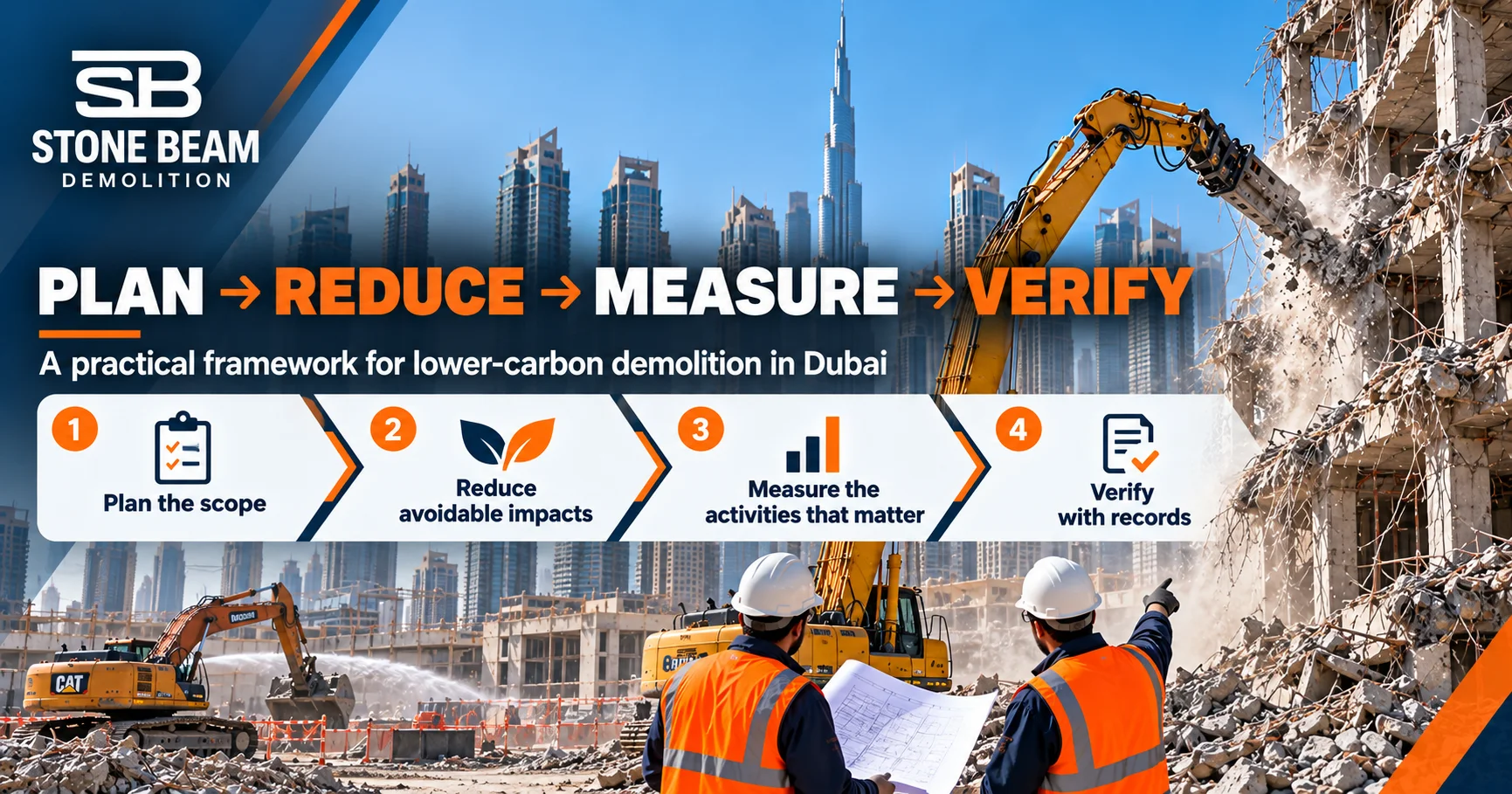
The Four Decisions Behind Lower-Carbon Demolition
Before committing to a method, answer four questions: What is the defined scope? Which technically acceptable option uses fewer relevant resources? How will the difference be measured? What will the client receive at handover? The answers vary with the structure, access, retained assets, occupancy, services, waste streams, and receiving facilities.
A sustainable demolition Dubai strategy must work in the real project, not merely in a sustainability presentation. Separate what can be controlled by the demolition contractor from structural design, utility releases, specialist hazardous-material works, waste-facility operations, and carbon verification. Establish the owner’s responsibilities in the RFQ.
The UAE Net Zero 2050 Strategy provides the wider policy context. Dubai’s waste laws and applicable building requirements govern their own specific activities. Neither establishes a single carbon-saving percentage for every demolition contract.
Practical Ways to Reduce Demolition Emissions in Dubai
The most useful reduction opportunities come before a machine begins work. Test them against an equivalent, approved demolition scope, including the downstream implications for waste transport and processing.
1. Assess retention before complete removal
Ask the structural designer whether suitable elements can remain as part of the approved future design. Retaining a viable slab, basement element or foundation may avoid some new material demand, but it can also introduce testing, strengthening or new interfaces. Compare the whole relevant scope, including any extra engineering and construction works. Structural condition, existing records and authority approvals determine feasibility—not a visual impression of sound concrete.
2. Select a suitable method and equipment capacity
Match equipment capability and access to the approved workfront. Oversized or unsuitable equipment may spend time waiting or manoeuvring; an undersized arrangement may prolong the task or require repeated handling. Ask bidders to explain machine suitability, site power needs and the proposed allocation of workfronts. Rated engine power or hire hours are not the same as measured fuel or energy use. Compare expected resource use with a consistent assessment method; verify it through site records.
3. Reduce avoidable idling and double handling
Programme plant, loading resources and vehicle arrivals around actual workfront readiness. Clarify when materials move directly to loading, when an intermediate collection point is necessary, and which temporary routes are permitted. In an occupied property, protected routes, agreed lift windows and basement loading may determine the feasible arrangement. The aim is fewer unnecessary movements without weakening the approved safety or structural controls.
4. Separate recoverable materials where practical
Use a material inventory to distinguish concrete, metals, recoverable fixtures and mixed or hazardous material. Selective removal or source segregation can make recovery more practical. It can also add labour, handling, storage and transport, so the carbon assessment needs both the potential recovery benefit and the extra processing impacts. Confirm actual acceptance routes rather than assigning every material a recycling outcome at tender stage.
5. Compare transport routes and receiving destinations
Examine payload records, carrier fuel or mileage, accepted quantities, processing energy, and residual disposal. A nearby destination with extensive processing or rejection may perform differently from a more distant suitable facility. Record the reasons for the selected route and what proof of processing will be available. Detailed transport and compliance responsibilities sit in demolition waste management in Dubai.
6. Evaluate electric equipment where technically suitable
For an appropriate workfront, electrically powered demolition equipment may avoid local combustion exhaust. Check the equipment’s access envelope, electrical supply, attachments, and actual suitability. Electricity-related greenhouse gas emissions still belong in the assessment. Electric or remotely operated equipment is a method option, not evidence of any specific fleet owned by Stone Beam.
7. Monitor progress while the work is happening
Collect fuel issues or meter readings by activity, transport records by material stream, and weighed receipts from receiving facilities. Compare actual activity data with the tender assumptions while changes can still be investigated. Missing data should be marked Estimated or Missing, not silently replaced by a precise-looking total. A periodic review helps the client distinguish planned reductions from achieved, evidenced outcomes.
Practical reduction decision table
| Reduction Opportunity | When to Consider It | Potential Trade-Off | Evidence to Request |
|---|---|---|---|
| Retain suitable elements | Existing structure might meet future requirements | Surveys, design changes, strengthening | Structural approval and comparative scope |
| Match plant to the workfront | Several feasible equipment arrangements | Access, productivity, energy demand | Plant selection basis and fuel/power logs |
| Avoid idle time and double handling | Staged work, lifts or constrained loading | Site access and programme interfaces | Activity logs and agreed logistics plan |
| Separate recoverable materials | Recognisable material streams and receivers | Extra handling and transport | Inventory, segregation and receiver records |
| Compare waste routes | More than one authorised receiving option | Journey emissions vs processing quality | Carrier, load, facility and residual records |
| Consider electric machines | Power and suitable equipment available | Supply emissions and site capability | kWh records and equipment suitability |
| Monitor during execution | Client requires auditable results | Metering and data collection effort | Dated ledger, receipts and allocation rules |
Use the table at tender review: decide which opportunities are technically feasible, who owns each action, what extra activities they introduce and which records will test the claimed result.
Example decision: a constrained refurbishment workfront
Consider a hypothetical refurbishment package where selected non-structural finishes and designated concrete elements need removal while occupied areas remain protected. The consultant can compare two technically acceptable site-logistics proposals without specifying a universal demolition sequence. One may consolidate internal collection and schedule one agreed vehicle-loading window; another may require interim storage and repeated handling because a shared service lift is available for fewer periods.
The comparison should record the same material quantities, retained protection requirements, service-lift restrictions and final destinations. The client then asks each bidder for its planned plant hours, vehicle movements, power needs, containment arrangements and waste-document trail. Neither bidder earns a carbon-saving claim simply by proposing fewer trips: load factors, processing outcomes and extra equipment time still belong in the comparison.
A useful procurement decision is to identify the operational assumptions most likely to change, assign who can confirm them, and require a documented adjustment if site access or waste acceptance differs from the tender basis. This turns emission reduction into a workfront decision instead of a generic pledge.
Pre-Demolition Information: Remove, Retain and Protect
An engineering-led pre-demolition review distinguishes verified existing conditions from drawings, assumptions and inaccessible areas. Record the structural system, previous alterations, retained assets, neighbouring sensitivities, services, access and known hazardous-material information. The removal method and environmental plan should follow the competent designers’ decisions and project approvals.

Retained structure, scanning and post-tensioned concrete
Concrete cutting can be appropriate for defined openings or selective boundaries after the required engineering release. GPR and other scans provide information within their coverage and detection limits. For post-tensioned (PT) structures, openings or removals require the structural engineer’s approved design and the PT specialist’s documented release before cutting. Scanning informs that decision; it is not an authorisation to cut. See the PT demolition decision guide for the responsibility boundary.
Temporary-works and structural-stability decisions belong to the competent designers. Lifting arrangements require a competent lifting planner and verified handling information. This guide provides decision and evidence requirements, not an execution sequence.
Services and hazardous materials
Confirm responsibility for electricity, water, drainage, telecommunications and any other affected systems, including utility-provider or authorised-specialist clearance records. Where asbestos or other suspected hazardous materials may be disturbed, the asset owner should arrange the applicable survey and authorised specialist interface before demolition. Hazardous waste follows its prescribed route rather than an ordinary recycling stream.
Choose Among Technically Acceptable Demolition Methods
Mechanical demolition, selective dismantling, concrete cutting, electric robotic removal, and hydrodemolition address different conditions. Carbon comparisons begin after engineering suitability, access, and approvals are established. Controlled demolition methods may help define removal near retained assets, but the environmental benefit still needs measurement.
Tool 3 — Demolition Method Choice Matrix

| Method | Suitable circumstances to assess | Environmental trade-off | Evidence needed |
|---|---|---|---|
| Mechanical demolition | Suitable access and approved structural removal | Fuel, working time, material mixing | Engineering method, plant logs, waste route |
| Selective dismantling | Recoverable components or retained assets | Additional labour, handling and storage | Material inventory and confirmed receivers |
| Concrete sawing and coring | Precise openings and separation boundaries | Electricity, water, slurry and handling | Engineering release and activity data |
| Electric robotic removal | Restricted workfront with suitable power | Electricity and equipment availability | Equipment suitability and metering |
| Hydrodemolition | Specialist selective concrete removal | Water, power and slurry treatment | Specialist scope, water and disposal records |
| Material processing/recycling | Acceptable, segregated material stream | Haulage, processing energy, residual waste | Facility permits, weights and output evidence |
Hydrodemolition is a specialist option whose assessment should include water sourcing, pumping, slurry containment and treatment. This is relevant in Dubai, where DEWA describes desalinated-water production. A water carbon factor must fit the actual source and boundary; no universal factor is assumed here. Method descriptions are educational and do not assert Stone Beam ownership of particular equipment.
Measure the Demolition Carbon Footprint on a Consistent Basis
Reducing demolition emissions is meaningful only when the comparison covers an equivalent work scope. Establish what activities, materials and reporting period belong to the assessment. The client’s appointed competent carbon assessor determines methodology, while contractors, utilities, carriers and facilities provide data for the activities assigned to them.
RICS lifecycle stages and pre-construction demolition
The RICS Whole Life Carbon Assessment, second edition distinguishes end-of-life C1 deconstruction/demolition, C2 transport, C3 waste processing and C4 disposal. Module D reports potential benefits and loads beyond the system boundary separately. For demolition carried out to prepare a new project, retrofit or refurbishment, RICS also addresses pre-construction demolition in A5.1 of that project’s assessment. The assessor should classify the scope correctly, avoid double counting, and keep Module D separate.
Tool 1 — Carbon Boundary and Responsibility Matrix
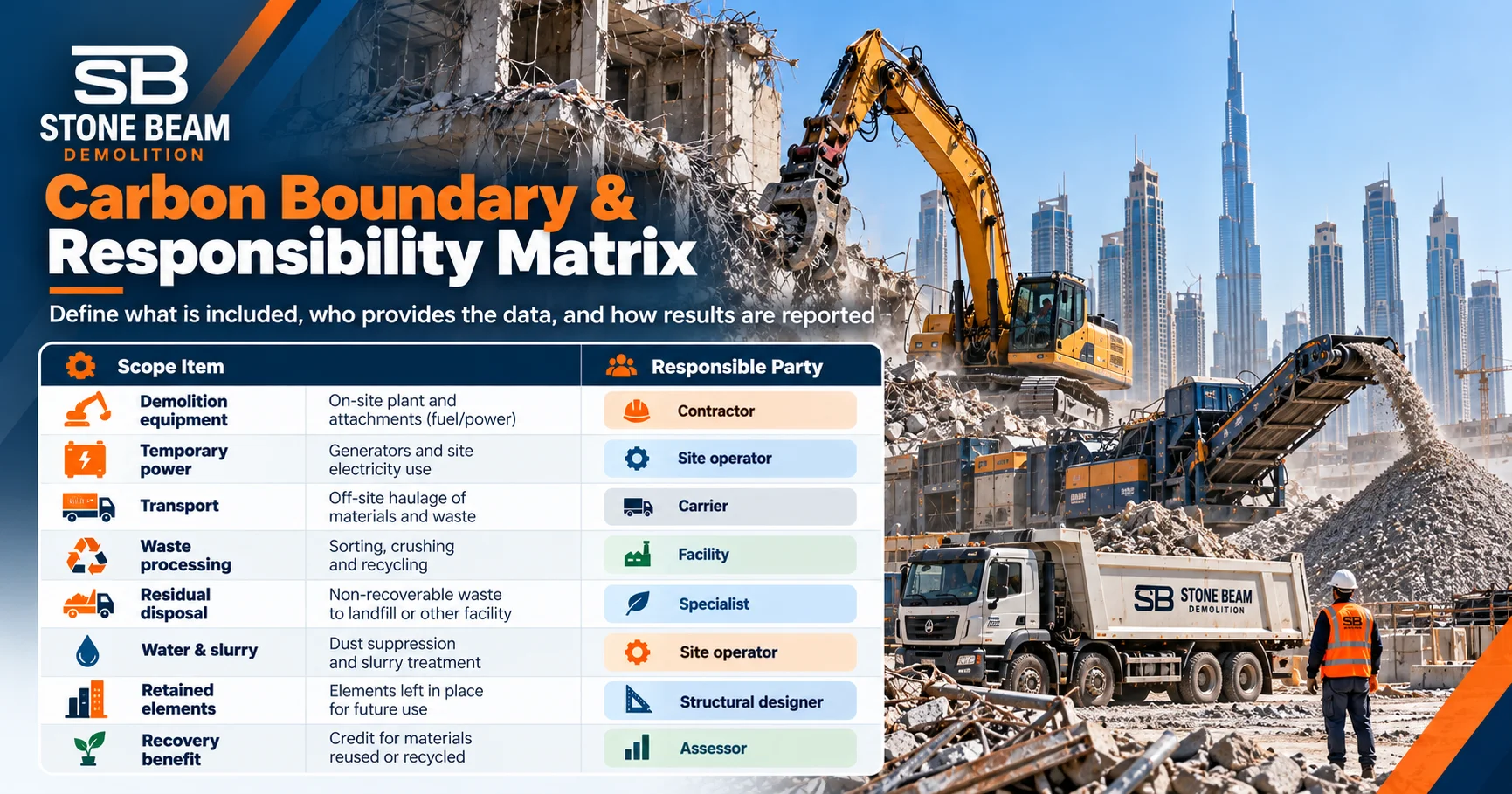
| Activity | Assessment decision | Information required | Responsible party |
|---|---|---|---|
| Demolition equipment | Include attributable consumption | Litres, kWh and workfront | Contractor / site operator |
| Temporary power | Include allocated share | Meter or fuel record, allocation | Site operator / assessor |
| Transport | Include relevant journeys | Fuel or distance/load record | Carrier / assessor |
| Waste processing | Include in agreed boundary | Tonnes and processing factors/data | Facility / assessor |
| Residual disposal | Include relevant disposal | Accepted residue and destination | Facility / carrier |
| Water and slurry | Include if material to method | m³, energy, treatment | Specialist / assessor |
| Retained structural elements | Compare under appropriate scope | Approved retention and replacement scenario | Structural designer / assessor |
| Recovery benefit | Report separately if justified | Actual recovery and substitution assumptions | Assessor |
Decision: choose the same functional scope and compatible data rules for both alternatives. If one option includes haulage and another omits it, the totals cannot support a reliable comparison.
Tool 2 — Demolition Activity-Data and Evidence Ledger

| Activity record | Unit | Evidence | Data-quality label |
|---|---|---|---|
| Plant fuel | L | Fuel issues and allocation log | Measured / Estimated / Missing |
| Equipment electricity | kWh | Meter or justified share | Measured / Estimated / Missing |
| Vehicle transport | km, tonne-km or L | Trip, payload or fuel record | Measured / Estimated / Missing |
| Waste quantity | t by stream | Weighbridge and facility acceptance | Measured / Estimated / Missing |
| Processing | t plus energy | Facility records or documented factors | Measured / Estimated / Missing |
| Water and slurry | m³ and relevant waste unit | Supply and treatment records | Measured / Estimated / Missing |
| Carbon result | kg CO₂e | Formula, factor register and sources | Calculated / Pending |
Link each record to the workfront, date, owner, source document, and chosen allocation rule. If measured vehicle fuel is already used, avoid adding a second complete distance-based estimate for the same transport activity. The same principle applies to electricity included in a common meter and a separate equipment estimate.
CO₂e equations and emission factors
For each activity: Eᵢ = Qᵢ × EFᵢ, where Eᵢ is kg CO₂e, Qᵢ is the activity quantity, and EFᵢ is the compatible emission factor. For the selected boundary: E_total = Σ Eᵢ. For equivalent baseline and proposed scenarios: ΔE = E_baseline − E_proposed.
The factor register should identify the source, reference year, geography, units, greenhouse-gas coverage, and system boundary. Distinguish activity measurements from estimates. The GHG Protocol Project Protocol offers comparative guidance on baseline-based reduction claims; it is not a Dubai permit requirement.
Illustrative Calculation — Hypothetical Values Only
Assume two technically acceptable alternatives with the same defined removal scope. This teaching example compares diesel consumption only; all values are invented and are not data from a Stone Beam project.

| Calculation component | Baseline | Proposed alternative |
|---|---|---|
| Assumed diesel consumption | 100 L | 80 L |
| Assumed illustrative factor | 2.5 kg CO₂e/L | 2.5 kg CO₂e/L |
| Diesel-related emissions | 100 × 2.5 = 250 kg CO₂e | 80 × 2.5 = 200 kg CO₂e |
| Difference | — | 50 kg CO₂e less; 20% of baseline diesel component |
What the result means: the proposed alternative has 20% less calculated emissions for this defined diesel activity (50 ÷ 250 × 100). It does not establish a 20% saving across the demolition project. The 2.5 kg CO₂e/L factor is hypothetical arithmetic input, not an authorised UAE diesel factor. For an actual carbon claim, use a sourced factor appropriate to the fuel, reference year, geography and boundary, and include other material activities such as electricity, haulage, processing and disposal before reporting any total-project saving.
Verify Waste Recovery Without Inflating Carbon Savings
The carbon-relevant question is what materials were actually reused or recycled, what processing they required, and what residuals were disposed of. The separate C&D recycling guide for Dubai covers detailed recycling pathways; this section focuses on records required for the emissions assessment.
Reuse, recycling, diversion and material balance
A component kept in use can offer a different benefit from crushed concrete becoming recycled aggregate. Recoverability depends on condition, contamination, receiver specifications and final use. Steel may enter recycling; direct structural-steel reuse needs traceability and design acceptance. Mixed and hazardous materials follow their relevant routes.
For any claimed diversion rate, reconcile eligible material generated with verified material reused or recycled, separately identifying excluded streams, residual disposal, and stock remaining at site or facility. Where mass reporting is permitted:
Diversion rate (%) = (eligible waste actually reused or recycled ÷ total eligible waste generated) × 100.
Use either a consistent mass basis or a consistent permitted volume basis. Distinguish measured weight from loose-volume truck estimates and in-situ concrete volume. A facility receiving ticket demonstrates acceptance, while recycling evidence needs information on the processing and recovered outcome. Temporary storage is not final recovery.
Waste evidence chain
Workfront → Segregation → Authorised carrier → Receiving facility → Accepted quantity → Processing outcome → Residual disposal.
| Evidence record | What it establishes | What else to request |
|---|---|---|
| Load/collection record | Waste collected from the site | Destination and material identity |
| Trip or transport record | Movement and carrier | Accepted weight or volume basis |
| Weighbridge/receiver ticket | Quantity accepted | Processing or recovery output |
| Processing record | Material treated | Actual recovered and rejected fractions |
| Output acceptance | Recovered product/use accepted | Carbon assumptions, if savings claimed |
The client should confirm whether the receiver’s documents support the required project claim. For further handling requirements, see demolition waste management and Dubai Municipality’s C&D recycling technical guidelines (version 1.0, dated 22 August 2024).
Reporting result: inventory, reduction and potential benefit
A useful report distinguishes (1) direct and associated emissions inside the selected boundary; (2) a baseline-based change, with transparent assumptions; and (3) potential benefits beyond the boundary, which belong in separate Module D reporting where applicable. It identifies which inputs are measured, estimated, or missing. An environmental policy or general waste plan describes management intentions; project-specific records establish what happened.
Dubai Regulations and the Scope of Al Sa’fat 702.01
The applicable demolition route depends on the plot and competent authority, including Dubai Municipality, Dubai Development Authority (DDA), or Trakhees where relevant. Utility and other third-party clearances are separate interfaces. For example, the DDA demolition permit service describes its own jurisdiction’s documents; the consultant should confirm the route for the actual site.
Dubai Law No. 18 of 2024 governs waste-management activities and responsible parties in the emirate. Administrative Resolution No. 34 of 2026 sets out implementing obligations. Its Article 2 identifies register information and specified categories, including hazardous-waste producers and operators of particular complexes and establishments. The contract must identify the producer, carrier, and receiver roles applicable to the project, rather than assign every register duty indiscriminately to a property owner.
What the 50% Al Sa’fat requirement actually covers
Provision 702.01 in the January 2023 second edition of Al Sa’fat states that, for new buildings outside the defined CBD area within the provision’s scope, at least 50% by volume or weight of applicable construction and/or demolition waste is to be diverted from landfill through reuse or recycling. The text routes concrete waste to a Construction Waste Treatment Plant and excludes excavated soil, land-clearing debris, and hazardous waste from the reuse/recycling percentage. The requirements table marks 702.01 as optional for private villas.
That scope is different from every standalone demolition contract in Dubai. The consultant should check building classification, plot, jurisdiction, applicable authority, and measurement basis. Regulatory targets and actual project outcomes must also remain distinct.
Dubai’s Al Sa’fat is distinct from the Estidama Pearl Rating System in Abu Dhabi; LEED documentation depends on its own scheme and version. The Emirates Green Building Council is a professional sustainability organisation, not a project rating scheme. A demolition contractor’s waste records may support an appointed assessor’s submission but do not independently confer credits or certification.
What to Include in a Low Carbon Demolition RFQ
Turn environmental objectives into contracted responsibilities. The RFQ should state the removal and retention boundaries, known surveys, site constraints, approvals, material destinations, activity measurements, and reporting acceptance criteria. Identify explicitly what is provided by the client, main contractor, demolition contractor, specialist, carrier, and carbon assessor.
Tool 4 — Low Carbon Demolition RFQ and Handover Checklist
| Required item | Before mobilisation | During work | At handover |
|---|---|---|---|
| Scope and approvals | Approved removed/retained elements and permit route | Track approved variations | Applicable completion/acceptance records |
| Structural and PT interfaces | Designer/specialist release responsibility | Work within released scope | Record changes and releases |
| Utilities/hazardous materials | Owner/provider/specialist responsibilities | Maintain required interfaces | Applicable clearances and disposal records |
| Equipment energy | Meter/log owner and allocation rule | Fuel and kWh records | Reconciled measured/estimated status |
| Transport | Carrier, waste stream, destinations | Trips, payload and receiving records | Material movement reconciliation |
| Recovery and disposal | Evidence expected from facility | Collect processing/receiver records | Recovery, residual and excluded streams |
| Carbon assessment | Appointed assessor, factor and baseline rules | Check data completeness | Qualified report with limitations |
| Handover | Acceptance criteria agreed | Resolve missing evidence | Client/consultant acceptance decision |
How to compare two environmental tender responses
Before giving weight to a bidder’s proposed reduction, prepare a like-for-like comparison of removed and retained elements, expected material streams, required protection and specialist interfaces. Confirm that both bidders price the same transport and disposal responsibilities and that neither excludes an energy-intensive activity from the claimed assessment boundary. Note any opportunity that is subject to survey results or facility acceptance as conditional, with an owner and an explicit decision point.
Ask whether the claimed improvement is a calculated estimate at tender stage or a measured result from the works. A tender-stage forecast can guide selection; the agreed contract should state the activity data that will be retained to test it. Where a carbon assessor is engaged, the assessor sets the emission factors and reporting basis, while the contractor supplies traceable records under the contract. A modest, well-evidenced comparison is more useful than a precise percentage with no common denominator.
A concise contractual provision may require the contractor to provide activity and waste records within its scope, while the client defines any comparative carbon-assessment method through its appointed competent assessor. Estimates, missing quantities and separate beyond-boundary benefits must be clearly labelled. The agreed responsibilities should cover lifting, access, power, water, slurry, transport and specialist works, rather than assume these are included in a demolition rate.
If you are preparing an RFQ, our contact page lists the inputs we need for an accurate quotation.
What Stone Beam Demolition Can Support
Stone Beam Demolition is a Dubai-based contractor specialising in demolition, concrete cutting and site enabling works. Our demolition planning typically covers a site visit and structural assessment, scanning and services review, a method statement and risk assessment, engineered sequencing and phasing, monitoring where the project requires it, and controlled debris removal and handover.
We work under a documented HSE and environmental management framework covering workfront readiness, supervision, emergency planning and environmental controls. A defined demolition package allows the contractor to identify its own operational records while the client and any appointed carbon assessor determine reporting requirements. Those roles should be agreed before tender acceptance.
About the Technical Reviewer
Eng. Awad Ashour is the founder and CEO of Stone Beam Demolition, a Dubai-based demolition, concrete cutting, and site enabling contractor. A civil engineer with more than 15 years of demolition experience in the UAE, he has led villa, building, basement, and enabling-works demolition, and now oversees Stone Beam’s engineering, method planning, and HSE delivery.
Frequently Asked Questions
Which activity usually offers the first reduction opportunity?
Start with scope and logistics. Confirm what may remain, what must be removed, how material leaves the workfront, and which feasible methods have comparable energy and waste-processing requirements. The dominant opportunity varies by project.
Does electric demolition equipment eliminate carbon emissions?
Electric equipment may avoid local machine exhaust. Compare its electricity-related emissions and other material activities against a suitable alternative for the same approved work.
Will selective dismantling increase cost or programme?
It can change labour, handling, access and transport. Ask bidders to define recovered materials, feasible receiving routes and additional operations, then compare equivalent scope and handover requirements.
How can foundations be retained to avoid embodied carbon?
The responsible structural designer must verify condition, design suitability, future loading,g and any strengthening. Carbon comparisons should include the additional works necessary to retain the element.
What evidence shows that waste was recycled?
Connect workfront records, carrier documents, and accepted quantities to facility processing and recovered outputs. Explain exclusions and residual disposal before calculating a percentage.
Does Al Sa’fat require 50% recycling for every Dubai demolition?
No. Provision 702.01 has a defined new-building/CBD scope and exceptions, with optional treatment for private villas in the 2023 requirements table. The consultant should confirm applicability and the permitted calculation basis for the actual development.
What does a useful demolition carbon report contain?
The scope, boundary, period, activity measurements, factor sources, assumptions, missing data, and relevant baseline; report any potential beyond-boundary benefits separately. The client-appointed assessor should verify the required assessment approach.
Planning a Low Carbon Demolition Package in Dubai?
For a useful first review, prepare drawings, the removed and retained scope, location and access restrictions, structural and utilities information, known hazardous-material survey status, waste destinations and the intended handover condition. The RFQ should identify any separate carbon-reporting obligation and who will prepare that assessment.
Planning a demolition, strip-out or cutting package in Dubai? Send us your drawings, the scope you want removed and retained, site access details, and your target handover condition. Our engineering team will review the inputs and come back with the questions and information needed to price the defined scope. Request a review