



A demolition tender scope in Dubai works only when every bidder prices the same physical boundary, measurement rules, responsibilities, constraints and handover condition. The BOQ then translates that defined scope into measurable items. Owners and consultants separate known work, provisional risk, exclusions, third-party costs, waste, salvage and approval responsibilities before requesting prices.
Demolition tender and approval interfaces vary by jurisdiction and project. This guide therefore does not treat any one authority checklist as universal across Dubai; the tender identifies the governing authority and allocates permits, utilities, technical submissions and owner-supplied information explicitly.
The practical rule is simple: define the job first, measure the defined job second, then price the measured job. A lower total is not a comparable bid when the contractor priced a different boundary or a different risk allocation.
Prepared by Stone Beam Technical Services L.L.C. (Stone Beam Demolition).
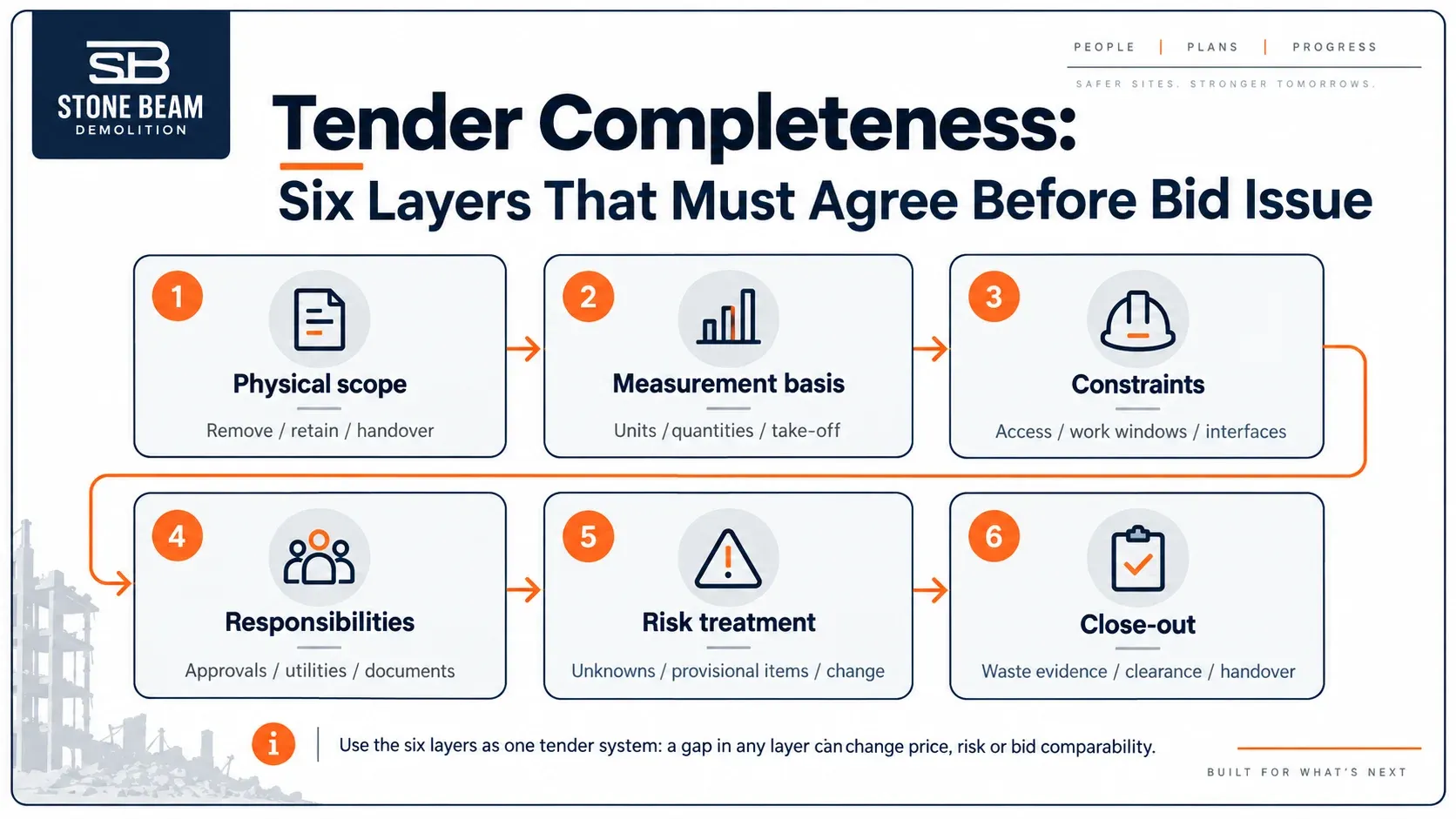
What should a demolition tender scope include in Dubai?
A complete demolition tender defines the commercial job that bidders are being asked to price. It combines the physical demolition boundary with the documents, measurement basis, access conditions, waste responsibilities, approval interfaces, commercial assumptions and handover requirements that affect that price.
Treat the tender as a system of linked documents. The BOQ quantifies work; drawings locate it; specifications and notes define quality and interfaces; surveys expose known conditions; and the responsibility schedule states who supplies information, approvals and third-party services.
| Scope rule
If two bidders must make different assumptions to fill gaps in the tender, the resulting totals are not genuinely like-for-like. |
|---|
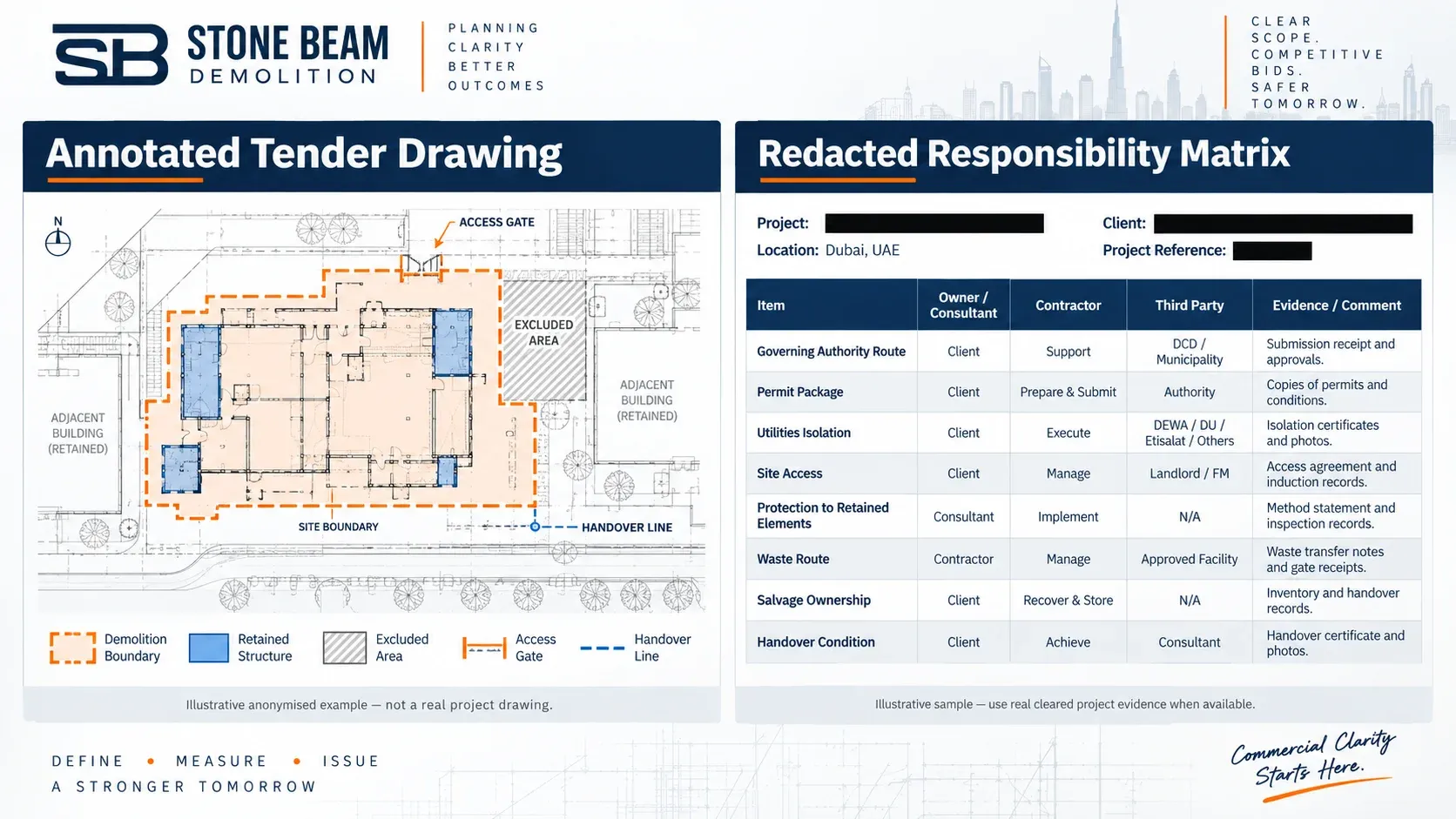
Define the demolition boundary before writing the BOQ
The first commercial task is to freeze what “demolition” means for this package. State exactly what is removed, what remains, where the boundary stops and what condition defines handover.
- Identify structures, floors, rooms, slabs, walls, external works and discrete assets inside the package.
- Mark retained structures, façades, services, finishes, landscaping, roads and neighbouring assets that required protection.
- State whether basements, foundations, ground slabs, pools, tanks, pits and buried elements sit inside or outside the demolition boundary.
- Define the final level and handover condition: exposed structure, cleared plot, formation level, retained foundation, clean shell or another stated endpoint.
- Record drawing references and revision status so every bidder measures the same information set.
For residential packages, the boundary between above-ground demolition and below-ground removal changes the commercial scope materially. Keep that boundary aligned with the villa demolition scope in Dubai rather than hiding it inside a generic “full demolition” line.
What information belongs in every demolition BOQ line?
Each BOQ line needs enough information for a quantity surveyor, estimator and contractor to understand the same measurable obligation. A useful item description states the element, location or reference, unit, quantity basis, principal inclusions and the rule for change or remeasurement.
| BOQ field | What to state | Commercial purpose |
|---|---|---|
| Work definition | What is removed or provided, with a drawing/specification reference. | Prevents bidders pricing different physical work. |
| Unit | Area, volume, length, number, tonne, item, lump sum or another defined basis. | Creates a consistent pricing denominator. |
| Quantity | Tender quantity and take-off basis. | Shows what the tenderer is pricing. |
| Inclusions | Breaking, cutting, handling, loading, protection, temporary access, disposal or documentation where assigned. | Stops hidden scope gaps. |
| Exclusions / by others | Items not carried by this line or not carried by the demolition contractor. | Makes interfaces visible. |
| Measurement rule | How the completed quantity is measured and valued. | Controls remeasurement and quantity disputes. |
| Change treatment | Fixed, remeasurable, provisional or subject to an agreed variation route. | Shows where uncertainty sits. |
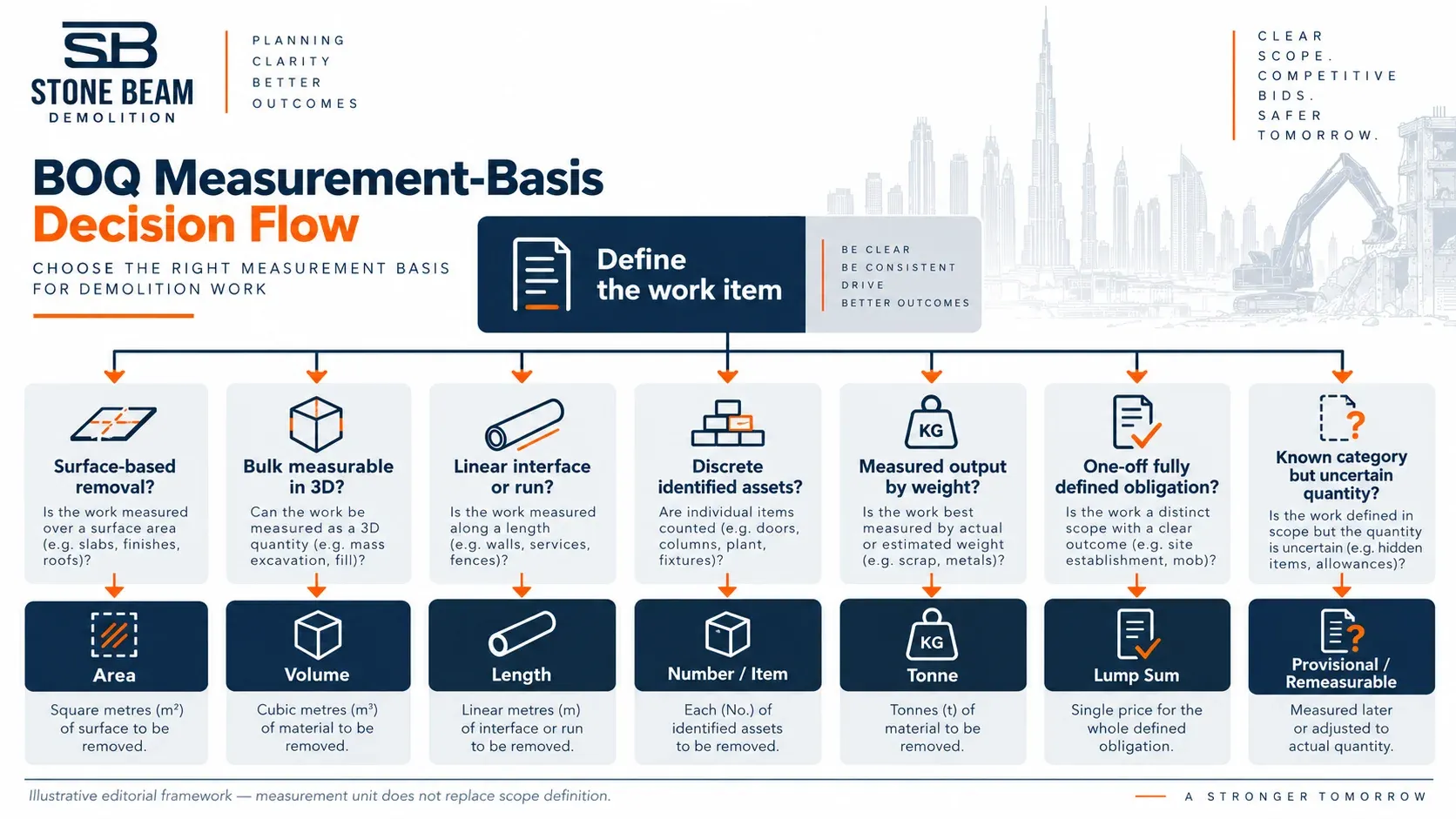
Which measurement basis fits demolition work?
The measurement unit must follow the work definition and the evidence available for measurement. Unit choice alone does not allocate commercial risk; the description, quantity basis, inclusions and valuation rule do that.
| Basis | Best use | Tender control |
|---|---|---|
| Area | Surface-based or plan-based removal where area represents the work. | State faces, openings, layers and boundary. |
| Volume | Mass removal or concrete/earth quantities where volume is measurable. | State geometry, deductions and source of quantity. |
| Length | Linear elements or interfaces. | State section/type and termination points. |
| Number / item | Discrete assets, openings, equipment or identified units. | Identify each item or item family. |
| Tonne | Recorded waste, steel or other measured output. | State the weighing record and who owns the evidence. |
| Lump sum | A one-off obligation with a fully defined boundary. | List inclusions; avoid using LS to hide unknown quantity. |
| Provisional / remeasurable | Known category with uncertain quantity or unresolved condition. | State trigger, measurement and valuation rule. |
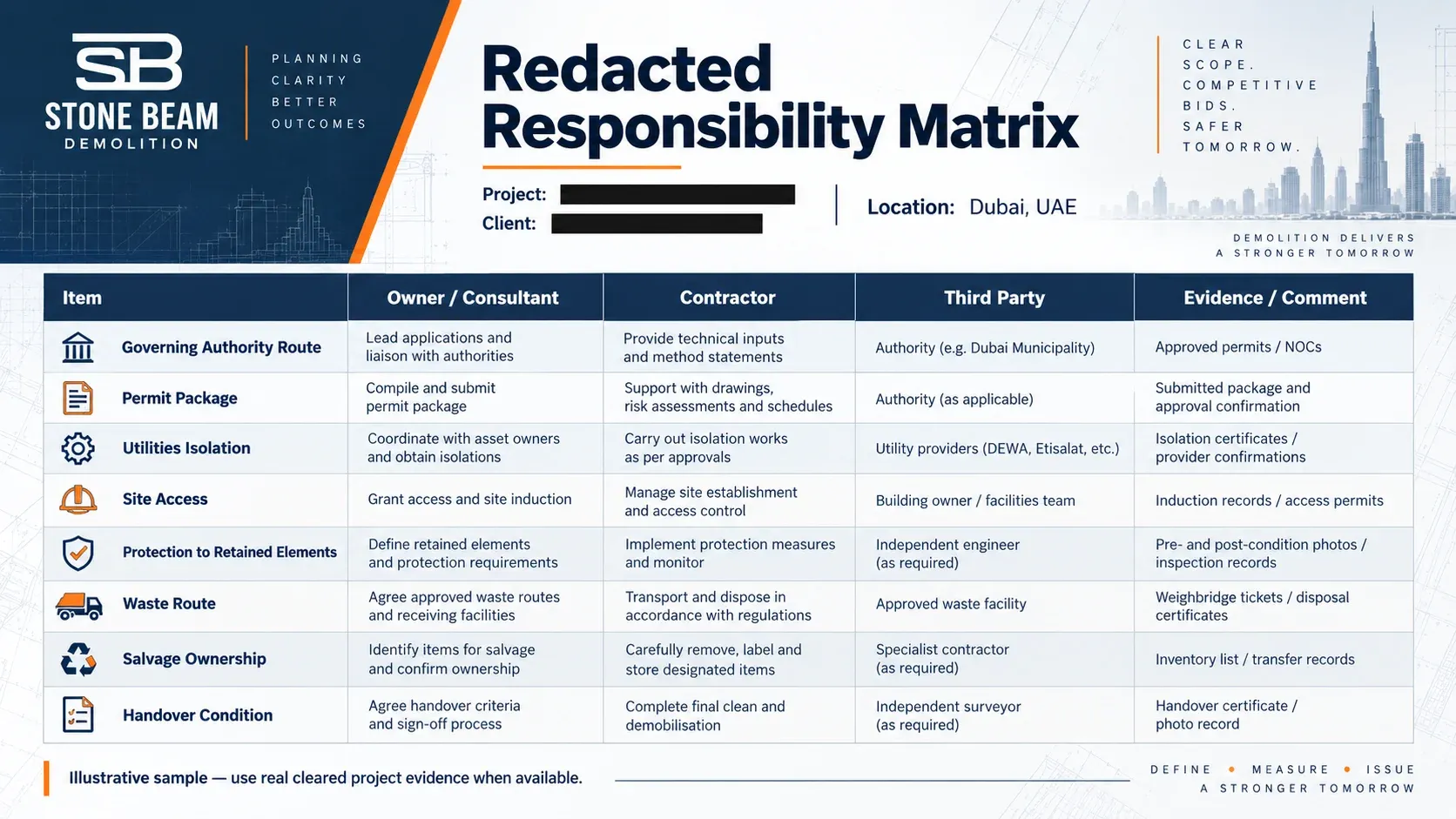
How should approvals, utilities and tender responsibilities be allocated?
Write approvals and utilities as responsibilities, not as a blanket phrase. The tender needs to identify the governing jurisdiction, who prepares each submission, who supplies supporting documents, who pays the stated third-party charges, and what evidence releases the workfront.
For sites governed by Dubai Development Authority, the DDA demolition permit service lists documents including a demolition-area plan, relevant NOCs, hoarding layout, method statement, HSE/emergency plan, risk assessments, a neighbouring-building impact study and a site photograph. That is DDA-specific evidence, not a universal Dubai checklist.
DEWA’s Demolishing Permits – Electricity/Water service identifies contractor application routes and notes an additional setting-out plan for partial demolition. Separately, DEWA’s Move-out / Demolish deactivation service covers service deactivation and final-bill clearance. The tender responsibility matrix states who carries each interface so it is neither priced twice nor omitted.
Contractor eligibility is a separate procurement layer. Dubai Municipality publishes consultant and contractor licensing standards including criteria for Wrecking & Demolition Works. The BOQ defines the work; prequalification verifies whether a bidder is eligible and competent for the required category.
Keep the engineering deliverables aligned with the project planning route described in the advanced demolition planning guide. The tender sets the required outputs and interfaces; it does not substitute for the contractor’s accepted method or the project engineer’s design decisions.
How should access, logistics, waste and salvage be defined?
Access and waste are commercial scope, not footnotes. A bidder needs the same logistics picture to price labour handling, plant movement, loading, haulage, protection and work windows consistently.
- Site access points, gate size, crane or plant restrictions, internal haul routes and loading zones.
- Working hours, noise-sensitive periods, occupied areas, live interfaces and security or permit-to-work controls.
- Vertical handling requirements for basements, towers, malls or internal strip-out areas.
- Who provides hoarding, scaffolding, protection, temporary access, power, water and lifting support.
- Who owns demolition waste, reusable materials, scrap and salvage, and whether any credit is included in the tender total.
- Who pays for loading, transport, tipping, receiving-facility charges, manifests, weighbridge records and close-out evidence.
For a detailed environmental owner page, route the waste-planning topic to construction and demolition waste in Dubai. For the cart-away and receiving side, use the demolition waste disposal guide. This tender article only defines who carries each commercial obligation.
What changes the price, programme, commercial risk or comparison outcome?
The tender outcome changes when any bidder prices a different quantity, access route, method constraint, waste route, unknown-condition risk or commercial responsibility. These drivers affect total price, programme exposure, variation risk and the ability to compare bids.
| Driver | What changes | Commercial effect | Tender treatment |
|---|---|---|---|
| Measurable quantities | Different structure boundary or take-off. | Different base cost before any rate comparison. | Issue common drawings, quantity basis and revision set. |
| Access / logistics | Different assumptions on work windows, vertical handling, loading or haul routes. | Changes labour, plant, supervision and programme. | State access constraints and support by others. |
| Method / engineering | Different retained assets, separation requirements or design responsibilities. | Changes engineering input and execution resources. | Define performance boundary and required submissions. |
| Waste / salvage | Different ownership of scrap, disposal, transport or evidence. | Changes net price and cash exposure. | State ownership, route and credit treatment. |
| Risk / unknowns | Hidden structures, services or quantities placed silently in bidder contingency. | Creates inconsistent contingency and later variations. | Use surveys, provisional items and explicit change triggers. |
| Commercial terms | Different fee, tax, bond, payment or third-party-cost assumptions. | Distorts the apparent tender total. | State pricing basis and exclusions consistently. |
This is also the point where a demolition contractor in Dubai needs a complete information pack. Pricing becomes more reliable when the same drawings, constraints, handover definition and responsibility schedule reach every bidder.
Do not treat the contractor tender total as the owner’s total project budget. Utility settlements, authority or developer charges, consultant surveys, specialist testing, bonds/insurance, traffic measures and client-provided access support sit inside or outside the contractor price according to the stated allocation. Classify each item as included, excluded, allowance or direct owner/third-party cost.
For programme pricing, separate two clocks: pre-mobilisation readiness/release dependencies and physical execution/handover. This is a Stone Beam planning framework, not an authority term. Define what starts and closes each clock, and do not convert an authority service estimate into the contractor’s demolition duration.
How should unknown conditions and provisional items be handled?
Do not force unresolved work into a fixed quantity just to make the BOQ look complete. Separate known scope from unknown quantity and unknown condition.
| Condition | Tender treatment | Why it matters |
|---|---|---|
| Known work + known quantity | Measured BOQ item with defined inclusions. | Normal tender comparison. |
| Known work + uncertain quantity | Remeasurable or provisional quantity with valuation rule. | Quantity risk stays visible. |
| Unconfirmed condition | Survey / opening-up / verification requirement plus a defined change trigger. | Condition risk is not disguised as bidder contingency. |
| Optional scope | Separate option or alternate with clear activation rule. | Base bids remain comparable. |
| Third-party service | Named allowance or responsibility outside contractor price. | Owner budget stays separate from contractor subtotal. |
| Limitations
This guide is a procurement framework, not a project method statement, structural design or universal authority checklist. Technical methods, temporary works, permits and workfront releases remain tied to the actual site, jurisdiction and accepted project controls. |
|---|
Information needed before a final commercial or procurement decision
Before a final estimate, tender issue or commercial recommendation, freeze the information that materially changes the bidder’s quantity, resources, responsibilities or risk. The list below is not an administrative document dump; each input changes a pricing decision.
- Current drawings and a marked demolition boundary, including retained and below-ground elements.
- Available structural, utility and site records, with known gaps identified rather than hidden.
- Site access, working hours, traffic or community constraints and occupied/live interfaces.
- Required engineering, HSE, survey, testing and temporary-works deliverables, without prescribing unreviewed design values.
- Authority jurisdiction and a responsibility matrix for permits, NOCs, utility actions and owner-supplied documents.
- Waste, cart-away, disposal, recycling evidence, scrap/salvage ownership and any credit mechanism.
- Measurement rules, provisional items, variation triggers and the hierarchy between BOQ, drawings, specifications and tender clarifications.
- Programme milestones and the definition of access release, start, completion and handover.
- Commercial basis: taxes, third-party fees, bonds/insurance requirements, payment basis and tender validity when they form part of the procurement.
- Required submission format so every bidder returns the same price breakdown, exclusions schedule and qualification schedule.
How does a good tender improve later quotation comparison?
A well-structured tender makes later quotation comparison faster because every bidder starts from the same reference case. The tender does not rank bidders; it creates the baseline against which bid qualifications, exclusions, arithmetic and commercial departures are tested.
- Keep the tender BOQ unchanged as the comparison baseline.
- Require bidders to price all base items, identify exclusions and list commercial qualifications separately.
- Record alternatives and value-engineering proposals outside the compliant base offer.
- Normalize only genuine departures after bid receipt; do not rewrite the original tender to make an incomplete bid appear comparable.
Quotation comparison is a separate decision stage. Keeping that stage separate prevents this page from drifting into bid-scoring methodology or generic cost advice.
Is the demolition tender ready to issue?
Issue the tender only after the scope, quantity basis and responsibility split are coherent across the tender set. The following checklist tests commercial readiness.
- One demolition boundary is shown consistently across drawings, scope and BOQ.
- Retained, protected, below-ground and handover elements are explicit.
- Every BOQ line has a defined unit, quantity basis and principal inclusions.
- Remeasurement, provisional items and unknown-condition triggers are written clearly.
- Access, working hours, protection, handling and logistics are common to all bidders.
- Permits, NOCs, utility actions, third-party fees and owner documents have named responsibility.
- Waste, disposal, scrap, salvage and evidence ownership are defined.
- Programme dates use defined start/release/completion terms rather than one ambiguous duration.
- Bid-return schedules force the same price breakdown, exclusions and qualifications format.
- Tender clarifications and revisions are controlled so every bidder prices the same final issue.
What should you send for a demolition tender review?
For a demolition tender review or contractor budget input, send the project location, latest drawings, marked demolition/retained boundary, available structural and utility information, access constraints, intended programme, waste/salvage assumptions and required handover condition. Stone Beam uses that project information to prepare a scope-specific commercial review or proposal; the final tender documents and site conditions govern the output. See Stone Beam’s demolition contractor page for the commercial enquiry route.