
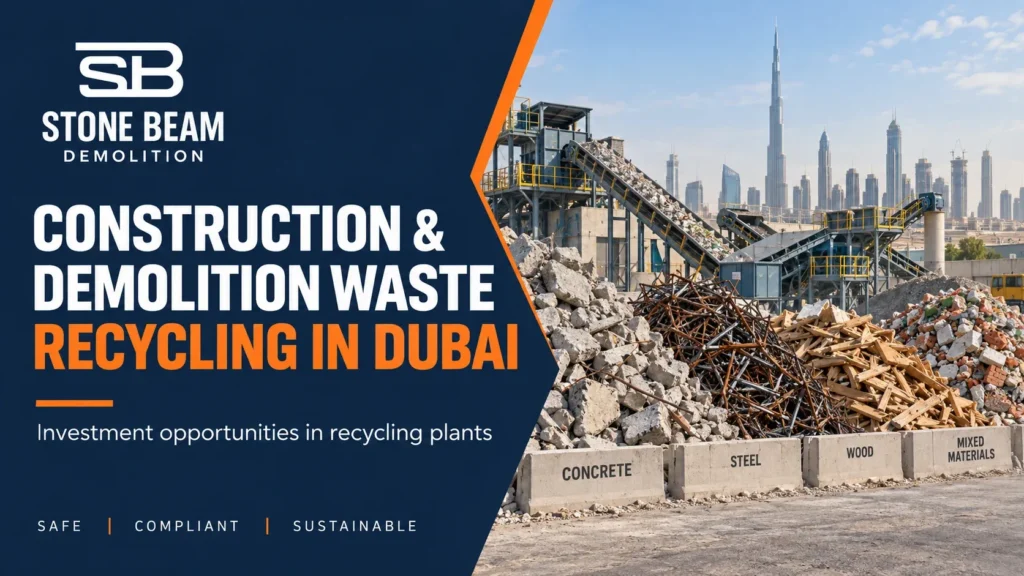
Construction waste recycling in Dubai turns suitable construction and demolition material into recoverable outputs instead of treating every load as disposal. For projects, the value starts with segregation, compliant movement and traceable records. For recycling plants, the opportunity depends on verified feedstock, processing fit, permits, output quality, offtake and total operating economics.
In Dubai, waste-management activities sit within a defined local framework led by Dubai Municipality, while federal waste law provides the UAE-level foundation. A recycling opportunity is therefore not established by policy direction alone; it has to work within the applicable licensing, facility, environmental, transport, documentation and material requirements.
Practical rule: separate the project-side waste stream from the plant-side investment case, and require evidence at every handoff between generation, transport, receiving, processing, recovered output and residual disposal.
Last reviewed: 15 September 2026
Construction & Demolition Waste Recycling in Dubai — Direct Answer
For this article, C&D recycling means identifying suitable material from construction or demolition activity and keeping it controlled for its intended route. The material then moves through approved waste-management channels to a licensed facility that accepts and processes the relevant stream. Residual material still needs a lawful final route.
The key distinction is simple: waste generated on a project is not automatically recyclable feedstock, and recovered material is not automatically a saleable product. Each step requires acceptance criteria, records and a viable end use.
Dubai’s local waste law expressly aims to encourage private-sector investment in waste management, advance recycling and support a circular economy. Dubai Law No. 18 of 2024 provides the official legal basis for that policy direction. It does not prove the profitability of a particular recycling plant.
What Counts as C&D Waste for This Article?
The scope here is limited to construction and demolition material relevant to the recycling decision. It includes inert mineral material, metals, timber or wood, dry recyclables and mixed loads where a compliant facility route exists. Hazardous or suspected hazardous material sits outside a normal recycling assumption and requires the applicable specialist controls.
Dubai Municipality’s C&D recycling guideline identifies non-hazardous C&D streams such as inert aggregates, metal, timber or wood, dry recyclables and general waste within its operating context. The same guideline also requires potentially hazardous material to be rejected or segregated and managed appropriately when encountered at a facility.
Terminology boundary — the article uses the following terms deliberately rather than interchangeably.
| Term | Meaning in this article | What it is NOT |
|---|---|---|
| Source segregation | Separation at the point where waste is generated, before incompatible streams are mixed. | Not the same as downstream sorting at a facility. |
| Reuse | Using material again without processing it into a new raw material. | Not the same as recycling. |
| Recycling | Processing waste so material can be recovered for use again. | Not the same as diversion or simple collection. |
| Recovery | A broader value-recovery concept used here when the exact downstream route is not yet proven. | Does not mean the output already meets a product specification. |
| Recycled output | Material produced after a recycling process and then subject to the applicable quality or buyer requirements. | Not automatically saleable or approved for a specific use. |
| Recycled content | The share of recycled material incorporated into a product or project material. | Not the same as a recycling rate or diversion rate. |
| Diversion | An outcome measure for material kept away from final landfill/disposal routes. | May include reuse or recycling; it is not a synonym for recycling. |
| Residual material | Material left after sorting or processing that still needs an approved treatment or disposal route. | Not a recovered product. |
| Recycling facility | A facility licensed and technically capable of accepting the relevant waste stream for recycling/treatment. | Not every waste facility accepts every C&D stream. |
How the C&D Recycling Chain Works
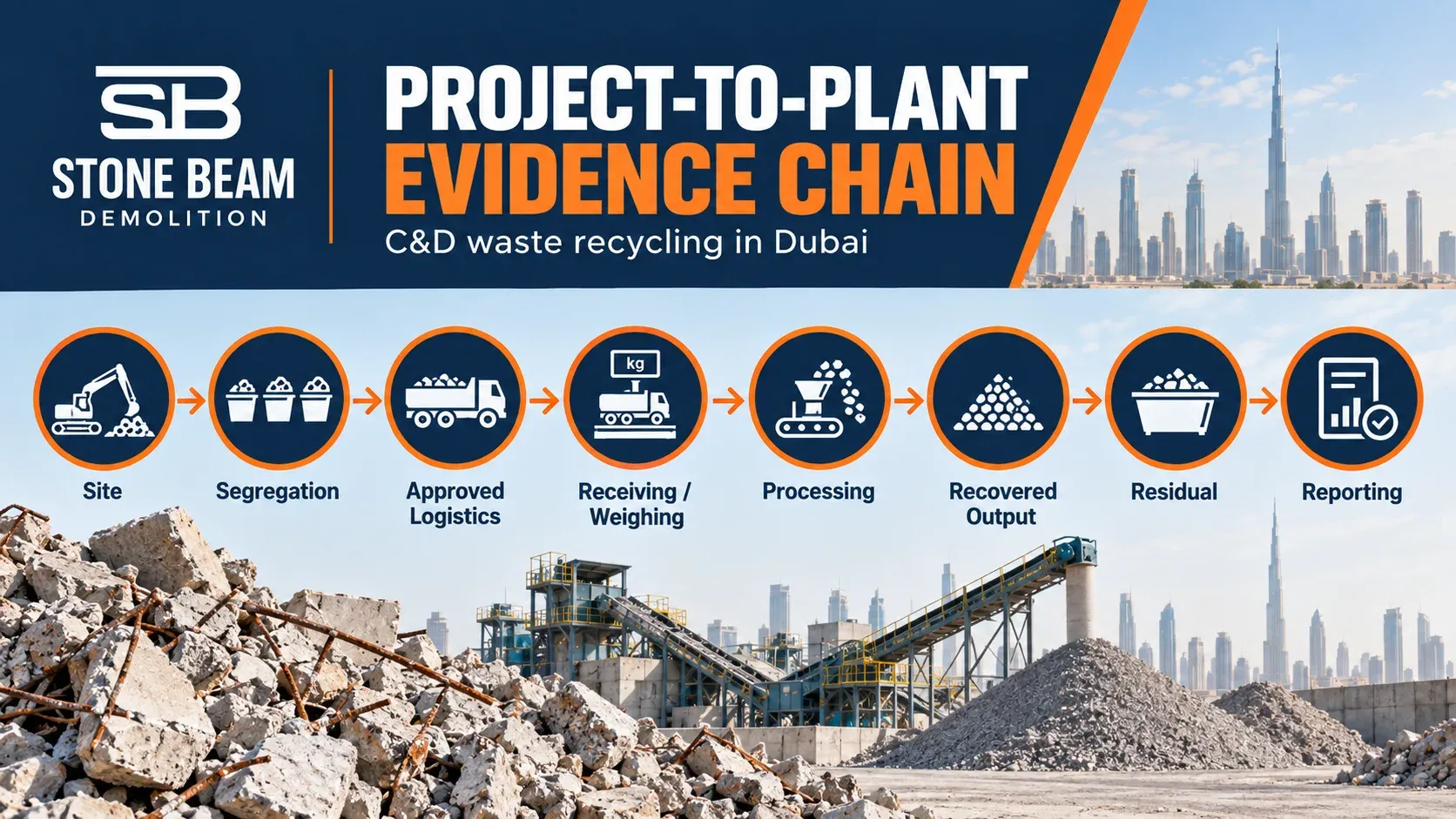
The following chain is a practical editorial model, not an official authority flowchart. Its purpose is to show where value and evidence are lost when handoffs are weak.
- Project generation — identify the material stream and the point at which it becomes waste or a recoverable material.
- Segregation — keep compatible streams apart where that improves acceptance, recovery or safe handling.
- Logistics — use the applicable approved carrier and destination route.
- Receiving — the facility evaluates the load, records it and confirms whether it is acceptable.
- Processing — accepted material goes through the facility’s appropriate sorting, size-reduction or separation stages.
- Recovered output — resulting material is assessed against the specification or buyer requirement relevant to its intended use.
- Residual fraction — rejected or unrecovered material follows its lawful disposal or treatment route.
- Reporting — weighbridge, transfer, recovery and other records close the evidence chain.
For projects where the final destination is disposal rather than recycling, see Stone Beam’s separate demolition waste disposal guidance. Keeping disposal and recycling as separate user jobs avoids treating every removed material as recyclable.
Which Waste Streams Create Different Recycling Opportunities?
Different streams create different processing routes, contamination risks and output questions. Check the matrix below against the receiving facility’s acceptance criteria and the specification of the intended recovered product.
| Waste stream | Potential recycling route | Key constraint | Possible output | Evidence to request |
|---|---|---|---|---|
| Concrete / masonry | Mineral fraction suitable for crushing or screening where accepted | Mixed finishes, embedded materials, hazardous contamination | Processed mineral output subject to required quality and end-use criteria | Load source, quantity, acceptance, processing record, product test/specification where relevant |
| Metals | Separation and recovery as a distinct material stream | Mixed debris, coatings, attachments, contamination | Recovered metal stream routed to an appropriate downstream operator | Weight, material description, destination, transfer records |
| Timber / wood | Separate recovery route where the receiving facility accepts it | Treated or contaminated wood; mixed loads | Recovered or treated output depends on facility route | Stream identification, acceptance evidence, destination |
| Dry recyclables | Sorting into compatible material categories | Food, wet waste, hazardous or incompatible contamination | Material-specific recovery route | Segregation record, carrier/facility evidence, recovered quantity |
| Mixed C&D waste | Sorting may recover some fractions | High contamination and uncertainty | Recovery varies by composition and facility capability | Composition data, inspection, rejected fraction, recovery record |
Recovered concrete is not automatically suitable for a specific construction use. For the separate product-quality topic, use the surviving recycled concrete aggregate page rather than expanding this article into an aggregate specification guide.
Why Source Segregation and Contamination Change Recovery
Segregation affects the value of the stream before it reaches the plant. A cleaner stream gives the receiving facility better information, reduces avoidable sorting, and makes acceptance and downstream quality checks easier. A mixed or contaminated stream creates more uncertainty, more rejection risk and a larger residual fraction.
Contamination is also a commercial variable. A plant investment model that assumes every incoming tonne becomes a marketable output is not a credible model. Incoming composition, accepted fraction, recovered yield and residual disposal have to be separated and measured.
This is why project data matters. Total waste volume is only one input. The stronger dataset also identifies material type, consistency, condition and the evidence that follows each stream to the receiving facility.
What Happens Inside a C&D Recycling Plant?
At a high level, a C&D recycling facility receives material, checks and records the load, separates incompatible or unsuitable material, processes accepted fractions, controls storage and environmental impacts, and records the movement of recovered outputs and residuals. The exact plant design depends on the licensed activity, feedstock and intended products.
Dubai Municipality’s Technical Guidelines No. 29 require facility-side controls for incoming loads, records, weighing, receiving and sorting. The guideline also covers segregation or rejection of potentially hazardous material and controlled product storage.
The guideline also addresses environmental and operational controls such as dust, emissions, housekeeping, safety, monitoring and reporting. Read the current Dubai Municipality C&D recycling guideline before making facility-specific design or compliance decisions.
This article deliberately stops at the conceptual level. It is a decision and evidence framework, not a plant-design manual, site operating method, waste-acceptance decision, environmental permit submission or investment recommendation. It does not provide equipment sizing, processing capacity, safe operating thresholds or a project permit procedure.
Where Are the Investment Opportunities?
The investment opportunity is not one single business model. It exists at different points in the C&D material chain, and each point has a different evidence burden.
| Opportunity area | Why it can matter | What must not be assumed |
|---|---|---|
| Processing capacity | Serving verified incoming C&D streams that match the licensed facility and process capability | Assumed tonnage without contracts or measured history |
| Recovered mineral products | Creating outputs that meet defined buyer or specification requirements | Treating all crushed material as automatically saleable |
| Metals / material recovery | Improving separation and downstream routing of identifiable streams | Assuming commodity value offsets all operating costs |
| Specialised sorting / preprocessing | Reducing contamination before core processing | Assuming mixed waste has a stable composition |
| Logistics integration | Reducing unnecessary handling and aligning collection with facility acceptance | Ignoring haul distance, queueing, fleet and transfer constraints |
| Offtake integration | Designing outputs around actual buyer requirements | Building inventory without credible offtake |
| Data and traceability | Using weighbridge, transfer and recovery records to prove feedstock and output performance | Using estimates as if they were measured performance |
| Contractor–operator interface | Planning demolition and segregation around downstream acceptance requirements | Promising recycling outcomes without receiving-facility evidence |
Dubai’s waste law creates a supportive policy direction for recycling and private investment. The stronger commercial signal, however, comes from project and plant evidence: repeatable feedstock, accepted material quality, lawful operating route, output specification, credible buyers and a cost base that survives sensitivity testing.
For a project-side demolition scope, the commercial link is different from a plant investment decision. Stone Beam’s Dubai demolition company page is the appropriate service owner for survey, scope definition and quotation.
What Actually Determines Recycling-Plant Viability?
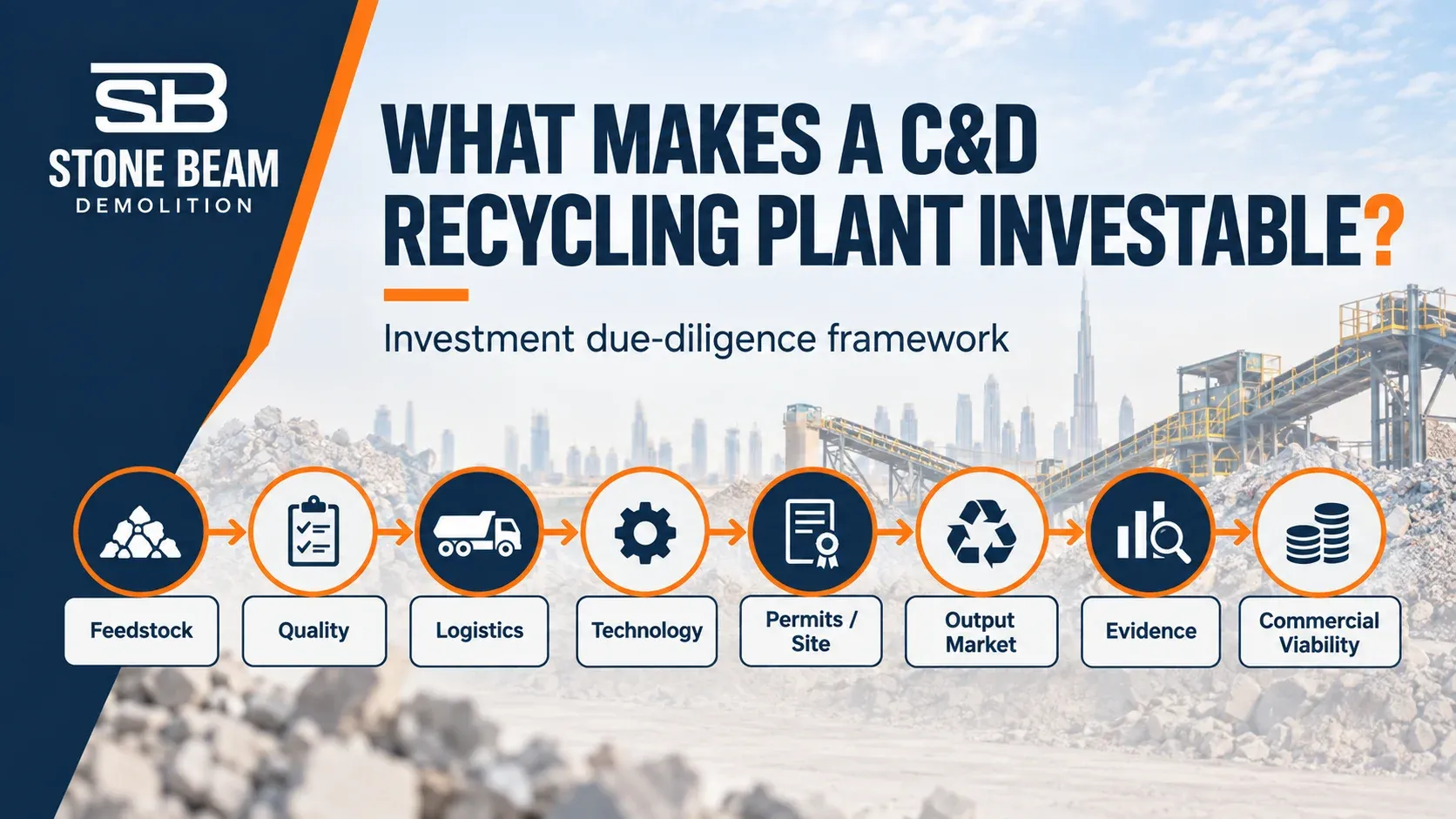
Screen the plant as an evidence problem before treating it as a financial model. The due-diligence matrix below separates the variables that require proof.
| Variable | Decision question | Evidence required |
|---|---|---|
| Feedstock | How much material is available, from which sources, with what timing? | Measured tonnage, source contracts, pipeline evidence, seasonality |
| Material quality | What is the composition and contamination profile? | Sampling, load records, composition data, rejection history |
| Facility acceptance | Will the intended facility accept the incoming stream? | Acceptance criteria, pre-approval, licence/activity scope |
| Process fit | Does the selected process match the actual input and output target? | OEM/process data, trials, commissioning evidence |
| Yield and residual | What proportion becomes compliant recovered output and what remains residual? | Measured operating data or trials; separate residual records |
| Land and utilities | Is the site practical for the intended activity? | Land-use approval, access, utilities, environmental requirements |
| Logistics | What does collection and haul distance do to operating cost and reliability? | Route, distance, fleet, queueing, transfer assumptions |
| Regulation | Is the activity properly licensed and permitted? | Applicable Dubai Municipality / licensing / environmental approvals |
| Output quality | Does recovered material meet the buyer’s required specification? | Testing, specification, acceptance criteria |
| Offtake | Who will buy or use the recovered output, in what grade and quantity? | LOIs, contracts, tender requirements, buyer qualification |
| Commercial model | Do revenues cover all direct and indirect costs? | Actual CAPEX/OPEX, pricing, utilisation and sensitivity assumptions |
| Residual disposal | What happens to rejected or unrecovered material? | Quantity, lawful route, disposal/treatment cost |
| Evidence quality | Can the key assumptions be audited? | Weighbridge, MRR, transfer, acceptance, output and invoice records |
Revenue Is Not Profit — Commercial Boundary
Potential revenue sources include processing arrangements and sales of recovered material. Those inflows do not establish profit. The cost side has to include the full system that makes the output possible.
- land, site preparation and facility infrastructure;
- plant acquisition, installation and commissioning;
- labour, supervision and administration;
- power, water and other utilities;
- maintenance, wear parts and downtime;
- sorting, handling and quality control;
- collection, transport and internal logistics;
- environmental, licensing, monitoring and audit requirements;
- rejected material and residual treatment or disposal;
- sales, stockholding and output-quality risk.
A credible investment case uses actual quotations, operating evidence and sensitivity testing. This article does not publish generic ROI, IRR, payback, plant-capacity or margin benchmarks because those figures change materially by site, process, feedstock, utilisation and output market.
What Evidence Should an Investor Request Before Assuming Feedstock Exists?
Feedstock is a common weak assumption in a recycling-plant proposal. “There is a lot of construction in Dubai” is not feedstock evidence. A decision-ready file documents where material comes from, whether it is available to the proposed plant, and its condition at the gate.
- Historically measured tonnage by material stream, not only total waste volume.
- Source projects, suppliers or collection areas, with timing and contract status.
- Material composition and contamination records.
- Seasonality and month-to-month variability.
- Weighbridge or transfer records that reconcile incoming quantities.
- Transport distances, access conditions and collection model.
- Receiving-facility acceptance criteria and rejection history where available.
- Output specification, testing requirements and buyer acceptance criteria.
- Offtake evidence such as buyer requirements, letters of intent or executed contracts.
- Residual quantity and the lawful route and cost for material that is not recovered.
If these records do not exist, the correct response is not to invent a market assumption. Move the project into a measurement phase before treating the investment model as decision-ready.
Dubai / UAE Regulatory Context
Three layers matter for this article: the UAE federal waste framework, Dubai’s local waste law and implementing bylaw, and Dubai Municipality’s technical guidance for C&D recycling.
UAE level. Federal Law No. 12 of 2018 provides the federal scope and definitions for integrated waste management, including segregation, reuse and recycling across the UAE. Official UAE legislation This article does not use the federal law as evidence for plant-specific market size, returns or demand.
Dubai law. Dubai Law No. 18 of 2024 applies across the Emirate, including special development zones and free zones, and covers waste-management activities. It states objectives that include encouraging private-sector investment, promoting recycling and increasing recycling and treatment. It also requires a Dubai Municipality permit for waste-management-related activity. Official Dubai legislation
Implementing bylaw. Administrative Resolution No. 34 of 2026 defines waste-related activities to include segregation, sorting, transport, storage, reuse, recycling, treatment and final disposal, and sets the implementing framework for permits and waste records. Official implementing bylaw
Technical guidance. Dubai Municipality Technical Guidelines No. 29 applies to relevant waste generators and operators involved with treatment and recycling facilities licensed for DET activity 3830910 — Construction & Demolition Waste Recycling — in Dubai, including free zones as applicable. It describes receiving, processing, storage, environmental and reporting controls. Dubai Municipality guideline PDF
Regulatory status must be checked for the specific site, activity and material. This article does not replace authority advice, environmental review, licensing submissions or facility-specific permit conditions.
Project-Level Waste Data and Plant-Level Decisions
Plant decisions improve when project records are structured for downstream use. Useful records include material type, estimated or measured quantity, segregation status, carrier, receiving facility, weighbridge evidence, acceptance or rejection, and final recovery or disposal record.
The value is not only compliance. These records reveal the consistency of the feedstock, the contamination problem, the distance to suitable facilities and the share of material that becomes a verified recovered output rather than a theoretical recyclable stream.
Publish case-study evidence only where Stone Beam has approved project records that support the claim. The surviving projects and case studies hub is the right place for documented project proof; this article does not invent recycling rates or tonnage.
Stone Beam Context
Stone Beam’s relevant role is on the demolition side of the chain: defining demolition scope, sequencing removal, identifying material interfaces and coordinating the information needed for removal and downstream routing. Do not present the company here as a recycling-plant owner or as guaranteeing feedstock, recovery percentage, output quality or investor returns.
For a commercial demolition project, review the scope through Stone Beam’s commercial demolition service page. Tie any recycling commitment in a quotation to the actual project, receiving facility and available records.
Key Questions Before Investing in a C&D Recycling Plant
- What measured C&D feedstock is contractually or operationally available to the proposed plant?
- Which material streams are clean enough for the intended process, and how is contamination measured?
- What licence, Dubai Municipality permit and environmental approvals apply to the site and activity?
- What evidence shows the selected process matches the actual feedstock?
- What is the measured recovery yield, and how much residual material remains?
- How far does material travel to the plant, and how sensitive is the model to logistics cost?
- Which recovered outputs have defined specifications and verified buyers?
- What tests or certifications does each target buyer require?
- What evidence supports gate or processing revenue assumptions?
- What evidence supports recovered-material selling prices and sales volumes?
- What are the actual land, plant, labour, utility, maintenance and compliance costs?
- How is rejected or residual material treated or disposed of, and at what cost?
- Are incoming, outgoing and recovered quantities reconciled through weighbridge and reporting records?
- What changes first if feedstock, utilisation, yield, output price or logistics cost is worse than the base case?
FAQ / Related Questions
Is all demolition waste recyclable in Dubai?
No. Material suitability depends on the waste type, contamination, receiving-facility acceptance and the intended recovery route. Hazardous or suspected hazardous material requires the applicable specialist controls.
Does Dubai support investment in recycling facilities?
Dubai Law No. 18 of 2024 includes encouraging private-sector investment and increasing recycling among its objectives. That policy direction does not guarantee demand, feedstock, approval or profitability for a specific plant.
What is the most important feedstock evidence?
Measured tonnage by material stream, composition and contamination data, source availability, transport distance, facility acceptance, and records that show how much material was actually recovered or rejected.
Is recycled concrete from demolition automatically ready to be sold as aggregate?
Not automatically. The recovered material has to meet the quality, specification and buyer requirements for its intended use. Product compliance is a separate decision from waste recovery.
What does a demolition contractor need to provide to support recycling?
The useful project-side package includes a clear waste scope, segregation plan where relevant, material records, carrier and destination information, and the documentation needed to reconcile removal with facility acceptance and final routing.
Project Enquiry
If a demolition project requires a defined waste-segregation, removal and documentation scope, send Stone Beam the project location and jurisdiction, demolition boundary, available drawings, site photos, access constraints, utility status, adjacent-structure constraints and required handover condition. Submit the demolition scope for review before quotation. Final method, programme, authority route and commercial proposal remain subject to survey, authority requirements and actual site conditions.