



Recycled concrete aggregate in Dubai is not accepted simply because it comes from crushed concrete. A project team needs evidence of source quality, segregation, processing, testing, traceability and intended use. Structural concrete requires a higher evidence threshold, and no policy or research percentage should be treated as a universal replacement rule.
Under Article 14 of Federal Law No. 12 of 2018, the competent authorities manage construction and demolition waste according to source-segregation standards, prevent it from being mixed with other waste, and transport it to the nearest waste-management facility for recycling. In Dubai, Law No. 18 of 2024 provides the local framework for segregation, recycling and the use of recycled materials. These are waste-management rules; they do not, by themselves, approve an RCA percentage for structural concrete.
Practical rule: define the intended use first, then test and document the RCA against the applicable specification. Do not start with a preferred replacement percentage and search for evidence afterward.
Last reviewed: 16 September 2026
Author: Stone Beam Demolition (Stone Beam Technical Services L.L.C.)
What Is a Recycled Concrete Aggregate?
Recycled concrete aggregate (RCA) is aggregate produced from concrete that has been recovered, processed and graded for a new construction use. It is not the same as mixed construction and demolition waste, and it is not automatically equivalent to virgin aggregate.
The distinction starts at the demolition source. Concrete recovered as a controlled mineral stream is easier to trace and assess than concrete mixed with gypsum, masonry, timber, plastics, soil or other debris. For that reason, material recovery begins before crushing.
On a demolition project, source control belongs in the wider construction and demolition waste plan. The material route, intended destination and documentation chain should be defined before mixed debris removes the evidence needed for later acceptance.
| Material | What it means | Decision consequence |
|---|---|---|
| Recycled concrete aggregate (RCA) | Aggregate produced from recovered concrete that is processed and graded for a defined use. | Assess the concrete source, processing history, properties, traceability and intended use. |
| Mixed recycled aggregate | Recycled mineral aggregate containing more than one demolition-material stream. | Do not assume it has the same composition, properties or acceptance route as RCA. |
| Virgin aggregate | Aggregate from a primary natural or manufactured source, supplied under its applicable specification and conformity route. | Use as the project baseline only where the project specification identifies it as such. |
How Does Demolition Concrete Become an RCA Material Source?
RCA quality starts before the crusher. Once concrete is mixed with gypsum, masonry, soil, timber, plastics or unknown debris, later processing has to manage a more uncertain feedstock. Demolition planning therefore affects the evidence quality of the recovered concrete stream.
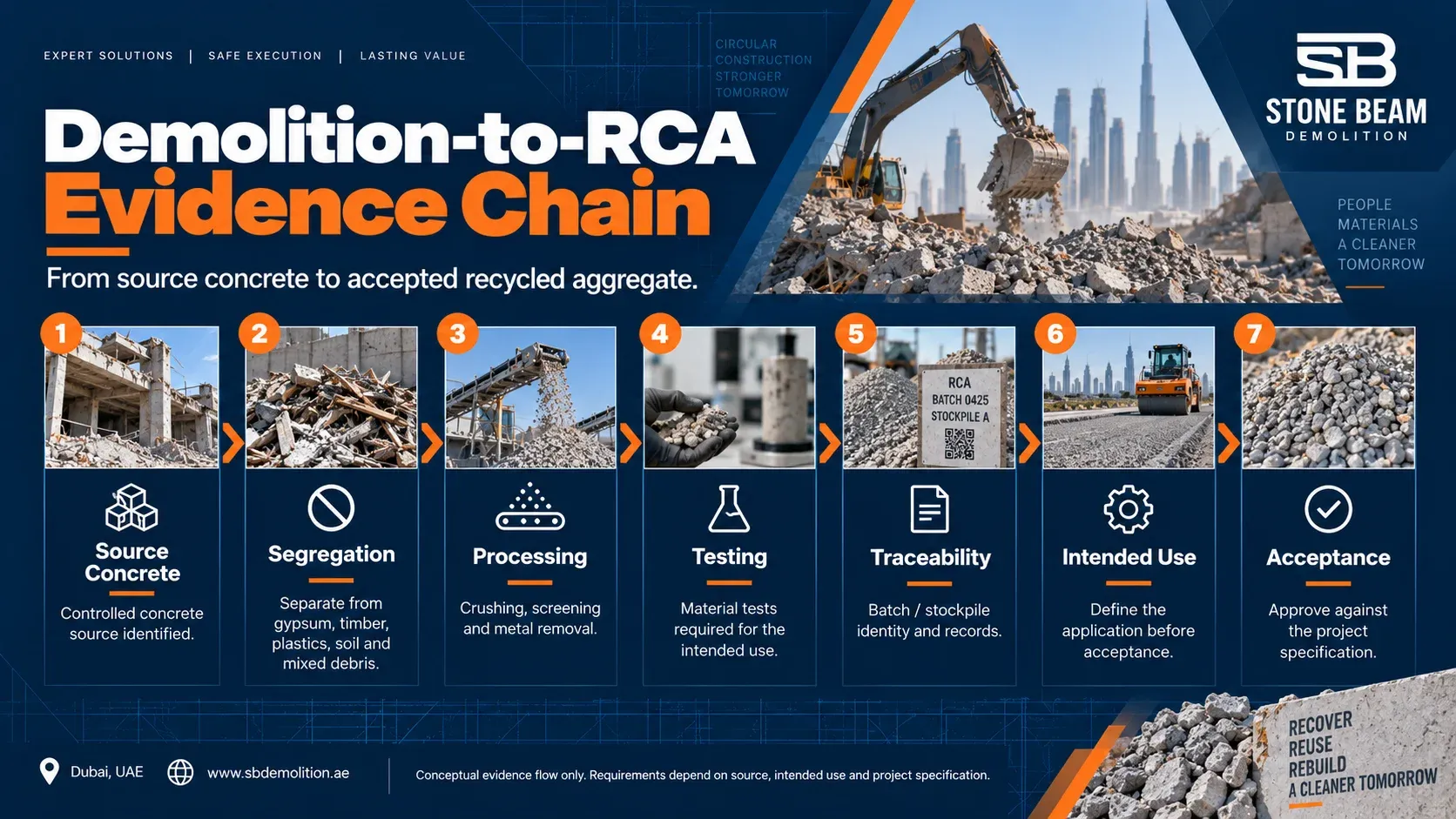
The useful question is not simply whether concrete was recycled. The project team needs to know what concrete entered the stream, how it was separated, what processing occurred, how the processed material was identified, and which records follow the batch or stockpile.
The evidence chain should remain intact from demolition source to final intended use. A missing handoff does not automatically make material unusable, but it creates a question that the receiving specification and acceptance route must resolve.
A project that intends to recover concrete for later aggregate use should connect demolition planning to the material-recovery objective. Stone Beam’s advanced demolition planning guidance explains how source conditions, retained assets and logistics are defined before execution.
If the owner is appointing a contractor to protect that recovery stream from the start, review the scope and evidence expected from a demolition company in Dubai before the waste route is fixed.
- Identify the concrete source and any exposure or contamination history relevant to the intended use.
- Separate the target concrete stream from incompatible demolition materials as early as practicable.
- Record the processor, crushing or screening route, metal removal and stockpile or batch identity.
- Obtain the material tests and product documentation required by the intended-use specification.
- Link the verified material record to the project acceptance decision before final use.
What Controls RCA Quality?
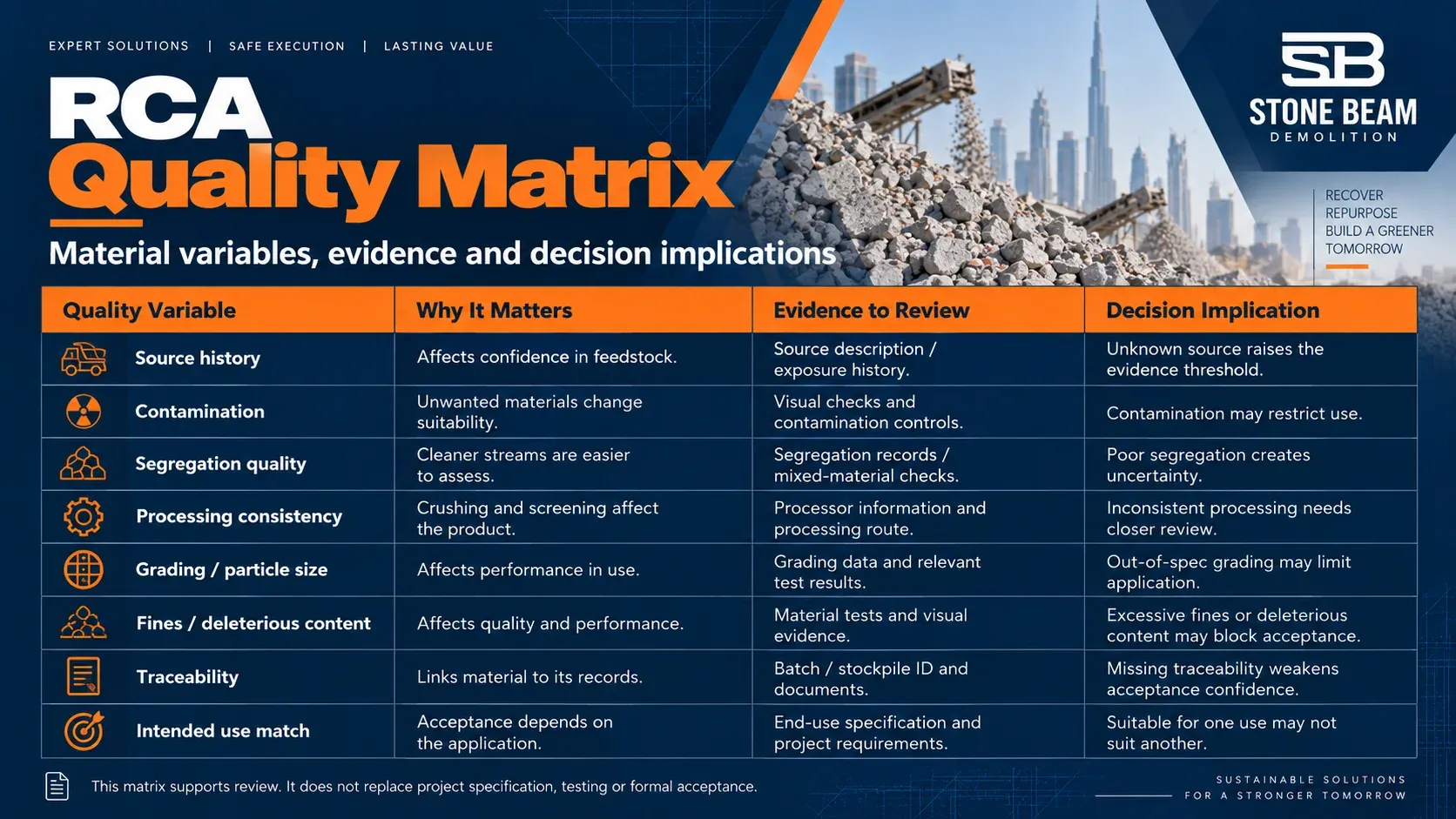
RCA quality can vary with the source concrete, residual or adhered mortar, crushing and screening history, grading, fines, moisture condition and contamination. These variables should be characterised for the actual material rather than assumed from another RCA source.
Residual or adhered mortar can change recycled-aggregate porosity, water absorption and density relative to natural aggregate. The magnitude is source-specific and should be measured for the material being proposed. These characteristics belong in material characterisation and concrete-performance assessment, not in a generic website correction factor.
Mixing the target concrete stream with gypsum or plaster, masonry, asphalt, soil, timber, plastics or other foreign material changes the feedstock composition and therefore the evidence and acceptance questions. A marine, chemical or otherwise aggressive exposure history can also trigger additional project-specific chemistry or durability checks.
Traceability ties those questions to a real batch or stockpile. A laboratory report without a clear material identity is weaker evidence than a report linked to a defined source, processing record and intended use.
See the UAE beam study on locally produced recycled aggregate for one example of how aggregate properties and concrete behaviour are evaluated under controlled research conditions.
| Variable | Why it matters | Evidence / check | Decision implication |
|---|---|---|---|
| Parent concrete and adhered mortar | They can influence particle condition, porosity, absorption and consistency. | Source record and aggregate characterization. | Do not transfer results from a different RCA source without justification. |
| Grading and fines | They influence packing, workability and layer or concrete behaviour. | Grading and fines results required by the applicable specification. | Acceptance limits come from the intended-use specification. |
| Moisture / absorption | They can affect aggregate water conditions and concrete batching assumptions. | Measured properties and controlled batching information where concrete use is proposed. | Do not publish a universal water correction. |
| Contamination | Foreign material changes feedstock composition and may change the required checks. | Visual/source controls plus specified physical or chemical checks. | A mixed or uncertain feedstock needs a different evidence response. |
| Exposure history | Marine, chemical or other aggressive exposure can change the project-specific chemistry and durability questions. | Source history plus chemistry/durability tests required by the specification. | Project exposure class and materials review govern the response. |
| Traceability | Test results must belong to the material being accepted. | Batch, stockpile, delivery and test identification. | Acceptance is stronger when the evidence chain is auditable. |
Why Does Intended Use Come Before Acceptance?
The same recycled aggregate does not face the same evidence threshold in every application. A road sub-base, engineered fill, manufactured non-structural product and structural concrete each have a different performance purpose and acceptance route.
The 2019 UAE recycled-aggregate policy addresses road construction and other infrastructure applications. The government statement on Ministerial Resolution No. 21 of 2019 identifies uses such as road paving, grading, parking areas and earth filling, with laboratory quality testing. That policy context is materially different from structural concrete design.
For structural concrete, the question moves from waste recovery to material and concrete performance. The project specification, aggregate properties, concrete trials or performance evidence, durability exposure and recorded consultant or materials decision become central.
This intended-use distinction prevents two opposite errors: rejecting useful recycled material simply because it is recycled, or accepting material for a higher-consequence use on the strength of an unrelated policy or laboratory percentage.
| Intended-use context | Primary evidence question | Acceptance boundary |
|---|---|---|
| Road paving, dirt-road/parking-area grading, or earth fill | Does the recycled aggregate meet the applicable quality and technical requirements for the stated infrastructure use? | Use the applicable road/infrastructure specification and project/authority requirements; do not transfer that acceptance into structural concrete. |
| Non-structural products or general civil use | Does the product or material meet its applicable conformity and performance requirements? | Product certification and project specification remain distinct from waste-recovery status. |
| Structural concrete | Does the specific RCA source support the required aggregate and concrete performance for the exposure and structural specification? | Materials/consultant acceptance follows evidence and project specification; no universal percentage applies. |
If a material does not follow a recovery or reuse route, the project needs a separate demolition waste disposal and receiving-evidence route rather than relabelling mixed waste as RCA.
Is There a Standard RCA Replacement Percentage for Structural Concrete?
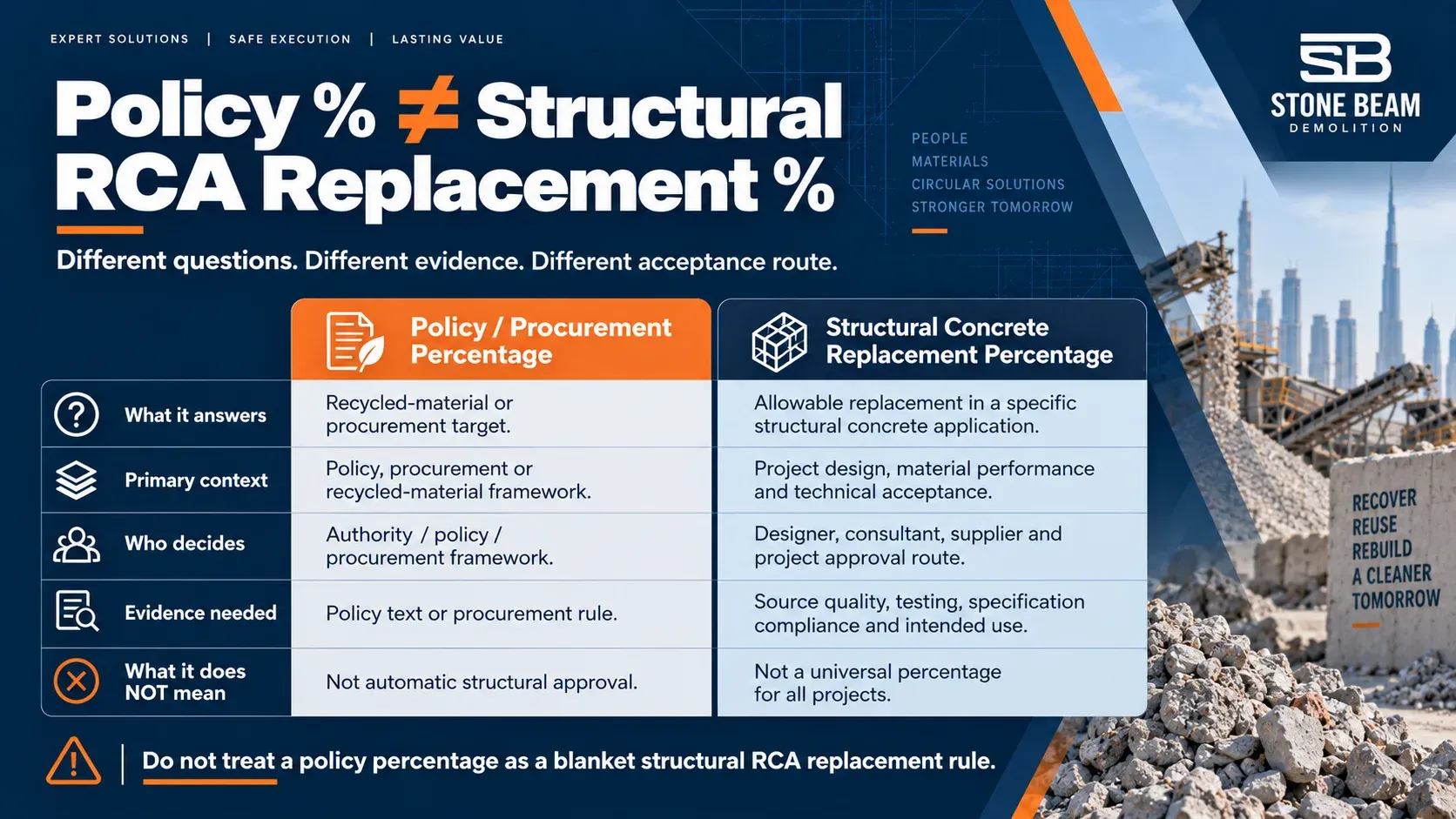
No. There is no universal RCA replacement percentage that applies across Dubai or UAE structural-concrete projects merely because a policy document or research paper reports a percentage.
A policy percentage answers a policy or procurement question within its stated scope. A research percentage reports what a defined material and concrete system did under defined test conditions. Neither becomes a project design rule without the specification and acceptance route that makes it applicable.
For structural concrete, the decision starts with the actual RCA source and the required concrete performance. Aggregate characteristics, durability exposure, trial or performance evidence, conformity requirements and the project materials review determine whether a proposed use is acceptable.
This is why the replacement article deliberately avoids member-by-member percentages for slabs, beams, columns or foundations. Those values would imply a universal design rule that the evidence does not support.
| Decision rule
There is no universal RCA percentage that becomes acceptable merely because a research paper, procurement policy or recycling target reports a value. Project specification and material evidence govern the structural decision. |
|---|
What Does UAE Recycled-Aggregate Policy Mean for Structural Concrete?
Ministerial Resolution No. 21 of 2019 was issued for recycled aggregates from construction and demolition waste in road construction and other infrastructure projects. The official WAM summary says public and private contractors may meet up to 40% of their material requirements from recycled aggregates in that policy context.
The 40% figure associated with Ministerial Resolution No. 21 of 2019 is a material-requirement figure in a road and infrastructure recycled-aggregate policy context. It is not a statement that structural concrete in Dubai accepts 40% RCA replacement.
Dubai’s Law No. 18 of 2024 gives Dubai Municipality authority to require segregation, recycling and the use of materials produced from waste treatment and recycling. Administrative Resolution No. 34 of 2026 then provides the mechanism: Article 13 says minimum recycled-material percentages and the projects/activities to which they apply are to be determined by a Director General resolution, considering availability, quality, conformity with approved technical specifications and standards, transport feasibility, project type and material type. Article 14 separately requires recycled materials intended for use to meet the requirements and technical specifications in the approved Technical Manuals. The reviewed bylaw therefore does not itself create a universal structural-concrete RCA replacement ratio.
For a project team, the practical consequence is straightforward: cite policy as policy, cite research as research, and use the applicable project or product specification for the material acceptance decision.
Dubai Central Laboratory’s product-certification framework makes the conformity boundary clearer. DCL states that its certification general rules have been updated to allow recycled materials in the manufacturing process of certified products, subject to the relevant provisions and terms. Product certification still confirms conformity of the product with its applicable standard or regulation; it is not blanket approval of RCA for structural concrete.
What Testing and Documentation Matter Before RCA Acceptance?
The test package should be derived from the intended use and its applicable specification. A generic website checklist cannot replace the project materials specification, but it can show the evidence categories that deserve attention.
At aggregate level, the evidence commonly addresses identity, grading and fines, physical properties such as density or absorption, and contamination or chemistry where exposure history makes those questions relevant. The exact methods and acceptance limits belong to the selected specification.
Dubai Central Laboratory’s Type 1 product-certification route covers a defined quantity of products assessed against a recognised international, national or local specification. Samples are tested through the scheme and the resulting certificate of conformity applies to the tested product. This illustrates the wider point: waste recovery status and product conformity are separate evidence questions.
Where structural concrete is proposed, aggregate compliance alone does not prove finished-concrete performance. The concrete specification and competent materials route determine whether trial, strength, durability or other performance evidence is required before approval.
- Source-concrete or material-origin record sufficient to identify the feedstock.
- Processor and batch or stockpile identification that links the source to the delivered material.
- Grading, fines and other aggregate physical-property results required by the intended-use specification.
- Contamination and chemical evidence required by the source history and project exposure conditions.
- Product certification or conformity documentation where the selected product route requires it.
- Concrete trial or performance evidence where the structural concrete specification requires it.
- A recorded acceptance decision by the project role designated to accept materials — for example, the consultant or materials engineer where applicable — tied to the governing project requirements.
RCA Acceptance Decision Matrix
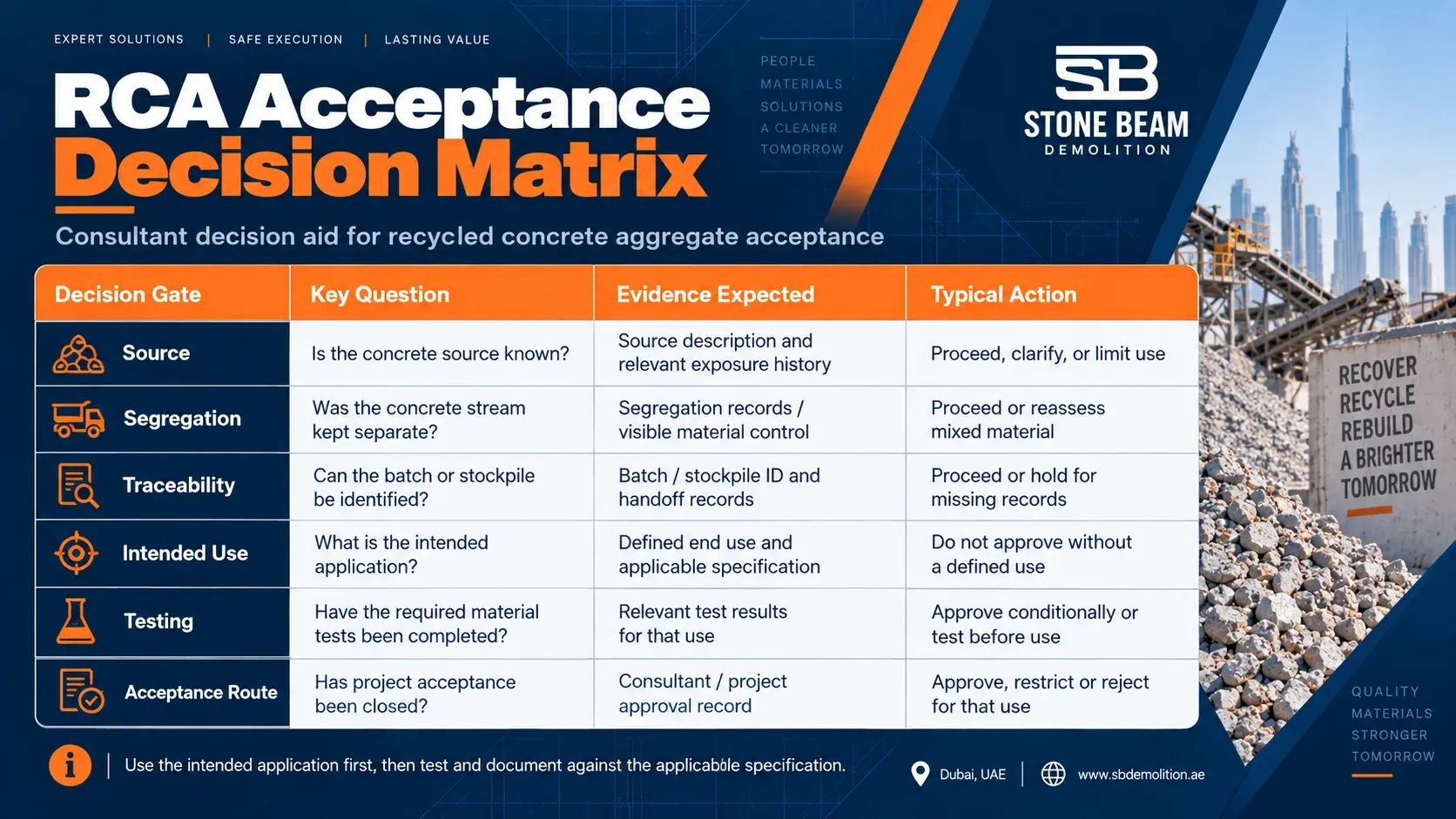
Use this matrix as a decision framework, not as an automatic approval checklist. Each row identifies the evidence question that should be closed before the project treats a particular RCA source as acceptable for its intended use.
| Factor | Why it matters | Evidence / test | Decision implication |
|---|---|---|---|
| Source material | The origin influences variability and exposure questions. | Source description, demolition/material record. | Unknown origin increases the evidence burden. |
| Segregation | Cleaner mineral streams reduce avoidable contamination uncertainty. | Demolition segregation and material-handling record. | Poor source control can change the receiving route. |
| Processing | Crushing, screening and separation define the produced aggregate. | Processor method, batch/stockpile identity. | Processing history must match the material being tested. |
| Aggregate properties | Physical and chemical characteristics govern the material response. | Tests required by the intended-use specification. | Limits come from the applicable specification, not this article. |
| Intended use | Different applications demand different performance evidence. | Project specification and use classification. | Do not carry acceptance from a lower-consequence use into structural concrete. |
| Concrete performance | Structural concrete requires evidence beyond aggregate identity. | Concrete trial/performance evidence required by the specification. | Acceptance belongs to the project materials route. |
| Traceability | The tested sample must represent the material supplied. | Batch, delivery, test and stockpile references. | Broken traceability weakens the acceptance record. |
| Acceptance record | A technical conclusion needs a responsible decision owner. | Defined project acceptance record, such as consultant/materials review where applicable. | Supplier or contractor marketing does not substitute for the project’s acceptance route. |
What Does UAE Research Tell Us About RCA?
UAE-based research has examined locally produced recycled aggregate in reinforced concrete beams, concrete made with recycled fine aggregate, and life-cycle performance of recycled-aggregate concrete.
Research has reported different performance outcomes across different recycled-aggregate systems. Those results describe the materials, replacement basis, mix design and test conditions that were studied; they are not a Dubai-wide permission, a standard replacement ratio or a Stone Beam recommendation.
The same discipline applies to environmental claims. UAE life-cycle research shows that transport distance and concrete constituents influence environmental and economic results. Recycled aggregate therefore does not create an automatic carbon-saving percentage for every project.
A project team should use research to frame technical questions and evidence needs, then return to the applicable material, concrete and project specification for acceptance.
What Should a Consultant or Specifier Close Before Approving RCA?
Before approval, close the following questions in the project record. They convert a sustainability intention into an auditable materials decision.
- What is the RCA source, and is the source history sufficiently known for the proposed use?
- How was the concrete segregated from gypsum, masonry, asphalt, soil, timber, plastics and other foreign material?
- Who processed the material, and how are the batch or stockpile and test samples identified?
- What is the intended use, and which specification governs that use?
- Which aggregate properties and contamination or chemistry checks does that specification require?
- If concrete use is proposed, what concrete performance evidence does the specification require?
- Do the test reports clearly represent the material that will be delivered or placed?
- Who records the final project acceptance, limitations and any conditions attached to use?
What Is Stone Beam’s Role at the Demolition-to-Material Interface?
Stone Beam’s documented environmental management system addresses waste hierarchy, source controls, responsibilities and record retention. That supports a demolition-side planning and segregation role where those activities are included in the project scope; it does not establish RCA manufacturing, laboratory testing, product certification or material acceptance capability.
For an RCA-oriented demolition scope, Stone Beam can define and document the demolition-side material-recovery objective, segregation interfaces and available source information within the agreed scope. Processing, aggregate production, laboratory testing, product conformity and final project acceptance remain with the relevant specialist/operator and the project roles defined by the applicable specification.
Stone Beam does not state in this article that it owns an RCA plant, manufactures or supplies certified structural-grade RCA, certifies aggregate, guarantees consultant approval, or has achieved a structural RCA case result. The current first-party evidence does not support those claims.
Where a demolition project intends to preserve concrete as a cleaner recovery stream, the material objective should be built into the demolition scope before the concrete is mixed with other waste. The same planning logic applies to full building work and villa demolition in Dubai where material recovery is part of the owner’s brief.
Limitations
| Scope limitation
This page is a material-decision and evidence framework. It is not a structural design, concrete mix design, project specification or automatic material approval. Final requirements depend on the actual RCA source, intended use, applicable technical specification, product or batch conformity route, exposure conditions and competent project acceptance. |
|---|
Planning Demolition With a Material-Recovery Objective?
If a demolition project is intended to recover concrete as a cleaner material stream, send the site location, scope drawings, known contaminants, retained elements, intended receiving route and material destination. Stone Beam can review the demolition-side segregation and documentation requirements before pricing or mobilisation.
For contractor capability and demolition scope, see our demolition company in Dubai page, or contact Stone Beam with the project information.