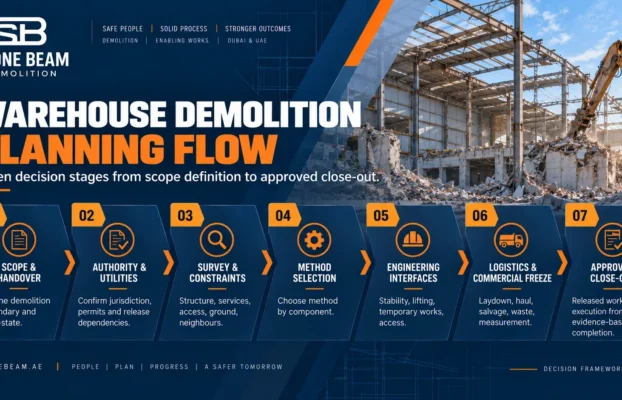




Advanced demolition in Dubai is about choosing a removal method that suits the structure, its surroundings, and the intended end condition. Conventional mechanical demolition, selective dismantling, robotic breaking, and diamond cutting each solve different problems.
Start with what must be removed, retained, and protected; then test structural stability, access, neighbouring buildings, services, and the route for debris. The result is a workable method brief—not simply a preferred machine. This guide helps you compare options and prepare drawings and site information for a technical discussion.
Stone Beam Demolition — contractor credentials. Stone Beam Technical Services L.L.C. holds Dubai trade licence 1563419, which includes Wrecking & Demolition Works. Its Dubai Municipality practice permit covers Wrecking & Demolition Works G+12 and Concrete Restoration. Both records are valid until 13 November 2027. Verify the licence through its Dubai Economy & Tourism QR code and check the practice permit on the Dubai Municipality engineering qualification portal using licence number 1563419. For our contractor scope and qualifications, see Stone Beam’s demolition services in Dubai. Project permissions are obtained through the competent authority for the plot.
Do you have a structure or opening to remove? Request a demolition method review. Send the site location, drawings, and a marked-up removal boundary to make the first discussion useful.
By Eng. Awad Ashour | Stone Beam Demolition • Updated: 28 October 2026
Which demolition method fits your project?
The most useful first choice is a method family. The engineering review then checks whether that family meets the site constraints.
| Your project situation | Initial method family | What could change the choice | Explore the service |
|---|---|---|---|
| A whole building with suitable ground access | Conventional mechanical demolition | Structural form, basements, machine approach, neighbours and debris exit | Building demolition |
| Part of the structure must stay | Selective or controlled demolition | Retained load paths, temporary stability and occupied areas | Controlled demolition |
| Breaking is needed in a restricted work zone | Remote-controlled robotic breaking | Access opening, supporting floor, services and dust controls | Robotic demolition |
| A thick reinforced-concrete member must be separated | Diamond wire sawing | Structural release, piece handling, water management and removal route | Wire sawing |
| A defined opening is required in a wall or slab | Wall or floor sawing, with scanning where appropriate | Reinforcement, post-tensioning, retained structure and lifting interface | Concrete cutting |
| A fit-out is being replaced while the building remains | Interior soft strip | Live MEP, access windows, fire routes and occupied neighbours | Interior strip-out |
| A shed, canopy or mezzanine is being removed | Engineered steel dismantling | Connections, temporary stability and component handling | Steel dismantling |
| An operating facility or plant structure is being retired | Decommissioning-related dismantling and demolition | Operator clearance, retained systems and hazardous interfaces | Industrial demolition |
The practical distinction: initial method means a plausible approach for pricing and planning; engineering release means the relevant design, service, and workfront questions have been resolved by their responsible parties. Separating the concrete, handling the piece, and maintaining the remaining structure are three different engineering decisions.
What are the main advanced demolition methods?
Different tools can belong to the same method family. A project often combines more than one family, especially when some elements are retained.
Mechanical demolition and hydraulic attachments
Conventional mechanical demolition uses appropriately selected plant and tools to remove structures under an engineered method. Hydraulic breakers, crushers and pulverisers have different breaking and material-processing roles. The choice depends on the building, access, ground and debris strategy—not which attachment appears fastest. High-reach excavators are a distinct equipment configuration whose suitability requires a project-specific engineering and access assessment; equipment choice stays within the contractor’s permitted building category.
We demolish buildings up to G+12 in Dubai under our Dubai Municipality practice permit. Our planning covers structural assessment, method statements, risk assessments, engineered phasing, environmental controls and handover.
Selective demolition and top-down planning
Selective demolition removes defined elements while protecting something that must remain: a façade, a neighbouring structure, a retained slab or an occupied area. Top-down demolition describes a broad direction of progressing through a structure; the project engineer establishes the detailed structural and temporary-works decisions. Deconstruction, by comparison, places greater emphasis on separating components for recovery or reuse. The project engineer determines whether either approach is appropriate.

We plan demolition scopes around structural assessment, engineered phasing and defined retention boundaries. For occupied buildings, we strip out interiors while planning protection, service-lift windows and debris logistics around continued use. Structural alterations proceed against the responsible engineer’s release.
Steel dismantling and facility decommissioning
We dismantle sheds, mezzanines and canopies in an engineer-approved sequence that takes account of temporary stability and component handling. We also take down plant and facility structures after the operator’s authorised specialists have isolated and cleared the relevant systems. In both cases, the quotation should identify retained assets, access restrictions and the material-removal boundary.
Robotic demolition and precision concrete cutting
Remote-controlled breaking can move the operator away from a constrained work face, while diamond wall sawing, floor sawing and wire sawing can separate defined concrete sections. Neither choice resolves support, handling or service risks automatically.

We use remote-controlled demolition machines where access or operator positioning warrants them. We cut wall and slab openings with saws following the structural engineer’s release, and use diamond wire sawing for thick reinforced sections under an approved handling arrangement. We scan slabs and walls before cutting or coring, and core openings after the engineer’s release. Our concrete scanning and core drilling services support these investigations and openings.
Hydrodemolition removes concrete with high-pressure water in certain specialist applications; it differs from diamond cutting and mechanical breaking. Controlled demolition commonly uses mechanical, robotic, or cutting methods rather than explosives. Explosive/implosion demolition is a separate specialist service outside Stone Beam’s scope.
How do engineers choose between two feasible methods?
A useful comparison considers the constraint that changes the decision, not simply an equipment list. This compact checklist gives an owner or consultant a way to challenge a proposed option before tendering.
| Decision constraint | Question to resolve | Evidence that makes the answer usable |
|---|---|---|
| Removal and retention | Which elements disappear, and which remain in service? | Current REMOVE / RETAIN / PROTECT drawings and handover definition |
| Structure and below-ground works | Are load paths, basements, foundations or alterations understood? | Structural records, inspection findings and engineer’s review |
| Occupied neighbours | What must stay accessible, protected and operational? | Condition baseline, occupancy requirements and protection plan |
| Plant and materials route | Can equipment enter and debris leave without creating a new constraint? | Site access, loading and movement assessment |
| Hidden services or PT | What investigation is required before an intervention? | Service information, scan/investigation report and specialist decision |
| Environmental exposure | Where will dust, noise and vibration affect people or assets? | Identified receptors, controls, monitoring responsibilities and response criteria |
| Authority and completion | Which permissions and final records apply to this plot? | Jurisdiction check, required NOCs and agreed close-out criteria |
The strongest bid explains why its proposed method fits these conditions, identifies open assumptions, and assigns an owner to each decision. Three common tender mistakes are choosing cutting without checking the debris route, treating a scan as structural permission, and comparing lump sums with different protection or waste boundaries. The RFQ checklist below makes these interfaces visible before price comparison.
A quick method-choice check: Consider a proposed opening in a retained slab. Sawing may appear suitable because it defines a neat removal boundary.
If the structure contains uncertain PT information, the decision stays with the structural and PT specialists, regardless of the saw available. If the engineering question is resolved but there is no workable route for the separated piece, the handling and logistics proposal must be reconsidered. The preferred method changes when the evidence changes; the equipment choice is the outcome of that review, not its starting point.
What evidence is needed before demolition starts?
Good planning connects drawings, site observations and specialist decisions to a defined workfront. It also distinguishes a missing fact from an actual engineering rejection.
The demolition readiness matrix
| Readiness area | Evidence to assemble | Decision owner or release route |
|---|---|---|
| Scope and final condition | Removal boundary, retained assets, foundations and below-ground limits | Owner, main contractor and consultant |
| Existing structure | Available structural drawings, change history and condition observations | Structural engineer; temporary-works specialist where relevant |
| Services | Utility records, live-service status, relevant NOCs and owner confirmations | Service/utility owner and authorised project representatives |
| Sensitive surroundings | Condition surveys, occupied zones, access and protection constraints | Consultant, contractor and relevant monitoring specialist |
| Specialist intervention | PT, unusual handling, façade retention or process-plant clearance | Appropriate structural, PT, lifting or process specialist |
| Workfront readiness | Current method statement, risk assessment, protection measures and release records | Contractor and consultant under the project arrangements |
| Close-out | Accepted final condition, applicable inspections and waste evidence | Owner, consultant, carrier and authority as applicable |
Illustrative engineering decision — proposed slab opening: the drawings show a required penetration, but the available records do not establish whether post-tensioning affects that area. The useful next action is to obtain appropriate investigation and the structural/PT specialists’ decision, then record the approved intervention. Selecting a saw first would leave the central question unanswered.
The decision log shows which evidence would resolve the uncertainty.
Our marked-up scanning report supports the engineer’s decision on a proposed opening. We cut and core PT slab openings under the structural engineer’s and PT specialist’s release, with the authorised scope recorded against the current drawings.
Who approves the specialist decisions?
Each technical question belongs to the party competent to decide it. The demolition contractor supplies method and workfront information; the engineer, utility owner, operator or appointed specialist provides the corresponding technical clearance.
| When this appears | Specialist decision needed | Typical evidence |
|---|---|---|
| Retained structure or PT | Structural engineer and PT specialist | Reviewed structural assessment and release |
| Temporary stability or façade retention | Temporary-works designer / responsible engineer | Checked temporary-condition design and approval |
| Complex movement of separated material | Appointed lifting specialist | Approved handling and lifting documentation |
| Tanks or operating process equipment | Facility operator and authorised specialists | System clearance and handover |
| Suspect asbestos | Authorised hazardous-material specialist | Survey and appropriate clearance before affected demolition |
| Nearby occupied or sensitive assets | Consultant and monitoring specialists where specified | Condition baseline, response criteria and named decision owner |
What are the seven demolition decision gates?
The seven gates turn method choice into seven checkable decisions: what is being removed, what is known, which option fits, what must be authorised, whether the workfront is ready, what is recorded, and how completion is evidenced. They are a decision framework; the detailed structural method and relevant authority permissions remain project-specific.
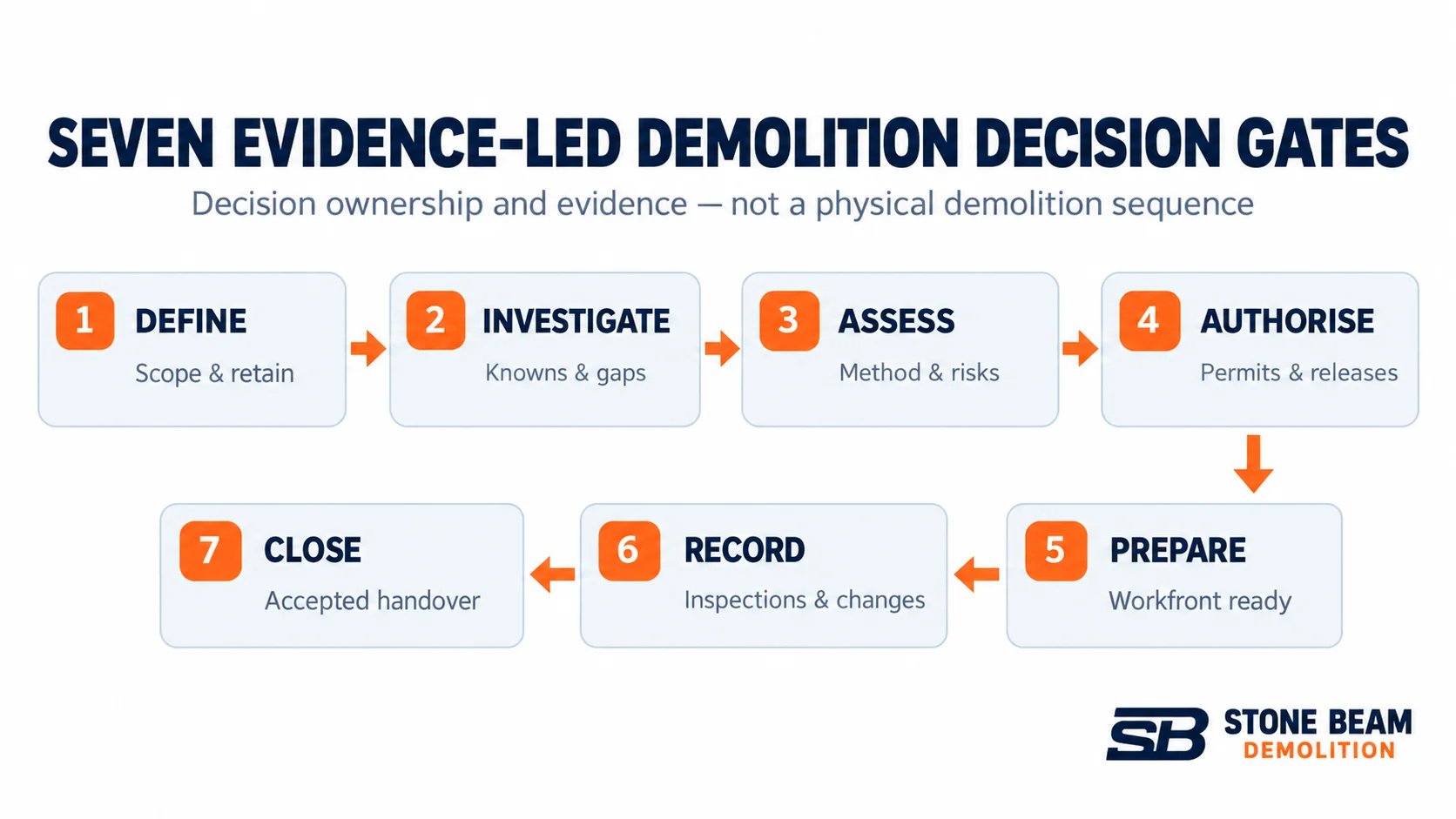
- Define: agree what must be removed, retained, protected and handed over.
- Investigate: record reliable drawings, observations and unresolved information gaps.
- Assess: compare method families, structural constraints and specialist interfaces.
- Authorise: establish the applicable authority permissions and technical decisions.
- Prepare: check the specific workfront, method documentation and protection measures.
- Record: capture inspections, changes, monitoring and material movements.
- Close: demonstrate the agreed final condition and complete the relevant handover.
Figure 1. Seven evidence-led demolition decision gates — a planning and evidence framework, not a structural removal sequence.
For each gate, assign one evidence owner and identify which record closes the decision. A workfront with a new structural finding can return to investigation while unrelated areas follow their own approved arrangements. This makes the framework useful in consultant reviews and tender clarifications, rather than just an attractive process diagram.
How are neighbouring buildings and occupied areas protected?
Protection starts with a record of what is nearby, how it is used and what could be affected. Monitoring only helps when the baseline, measurement point, reporting route and response owner are known.
| Receptor | Baseline or information needed | Control and monitoring focus | Response owner |
|---|---|---|---|
| Adjoining building or basement | Dated condition record and boundary information | Movement, vibration and visible condition | Engineer or appointed specialist |
| Occupied office, residence or retail unit | Access windows, occupancy requirements and fire routes | Dust suppression, noise and protected circulation | Site manager and occupancy representative |
| Live utility or sensitive equipment | Service plans and owner confirmation | Continuity, access and service protection | Utility/facility owner and site coordinator |
| Road or public interface | Boundary, vehicle access and pedestrian routes | Hoarding, movements and segregation | Contractor and relevant road authority |
| Debris loading and movement | Transfer route and receiving arrangements | Housekeeping, covered movement and loading controls | Contractor and licensed carrier |
Monitoring may use vibration in mm/s, noise in dB(A) and airborne particulate concentration in µg/m³, where appropriate. Project-specific criteria come from the assessment and applicable authority or consultant requirements, rather than a single limit copied from another job.
We work under a documented HSE and environmental management framework covering supervision, workfront readiness, emergency planning and environmental controls. Ask each tenderer to specify responsibility for dust suppression, hoarding, surveys and monitoring, so their quotations include comparable protection obligations.
Which authority controls demolition planning in Dubai?
The plot’s regulatory jurisdiction determines the main application route. Dubai Municipality, Dubai Development Authority (DDA), and Trakhees/PCFC administer different building-control areas. DEWA, telecommunications providers, developers, and the RTA can have separate interfaces where the scope affects their assets or jurisdictions.
| Interface | Why the project team checks it |
|---|---|
| Dubai Municipality | Main demolition-permit route for projects in its building jurisdiction |
| DDA | Demolition Permit route for DDA-regulated plots |
| Trakhees / PCFC | Demolition and removal NOC route in relevant regulated areas |
| DEWA and telecoms | Utility demolition NOCs and service-owner clearances |
| Developer, community or RTA | Estate conditions, access and public right-of-way controls, where triggered |
Published DDA example (checked 28 October 2026): its Demolition Permit service lists AED 1,000 per unit per floor, plus AED 10 Knowledge Dirham and AED 10 Innovation Dirham per transaction. The estimated service delivery time is 5 working days under the DDA service. These are DDA authority figures, not contractor demolition prices or the complete programme.
DEWA example (checked 28 October 2026): the Demolishing Permits — Electricity/Water service lists the application as free, with a 10-working-day combined approval target for its described route. The page distinguishes applications through Dubai Municipality’s Building Permit System from other applicable DEWA channels. Final bills and account deactivation are separate customer matters.
For requirements, supporting documents, and NOC responsibilities, read the dedicated Dubai demolition permit guide. The Dubai Municipality Safety Guide for Construction Works provides the relevant technical safety framework for demolition planning.
How do access, dust, and waste change the method?
A method is viable only when it also works for movement and handover. A precision cut may provide the required separation, yet a limited loading route could make the proposed piece-handling plan unworkable. Equally, a mechanical option that fits the open site may be unsuitable beside an occupied entrance without additional protection.
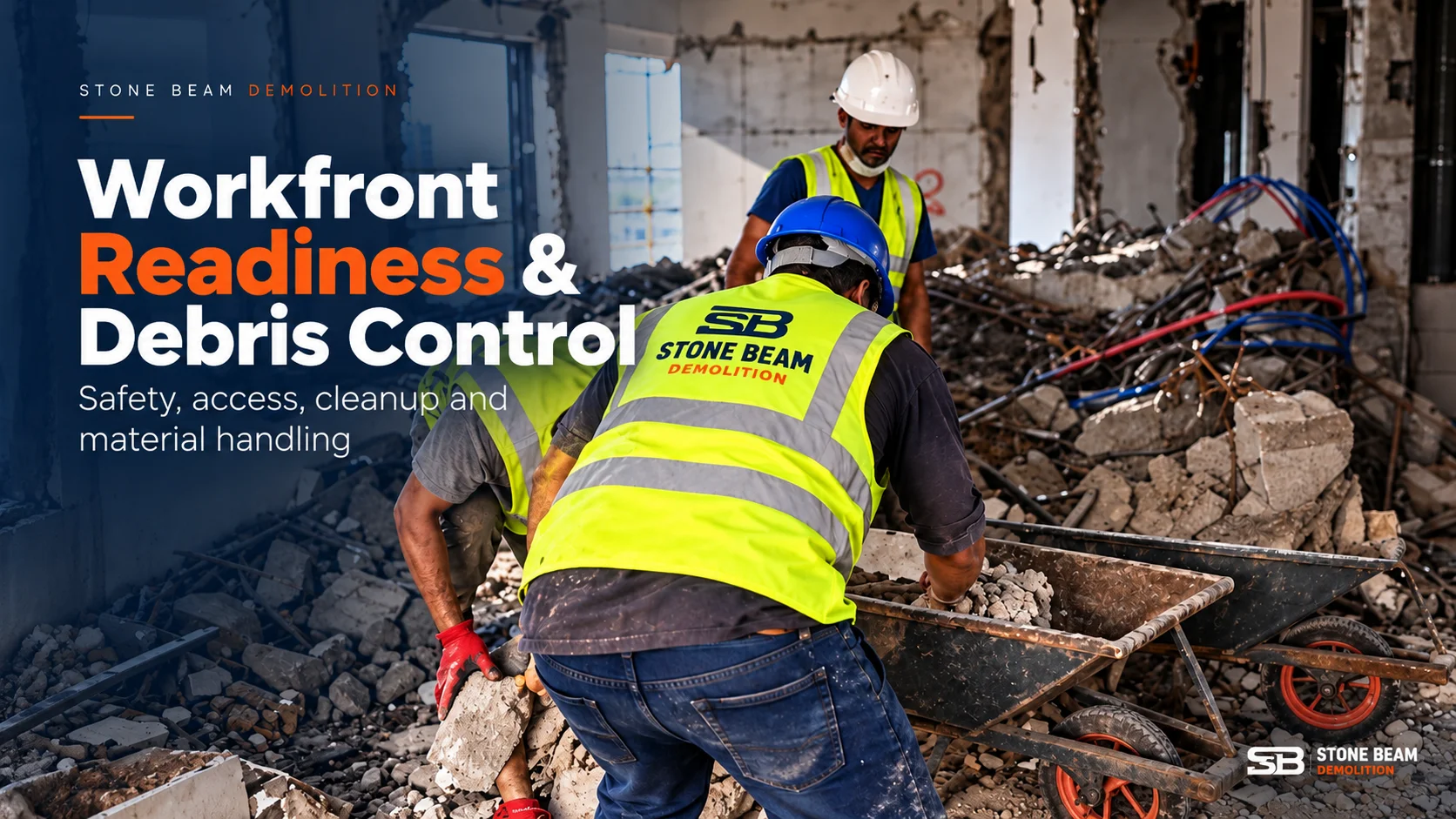
Plan the debris journey as segregation → controlled loading → authorised transport → permitted destination. We separate demolition debris on site and load it under control. We coordinate the licensed waste carrier for covered and registered transport to designated facilities; that role is distinct from operating the carrier or receiving facility.
Dubai’s Law No. 18 of 2024 Regulating Waste Management sets the broader framework for waste-management roles in the emirate. Dubai Municipality’s Technical Guideline No. 3 on C&D Waste Collection and Transportation addresses the licensed waste-collection and transport activity, including relevant third-party transport arrangements and vehicle registration. The project team should confirm the carrier’s current authorisation, vehicle arrangements, and destination; the transport records belong in the agreed close-out requirements. For the detailed process, see demolition waste management.
How long does demolition take in Dubai? Approvals vs physical work
Separate readiness time from site delivery time. An estimated authority processing period describes one part of readiness; the actual demolition programme also depends on investigations, utility status, structural decisions, access, removal method, debris movements and the agreed final condition.
| Programme clock | Includes | Useful completion evidence |
|---|---|---|
| A — Surveys, decisions and approvals | Drawings, condition surveys, investigations, method review, NOCs, permissions and access preparation | Required records and authorisations for the defined workfront |
| B — Physical works and close-out | Mobilisation, permitted removal, debris movements, inspections, changes and handover | Agreed final condition and contractual or authority close-out documents |
Some independent preparations can run alongside one another, while an unresolved structural issue can change the planned start for its workfront. Ask tenderers to show the assumptions connecting both clocks rather than offering an unsupported universal number of weeks.
What proof should a demolition contractor provide?
Start with the legal entity, licensed activities, relevant practice-permit category, and a checkable work record. Then ask whether the proof actually relates to the service, building type, and project stage being discussed.
Stone Beam completed the demolition of a parking building in Dubai Investment Park 2, closed out with a Dubai Municipality completion certificate dated 29 July 2026. The authority certificate confirms completion of that defined demolition scope.
For our company qualification information, visit Stone Beam’s demolition company page. The distinction between a contractor’s practice permit and a building’s project-specific demolition permit remains important when comparing tenders.
What should you send for a demolition method review and quotation?
A useful request gives a contractor enough information to identify the likely approach, unresolved interfaces, and comparable scope. Send what you have; mark missing items rather than assuming they are settled.
| RFQ item | What to send | Why it changes the proposal |
|---|---|---|
| Project location | Plot/development and authority if known | Jurisdiction and access assumptions |
| Building information | Type, floors, approximate footprint in m², basements and foundations | Structural and logistics screening |
| Current drawings | Structural, architectural and relevant as-built revisions | Reliability of existing information |
| Removal boundary | Marked REMOVE / RETAIN / PROTECT drawings | Physical scope and retained assets |
| Special conditions | PT, structural alterations, existing damage or unknown services | Specialist decisions and investigation |
| Occupation and neighbours | Live tenants, sensitive boundaries, operating hours and public access | Protection and working windows |
| Plant and debris access | Entrances, loading points, vehicle routes, restricted areas | Feasibility of handling and transport |
| Approvals and reports | Available surveys, NOCs, permits, consultant comments | What is ready and what remains open |
| Final condition | Waste responsibilities, handover records and clearance boundary | Comparable quotations and close-out |
Request a demolition method review from Stone Beam. We assess building-demolition, interior strip-out, concrete cutting, scanning and core-drilling scopes, and prepare method statements and risk assessments for consultant review. Send your project details and drawings so the technical discussion addresses your actual constraints.
Frequently asked questions
What is the difference between selective and full demolition?
Full demolition removes the defined structure; selective demolition protects designated elements while others are removed. The retained boundary, stability assessment, occupied neighbours and handover condition determine the appropriate method. Controlled demolition provides the service-specific detail.
Does controlled demolition involve explosives?
Controlled demolition usually describes engineered removal using mechanical, robotic, cutting or dismantling methods. Explosive demolition is a separate specialist category with its own approval considerations; it is not a Stone Beam service.
When is a demolition robot preferable to an excavator?
Remote-controlled equipment is worth assessing when operator positioning or restricted access makes conventional plant less suitable. The supporting structure, equipment route, services and handling arrangements still decide feasibility.
When is GPR scanning needed before concrete cutting?
GPR scanning helps investigate concealed reinforcement, services and relevant features before a proposed opening. Its report informs the responsible engineer’s decision; the scan itself does not approve a structural alteration. Read about concrete scanning.
How is the demolition programme calculated?
Build a programme from two parts: readiness/approvals and physical demolition/close-out. Combine the actual scope and access with the applicable authority route, specialist reviews and debris arrangements instead of borrowing another project’s duration.
What determines the cost of advanced demolition?
The price follows the scope and constraints: retained structure, method, specialist reviews, access, protection, waste transport and final handover. Compare tender inclusions and exclusions on the same basis. Official permit fees are separate from the contractor’s quotation; see the quotation comparison guide.
About the author
Eng. Awad Ashour, Founder & CEO, is a civil engineer with more than 15 years of demolition experience in the UAE. His experience informs Stone Beam’s engineering-led approach to demolition planning, method selection, consultant submissions and workfront interfaces.
Official references
- Dubai Development Authority — Demolition Permit. Service requirements, DDA fees and estimated processing time; checked 28 October 2026.
- Dubai Electricity and Water Authority — Demolishing Permits, Electricity/Water. Utility application, published charge and combined approval target; checked 28 October 2026.
- Dubai Municipality — Safety Guide for Construction Works. Technical safety framework for demolition; source register reviewed 26 October 2026.
- Government of Dubai — Law No. 18 of 2024 Regulating Waste Management. Waste-management scope and roles; checked 28 October 2026.
- Dubai Municipality — Technical Guideline No. 3: C&D Waste Collection and Transportation. Licensed carrier/third-party transport scope, vehicle registration, and movement records (particularly scope and general provisions); checked 28 October 2026.