


The difference between demolition and strip-out is the agreed removal boundary. Strip-out removes specified interior fit-out while retaining the designated structure. Selective demolition removes defined building parts, potentially structural, under engineering controls. Full demolition removes the structure specified in the approved scope. Dubai approvals depend on the actual intervention and plot jurisdiction.
For a tenant, landlord or consultant, the most useful question is not whether a BOQ says demolition. It is whether the work affects structural stability, shared building systems or a handover obligation. Stone Beam’s documented work includes both a completed building-demolition project and an appointed occupied-building strip-out package; their different evidence and scope boundaries are explained below.
Which Scope Are You Buying? Use This Four-Question Decision Gate
Start with the intended handover condition, then answer these four questions before requesting prices. The decision gate classifies the RFQ; it cannot replace a structural assessment, authority decision or workfront release.

- Will the entire specified building or structure be removed? If yes, define a full-demolition package, including exactly which foundations, basements and external works are in scope. If part will remain, go to the next question.
- Are you removing only finishes, fittings and confirmed non-structural components? If yes, an interior strip-out may be the appropriate base scope. Identify all retained building services, interfaces and the handover condition.
- Will an existing structural element be cut, altered or removed? If yes, establish a separate selective-demolition or building-modification interface. The appointed structural engineer determines the design and release requirements; the competent authority determines the applicable permit route.
- Is the element’s role uncertain, or will others occupy the property during the work? If yes, record the uncertainty rather than guessing. Obtain the available drawings and the responsible engineer’s assessment, and agree the building-management controls before defining the workfront.
A refurbishment contract can contain both work types. Classify the clear non-structural items now; list uncertain or structural items separately as HOLD — engineer/authority decision pending. If the removal is principally interior fit-out, see Stone Beam’s interior strip-out service, which explains the service rather than the classification decision.
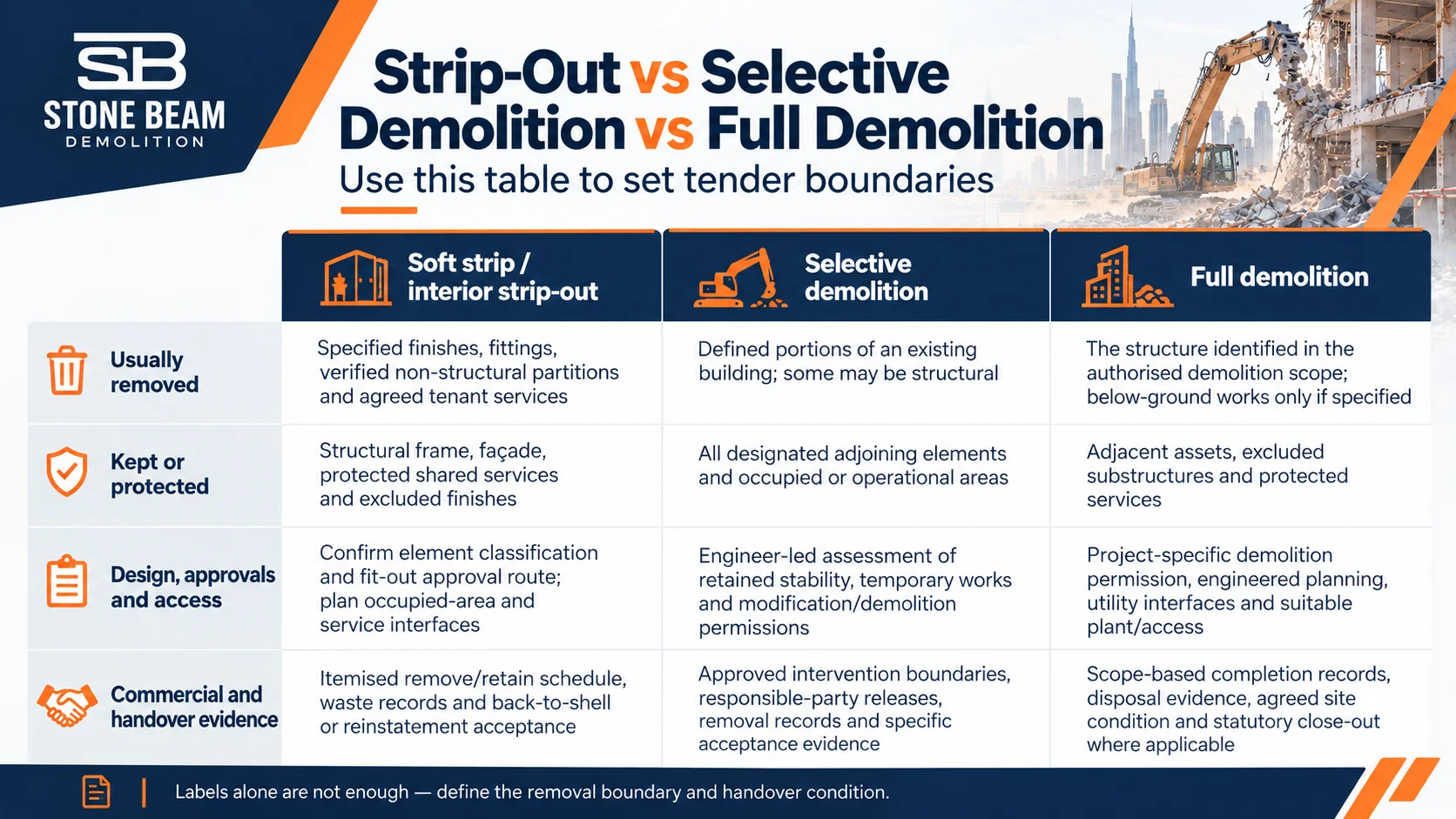
Strip-Out vs Selective Demolition vs Full Demolition
Use this table to set tender boundaries. Descriptions such as soft strip, Cat A/Cat B removal, shell and core and back to shell only become reliable when the relevant lease, drawings and handover schedule explain what they mean for that property.
| Work type | Usually removed | Kept or protected | Design, approvals and access | Commercial and handover evidence |
|---|---|---|---|---|
| Soft strip / interior strip-out | Specified finishes, fittings, verified non-structural partitions and agreed tenant services | Structural frame, façade, protected shared services and excluded finishes | Confirm element classification and the building/fit-out approval route; plan work in occupied areas and service interfaces | Itemised remove/retain schedule, agreed waste records and back-to-shell or reinstatement acceptance |
| Selective demolition | Defined portions of an existing building; some may be structural | All designated adjoining elements and occupied or operational areas | Engineer-led assessment of retained stability, any temporary works and the applicable modification/demolition permissions | Approved intervention boundaries, responsible-party releases, removal records and specific acceptance evidence |
| Full demolition | The structure identified in the authorised demolition scope; below-ground works only if specified | Adjacent assets, excluded substructures and protected services | Project-specific demolition permission, engineered planning, utility interfaces and suitable plant/access | Scope-based completion records, disposal evidence, agreed site condition and statutory close-out where applicable |
The term interior demolition can describe anything from tenant fit-out removal to structural alterations. It should therefore never replace a marked-up schedule showing exactly what is removed, retained, protected and handed over. For a whole-building contract, the appropriate commercial page is building demolition in Dubai.
Where Does Strip-Out Become Demolition? The Grey-Zone Register
The boundary is not always visible. An item that looks like a finish or partition may also protect a shared service, fire compartment or structural element, so unresolved items must be separated from the released strip-out scope.
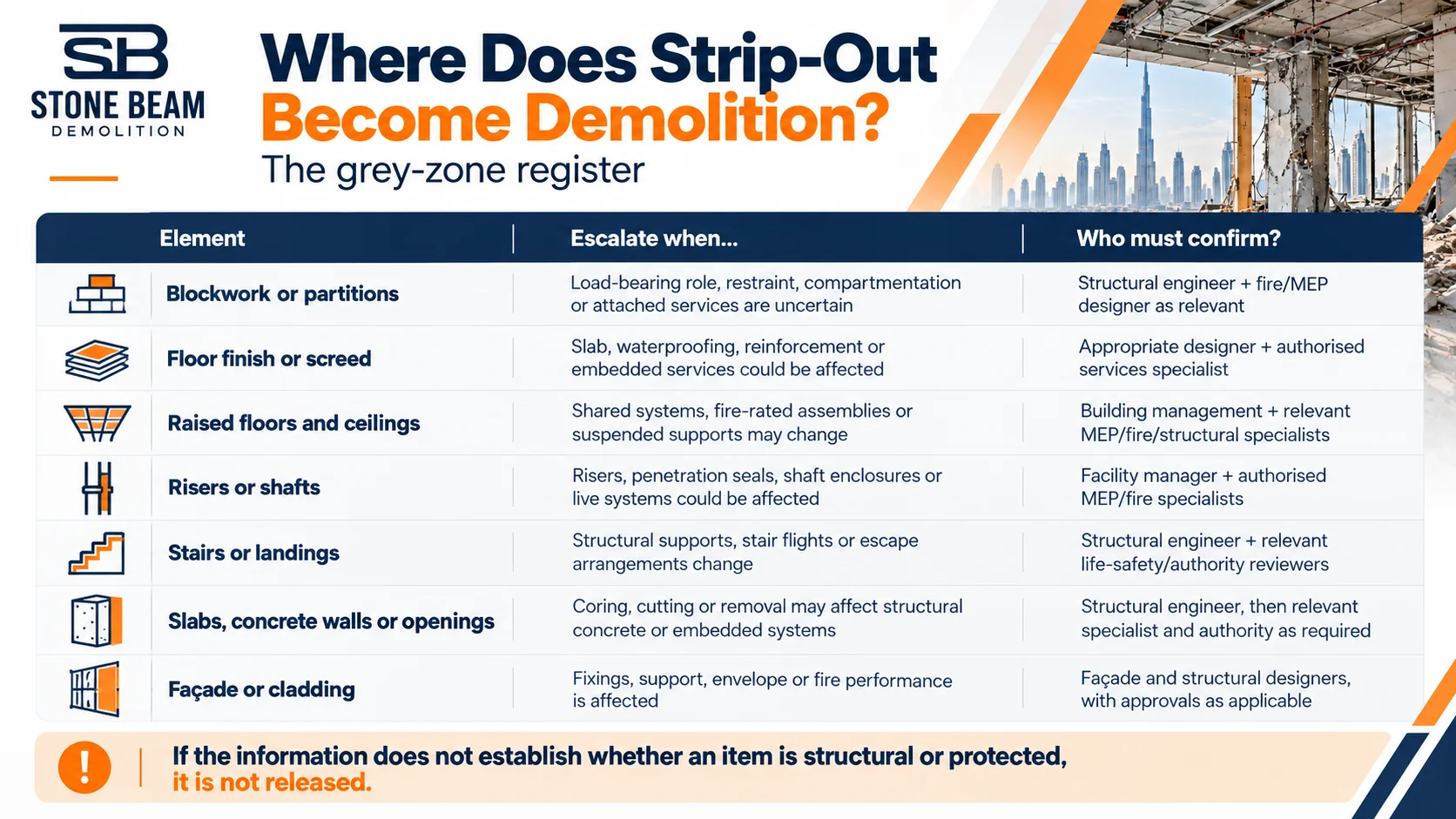
| Element | Usually fits strip-out when… | Escalate when… | Who must confirm? |
|---|---|---|---|
| Blockwork or partitions | Documented as non-load-bearing, with connected services identified | Its load-bearing role, restraint, compartmentation or attached services are uncertain | Structural engineer, plus fire/MEP designer as relevant |
| Floor finish or screed | Removal is limited to an agreed non-structural layer | The slab, waterproofing, reinforcement or embedded services could be affected | Appropriate designer and authorised services specialist |
| Raised floors and ceilings | Only identified tenant components will go | Shared systems, fire-rated assemblies or suspended supports may change | Building management and relevant MEP/fire/structural specialists |
| Risers or shafts | Identified tenant-side fittings can be removed without disturbing shared systems | Risers, penetration seals, shaft enclosures or live systems could be affected | Facility manager and authorised MEP/fire specialists |
| Stairs or landings | Only separately identified finishes or fittings are removed | Structural supports, stair flights or escape arrangements change | Structural engineer and relevant life-safety/authority reviewers |
| Slabs, concrete walls or openings | Work is limited to a verified surface finish | Coring, cutting or removal may affect structural concrete or embedded systems | Structural engineer, then the relevant specialist and authority as required |
| Façade or cladding | A specifically assessed removable finish has an agreed retention/protection plan | Fixings, support, envelope or fire performance is affected | Façade and structural designers, with building/authority approvals as applicable |
Decision rule: if the information does not establish whether an item is structural or protected, the item is not released merely because it is called a partition or finish. A scan can reduce uncertainty within its coverage, but it does not replace an engineer’s design decision or authorise an intrusive cut. Read more about the concrete-cutting interface where an approved intervention is part of the work.
Three Dubai Scope Scenarios That Change the Decision
Consider three typical RFQ situations. Office handover: “blockwork demolition” may mean verified non-load-bearing partitions, so it can belong to an agreed strip-out. Restaurant refurbishment: finishes and screed may be non-structural, but a new slab opening is a separate engineered intervention. Partial building retention: removing one wing while keeping another is selective demolition, not an unrestricted strip-out. These are illustrative classification examples, not claims about completed Stone Beam projects.
For every disputed element, keep a scope classification record: location → remove/retain/protect/isolate → drawing or site evidence → responsible designer → required approval/release → handover proof. If the evidence is missing, mark the element HOLD or a clearly described provisional item. State the variation trigger for concealed conditions; this prevents an undefined structural obligation being buried in a lump-sum strip-out quotation.
Do You Need a Permit for Strip-Out or Demolition in Dubai?
Do not assume strip-out is permit-free. First establish the plot’s competent authority and the building operator’s requirements; then classify the work. An owner’s, developer’s or building-management NOC can form part of the process but does not automatically replace an authority permit.
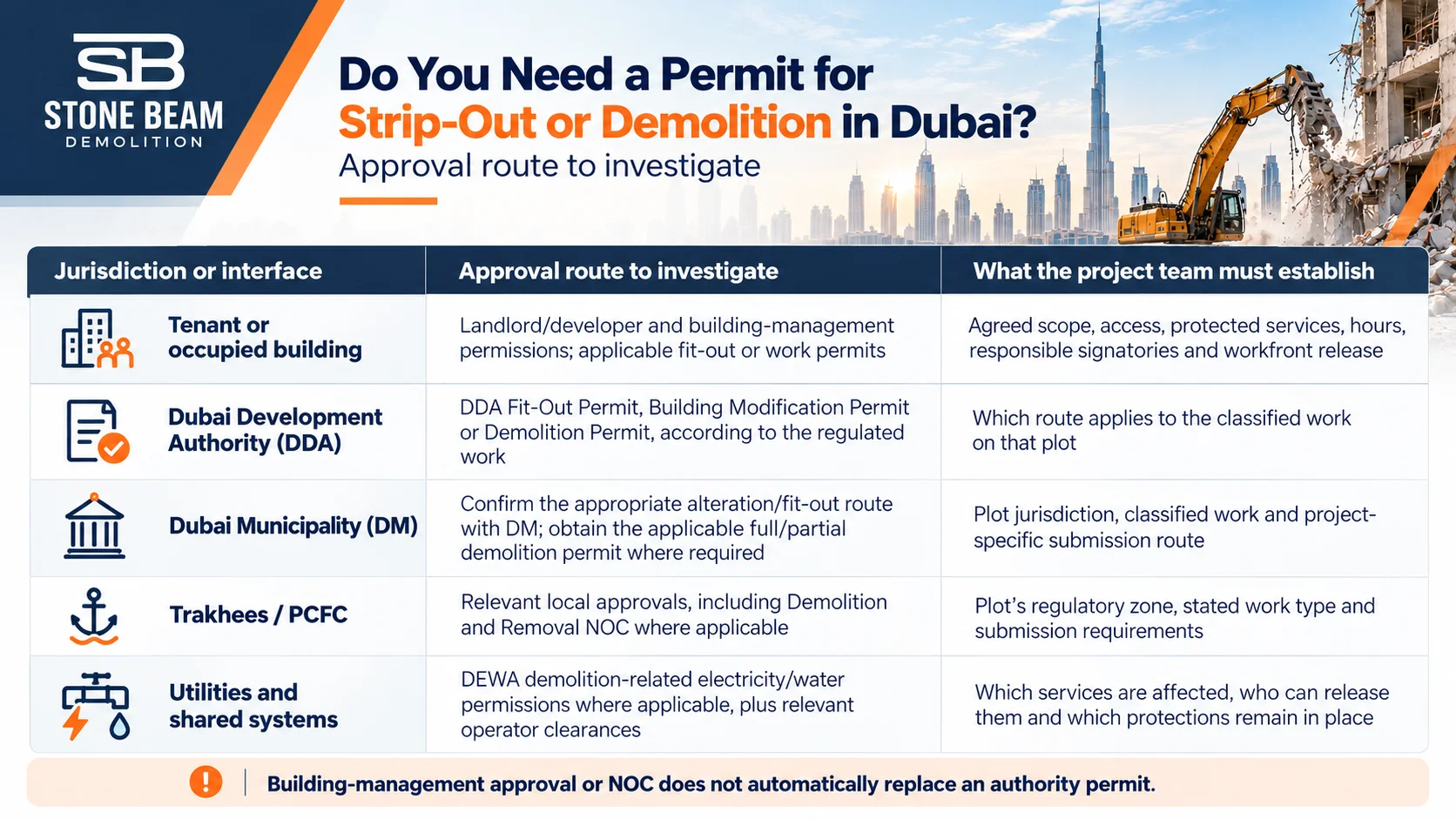
| Jurisdiction or interface | Approval route to investigate | What the project team must establish |
|---|---|---|
| Tenant or occupied building | Landlord/developer and building-management permissions; applicable fit-out or work permits | Agreed scope, access, protected services, hours, responsible signatories and workfront release |
| Dubai Development Authority (DDA) | DDA Fit-Out Permit, Building Modification Permit or Demolition Permit, according to the regulated work | DDA’s fit-out route covers applicable fit-out works; its modification route addresses relevant changes to a completed building; its demolition route concerns structural demolition |
| Dubai Municipality (DM) | Confirm the appropriate alteration/fit-out route with DM; obtain the applicable full/partial demolition permit where the work requires it | The plot jurisdiction, classified work and project-specific submission route |
| Trakhees / PCFC | Relevant local approvals, including Demolition and Removal NOC where applicable | Plot’s regulatory zone, the stated work type and the authority’s submission requirements |
| Utilities and shared systems | DEWA demolition-related electricity/water permissions where applicable, plus relevant operator clearances | Which services are affected, who has authority to release them and which protections remain in place |
DDA explicitly distinguishes its Fit-Out Permit, Building Modification Permit and Demolition Permit. These services belong to DDA-regulated properties; they do not create a universal Dubai permit rule. Dubai Municipality lists a permit for full or partial demolition, while Trakhees operates a demolition-and-removal NOC service for its jurisdiction.
DEWA’s demolition-permission process concerns the relevant electricity/water interface. Its route differs between DM projects integrated with the Dubai Building Permit System and other authority projects; in either case, a utility clearance is not itself a building-demolition permit. For project-specific steps, consult the Dubai demolition-permit guide and the competent authority. A lease instruction or company practice permit does not substitute for the project permit.
How Do Access, Equipment and Waste Logistics Differ?
In an occupied building, the critical questions are who protects shared areas, who books the service lift, who moves bagged material, and who accepts the loading-area handover. Specify access windows, corridor protection, debris containment, staging and truck-loading responsibility in the RFQ. These interfaces can drive scope and cost even when the structural frame remains untouched.
Stone Beam has been appointed, rather than documented as having completed the work, for non-structural strip-out inside an occupied residential tower. The appointed scope covers specified partitions, ceilings, floor finishes and wet areas while retaining identified air-handling, fire-protection and façade systems. The planned debris route uses bagging and service-lift movements subject to building arrangements; the appointment does not demonstrate final completion, production rates or acceptance.
Stone Beam has separately been engaged for manual partition and blockwork demolition on an upper floor of an occupied commercial tower. The work-order scope identifies bagging, lift movement and basement-level loading. That record demonstrates a logistics interface at appointment stage, not that the works were delivered or accepted.
For a vacant building, the contractor may select different mechanical or manual methods after assessing access, neighbouring assets, retention and site stability. “Vacant” does not mean “unrestricted”; an engineered approach, applicable permissions and a managed waste route are still required.
What if Hazardous Materials Are Suspected?
Stone Beam does not provide asbestos removal. A suitably authorised specialist must survey and, where necessary, manage and remove suspected asbestos before the affected work is released. Other hazardous-material interfaces likewise require competent specialist assessment rather than assumptions based on an ordinary strip-out inspection.
The scope of the survey must reflect the actual disturbance proposed and state inaccessible areas or limitations. The UK Health and Safety Executive’s asbestos survey guidance offers comparative UK context on selecting an appropriate survey; it does not establish Dubai licensing, sampling or removal requirements. Confirm the local requirements with the competent authority and appointed specialist.
How Does Handover Differ: Back-to-Shell or Cleared Site?
A back-to-shell requirement means the contractually specified interior condition, not a universal instruction to remove every screed, ceiling or tenant service. The lease and handover schedule must identify items that remain, services that are protected, the cleanliness standard and the party who signs acceptance. A landlord’s reinstatement acceptance should be distinguished from a regulatory completion certificate when one is required.
For full demolition, define whether below-ground structures, foundations, boundary works, debris removal, grading or other site conditions are included. Do not infer that a cleared plot includes backfilling or site preparation; those require their own expressly agreed scope and appropriately authorised delivery arrangements. Dubai Development Authority, for example, lists a separate Demolition Completion process.
Completed Stone Beam example: Stone Beam demolished a parking building in Dubai Investment Park 2, with a Dubai Municipality completion certificate dated 29 July 2026. This is evidence of completion of that demolition scope, but not evidence of a particular programme duration, debris quantity, recycling percentage or other undocumented project outcome.
For either type of work, identify the waste handoffs: workfront segregation → internal transfer → loading → authorised carrier → destination record. Name the responsible party and the required ticket or receipt at each contracted handoff. Dubai’s Law No. 18 of 2024 Regulating Waste Management addresses waste-producer and carrier responsibilities. A target for reuse or recycling must not be presented as an achieved result. See our demolition waste disposal guide for the disposal-scope interface.
Is Strip-Out Sometimes the First Stage of Demolition?
Yes, it can be — but it can also be a complete stand-alone project. A full-demolition plan may include the removal of agreed fittings and fit-out before the main structural demolition works. An office tenant, by contrast, may commission strip-out solely to restore leased space while the building remains occupied and operational.
Price depends on comparable scope, not labels. Important cost drivers include the extent of structural work, engineering approvals, occupied-building restrictions, vertical movement, protection, specialist interfaces, equipment access, transport and required handover records. A low area-based rate can be misleading if another quotation includes waste transport, lift access or reinstatement that the first excludes.
Time also has two clocks: pre-start readiness (surveys, decisions, permissions and access) and the actual execution period after workfront release. An authority’s service target or the date on a completion certificate does not prove how long demolition physically took. Our strip-out cost guide explains the factors without relying on unsupported Dubai market-rate averages.
What Should Be Included in a Strip-Out or Demolition RFQ?
Ask bidders to price the same defined removal boundary and handover condition. Provide the following inputs, with unknowns expressly marked as pending rather than silently included.
- Property and jurisdiction: address or plot reference, building use, occupied floors, competent authority and management/developer restrictions.
- Drawings and element register: architectural, structural and MEP information; marked-up removal, retention and protection limits; disputed structural items for engineer review.
- Services and specialists: retained electrical, water, HVAC and fire systems; who obtains the required releases; hazardous-material survey status and exclusions.
- Site access and waste: permitted working periods, lift and loading arrangements, dust/noise controls, waste streams, carrier and disposal responsibility and required movement evidence.
- Handover and tender basis: room-by-room or element-based acceptance criteria, approvals already held, exclusions, provisional or optional items, responsible signatories and variation triggers.
For comparable quotations, ask each bidder to mark every disputed item included, excluded, provisional or by others, and to identify who arranges designer approval, access equipment, lifting, transport and handover sign-off. One contract can contain both work types, but structural interventions must remain separately identified and subject to the relevant engineering and authority releases. Stone Beam can review the defined scope and identify information still needed to price it.
Frequently Asked Questions
What is a soft strip?
A soft strip removes agreed non-structural contents and fit-out, often ahead of refurbishment or a wider demolition project. Typical items include finishes, fittings and verified internal partitions. The client must specify the retained base-build systems and handover condition; calling the work “soft” does not mean hazardous materials or structural interfaces can be ignored. Any suspect item remains on hold until appropriately assessed.
Is removing an internal block wall always strip-out?
No. Some blockwork is verified non-load-bearing infill, but it may still enclose a fire-rated area, conceal services or perform another important function. The designer and relevant specialists must establish the wall’s role before removal. A contractor should identify the exact location and record any unresolved condition rather than treating all blockwork as interchangeable.
Can strip-out happen while other tenants occupy the building?
It may be possible with the building operator’s consent and project-specific controls. Agree access periods, protection, waste routes, shared-system boundaries and the process for approving each workfront. Restrictions on service lifts, loading and noise can materially affect the programme and quotation. Occupancy also increases the importance of identifying who authorises isolation or protection of shared services.
Is strip-out cheaper than full demolition?
There is no defensible universal comparison without matching the scope. Strip-out generally excludes removal of the main structure, whereas full demolition adds structural, plant, clearance and approval interfaces. However, difficult occupied-building logistics and reinstatement requirements can materially change a strip-out quotation. Compare inclusions, exclusions and the agreed handover instead of relying on an unsupported average price per square metre.
Can strip-out and selective demolition be awarded under one contract?
Yes, if the BOQ and method responsibilities separate non-structural removal from engineered interventions. The contract should identify which party supplies design information, applies for permissions, obtains specialist releases, handles materials and signs acceptance. A combined contract does not by itself authorise intrusive cutting or structural removal. These activities must stay on hold until the relevant conditions are satisfied.
Does back-to-shell require removing every MEP component?
No. A landlord may require tenant fixtures or connections to go while retaining base-build cooling, firefighting, risers or other shared systems. The handover schedule should list each service to retain, remove, protect or isolate and state the required evidence. Without those boundaries, two contractors can interpret “back to shell” differently and submit non-comparable bids.
References and Scope Note
Regulatory and technical sources checked: 10 October 2026. Confirm the applicable authority and latest conditions for the actual plot and proposed works. The UK source below is comparative guidance, not UAE law.
- Dubai Municipality — Dubai Municipality Services (Demolishing Works Permit) — official; DM jurisdiction.
- Dubai Development Authority — Fit-Out Permit — official; DDA jurisdiction.
- Dubai Development Authority — Building Modification Permit — official; DDA jurisdiction.
- Dubai Development Authority — Demolition Permit — official; DDA jurisdiction.
- Dubai Development Authority — Demolition Completion — official; DDA jurisdiction.
- Trakhees / PCFC — Demolition and Removal NOC — official; Trakhees jurisdiction.
- DEWA — Demolishing Permits, Electricity/Water — official; utility interface.
- Government of Dubai — Law No. 18 of 2024 Regulating Waste Management — official; waste duties.
- UK Health and Safety Executive — Arrange an Asbestos Survey — comparative technical guidance (United Kingdom).
Planning a demolition, strip-out or cutting package in Dubai? Send us your drawings, the scope you want removed and retained, site access details and your target handover condition. Our engineering team will review the inputs and come back with the questions and information needed to price the defined scope. Request a review