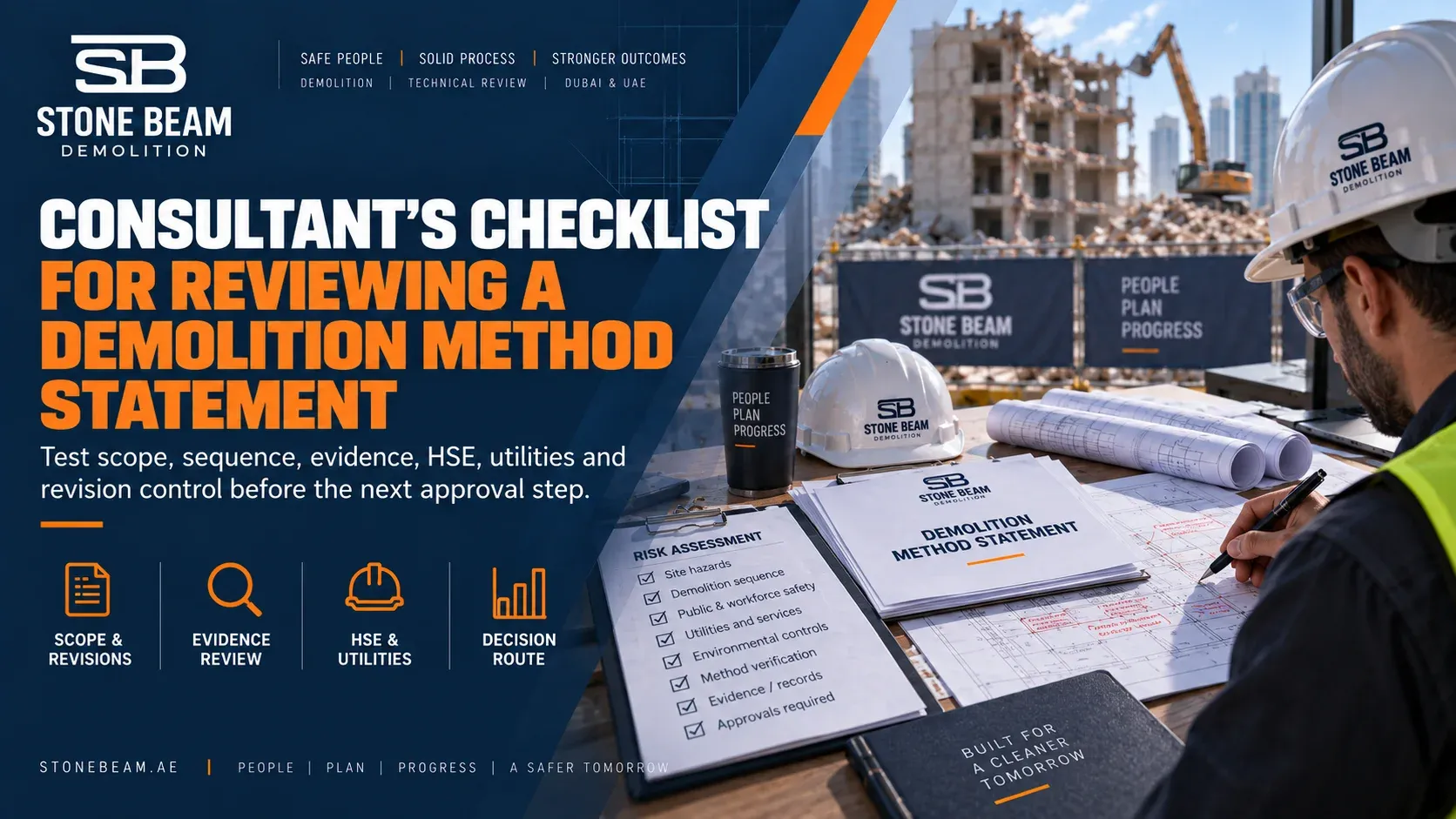

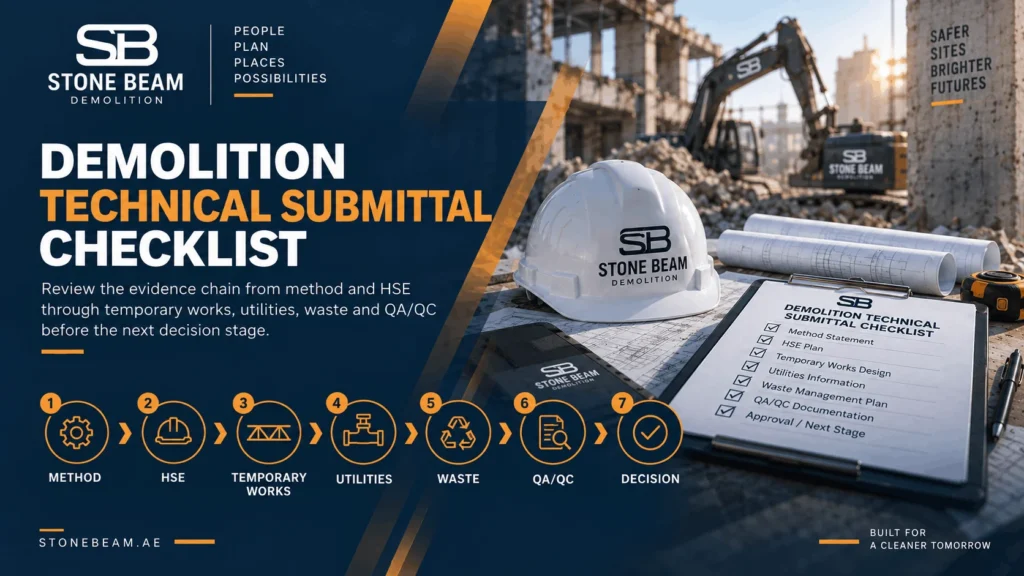
A demolition technical submittal is the project-specific evidence package used to show how the proposed demolition scope will be planned, controlled, checked and documented. A reviewer does not approve it because the files are present; each document must match the latest scope, drawings, risks, responsibilities and release conditions, with unresolved interfaces recorded before work starts.
In Dubai, the exact package is not universal. Requirements change with jurisdiction, contract, method and site interfaces. For example, Dubai Development Authority’s demolition-permit service lists a method statement, specific HSE and emergency plan, risk assessments, relevant NOCs, hoarding information, a neighbour-impact study and site photographs for DDA projects.
Other Dubai routes are authority-specific. Dubai Municipality’s Demolishing Works Permit service and Trakhees / PCFC’s Demolition and Removal NOC route are separate jurisdiction examples, not one universal citywide checklist.
Practical rule: review the package as an evidence chain, not as a folder count.
Prepared by Stone Beam Technical Services L.L.C.
What is a demolition technical submittal?
A demolition technical submittal is a controlled package of documents used to explain and evidence the proposed demolition approach for a defined scope. It connects the method, HSE records, current drawings, specialist interfaces, environmental controls, inspection records and responsibilities so the reviewer can judge whether the submission is coherent and ready for the next review stage.
It is not the same as contractor prequalification, an authority permit or permission to start work. Those decisions use different evidence and sit with different parties.
| Decision stage | Primary question | Typical evidence | What it does not prove |
|---|---|---|---|
| Prequalification | Is the organisation eligible and capable enough to be considered? | Corporate credentials, experience, insurance, resources, management systems | That the proposed project method is acceptable. |
| Technical submittal review | Does the proposed package coherently address this scope and its interfaces? | Method, HSE, drawings, specialist-interface records, waste, QA/QC, responsibilities | That authority or workface releases are closed. |
| Authority / utility approval | Has the relevant authority or utility accepted its required submission or interface? | Authority-specific applications, NOCs, service records | That every contractual or technical interface is closed. |
| Workface release | Are the required pre-start conditions closed for the defined work area? | Accepted documents plus permits, isolations, access and site release records | That later conditions cannot change. |
What should a demolition technical submittal include?
A useful demolition technical submittal contains enough linked evidence to let the reviewer trace the proposed work from scope to document control, interface ownership and inspection records. The exact document set comes from the contract, jurisdiction and project requirements, but the review normally tests these evidence categories:
- Controlled document index and revision register tied to the latest scope, drawings and comments.
- Method statement and drawings that define the current scope limits, work areas, interfaces, access logic and document revisions.
- HSE documentation that is clearly tied to the same scope, work areas, revisions and responsible roles as the method submission.
- Specialist engineering or design-interface records where the project requires a separate design, check or acceptance route. This checklist verifies the record path only; it does not assess design adequacy.
- Utility and live-service records identifying the interfaces, status documents and external releases that the project requires before the relevant work area can proceed.
- Waste, environmental and logistics controls covering segregation, loading, transport, receiving route and records expected by the project.
- QA/QC evidence such as the inspection and test plan, hold/witness points, checklists, records and close-out requirements.
- Responsibility, competence and supporting records that show who prepares, checks, coordinates, accepts and closes each part of the package.
Original decision visual – Submission Status Ladder
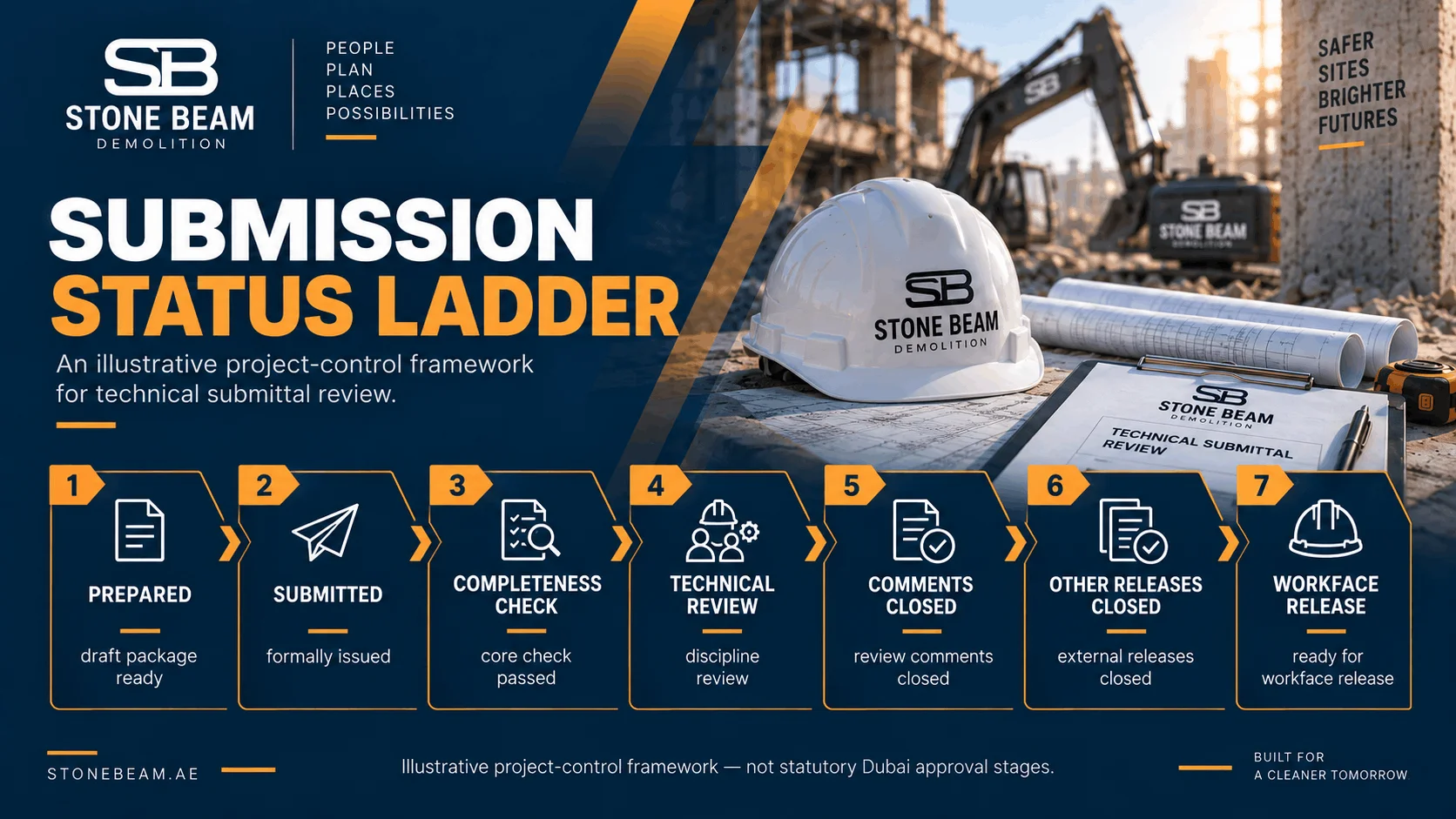
| Prepared | Submitted | Completeness check |
Technical review |
Comments closed |
Other releases closed |
Workface release |
|---|
Illustrative project-control framework. These are not names of statutory Dubai approval stages.
For the commercial service context behind these submissions, see Stone Beam’s demolition company in Dubai page. This article stays focused on the technical evidence package rather than contractor selection or sales claims.
How should Method, HSE, Specialist Interfaces, Waste and QA/QC be reviewed together?
The strongest review tests cross-document consistency. A method that refers to one scope or revision while the HSE, drawings or inspection records refer to another is not a complete evidence chain. The same applies when a specialist interface is referenced but no responsible reviewer or accepted project record is identified, or when the waste plan does not match the stated logistics.
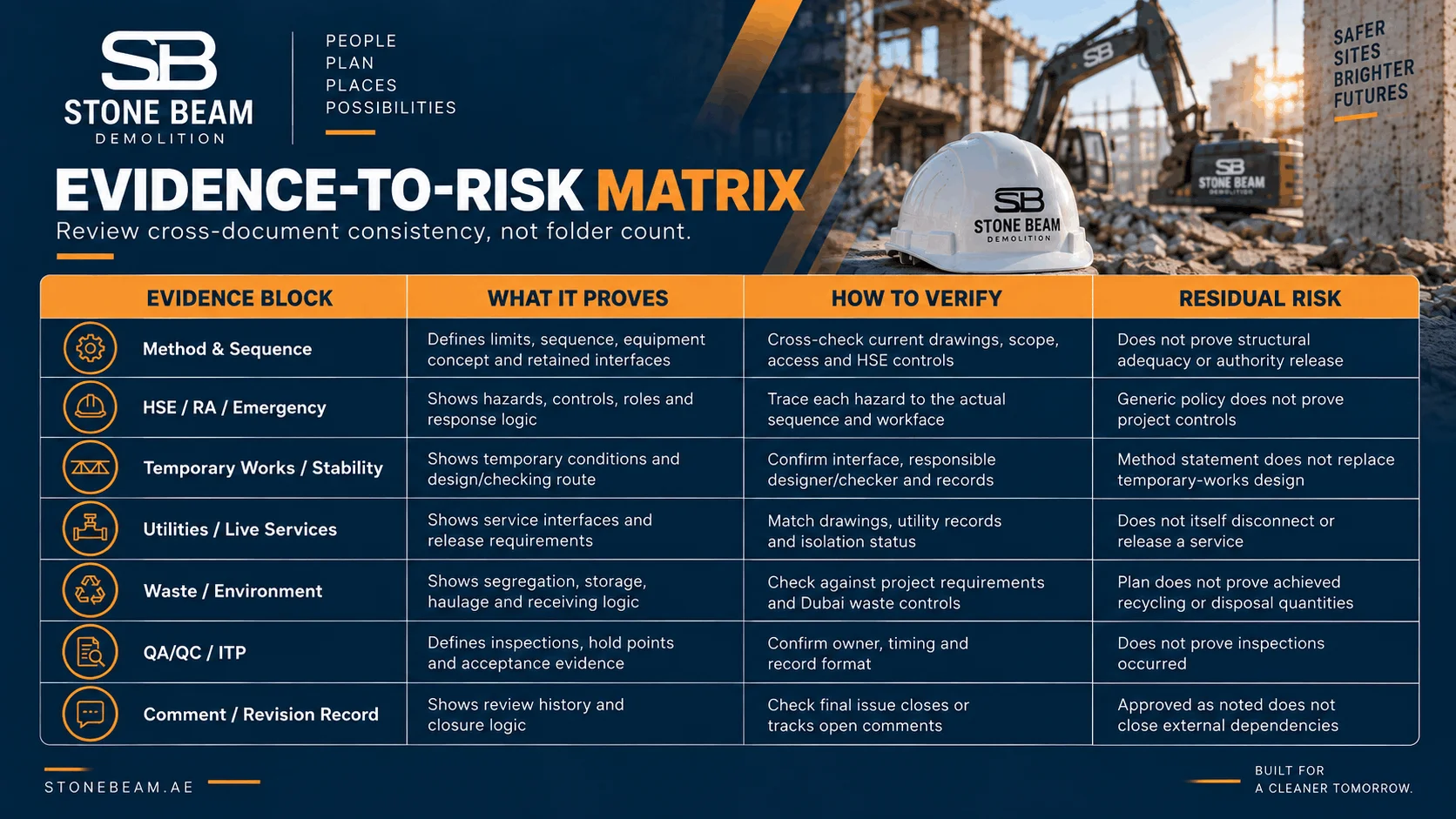
Evidence-to-Risk Matrix
| Evidence block | What it proves | How to verify | Residual risk / what it does not prove |
|---|---|---|---|
| Method & sequence | Defines the submitted scope, work areas, current revisions and stated execution approach. | Cross-check against the current scope, drawings, document index and interface records. | Presence alone does not prove design adequacy, authority release or permission to start work. |
| HSE / RA / emergency | Shows the HSE documents submitted for the same scope, work areas and responsible roles. | Check that HSE records reference the same scope and document revisions as the technical package. | This checklist does not assess the adequacy of site controls or replace competent HSE review where the project requires it. |
| Specialist engineering interface | Shows that a project-required specialist design/check/acceptance interface has an identified owner and record path. | Confirm the responsible specialist role and the project record or status that closes the interface. | A document index does not prove the technical adequacy of the underlying design or specialist decision. |
| Utilities / live services | Shows the utility or live-service documents and external status records identified by the project. | Match the submission to the current utility/interface record and responsible release route. | A technical submission does not itself disconnect, isolate or release a service. |
| Waste / environment | Shows segregation, storage, haulage, receiving and record expectations. | Check the route against project requirements and relevant Dubai waste controls. | A plan does not prove achieved recycling or disposal quantities. |
| QA/QC / ITP | Defines inspections, acceptance evidence, hold points and close-out records. | Confirm each control has a responsible party, timing and record form. | An ITP does not prove inspections have occurred before records exist. |
| Competence / resources | Connects the planned work to competent roles and required resources. | Check role relevance, validity and alignment with the proposed method. | A CV, certificate or plant list does not prove the method is suitable. |
| Comment / revision record | Shows review history and closure of comments. | Check that the final issue closes or tracks each open comment without silent scope change. | “Approved as noted” does not automatically close external dependencies. |
Method and document alignment
Check that the method statement, drawings and document index refer to the same scope limits, work areas and current revisions. This checklist does not evaluate structural adequacy, demolition sequence design or engineering calculations; those remain with the competent project reviewers appointed for that scope.
HSE document alignment
Check that the HSE documents clearly relate to the same submitted scope, work areas, revision set and responsible roles. This article does not prescribe permit-to-work, emergency, exclusion-zone, PPE/RPE, monitoring or hazardous-work controls.
Specialist engineering interfaces
Where the project requires a separate engineering, design or specialist-review record, the document reviewer checks only that the responsible role, record and review status are visible in the package. The technical adequacy of that specialist work remains outside this checklist.
Waste and environmental controls
Waste evidence is stronger when the submission links segregation, storage, haulage, receiving route and close-out records to the actual demolition flow. Dubai Municipality’s Waste and Sewerage Agency technical-guidelines index includes current construction-and-demolition waste guidance for Dubai. Project and jurisdiction requirements still control the exact records.
For deeper waste-management context, use the construction and demolition waste guide rather than expanding this checklist into a waste-operations article.
QA/QC and close-out evidence
QA/QC is the evidence trail that shows how the project checks work against its accepted requirements. The ITP, checklists, inspection records, comment register and handover records need clear owners and timing. A blank form demonstrates a proposed control format; it does not prove an inspection happened.
How do you check whether a demolition submittal is project-specific?
Use a consistency review rather than a document-count review. This is a whole-package coherence test, not a method-statement-only review. The sequence below is designed for consultant, main-contractor and owner-side review teams:
- Freeze the reviewed scope: identify the work area, exclusions, protected or retained assets, handover condition and latest document/drawing set.
- Check revision control: confirm the same current drawing and document revisions appear across the method, risk assessment, ITP and supporting schedules.
- Trace the package: follow each submitted work stage through its HSE document reference, specialist-interface record where required, logistics/debris record and inspection evidence.
- Check external dependencies: identify permits, utilities, access constraints or specialist releases that sit outside document acceptance.
- Test responsibilities: every critical action needs a named contractual role or responsible function, with escalation for specialist review.
- Close comments visibly: each review comment is closed, carried forward or assigned an owner. Silent deletion is not closure.
- Separate technical acceptance from workface release: record what the review accepts and what remains outside that decision.
A villa package, for example, can place more emphasis on neighbour interfaces, below-ground scope, property access and the required handover condition. The villa demolition Dubai service page provides that commercial context without changing the review logic in this checklist.
Who is responsible for each part of a demolition technical submission?
There is no universal responsibility table for every project. The contract, appointments and authority route control the final allocation. A useful review nevertheless checks these interfaces so that no critical item is assumed to belong to somebody else.
| Party / interface | Review focus | Common gap to detect |
|---|---|---|
| Owner / client | Define scope, available information, retained assets, handover requirement and owner-controlled releases. | Missing inputs, late scope change or unclear acceptance basis. |
| Consultant / appointed reviewer | Review within the appointment, record comments and route specialist issues to competent reviewers. | Review outside competence; comments not linked to closure evidence. |
| Main contractor | Coordinate interfaces, document control, site logistics and release workflow within its contract. | A subcontractor package accepted in isolation while site interfaces remain open. |
| Demolition specialist | Prepare the project execution package for its scope and respond to review comments. | Generic documents, mismatched revisions or unsupported project assumptions. |
| Specialist reviewer / design / HSE / utility interface | Provide the competence and records assigned by the project for matters outside the document reviewer’s own appointment. | Specialist responsibility inferred from job titles rather than actual appointment, scope and recorded status. |
What changes the prequalification, verification or award decision?
This section does not score the contractor or repeat a prequalification checklist. It asks only whether the submitted project evidence changes the next procurement or acceptance decision. Corporate registration, insurance or past experience support eligibility, but they do not replace a coherent method, project controls or specialist review for the actual scope.
| Review finding | Decision effect |
|---|---|
| Evidence is current, relevant and internally consistent | Proceed to the next defined review or commercial stage; keep external releases visible. |
| Documents exist but do not match the scope or latest revisions | Revise and resubmit the affected package before relying on it. |
| A specialist design or technical interface falls outside the reviewer’s competence | Route the interface to the competent appointed reviewer before relying on that part of the package. |
| Authority, utility or access dependency remains open | Keep that dependency open; technical acceptance does not close it. |
| Key competence, resource or responsibility is unsupported | Request focused evidence tied to the planned work rather than broad marketing material. |
| Waste or QA/QC controls have no traceable records or owner | Require a recordable control route before the package is treated as complete. |
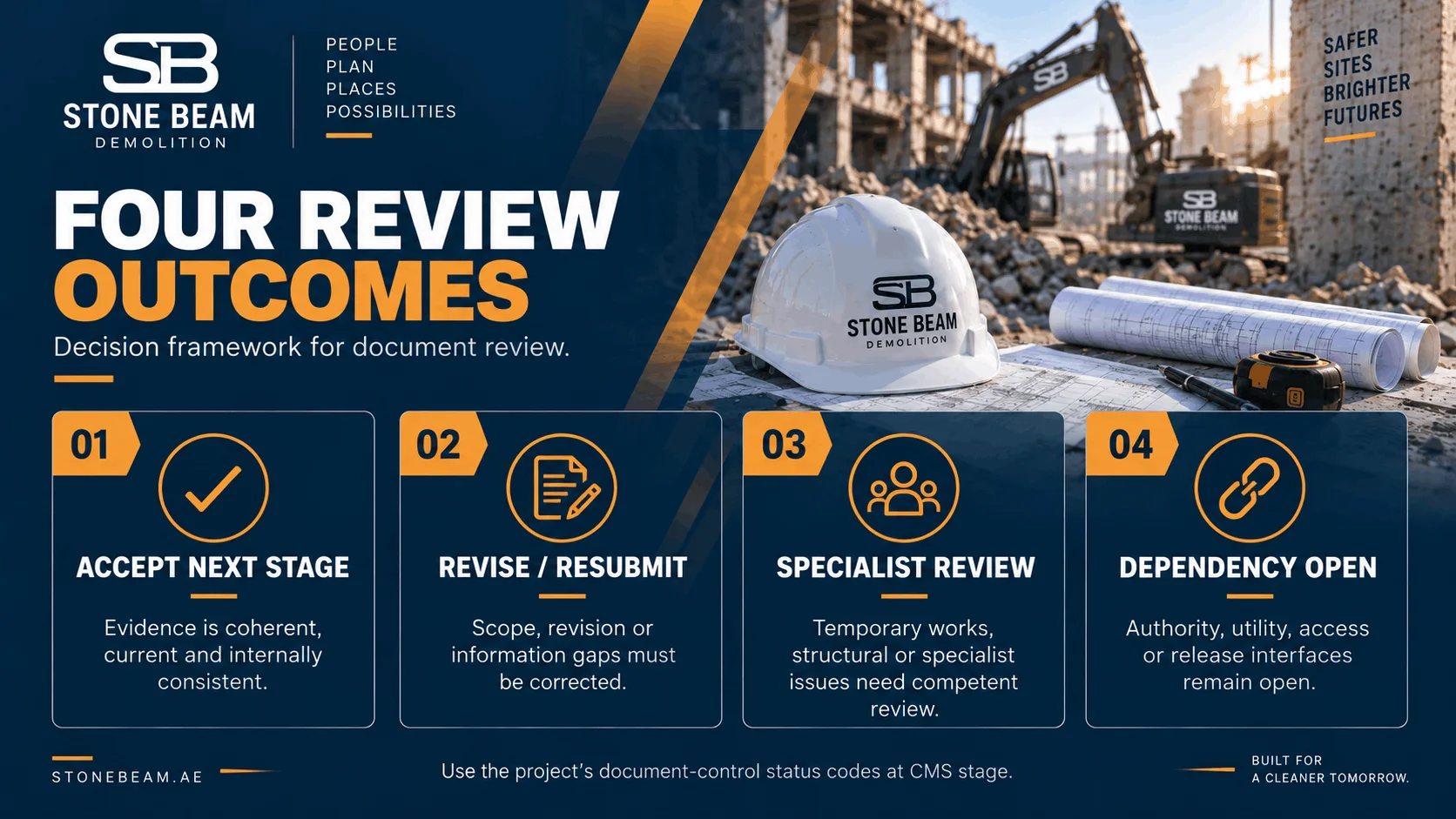
Original decision visual – Four possible review outcomes
| ACCEPT NEXT STAGE | REVISE / RESUBMIT | SPECIALIST REVIEW | DEPENDENCY OPEN |
|---|
Decision framework for document review. Actual contract status codes and approval terminology follow the project document-control procedure.
Which demolition submittal red flags require action?
| Red flag | Why it matters | Next review action |
|---|---|---|
| Method copied from another project or location | The sequence may omit the actual structure, access, neighbours or retained assets. | Return for project-specific correction and cross-document review. |
| Risk assessment does not follow the method sequence | Hazards and controls cannot be traced to the planned work. | Align method, RA, drawings and work areas before acceptance. |
| A required specialist design/checking interface is referenced but no responsible reviewer or accepted record is identified | The package names a specialist dependency but does not show who owns or closes it. | Request the appointed specialist role and project record/status; do not infer technical approval from the method statement. |
| Old or conflicting drawing revisions | Different parts of the package may control different work. | Freeze the reviewed revision set and reissue the document index. |
| Utility status is assumed from drawings alone | Drawings do not prove physical isolation or release. | Obtain the relevant utility / site release evidence. |
| Waste route described only as “approved dumping area” | The plan lacks traceable project logistics and receiving evidence. | Define the project’s required transport, receiving and record route. |
| ITP or checklist has no owner, timing or record | A control exists on paper but cannot be evidenced during execution. | Assign responsibility, timing and retained record. |
| “Approved” stamp used to imply every dependency is closed | Document status is being stretched beyond the reviewer’s decision. | Record the exact acceptance scope and list external open items. |
When can a technical submittal be accepted but demolition still not be released?
Document acceptance and workface release are different decisions. A reviewer may accept the technical logic while an authority, utility, access, isolation or site-control dependency remains open. Treating one approval as a substitute for every release creates a false readiness signal.
The separation is visible in current Dubai interfaces. DDA has its own demolition-permit document requirements, while DEWA’s builder-services framework separately lists demolishing permits for electricity and water. A technical-submittal reviewer therefore records these as interfaces rather than claiming that document acceptance closes them.
For the wider planning sequence around these interfaces, use the advanced demolition planning guide instead of turning this checklist into a full project-programme article.
What information is needed before a final verification or award decision?
The final review becomes reliable only when the reviewer has enough information to test the submission against the actual job. Ask for the missing inputs that change technical risk or responsibility, not a generic stack of certificates.
- Latest scope, BOQ or demolition boundary, including explicit exclusions.
- Current project drawings and known revisions, plus any client-identified protected or retained assets.
- Jurisdiction, permit/NOC route and utility interfaces relevant to the location.
- Access, logistics, working-hour, neighbour, occupied-area or live-asset constraints.
- Known technical uncertainties and the design/review responsibilities assigned by the project.
- Any specialist design/checking interface identified by the project, with the responsible reviewer and record/status route.
- Waste handling, transport and receiving requirements for the project.
- Required QA/QC records, hold points, inspections and completion/handover evidence.
- Responsibility matrix for owner, consultant, main contractor, demolition specialist and specialist reviewers.
- Open comments, assumptions and dependencies that remain outside the requested decision.
How should the review decision be recorded and handed over?
Record the decision in a form that the execution team can audit later. The review record identifies the submitted revision, reviewer scope, status, closed comments, open comments, specialist referrals and external dependencies. The next team receives both the accepted evidence and the remaining actions; it does not receive a bare “approved” label with no boundary.
| Record field | What to capture |
|---|---|
| Document status | Accepted / revise / specialist review / dependency open, using the project’s actual status codes. |
| Revision basis | Exact document and drawing revisions reviewed. |
| Comment closure | Closed, carried-forward and open comments with owners. |
| Specialist interfaces | Specialist technical, HSE, utility or other appointed-review status. |
| External releases | Authority, utility, access, isolation and client/main-contractor release status. |
| Execution handoff | What the site team may rely on, what remains prohibited and what records must be retained. |
Limits of this demolition technical submittal checklist
| Limitations This checklist is a procurement and document-review framework, not a demolition design, structural review, specialist-design review, permit decision or safe-work instruction. The contract, authority jurisdiction and appointed project reviewers control the final evidence set. Any engineering or HSE judgment outside document-control review remains with the competent project reviewer. |
|---|
Request a project-specific technical review input list
For a Stone Beam demolition enquiry, send the project location, demolition scope, current drawings, protected/retained assets, access constraints, authority/NOC status and required handover condition through the demolition company Dubai service page. Those inputs allow the technical submission and commercial scope to be reviewed against the actual project rather than a generic checklist.