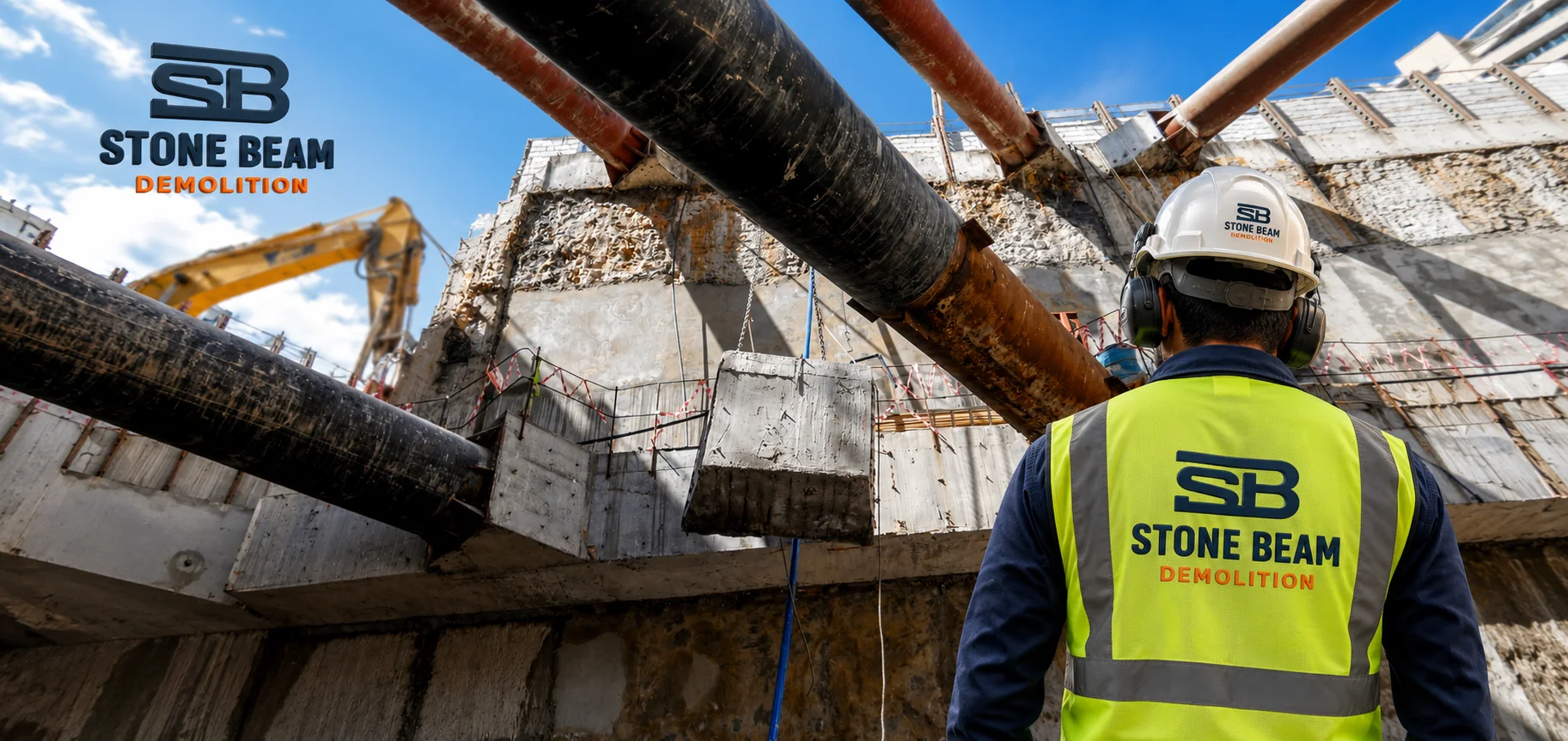























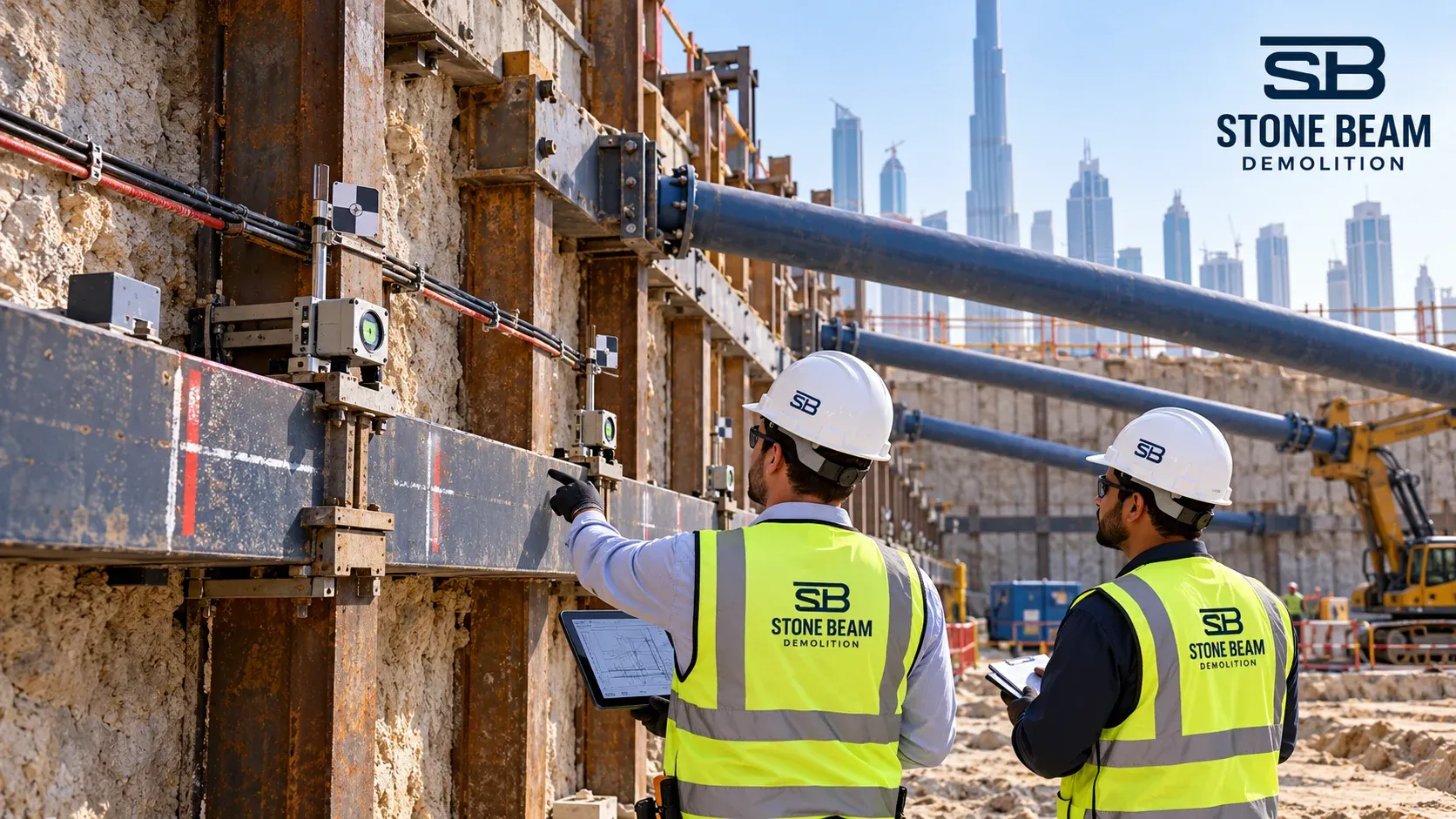
Whaler beams cutting Dubai
Temporary support removal, released not guessed
Whaler beams cutting in Dubai: controlled cutting of walers, struts, brackets and temporary supports in deep basements, with removal proceeding only after the release condition, not the cutting location, is confirmed.
Walers · struts · anchors · king posts
Overview
Whaler, whaler or wale — same member
The usual engineering term for the horizontal member that collects load from an excavation-support wall and transfers it to struts, anchors, rakers, or other restraints. "Whaler beams" is common in the UAE market and tender language and is used naturally alongside "waler".
The support system also includes cross-lot or corner struts (compression members), raking shores, anchors/tie-backs (tension, design and system-specific release), brackets/stools/gussets and king posts, each with its own release logic, not a single generic "temporary steel" treatment.
Do not use the saw or torch as a load test
Cutting into a member to "see whether it's still loaded" is not an acceptable release method. Uncertainty about residual force is resolved through the approved design, release evidence and controlled de-stressing or restraint procedure.
Request a demolition quote
Use this form layout on the live page to qualify leads before a call.
Six checks, none skipped for the final cut
What must be true before the last connection is opened.
Gate
Structural release
Monitoring status
Member control
Lifting route
Hot-work / cutting permit
People / exclusion
Method matched to the member and depth
Selected from geometry, coatings, hot-work restrictions, and site ventilation, mechanical cutting, cold cutting, or hot cutting, each with its own controls.
Deep-basement logistics
Hot work & ventilation
Unknown conditions

A monitored temporary-works system, not ordinary site steel
Dubai's published building requirements call for the protection of existing utilities, on-site deflection/monitoring records, control of heavy equipment near shoring, and written consultant consent before anchor removal, alongside the Safety Guide for Construction Works adopted under Administrative Resolution No. 112 of 2026. This page is a technical overview, not a substitute for the approved temporary-works design or current authority requirements.
Access and release evidence, not just member count
A short waler in a shallow basement and a long, corroded strut deep below grade are very different jobs at the same "per member" glance.
Member geometry & condition
Release evidence status
Access & lifting
Permit constraints
Monitoring requirement
Scrap & commercial terms
Not a fixed rate
An itemised proposal reflects the actual release sequence, member schedule and access, not a generic per-member price.
An engineered service, not equipment for hir
The method is selected after reviewing the structure, access, and risk, not chosen because it's the tool on the truck that day.

Cutting, scanning, temporary support, lifting and waste handling coordinated under one plan, not fragmented between separate contractors.
Scope, exclusions, assumptions, and handover conditions are stated in the quotation, not hidden inside a single lump-sum line.
Equipment, certifications, and capability are stated only where current records support them, never a generic "we do everything" promise.
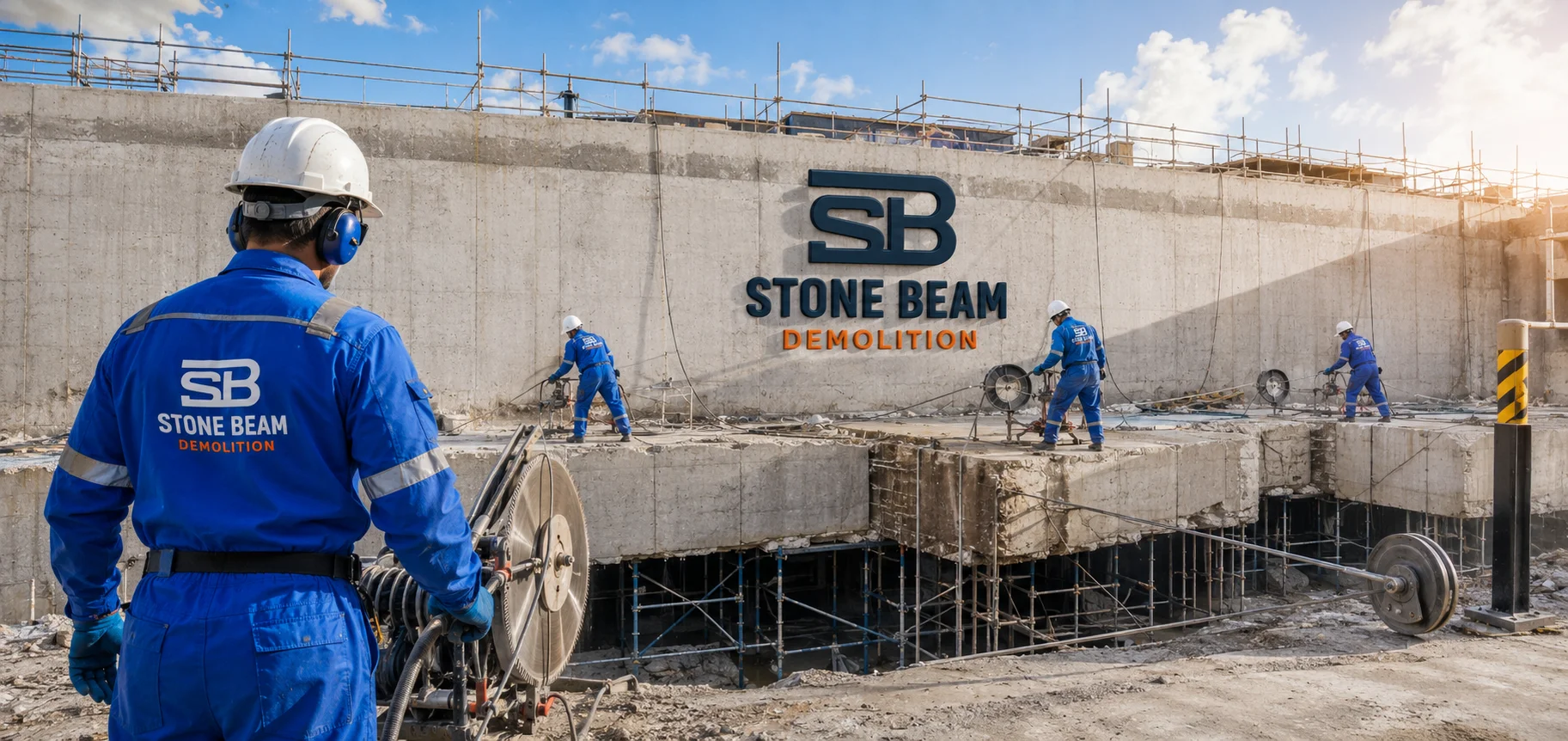
Common questions, answered straight
What temporary-works engineers and main contractors ask before they call.
Both refer to the same member — "waler" is the standard engineering term; "whaler beam" is common in UAE market and tender language.
Only once the designer or consultant confirms the member is redundant under the approved de-propping sequence — never based on visual judgement at the cutting crew's discretion.
No. The sequence is developed by the appointed temporary works designer. Stone Beam executes the approved cutting and removal within that design.
With a method matched to member geometry, coatings and ventilation, plus a rigging plan addressing headroom, crane/hoist route, floor-loading limits and landing zone before cutting starts.
Yes, when scoped — each component type has its own release logic and is planned individually, not treated as generic temporary steel.
Where the project or authority requires it — baseline readings and trigger/action levels are followed and the work stops or holds if a trigger is reached.
Anchor release is design- and system-specific and needs written consultant consent — never treated as a routine cutting task.
Yes, as a separate interface from steel whalers — addressed through the relevant concrete-cutting or demolition method once release conditions are confirmed.
Still have questions?