





















Hydrodemolition, selective by design
High-pressure water jetting for selective concrete removal and repair preparation — sitting between demolition and repair, judged by the condition it leaves behind, not just the material it removes.
High-pressure water · concrete removal
Overview
Judged by the condition left behind
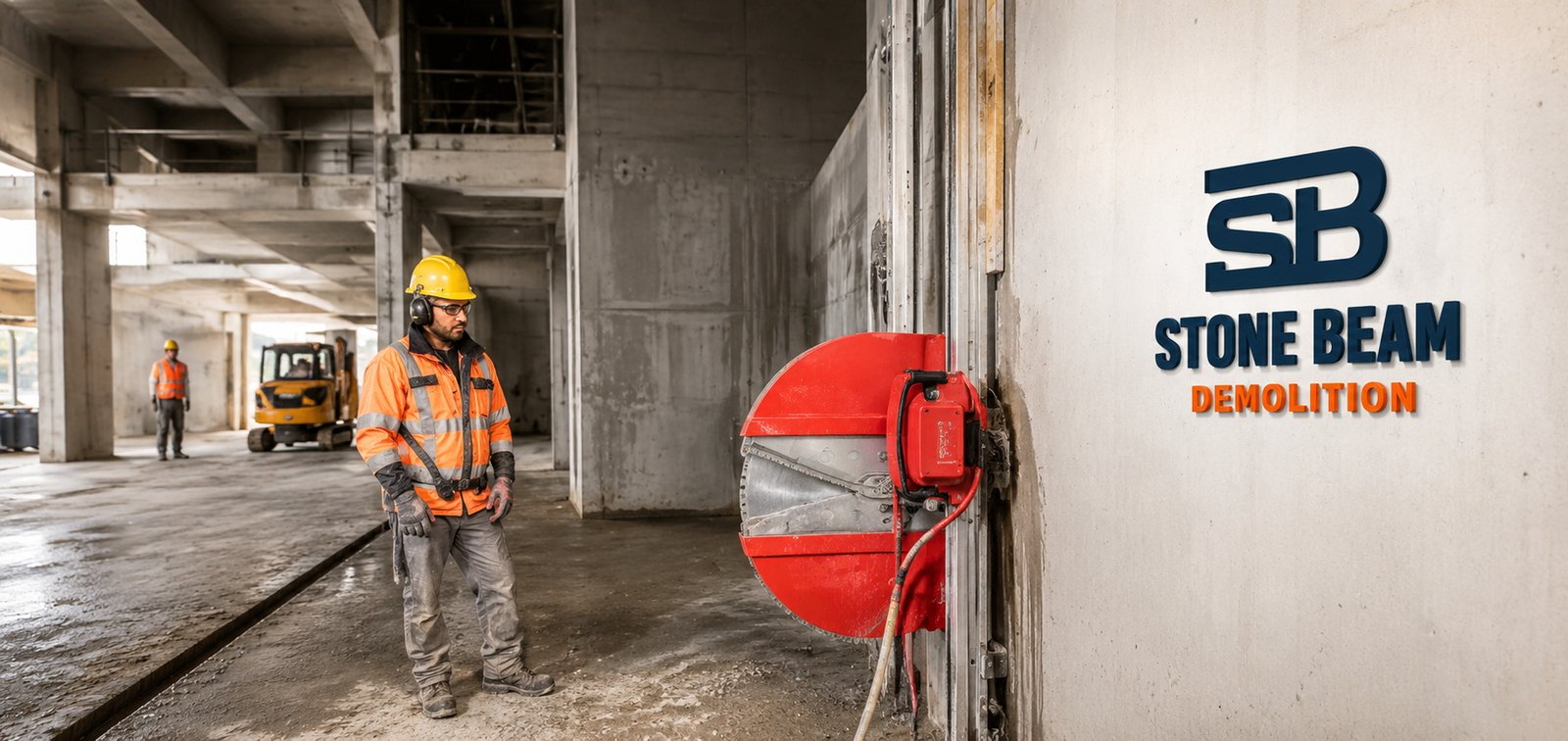
High-pressure or ultra-high-pressure water removes weakened or deteriorated concrete while leaving sounder material and exposed reinforcement available for inspection and repair — or supports shallow prep, partial-depth removal or deeper removal where equipment, containment and access allow.
The method sits between demolition and concrete repair. Success is measured by the correct removal boundary, acceptable retained concrete, reinforcement condition, surface profile, cleanliness, water/slurry control and readiness for the engineer's specified repair system — not simply how much material was removed.
Page ownership
This page owns hydrodemolition as a concrete-removal and repair-preparation method. Bridge deck repair and general concrete cutting are covered on their own dedicated pages.
Request a demolition quote
Use this form layout on the live page to qualify leads before a call.
Five claims this method doesn't support
Marketing shortcuts that don't hold up on a real project.
Not a guarantee of zero vibration — pumps, robots, hoses and jets still create dynamic effects and site disturbance
Not the same as hydroblasting for paint, rust or coating removal — a separate intent from concrete removal
Not automatically closed-loop or discharge-ready — collection, treatment and discharge depend on the project's environmental plan
Not automatically damage-free — poor settings, unsuitable access or an incorrect sequence still create project risk
Not a substitute for structural or repair design — the engineer still defines the boundary and acceptance criteria

Pressure alone is not the specification
Removal energy depends on the complete system and its movement — pressure, flow, nozzle geometry, stand-off distance, traverse speed, lance motion and concrete condition together, not a headline pressure figure.
Settings are established on representative concrete and verified before production — and may need to change as strength, repair history, reinforcement congestion or geometry changes across the work area.
A quality-control gate, not a productivity test
Before full production, a representative trial area confirms the method matches the repair specification and site conditions.
Removal condition
Site behaviour
Formal acceptance
A waste stream to plan, not a byproduct to ignore
Hydrodemolition converts removed concrete into coarse fragments, fine cementitious solids and alkaline wastewater — a water plan is needed before the pump starts.
Stage
Supply
Containment
Collection
Treatment / discharge
Depth, area and containment — not a flat rate
A shallow, open horizontal deck prep is a different job from overhead removal in a confined, occupied structure.
Area & depth
Orientation
Reinforcement & PT
Water plan
Trial & calibration
Access & occupancy
Not a fixed rate
An itemised, project-specific quotation reflects the removal boundary, water plan and repair-readiness requirement.
An engineered service, not equipment for hir
The method is selected after reviewing the structure, access, and risk — not chosen because it's the tool on the truck that day.
The method, sequence and controls are confirmed from the actual site condition before any machine or tool is mobilised.
Cutting, scanning, temporary support, lifting and waste handling coordinated under one plan, not fragmented between separate contractors.
Scope, exclusions, assumptions and handover condition are stated in the quotation — not hidden inside a single lump-sum line.
Common questions, answered straight
What consultants and repair contractors ask before they call.
Controlled removal or preparation of concrete using high-pressure or ultra-high-pressure water, targeting weakened or deteriorated material while leaving sounder concrete and reinforcement in place.
It's designed to remove concrete around bars without severing them, but existing corrosion or section loss still needs the repair engineer's assessment — not an automatic guarantee of undamaged steel.
No. It avoids repetitive percussive impact, but pumps, robots, hoses and jets still create dynamic effects and site disturbance.
It largely replaces airborne dust with wastewater and slurry — which still needs a defined containment, collection and discharge plan.
Yes, with adjusted parameters, but the repair specification and trial area should confirm the boundary — it's typically selected for selective, condition-based removal rather than bulk demolition.
Yes — selective deck removal, patch repair and overlay preparation are common applications where the bridge repair design calls for it.
Yes, with a suitable automated or manual system addressing falling material, rebound, water collection and temporary support for that orientation.
It's contained, collected and treated per the project environmental plan — solids separation, pH/turbidity control and an approved discharge or disposal route.
Still have questions?