



Before requesting a demolition quotation, send the contractor the project location, demolition boundary, available drawings and quantities, current site photographs, access restrictions, known structural and utility information, waste and salvage responsibilities, programme constraints, and the required handover condition. The goal is to price a defined scope rather than a generic demolition assumption.
In Dubai, permit, utility and community inputs vary by jurisdiction and scope. A document requested by one authority is not a universal quotation requirement. For pricing, send the evidence already available and identify unresolved items instead of presenting assumptions as confirmed conditions.
Practical rule: issue every bidder the same revision of the same scope information, then record every clarification, assumption, exclusion and responsibility change against that baseline.
Prepared by Stone Beam Technical Services L.L.C.
What information is needed for a demolition quote?
A useful demolition quotation starts with nine practical input groups: project identity, demolition boundary, drawings and quantities, current condition, access and logistics, technical interfaces, waste and salvage, programme and handover, and the commercial basis. The aim is not to send every document on the project; it is to give every bidder the same facts that materially change scope, method, risk, logistics or responsibility.
| Input group | What to send | Why it changes the quotation | Verification / limit |
|---|---|---|---|
| Project identity | Location, asset type, jurisdiction or community, site contact | Sets site context and route for survey/logistics | Address and issued project reference; does not prove permit readiness |
| Demolition boundary | Remove/retain limits, full or partial scope, basements/foundations/external items | Prevents bidders pricing different physical scopes | Marked drawing or scope schedule; labels alone do not define every buried element |
| Drawings and quantities | Latest drawings, BOQ/schedule, dimensions and revision status | Creates a common measurement basis | Revision register and cross-check; drawings do not prove current site condition |
| Current condition | Recent photos, access route, visible constraints and known changes | Shows gaps in the document set | Dated photos/site survey; photos do not replace technical investigation |
| Access and logistics | Gate sizes, truck route, lifts, crane zones, work hours, staging limits | Changes plant selection, labour handling and haulage assumptions | Site rules and survey; access today does not prove future workface release |
| Technical interfaces | Available structural data, retained elements, known utilities and surveys | Identifies interfaces that affect method and readiness | Competent review and records; information does not itself approve a demolition sequence |
| Waste and salvage | Who owns scrap, who transports waste, destination constraints, segregation needs | Prevents hidden disposal or credit assumptions | Commercial responsibility schedule; no recycling result is implied |
| Programme and handover | Target dates, work windows, completion condition, backfill/reinstatement/document needs | Defines what bidders are programming and finishing | Written milestone/handover definition; target dates are not execution guarantees |
| Commercial basis | Permits, third-party surveys, monitoring, protection, taxes/fees, client-supplied items | Separates contractor price from owner/third-party costs | Responsibility matrix; inclusion in a total price must be explicit |
What is the minimum information for an initial budget versus a final quotation?
The information threshold rises as the client moves from an early feasibility discussion to a procurement decision. Treat these as three commercial maturity levels, not as authority stages.
| RFQ maturity | Core information | Purpose | Boundary |
|---|---|---|---|
| First review | Location, asset type, demolition boundary, current photos, target timing | Confirm scope understanding, survey needs and obvious information gaps | Not a firm commercial basis |
| Budget quotation | Latest drawings/quantities, access, utility status, waste roles, handover condition | Build a priced assumption set against a defined scope | Open assumptions remain visible |
| Tender-ready / final pricing | Controlled document issue, measurement basis, surveys held, responsibility matrix, clarifications and commercial terms | Put bidders onto the same commercial baseline | Final proposal still follows site verification and the agreed contract basis |
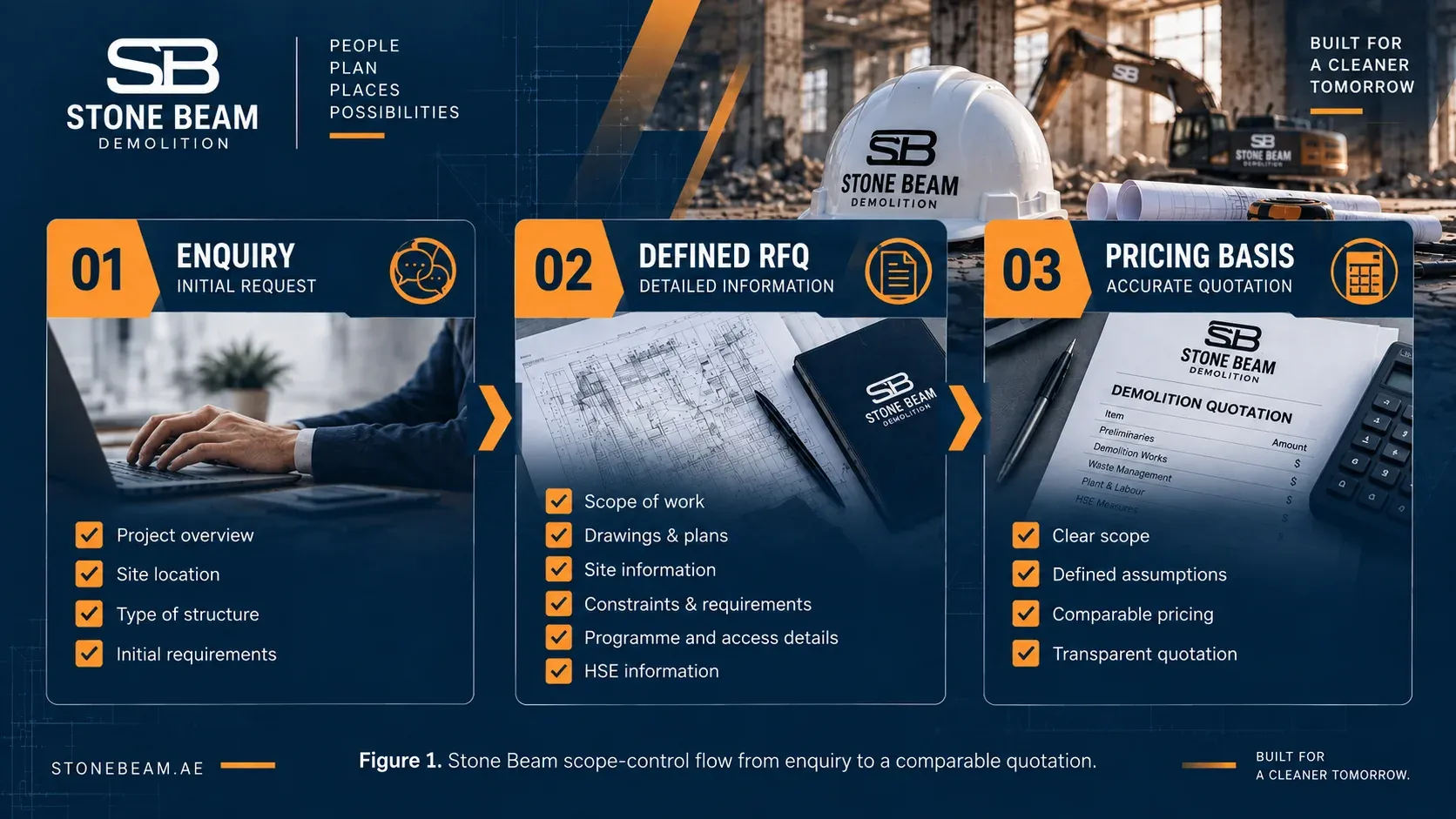
Why do scope boundaries and quantities matter?
“Full demolition” is not a complete measurement instruction. A quotation needs a clear boundary for superstructure, basement, foundations, slabs, pools, tanks, external walls, hardscape, temporary works removal, backfilling, grading and retained assets. Only the items that exist in the scope belong in the RFQ.
Use one measurement basis for all bidders. Use a BOQ, marked drawings, a quantity schedule or a contractor measurement from an agreed survey. State the document revision and identify quantities that remain provisional rather than mixing confirmed and assumed quantities.
For villa-specific scope, see Stone Beam’s villa demolition in Dubai service page. This guide focuses only on the information needed before pricing.
| Illustrative scope-normalisation example
ILLUSTRATIVE ONLY: Bidder A reads “remove building” as superstructure only. Bidder B includes foundations and the basement slab. Their totals are not like-for-like even if both quotations are internally correct. The client resolves the mismatch by issuing one explicit demolition boundary and handover condition. |
|---|
How do access and logistics change the quotation?
Access information belongs in the RFQ because demolition is also a materials-handling and logistics problem. Share the usable entrances, internal routes, truck restrictions, loading areas, lift or hoist limits, work-hour restrictions, neighbour interfaces and any client-controlled gate or permit-to-work process.
Restricted access changes plant and handling assumptions. Possible responses include smaller plant, additional handling, staged debris movement, lifting support or different haulage arrangements. The quotation must state the access condition used for pricing, because one site visit does not guarantee that the same access will be available during the works.
For broader commercial-demolition requirements, see Stone Beam’s commercial demolition in Dubai service page. This quotation guide still needs the site restrictions that affect price.
What structural, utility and survey information belongs in the RFQ?
Send the structural and service information already held by the project team. Useful inputs include structural drawings, alteration records, retained-element drawings, available survey reports, utility information, isolation status, hazardous-material information and any consultant comments that change the demolition boundary.
The client does not need to invent missing engineering information. Mark it as unknown and let the quotation record the required survey, review or release. This approach is stronger than presenting an unverified drawing as an as-built fact.
- Structural system and retained structural elements known from the issued records.
- Known live, isolated or abandoned utilities and the evidence supporting that status.
- Available survey outputs, including condition, scanning or hazardous-material records relevant to the scope.
- Adjacent structures, shared walls, basements or foundations that affect the demolition interface.
- Consultant or client restrictions that change method selection, access or release conditions.
For the end-to-end planning workflow, see the advanced demolition guide. This quotation guide stops at the information needed to price and clarify the package.
What changes the price, programme, commercial risk or comparison outcome?
Four things move together when quotation information improves: the price basis becomes clearer, programme dependencies become visible, commercial risk moves to the correct party, and competing bids become easier to compare. None of those outcomes requires publishing a generic market rate.
| Driver | Commercial effect | What to define before pricing |
|---|---|---|
| Measurable scope | Quantity uncertainty becomes explicit | Issue dimensions/BOQ/boundary and label provisional items |
| Access and logistics | Handling, plant and haulage basis becomes explicit | Issue working hours, routes, staging and gate constraints |
| Method / engineering interfaces | Survey, review and retained-element needs become explicit | Issue known structural/service data and identify unresolved interfaces |
| Waste / salvage | Disposal cost and scrap credit assumptions stop being hidden | Allocate ownership, transport and destination responsibilities |
| Risk / unknowns | Variation exposure is visible before award | Record unknowns, surveys required and pricing assumptions |
| Commercial terms | Contractor price separates from owner/third-party cost | Allocate permits, monitoring, protection, fees, testing and reinstatement |
When programme information materially affects a quotation, Stone Beam’s editorial planning model separates two clocks. Clock 1 covers pre-mobilisation readiness; Clock 2 covers released physical execution and handover. Between them, Readiness Gate A is the point where the project-specific pre-start conditions needed for the defined workface are closed. It is not an authority term, permit or promise of readiness.

When the client is ready for a contractor review of the overall demolition package, use Stone Beam’s demolition company in Dubai page. The RFQ should arrive with the scope, responsibilities, assumptions and known constraints already identified.
How should waste, salvage and handover responsibilities be defined?
Waste responsibility must be defined in the pricing basis, even when disposal is client-managed. State who loads, transports and pays for disposal; whether segregation is required; who owns recoverable steel or other salvage; and what tickets, manifests or other records are required at handover.
Handover needs the same precision. Define whether the contractor leaves a cleared slab, removes foundations, backfills, grades, reinstates access, supplies disposal records or completes another agreed close-out condition. A quotation cannot be compared fairly when each bidder finishes at a different endpoint.
For waste-planning detail, see Stone Beam’s construction and demolition waste in Dubai page rather than expanding this article into a separate waste guide.
Which commercial responsibilities should be allocated before bidders price?
Create a short responsibility matrix before bids are issued. It prevents a low total from looking attractive only because the bidder excluded a cost that another bidder included.
| Responsibility topic | RFQ question |
|---|---|
| Permits / NOCs | Who applies, pays and responds to comments |
| Utility actions | Who obtains records, deactivation, isolation or clearance evidence |
| Surveys / testing | Who appoints, pays and provides reports |
| Engineering / temporary works | Who designs, reviews, supplies and removes the required temporary measures |
| Protection / monitoring | Who provides hoarding, neighbour protection, monitoring and reporting |
| Waste / salvage | Who owns material, transport, disposal charges and records |
| Access / traffic | Who secures gate passes, work windows, road or community access |
| Reinstatement / handover | Who completes backfill, grading, cleaning, documentation or retained-area repair |
| Taxes / third-party fees | What sits inside the contractor price and what remains owner-paid |
What happens when key information is missing?
Missing information does not disappear from the quotation. It returns as an assumption, exclusion, provisional sum, remeasurement basis, clarification request or later variation. The commercial objective is not to eliminate every unknown; it is to identify each material unknown before award and allocate it openly.
| Missing information | Commercial consequence | Procurement response |
|---|---|---|
| Undefined below-ground scope | Different bidders stop demolition at different levels | Mark foundations/basement/slabs as included, excluded or provisional |
| Unknown access route | Plant and haulage assumptions differ | Issue surveyed route and known restrictions |
| Unclear utility status | Readiness and method assumptions diverge | State current status and evidence held; list outstanding release |
| Undefined scrap ownership | Bid totals embed different salvage credits | State ownership and valuation treatment |
| No handover definition | Close-out scope differs | Issue one finish condition and documentation requirement |
How do Dubai authority and utility interfaces affect the information package?
Authority information matters because it identifies dependencies, not because every permit attachment is a quotation attachment. Within Dubai Development Authority jurisdiction, the DDA Demolition Permit service lists items such as a demolition-area plan, relevant NOCs, method/HSE documents, an adjacent-building impact study and a site photograph. That list belongs to the DDA permit service and must not be generalised to every Dubai project.
For utility interfaces, DEWA Demolishing Permits – Electricity/Water describes a demolition-permit journey for enrolled demolition contractors and distinguishes Dubai Municipality Building Permit System projects from other authority scenarios. The RFQ therefore needs the utility status and the evidence already held, not a generic statement that “utilities are clear.”
DEWA also publishes a separate deactivation service for demolition. This distinction is useful commercially: an application, NOC status, final-bill process and physical deactivation are different pieces of evidence. Record the actual status instead of collapsing them into one checkbox.
How should the client package the RFQ for like-for-like quotations?
A controlled RFQ pack makes the later quotation-comparison stage much easier. Use this sequence:
- Freeze one scope description and demolition boundary for the tender issue.
- Issue one controlled drawing and quantity set with revision numbers and a document list.
- Add current photos, access constraints, utility status and surveys already held.
- Allocate waste, salvage, permits, third-party surveys, monitoring, protection and reinstatement responsibilities.
- State the target programme, working windows and required handover condition.
- Record every bidder question and issue the answer consistently to all bidders when it changes the pricing basis.
- Require each quotation to identify assumptions, exclusions, provisional items and deviations from the issued baseline.
- Compare totals only after the scope and responsibility differences have been normalised.
What information is needed before a final commercial decision?
Before a final estimating, procurement or contract decision, close the commercial evidence trail rather than relying on the headline total. The client team needs a controlled basis that shows what is measured, what is assumed, what is excluded, who owns each third-party action and what condition defines completion.
- Latest controlled RFQ issue and demolition boundary.
- Quantity or measurement basis, with provisional items identified.
- Bidder clarifications and approved responses.
- Assumptions, exclusions and qualifications recorded against the RFQ baseline.
- Responsibility matrix for permits, utilities, surveys, monitoring, protection, waste, salvage and reinstatement.
- Programme basis and known readiness dependencies.
- Handover and close-out deliverables.
- Commercial comparison adjusted for material scope differences before award.
| Scope and limitations
This article is procurement guidance, not a demolition permit checklist, structural design, method statement or market-rate publication. Authority routes and technical releases follow the actual jurisdiction and project. Final method, programme and commercial proposal remain tied to the verified site condition, issued scope, authority requirements and agreed contract basis. |
|---|
What should the client send to Stone Beam for a project-specific review?
For a project-specific quotation review, send Stone Beam the site location and jurisdiction, demolition boundary, latest drawings or BOQ, current photographs, known utility status, access constraints, adjacent or retained structures, waste/salvage responsibility, intended programme and required handover condition.
Submit that information through the Stone Beam demolition company in Dubai page so the enquiry begins from a defined commercial basis. The final proposal follows the project survey, authority route, technical review and confirmed site conditions.