
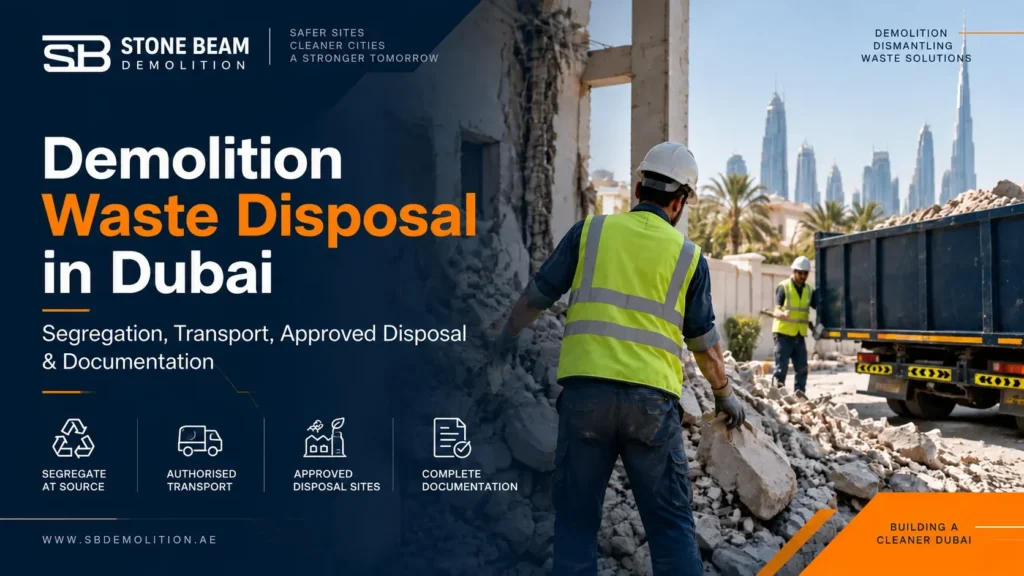
Demolition waste disposal in Dubai should be treated as a documented chain, not simply debris removal: identify and segregate waste on site, define the loading and transport interface, route loads through the applicable licensed or authorised transport arrangement to an approved receiving point, then retain the receiving evidence needed for project close-out.
Dubai’s current framework includes Law No. 18 of 2024 Regulating Waste Management in the Emirate of Dubai and its 2026 Implementing Bylaw. The law applies across the Emirate, including free zones, while individual duties depend on the waste activity, Waste Producer category and project context.
| Practical rule: Do not close a waste line item at “removed from site”. Close it when the destination, quantity basis and receiving evidence required by the applicable route and contract have been reconciled. |
Last reviewed: 16 September 2026
Prepared by Stone Beam Technical Services L.L.C.
What does demolition waste disposal actually include in Dubai?
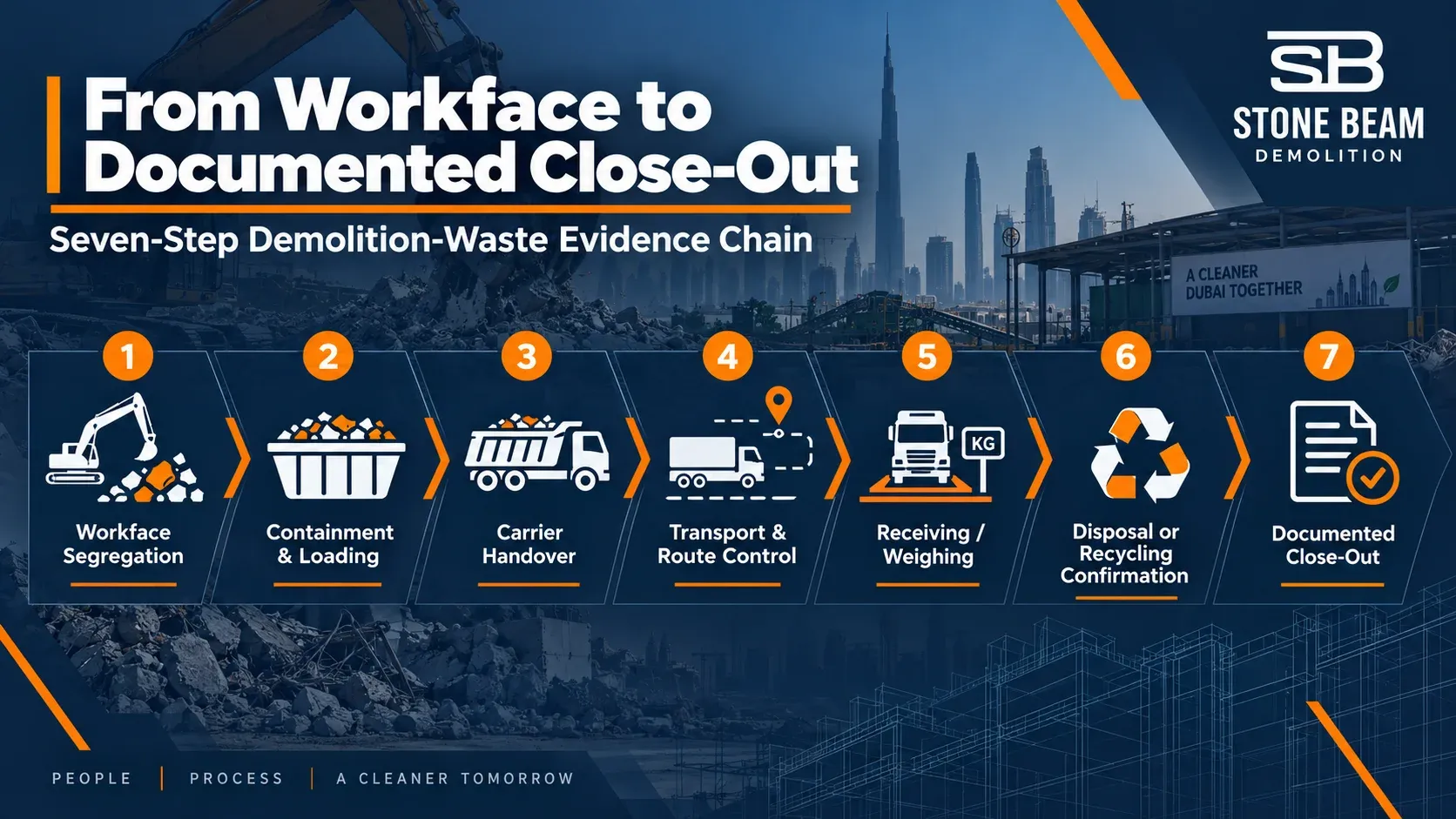
For a demolition project, “disposal” is best understood as a chain of decisions and records rather than a single truck movement. The chain starts when waste is generated within the demolition scope and finishes when the agreed receiving route and evidence are reconciled for close-out. The project should distinguish the following stages:
- Generation – material becomes waste within the defined demolition or strip-out scope.
- Segregation – relevant streams are separated rather than treated as one unidentified mixed load.
- Internal handling – waste is moved within the site to the agreed collection or loading point.
- Loading / handoff – the load is identified and transferred into the agreed collection or transport arrangement.
- Transport – the applicable licensed/authorised carrier and vehicle requirements are confirmed for the route.
- Receiving – the load reaches the project-applicable approved or designated receiving facility/site.
- Recovery / recycling / treatment / final disposal – the receiving outcome is recorded accurately rather than assumed.
- Close-out – the agreed project records are reconciled against the waste stream, quantity basis and contractual requirements.
This narrower disposal focus supports Stone Beam’s broader construction and demolition waste management page without duplicating it. Technical use of recovered concrete belongs with the recycled concrete aggregate page rather than this disposal owner.
The disposal chain: from demolition workface to documented close-out
A useful project control is to define the evidence chain before demolition starts. If the tender says only “cart away debris”, two quotations may not be comparable: one may include segregation, regulated transport, receiving fees and close-out records while another may price only loading and removal from the workface.
Why source segregation matters before waste leaves the site
Dubai Municipality’s current Waste Segregation Guide expressly includes construction and demolition sites and publishes separate categories for inert aggregates, metal, timber/wood, dry recyclables, hazardous materials and general waste. Its current C&D transport guideline also reproduces colour categories for these streams.
For procurement and close-out, segregation matters because it affects:
- which container or collection arrangement is suitable;
- whether a load can follow the intended recovery, recycling, treatment or disposal route;
- how contamination or mixed material may change facility acceptance;
- which transport or specialist interface is needed; and
- whether receiving records can be reconciled to a meaningful waste stream rather than an unidentified mixed load.
| Boundary: This page does not provide a hazardous-waste handling procedure. Where a stream may be hazardous or requires specialist classification, it should leave the ordinary C&D workflow and be routed through the applicable competent and authorised process. |
Demolition Waste Route & Evidence Matrix
| Stream / condition | Site decision | Transport interface | Receiving route | Evidence to close |
|---|---|---|---|---|
| Inert demolition material | Segregate where the project route requires it; identify contamination/foreign material before loading. | Confirm the applicable C&D transport provider/vehicle route. | Approved/designated receiving route suitable for the stream. | Load identification + applicable transport record + weight/receiving evidence. |
| Metal | Separate from mixed waste where practical and contractually required. | Confirm transport arrangement and salvage ownership. | Approved receiving/recovery route where used. | Handoff/receiving record; recovery outcome only if documented. |
| Timber / wood | Separate untreated/clean material from contaminated or treated material where the route distinguishes them. | Confirm accepted stream and vehicle/container arrangement. | Receiving route appropriate to the accepted material condition. | Receiving record; do not call it recycled unless the outcome is evidenced. |
| Dry recyclables | Keep identifiable if the intended route depends on clean separation. | Confirm collection/transport interface. | Approved recovery/recycling route where actually used. | Receiving evidence and documented outcome where available. |
| General / mixed residual waste | Avoid assuming mixed loads qualify for a recycling outcome. | Confirm carrier and designated facility route. | Approved/designated disposal or treatment route. | Trip/weight/receiving record according to the applicable route. |
| Unexpected / potentially hazardous stream | Remove from ordinary C&D assumption; isolate the decision, not by DIY handling instruction. | Specialist/authorised transport route may be required after classification. | Applicable authorised facility/process. | Specialist records required by that route; project-specific verification needed. |
Matrix purpose: decision support for tendering and evidence planning. It does not replace project-specific waste classification, facility acceptance criteria or authority requirements.
Who handles transport, receiving and disposal?
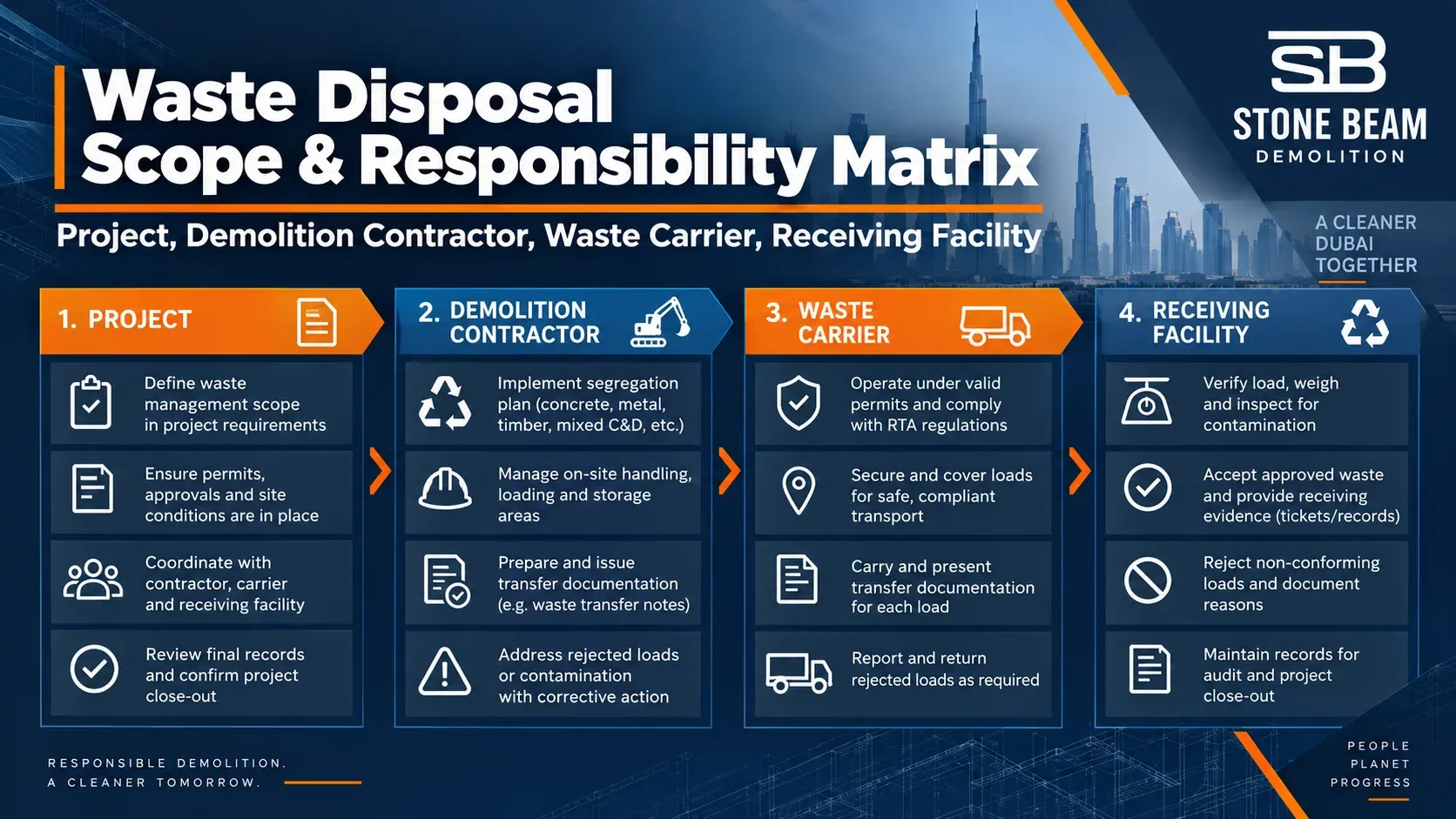
The 2026 Implementing Bylaw treats collection, segregation, transport, recycling, treatment and final disposal as distinct waste-related activities. For the specified Waste Producer categories in Articles 2-3, transport is through a licensed Waste Carrier or the Waste Producer’s own authorised waste-transport vehicle. Dubai Municipality’s Technical Guidelines on Construction and Demolition Waste Collection and Transportation Services separately govern covered C&D collection/transport companies and their vehicles.
That is why the demolition contractor, waste carrier and receiving facility should not be treated as the same legal or commercial role by default. The signed contract should identify who is responsible for each interface and which regulated party performs it.
What records should owners and consultants expect?
There is no safe reason to invent one universal “demolition waste certificate” for every project. Instead, define the evidence package around the applicable authority route, carrier/service and contract. Depending on the route, useful records can include:
- waste-stream or load identification sufficient to understand what left the site;
- the applicable waste-carrier / vehicle evidence where regulated transport is used;
- a waste manifest or other DM-required transfer/transport record where that framework applies;
- the vehicle weight receipt required by the current DM C&D transport guideline for covered waste-collection vehicles;
- receiving-site, tipping, acceptance or facility record generated by the applicable route;
- a reconciliation log linking date, stream, quantity basis and receiving record to the demolition scope; and
- the final close-out package required by the client, consultant, main contractor or authority route.
For covered C&D transport companies, the current DM guideline states that waste transport should be recorded in the waste manifest and other required records, and that collection vehicles must keep the trip vehicle-weight receipt when using a disposal site or facility. These are carrier-side requirements within that guideline, not proof that every demolition project uses an identical document set.
| Documented disposal means: enough project-applicable records to trace a defined waste stream from the site handoff/transport interface to the receiving point and reconcile the quantity basis required for close-out. It does not, by itself, prove a recycling outcome. |
Removed, received, recycled and finally disposed are not the same thing
| Status | What it tells you | What it does NOT prove |
|---|---|---|
| Generated | Waste arises from the defined work scope. | Nothing yet about where it goes. |
| Removed from site | The load has left the workface/site. | Not proof of the receiving destination. |
| Received | A facility/site has recorded the load. | Not automatically proof of recycling. |
| Recovered / recycled | A documented recovery/recycling outcome has occurred. | Requires evidence of the outcome, not an intention or target. |
| Treated | The waste has gone through a defined treatment process. | Treatment is not synonymous with recycling. |
| Finally disposed | The residual waste has reached its final disposal route. | Do not label this as diversion/recycling. |
Stone Beam does not publish an achieved recycling or diversion percentage on this page because the current internal evidence pack does not contain a sufficiently comparable, publishable set of actual weighbridge, receiving and outcome records. A target, plan or receiving ticket is not an achieved recycling percentage.
What changes demolition-waste disposal cost and commercial risk?
The commercial exposure is driven by scope and logistics, not one universal AED/tonne or AED/trip figure. Before comparing quotations, check whether each bidder has priced the same disposal chain.
| Driver | Why it changes commercial exposure |
|---|---|
| Waste composition / contamination | Different streams may need different containers, acceptance routes or specialist interfaces. |
| Segregation requirement | More source separation can change labour, space, container and handling needs. |
| Internal movement | Basements, upper floors, long horizontal routes or restricted lifts can add handling interfaces before loading. |
| Access and loading | Truck/skip size, loading position, time windows and road/site restrictions can change productivity and waiting. |
| Transport / carrier arrangement | Confirm whether the bidder, client or another party appoints the regulated transport service. |
| Receiving route | Disposal, treatment or recovery charges and acceptance conditions can differ by waste stream and facility. |
| Rejected / mixed loads | Contamination or a non-conforming load can create rehandling, rerouting and variation risk. |
| Documentation | Manifest, weight, receiving and reconciliation requirements can add administrative scope. |
| Salvage ownership | Define who owns recoverable metal/material and whether any credit is assumed. |
| Exclusions / third parties | Ambiguous specialist waste, permits, fees or transport interfaces often become post-award variations. |
For the wider demolition scope, access, retained elements and project constraints, see Stone Beam’s demolition contractor in Dubai page. For villa-specific scope boundaries, including below-ground demolition, see villa demolition in Dubai.
What should be defined before requesting a demolition-waste quotation?
A comparable quotation needs a defined waste scope. Before inviting prices, provide or agree the inputs that materially change responsibility, logistics and variation exposure:
- project location/jurisdiction and demolition boundary;
- known or expected waste streams and any known contamination/specialist-material information;
- source-segregation expectations and space available for containers/stockpiles;
- internal horizontal/vertical handling and the point where waste is handed to the transport service;
- site access, loading area, permitted vehicle/container constraints and working windows;
- who appoints and verifies the waste carrier, vehicle route and receiving destination;
- which disposal/recovery/treatment fees and third-party charges are included or excluded;
- the commercial measurement basis – for example whether reconciliation relies on weight, receiving tickets or another agreed basis;
- salvage ownership and any assumed credit;
- how unexpected or potentially hazardous waste is excluded and routed to specialist decision-making;
- the exact close-out records required before the waste scope is considered complete; and
- variation triggers for rejected loads, changed waste classification, access restrictions or destination changes.
Where interior demolition or fit-out removal is the main scope, the waste mix and handling route may differ materially; see interior strip-out in Dubai for the commercial owner of that service.
Waste disposal red flags before award
- The quotation says “remove debris” but does not define the receiving route or evidence required.
- Mixed loads are priced as if every tonne will be recycled, without an acceptance or outcome basis.
- The waste carrier / vehicle status is unclear or treated as if the demolition trade licence automatically covers transport.
- A named landfill, recycling plant or “approved facility” is promised without current project-specific verification.
- Disposal/recovery charges, waiting time or third-party fees are excluded but not clearly stated.
- Salvage ownership or metal credit is assumed by both parties.
- The quantity basis is undefined, making final reconciliation difficult.
- Unexpected hazardous/specialist material is discovered but the ordinary C&D route is still assumed.
- No receiving record is required even though the client/consultant expects a documented close-out.
- The contract closes the waste scope at “site removal” although the project requires evidence of receiving/disposal.
What if unexpected or potentially hazardous material is found?
Do not force an unidentified or potentially hazardous material into the ordinary C&D disposal route. The correct response is to stop making assumptions about the waste stream, obtain the required project-specific classification/competent input, and confirm the specialist carrier, vehicle, container, receiving and authority route that applies before disposal.
| Safety and engineering limitation: This page is a decision and evidence framework, not a project-specific demolition sequence, structural or temporary-works design, hazardous-waste handling method, lift plan, isolation procedure, hot-work procedure or confined-space method. Those decisions remain with the competent project roles and applicable authority/client controls. |
Stone Beam’s role and scope boundary
Stone Beam is a demolition contractor, and this page focuses on how the demolition-side waste interface should be defined. Within a project scope, that may include identifying waste streams, planning source segregation, internal handling/loading boundaries, coordinating third-party interfaces, and compiling the agreed demolition-waste close-out package.
Transport, treatment, recycling and final-disposal activities must be confirmed project by project with the appropriately authorised parties. This page does not claim that Stone Beam is a licensed waste carrier, disposal-site operator, recycling-facility operator or hazardous-waste contractor.
If you need a project-specific scope, send the location, demolition drawings, access/loading constraints, known waste streams and required close-out evidence through Stone Beam’s contact page. The quotation can then separate demolition work, waste handling and regulated third-party interfaces before award.
Frequently asked questions
Does a demolition contractor automatically have the right to transport C&D waste in Dubai?
No. Waste transport is a separately regulated activity. The 2026 Implementing Bylaw and Dubai Municipality’s C&D transport guideline distinguish the waste carrier/vehicle route from the demolition contractor role. The project should confirm who performs the transport and the applicable licence/authorisation before award.
What proves demolition waste was disposed of correctly?
Use the evidence generated by the applicable route and required by the contract. Depending on the service, this may include load identification, manifest/transfer records, vehicle-weight receipts and receiving-site records. A site-removal note alone does not prove recycling or final disposal.
Do demolition projects need weighbridge tickets?
Dubai Municipality’s current C&D collection/transport guideline requires covered waste-collection vehicles to keep the vehicle-weight receipt for the trip to a disposal site or facility. The project should state which copies or receiving records are required for its own close-out package.
Can a receiving ticket be counted as proof that waste was recycled?
Not automatically. A receiving ticket proves receipt at the stated destination to the extent shown by that record. A recycling or diversion claim requires evidence of the recovery/recycling outcome and a defensible quantity basis.
What should be included in a demolition-waste quotation?
Define segregation, internal handling, loading, carrier/transport interface, receiving route, third-party charges, quantity/measurement basis, salvage ownership, unexpected-waste exclusions and the final documentation required for close-out.
Where does demolition waste disposal end for this page?
Editorially, the chain closes when the project-required receiving route and evidence have been reconciled to the defined waste scope and quantity basis. If the project also claims recycling/diversion, that outcome needs separate evidence rather than inference from removal or receipt.