

A demolition NOC in Dubai is not one universal certificate. It is a clearance tied to a specific authority, utility, telecom network, protected asset, or master developer. The required set changes with the plot, licensing authority, demolition method, and existing services, so the first task is to identify the correct trigger for each clearance.
The approval route changes with the licensing authority. DDA and PCFC/Trakhees publish separate demolition services. DEWA’s current demolition service covers electricity and water and integrates with Dubai BPS for Dubai Municipality-licensed projects. Telecom and gas-related clearances depend on the network or asset owner; a master-developer NOC remains a separate community or property-control layer.
Practical rule: build the NOC list from the plot and authority route, not from a generic checklist copied from another project.
Prepared by Stone Beam Technical Services L.L.C.
Last reviewed: 5 September 2026
What NOCs Are Required Before Demolition in Dubai?
There is no reliable Dubai-wide list that applies unchanged to every demolition. The safest structure is a trigger matrix: identify the licensing authority, then check utilities, telecom assets, protected pipelines, and community controls that touch the plot or scope.
| Clearance layer | Typical trigger | Who/what owns the decision | What the clearance does not prove |
| DEWA electricity/water | Existing DEWA electricity or water service tied to the demolition scope | DEWA, through Dubai BPS for Dubai Municipality-licensed projects or DEWA channels for other authority scenarios | It is not the main demolition permit and does not, by itself, release the workface. |
| Telecom | Telecom assets, ducts, entry points or provider requirements affected by the work | The telecom service provider named by the authority, plot records, or current provider process | A DU process must not be copied to e& or another operator without verification. |
| Gas / hydrocarbon pipeline | A known gas service, protected pipeline, facility, or operator NOC zone affected by the work | The actual gas or pipeline asset owner; DUSUP is one example for protected Dubai pipeline zones | There is no single universal “gas NOC” proven for every demolition in Dubai. |
| Master developer / community | Plot sits in a managed development with alteration, access or contractor-control rules | The relevant master developer or community manager | Community approval is not a substitute for the government demolition permit. |
| Scope limitation — read once: This guide explains the decision logic behind NOCs. It does not replace the current plot-specific authority check. DEWA’s published delivery target is not the total project programme, and a “gas NOC” must be tied to the real asset/operator rather than assumed from the title of this article. |
DEWA Demolition NOC: Electricity and Water
DEWA currently publishes a combined Demolition Permits – Electricity/Water service for demolition contractors. The service covers DEWA electricity/water demolition clearance and billing-service NOC steps.
The current DEWA journey states that DEWA-enrolled demolition contractors submit the request. For projects licensed under Dubai Municipality, the demolition application goes through Dubai BPS and reaches DEWA by digital integration. DEWA says those projects do not need a second submission through DEWA channels.
For other authority scenarios, DEWA directs the contractor to its own channels. Its published requirements include the online application, an owner letter for the electricity side, an affection plan for free-zone projects, and a setting-out plan showing the demolition area for partial demolition.
DEWA currently lists the application as free and gives a 10-working-day target for the combined demolition approval. Treat that figure as DEWA’s service target, not a promise for the complete demolition approval programme.
The DEWA journey also separates approval from final billing and service deactivation. That distinction matters: documentary progress and physical service conditions are not the same control.
Who should manage the DEWA interface?
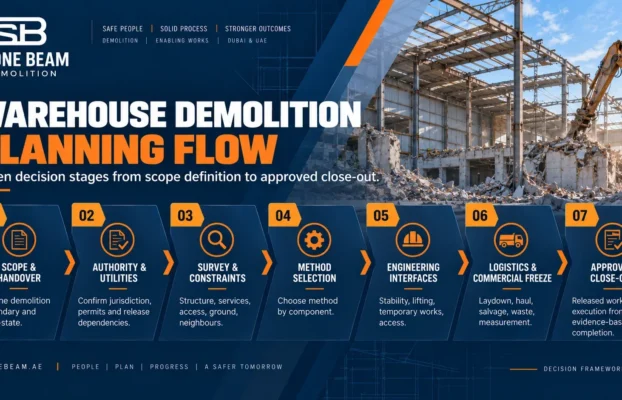
The owner assigns a DEWA-enrolled demolition contractor, while the contractor manages the application path described by DEWA. On a live project, keep that interface aligned with the main demolition planning workflow so utility status, method planning, and mobilisation dates do not drift apart.
Telecom NOC Before Demolition: Which Provider Applies?
The Dubai Development Authority demolition permit service currently lists a NOC from the Telecom Service Provider for mechanical demolition. That wording is useful because it does not assume one operator for every plot.
du publishes a general No Objection Certificate process for property developers, consultants, and contractors. Its process covers design validation, materials, and inspections for telecom infrastructure. It is not presented as a universal demolition procedure, so use it only when du is the relevant provider or the authority route points to it. In Trakhees-governed areas, use the current PCFC/Trakhees Demolition and Removal NOC service as the jurisdiction-specific reference rather than generalising another authority’s telecom route across Dubai.
For e& or another telecom operator, confirm the current provider route from the authority, network records, or project correspondence. Do not copy one operator’s submission documents, validity or inspection steps into another operator’s workflow.
A practical telecom verification sequence
- Identify the licensing authority and the plot’s telecom service provider before preparing the NOC package.
- Confirm whether the demolition affects service entry points, ducts, chambers, risers or external network assets.
- Use the provider named by the current authority route; do not assume that both major telecom operators are required.
- Keep the telecom clearance status separate from the main demolition-permit status and from physical service isolation on site.
Is a Gas NOC Required Before Demolition?
Not as one universal Dubai requirement. “Gas NOC” is an umbrella phrase that hides different asset owners and risks. The correct question is whether the work affects a gas service, hydrocarbon pipeline, protected facility or operator NOC zone, and who owns that asset.
For example, Dubai Supply Authority (DUSUP) operates its pipeline NOC process through RTA’s E-NOC system. DUSUP states that work within its NOC zone requires review and that no work is to be carried out within 60 metres of a pipeline or related facility without an approved written DUSUP NOC.
That DUSUP rule belongs to the DUSUP pipeline context. It must not be rewritten as “all Dubai demolition needs a DUSUP NOC” or “all demolition needs a gas NOC.” A building gas-service interface may involve a different operator and a different release process.
Do not confuse pipeline clearance with process gas-freeing
A pipeline NOC protects an external asset corridor. Gas-freeing, hazardous-area control, and process isolation inside an industrial facility are separate process-safety subjects. They require the facility’s permit system and competent process/HSE review, not a generic demolition checklist.
When Is a Master Developer or Community NOC Required?
A master-developer or community NOC enters the route when the property sits inside a managed development that controls alterations, access, contractor entry or common assets. For example, Emaar Community Management’s current home-modification guidance tells residents to apply for a Home Modifications NOC for alterations in the relevant community.
That type of community approval does not replace the government permit. It adds another control layer around the property and may also affect access, working conditions or contractor entry.
First-party evidence: one managed-community approval record
Stone Beam reviewed an anonymised February 2026 managed-community villa NOC in its project records. The record approved a defined home-modification scope, but structural element removal, a villa extension and lift installation remained conditional on separate government approvals before commencement. The record stated that failure to obtain the required Dubai Municipality approval voids the community NOC.
This is one anonymised project record, not a universal community rule. Its value is the approval logic: community NOC first did not equal structural workface release. Owners planning villa works should also review the separate villa demolition service requirements for the demolition scope itself.

Where Do NOCs Sit in the Demolition Approval Workflow?
NOCs sit mainly in the pre-mobilisation readiness clock. They close defined objections or dependencies before the demolition authority, project team, and site controls release the relevant workface. The exact route is not one fixed sequence because some clearances run in parallel and different authorities integrate different services.
Clock 1 – Pre-mobilisation readiness
This clock covers jurisdiction confirmation, authority submissions, utility and telecom interfaces, master-developer controls, engineering/HSE inputs, access and document comments. DEWA, telecom and asset-owner NOCs belong here when their triggers apply.
Readiness Gate A
Readiness Gate A is Stone Beam’s editorial planning model, not a Dubai government service. It marks the point where the applicable releases, isolations, access conditions, and technical controls are sufficiently closed for the defined demolition workface to proceed under the accepted project controls.
Clock 2 – Physical execution and handover
This clock starts with the released workface and covers site establishment, protection or enabling works, demolition, debris handling and the agreed handover. A fast physical demolition method does not shorten an unresolved NOC or utility dependency in Clock 1.

What Changes the Approval Path, Documents, Timeline and Compliance Risk?
The approval path changes when one of the underlying triggers changes. The table below is more useful than a fixed “documents required” list because it shows what must be checked before the list is built.
| Variable | Why it changes the NOC path | Decision before submission |
| Licensing authority | Dubai Municipality, DDA, and Trakhees do not use an identical permit route. | Confirm the plot authority and use its current demolition service. |
| Full vs partial demolition | Partial work leaves retained structure and may require drawings that define the demolition area. | Freeze the demolition boundary before utility and authority submissions. |
| Demolition method | Some authorities add NOCs or studies for higher-risk methods. | Do not reuse a mechanical-demolition checklist for another method. |
| Utility status | Existing accounts, deactivation, diversions, or retained supplies affect the utility interface. | Separate documentary approval from the physical service condition. |
| Telecom provider | The relevant operator and network assets vary by plot. | Confirm the provider before preparing operator-specific documents. |
| Pipeline / gas asset | Protected pipelines and building gas services have different owners and procedures. | Identify the actual asset and operator; apply only the triggered NOC route. |
| Master developer / community | Managed developments add access, alteration, or community-control layers. | Check the community route without treating it as the government permit. |
| Retained/adjacent assets | Existing services or structures may require separate investigation and protection. | Feed verified findings into the method and readiness plan before release. |
Where live services or hidden assets are uncertain, the project team should confirm the investigation route before intrusive work. The concrete scanning guide covers a separate investigation topic for concrete, reinforcement, post-tensioning, and service detection. Scanning itself is not an authority NOC or permission to cut.
Common NOC Verification Failures Before Demolition
The items below are operational verification risks, not a published rejection list from one Dubai authority. They are included because each failure creates a predictable gap between paperwork and a released demolition workface.
- Treating one authority’s NOC list as a Dubai-wide checklist.
- Submitting separately to DEWA for a Dubai Municipality project when the current Dubai BPS integration is the applicable route.
- Assuming that an approved NOC proves the utility is physically disconnected or safe for demolition.
- Using the wrong telecom provider’s documents or assuming that both operators are always required.
- Calling every gas or pipeline interface a universal “gas NOC.
- Starting structural work because a master-developer NOC exists while the required government permit or structural approval is still open.
- Allowing the demolition boundary, owner details, drawings, or scope to change without checking whether the NOC package must be revised.
- Failing to align authority status with site access, method planning and the contractor’s mobilisation programme.
Information Needed Before a Final NOC and Approval Decision
A useful NOC review starts with inputs, not a template. Before a contractor or consultant gives a final approval-path answer, collect the following information:
- Plot number, location, and the authority that licenses the building or development.
- Owner and consultant details, plus the party appointed to submit the demolition package.
- Full or partial demolition boundary, including retained structure and retained services.
- Current drawings, setting-out information and available utility records.
- DEWA account/service status and whether electricity or water must be retained, diverted or deactivated.
- Telecom provider and known ducts, chambers, building entry points or external assets.
- Known gas service, pipeline corridor or facility operator information.
- Master developer or community manager, including contractor-entry requirements.
- Proposed demolition method and any authority-specific additional NOCs tied to that method.
- Access, neighboring assets, work-hour constraints, and the required handover condition.
Demolition NOC FAQs
Do all demolition projects in Dubai need the same NOCs?
No. The required set varies with the licensing authority, demolition method, utilities, telecom provider, protected assets, and master-developer controls.
Is the DEWA demolition NOC the same as the demolition permit?
No. DEWA manages the electricity/water clearance layer. The main demolition permit remains with the relevant building authority.
Do Dubai Municipality projects apply separately to DEWA?
DEWA’s current service says projects requiring a Dubai Municipality demolition permit apply through Dubai BPS. DEWA receives the request through the integration, so a separate DEWA-channel application is not required for that scenario.
Does every demolition need a gas NOC?
No universal rule was identified. First, identify the gas or pipeline asset and its operator. DUSUP, for example, has a defined pipeline NOC route through RTA E-NOC for work in its protected zone.
Is a master-developer NOC enough to start demolition?
No. A community or master-developer NOC is a separate control layer. Government permits, utility, and technical releases still follow the applicable project route.
How long does a DEWA demolition NOC take?
DEWA currently publishes a 10-working-day target for its combined demolition approval. That is a DEWA service target, not the total demolition-project duration.

| Project-specific NOC review: provide the plot authority, demolition boundary, available drawings, utility status, telecom/gas interfaces, community controls, and access constraints before the approval path is fixed. Send the project details. |