


Advanced Demolition in Dubai: A Complete Guide from Planning to Recycling (2025)
Stone Beam Demolition, a leading Demolition Company in Dubai, presents an expert guide on advanced building demolition – from meticulous planning and Dubai Municipality Demolition Permits to cutting-edge techniques like قص الخرسانة and GPR Scanning Dubai. Whether you’re preparing for a full Villa Demolition or a complex industrial teardown, this comprehensive guide leverages our experience as a top Demolition Contractor Dubai to ensure your project is safe, efficient, and compliant. We cover everything project owners and managers need to know: demolition safety procedures, regulatory steps, interior strip-outs, هدم المباني best practices, and sustainable construction waste recycling Dubai. Let’s dive in to plan and execute your demolition project with confidence and expert insight.
Table of Contents
- Demolition in Dubai: Key Considerations
- Planning a Demolition Project (Permits & Preparation)
- Safety Measures and Site Preparation
- Advanced Demolition Techniques (Concrete Cutting & GPR)
- Traditional vs. Advanced Demolition – A Comparison
- 7-Step Demolition Project Journey (Infographic)
- Case Studies: Stone Beam’s Demolition Expertise
- Case Study 1: Full Villa Demolition with Strip-Out in Jumeirah
- Case Study 2: Precision Slab Removal in Al Quoz (GPR Scanning & Cutting)
- Case Study 3: Industrial Demolition of a Fuel Station (Oil & Gas)
- FAQs: Advanced Demolition in Dubai
- Internal Links – Related Services
Demolition in Dubai: Key Considerations
Dubai’s rapid development and strict regulations mean demolition projects here require advanced planning and adherence to high standards. Advanced demolition refers to using modern techniques, expert planning, and compliance with local laws to safely dismantle structures. Unlike simplistic knock-down jobs, advanced methods minimize risk, control environmental impact, and often save time and cost in the long run. Here are key factors to consider in Dubai’s demolition landscape:
- Regulatory Compliance: Every demolition (from a single villa to a multi-story building) must be approved by Dubai authorities. In fact, Dubai Municipality (DM) requires an official permit for any building demolition or even significant interior removal, with detailed plans and safety measures submitted before work beginsalmrooj.ae. Only licensed demolition contractors can obtain such permits, ensuring they meet experience and safety criteriastructuralsolutions.ae. As a certified contractor, Stone Beam Demolition navigates this process for clients, making sure all paperwork and approvals are in place in compliance with DM Demolition Permits.
- Licensed Contractors: It’s not just about getting a permit – who does the demolition matters. Dubai mandates that the contractor be properly licensed for demolition activities, hold a Dubai Civil Defence safety certification, and submit a detailed method statement and risk assessment for the jobstructuralsolutions.ae. Hiring an experienced Demolition Contractor in Dubai like Stone Beam ensures your project has qualified supervision and adheres to approved procedures. As a result, you avoid legal issues and safety risks that come with unqualified teams.
- Urban Environment & Safety: Dubai’s dense urban areas (from Jumeirah villas to Al Quoz industrial zones) often mean demolition sites are close to neighboring properties or public areas. Thus, demolition safety procedures and precautionary measures are paramount. Expect requirements like protective hoardings, dust control, noise mitigation, and careful sequencing of work to prevent any uncontrolled collapses. Advanced demolition companies have experience working in tight urban sites with minimal disruption to the community.
- Environmental Responsibility: Modern demolition isn’t just smash and haul; it involves sustainable practices. Dubai’s Vision 2040 and green building regulations emphasize recycling and reuse of materials. Construction waste recycling is not only good practice but in many cases required – Dubai Municipality regulations mandate at least 50% of demolition waste by volume or weight be diverted from landfills through reuse or recyclingecomena.org. Advanced contractors will plan for sorting materials (concrete, steel, wood, etc.), salvaging where possible, and properly disposing of hazardous waste. This not only reduces environmental impact but can reduce disposal costs and even generate scrap value to offset project expenses.
- Project Complexity: Demolition projects range from full building demolitions (clearance of an entire structure) to interior strip-outs (removing non-structural elements for renovation). They may also involve partial demolitions where part of a structure is retained. More complex projects (like high-rises or industrial facilities) require advanced engineering – including structural analysis, Concrete Scanning (GPR) to detect hidden elements, and possibly phased demolition plans. Understanding the scope and complexity of your project will determine what expert services and planning are needed.
By considering these factors, project owners can appreciate why “advanced demolition” is essential in Dubai. Next, we’ll detail how to plan a demolition properly – from initial consultation through permit approvals and site preparation.
Planning a Demolition Project (Permits & Preparation)
Thorough planning is the foundation of a safe and successful demolition. In this phase, Stone Beam Demolition leverages its extensive experience to guide project owners through legal requirements and preparatory steps. Below is a breakdown of the planning stage:
- Initial Consultation & Site Assessment: Every project begins with understanding the client’s goals and the site’s condition. We conduct an on-site assessment to evaluate the structure (size, construction type, structural integrity) and its surroundings (neighboring buildings, access roads, utilities). For example, if it’s a villa demolition, are there trees or landscaping to preserve? If it’s a commercial building, what’s the proximity to other structures? We discuss whether it’s a full demolition or a partial demolition/strip-out. This is the time to identify any special challenges (like asbestos, confined space, or the need for excavation services Dubai to remove foundations or underground tanks). Our team also explains the typical timeline and budget expectations, emphasizing transparency in quoting and deadlines – clients receive a clear, itemized quote and an honest project duration estimate.
- Dubai Municipality Permits and Approvals: Navigating the permit process in Dubai is a critical step. As a certified demolition contractor, we handle the permit application on behalf of the client. This involves preparing a detailed demolition plan to submit to Dubai Municipality (or the relevant authority like DDA in certain zones). The plan includes architectural drawings of the structure, the proposed method of demolition, and a waste management plan. Authorities also require NOCs (No Objection Certificates) from utility providers: for example, disconnection letters from DEWA (water & electricity) and telecoms (Etisalat/Du) to ensure power, water, and communications are safely cut off before demolitionstructuralsolutions.ae. If the project is in a controlled development (like a free zone or a master community), approvals from the developer or authority (e.g., Nakheel, EMAAR) may be neededstructuralsolutions.ae.
Demolition Permit Requirements: Dubai Municipality’s permit stipulations ensure only qualified teams perform demolitions under safe conditions. Key requirements include hiring a licensed engineering consultant to oversee the project, appointing an approved demolition contractor (like Stone Beam), and submitting a structural report if only part of the building will be demolishedstructuralsolutions.ae. A Demolition Safety Plan must also be submitted, detailing how you will control dust, noise, debris, and protect adjacent propertiesstructuralsolutions.ae. Only when all documents are in order and compliance is demonstrated will DM issue the demolition permit. Typically, the approval process can take about 7–10 working days under Dubai Municipality (longer if corrections are needed)structuralsolutions.ae. We keep our clients updated throughout and ensure swift responses to any municipal queries to avoid delay.
- Utility Disconnections and Site Preparation: Once permits are in progress, preparatory site work begins. All utilities (electricity, water, gas, and even chilled water or solar if present) must be safely disconnected or rerouted. We coordinate with DEWA for power/water cut-off and with Civil Defence for any fire alarm disconnections. If the building had septic tanks or fuel tanks (common in industrial or older sites), those are emptied and made safe (often an external tanker service handles hazardous liquids). For an oil and gas demolition scenario like a fuel station (see Case Study 3), this step is critical – cleaning out fuel lines and tanks to eliminate fire risk. Site prep also involves installing temporary facilities: site office, first aid station, and security fencing. According to DM regulations, demolition sites must be enclosed with proper fencing and signage to keep the public safedm.gov.ae. We also plan traffic management if debris trucks will impact nearby roads.
- Method Statement & Risk Assessment: A comprehensive method statement is drafted, which outlines step-by-step how the demolition will be executed, the equipment to be used, and the sequence of work (e.g., first remove roof, then upper floor slab, etc.). Alongside, a risk assessment identifies potential hazards (falling debris, structural instability, dust, noise) and mitigation measures for each. For instance, if part of the structure will remain, we plan temporary supports or bracings as needed. This documentation isn’t just bureaucratic – it’s our blueprint for a controlled demolition. We share key points with all crew members so everyone knows the game plan.
- Neighbor Notifications: Though not always formally required, it’s a good practice to inform neighboring properties or tenants about the upcoming demolition schedule. Dubai Municipality may require evidence that neighbors were notified, especially for villa demolitions in residential areas. Stone Beam provides guidance or even handles this communication to maintain good community relations. This typically includes sharing the demolition dates and safety measures (like dust control) to assure neighbors that disturbance will be minimized.
Planning is often the longest phase, but it’s time well spent. By the time we’re ready to break ground (or rather, break walls), we have all permits in hand, all precautions set, and a clear roadmap to follow in compliance with DM regulations and safety standards. Next, we’ll discuss the safety measures and on-site preparations crucial before any structure comes down.
Safety Measures and Site Preparation
Safety is the cornerstone of demolition work – no structure is taken down before robust safety measures are in place. In Dubai, this is not just best practice but a legal requirement enforced by authorities. Stone Beam Demolition’s approach to safety is proactive and thorough, protecting our workers, clients, the public, and even the project’s future timeline (accidents can cause costly delays). Here’s how we implement safety and prep the site:
- Dedicated Safety Officer: As per Dubai Municipality’s Code of Construction Safety Practice, any substantial demolition project must appoint a qualified safety officer or manageralmrooj.ae. Stone Beam always has an HSE (Health, Safety, Environment) officer on our team for major demolitions. This person continuously monitors compliance with safety rules, conducts toolbox talks each day, and coordinates any incident response. Having a safety expert on-site is a DM requirement and simply the right thing to ensure everyone goes home safe each day.
- Demolition Safety Plan: We prepare a detailed safety plan (often submitted during permitting) and execute it on site. This covers dust control, noise reduction, debris containment, and emergency procedures. For dust suppression, we install misting machines or use water sprays during demolition to prevent dust clouds (especially important in dense areas to maintain air quality). Noise is mitigated by scheduling heavy breaking during permissible hours and using equipment with noise dampening where possible. Debris nets and protective covers are placed if there’s a risk of flying debris – for example, when using jackhammers on high elevations, scaffolding with netting or catch-fans is erected to catch falling piecesdm.gov.ae. Adjacent structures are given extra protection like plywood boards or padding on shared walls, as adjacent property protection is mandatory before work startsstructuralsolutions.ae.
- Structural Stability & Temporary Supports: Before and during demolition, we constantly assess the structure’s stability. If we are doing a partial demolition or strip-out, it’s critical to shore up any remaining parts. For example, removing a load-bearing wall requires installing temporary beams (needling) or supports to carry the load above. Our engineering team checks the building plans and may conduct on-site structural scanning or inspections to locate critical support elements. In some cases, we use steel props or scaffolds to support ceilings or beams until the demolition is complete. This careful approach prevents unintended collapses and is part of the risk mitigation strategies in our method statement.
- Utilities and Hazardous Materials: By the time we begin physical teardown, all live utilities are confirmed disconnected – our team double-checks to avoid any electrical shock or gas leak risks on day one. We also scan for hazardous materials. Asbestos was commonly used in old building materials (roof sheets, insulation) and must be handled by certified removal experts prior to general demolition. If the structure has any signs of asbestos or other hazardous waste (like chemical residues in industrial facilities), we coordinate specialized removal and clearance certificates as required by DM. In oil and gas demolition projects, there may be contaminated soil or fuel residues; we work with environmental consultants to remediate these safely (for instance, by soil testing and using vacuum trucks to remove any remaining fuels). All hazardous waste is segregated and sent to authorized treatment facilities per municipal regulations.
- Personal Protective Equipment (PPE): Every crew member is equipped with appropriate PPE at all times. Hard hats, high-visibility vests, steel-toe boots, gloves, and dust masks or respirators (especially when cutting concrete or in dusty environments) are standard. For tasks like قص الخرسانة or jackhammering, we enforce hearing protection and face shields as well. Stone Beam’s strict PPE policy ensures no worker or visitor is on site without protection. We also keep first aid kits on site and have trained first aiders in the team.
- On-site Safety Protocols: We establish clear zones on the site: the active demolition zone (where only essential crew are allowed), buffer zones, and viewing areas for supervisors or client reps if they need to observe. Barriers and warning tapes mark these zones. We implement a “permit to work” system for any particularly hazardous operations, meaning the safety officer must review and sign off before, say, working at height or entering a confined space. Emergency protocols are in place – for example, an evacuation route is mapped, and fire extinguishers are kept within reach. Given the high temperatures in Dubai, we also schedule breaks and hydration to prevent heat stress incidents.
- Monitoring and Adjusting: During demolition, conditions can change rapidly (for instance, an unexpected structural quirk or shift). Our team conducts continuous monitoring. Vibration monitors might be installed if there are concerns about affecting nearby structures (especially for mechanical demolition near other buildings). Noise and dust levels are also monitored to ensure compliance with limits (Dubai has guidelines for construction noise levelsdm.gov.ae). If anything is trending beyond acceptable range, we pause and adjust methods – for example, cutting elements into smaller pieces to reduce vibration or increasing water spraying to catch dust. This responsive approach is crucial for both safety and community relations.
By implementing these safety measures, Stone Beam Demolition maintains an impeccable safety record. Our commitment is evidenced in every project phase: we plan for safety, invest in training, and enforce standards rigorously. This not only protects everyone involved but also keeps the project on schedule (accidents and shutdowns can be far more costly than any preventative measure!). With safety and site prep addressed, we move on to the core of our topic – the advanced techniques that set modern demolition apart from old-fashioned wrecking balls.
Advanced Demolition Techniques (Concrete Cutting & GPR)
One major aspect that distinguishes advanced demolition is the use of specialized techniques and equipment to carry out the work with precision, speed, and minimal disruption. Stone Beam Demolition employs state-of-the-art methods such as diamond wire Concrete Cutting, GPR concrete scanning, and robotic demolition to handle challenging structures that conventional methods struggle with. Let’s explore some of these key techniques:
Concrete Scanning (GPR Scanning in Dubai)
Before any cutting or heavy demolition on structural elements, we perform Concrete Scanning using Ground Penetrating Radar (GPR). This is essentially an X-ray for concrete slabs and walls, allowing us to “see” inside before we cut or tear down. Why is GPR Scanning important, and is it mandatory? In practice, Dubai regulations strongly emphasize safety and preventing damage to shared infrastructure. While not explicitly required by law in every case, GPR scanning has become a standard prerequisite for advanced contractors before cutting into concrete or initiating structural demolition. It helps locate:
- Reinforcing Steel (Rebar): Large buildings in Dubai are heavily reinforced with steel rebars. Cutting through rebar blindly can be dangerous (it can cause saws to jam or structures to behave unpredictably). Scanning maps out the rebar grid so we can cut in safe zones or plan extra support if cutting near load-carrying rebars.
- Post-Tension Cables: Many modern slabs are post-tensioned; cutting a tensioned cable accidentally can cause a sudden snap (extremely hazardous) and compromise structural stability. GPR detects these cables so they can be avoided or carefully de-tensioned prior to demolition.
- Utilities and Embedments: Especially in renovations or partial demolitions, walls and floors may conceal electrical conduits, plumbing, or HVAC lines. GPR scanning identifies anomalies that could be piping or wiring, so we don’t cut through live services. In older industrial sites, it might even find things like old fuel lines in concrete.
- Thickness and Voids: GPR can gauge slab thickness and detect voids or honeycombing inside concrete. This is useful to plan the right equipment – for instance, a thicker section might be better tackled with a wire saw than a handheld cutter.
In one example (see Case Study 2), our team used GPR scanning on an old factory slab in Al Quoz and discovered an unexpected embedded steel beam and an abandoned cable conduit. By finding these ahead of time, we adjusted our cutting plan, saving potential damage. In short, GPR Scanning in Dubai demolition projects is considered essential for precise, accident-free work. It’s a small upfront step that prevents costly surprises and is often required by consultants or clients for safety assurance.
Precision Concrete Cutting (Diamond Wire Saws & More)
Gone are the days of relying solely on noisy jackhammers or wrecking balls for every demolition task. قطع الخرسانة has become an art and science of its own, especially for selective demolition or cutting large structures into manageable pieces. Stone Beam’s arsenal includes diamond blade wall saws, floor saws, core drills, and diamond wire saws – each suited to different tasks:
- Wall Sawing & Floor Sawing: These are track-mounted saws with industrial diamond blades, used to cut straight through concrete walls or slabs. Need a new opening for a door or window in a remaining wall? A wall saw can cut a precise rectangular opening with surgical precision, leaving clean edges. Floor saws (also called slab saws) cut horizontally – for instance, slicing a slab into sections or making trenches in a concrete floor. These saws are fast and accurate, and they produce less vibration than impact tools, protecting the structure’s integrity.
- Core Drilling: When we need circular openings (for plumbing, HVAC, or anchoring points) or to take concrete samples, we use core drills. For demolition, core drilling might be used to create pilot holes for threading a wire saw (more on that next) or to weaken a structure in a controlled way (drilling out key points). It’s also a quiet method to remove concrete in cylinders if needed.
- Diamond Wire Sawing: Diamond wire cutting is a game-changer for heavy concrete and steel cutting. It involves a cable embedded with diamond beads that is looped around a large concrete mass and pulled continuously to slice through it. The benefits of diamond wire sawing are tremendous: it can cut through any thickness of concrete or even reinforced concrete and steel, and it’s highly accurate, leaving clean, smooth surfacesbluegrassbit.combluegrassbit.com. We use wire saws for things like cutting bridge piers, thick foundation blocks, or entire building sections. For example, if a building’s column or shear wall needs removal, a wire saw can cut it at the base without causing vibrations that might crack the remaining structure. It’s also relatively quiet and safe – no percussive banging, and with remote operation, workers can stand clear during the cut. Diamond wire sawing produces less dust and can be done wet (water-cooled) to eliminate dust and heatbluegrassbit.com. Because of its precision and efficiency, wire sawing often speeds up complex demolitions – what might take days of hacking can be done in hours. It is considered one of the safest and most efficient advanced demolition methods, ideal for dense urban environments where control is paramountbluegrassbit.combluegrassbit.com.
- Hydraulic Breakers & Robots: Not all demolition is cutting; sometimes you need to break apart concrete, especially for total demolition of a structure. Instead of manual labor with jackhammers, we deploy hydraulic excavator-mounted breakers for heavy work. For interior demolition or small spaces, robotic demolition machines (remote-controlled demolition robots) can be used. These compact robots wield breakers or crushers and can operate in confined areas (like inside a building floor) where using larger equipment isn’t feasible. They keep operators at a safe distance and reduce risk in hazardous spots (for instance, on weakened floors).
- Controlled Explosive Demolition: For completeness, it’s worth mentioning that in some rare cases, implosion (using explosives) is an advanced technique used to bring down tall structures rapidly. However, in Dubai, explosive demolition is tightly regulated and uncommon due to the close proximity of other buildings and infrastructure. It’s typically reserved for large isolated structures and requires months of planning with government approval. Stone Beam focuses on mechanical and cutting methods which are more suitable for most projects here, offering greater control.
By utilizing these advanced techniques, we achieve faster, safer, and more precise results compared to traditional methods. For instance, instead of battering through a reinforced concrete wall for hours (causing noise and micro-fractures), a combination of GPR scanning and wire sawing can cleanly detach the wall in a planned cut, which is then carefully lifted away by crane. This precision is especially critical when only part of a structure is removed (we avoid collateral damage to the parts meant to stay).
Moreover, advanced techniques contribute to cost-effectiveness. While the equipment is high-tech, it can save time (and time is money) by completing tasks faster and avoiding over-break or damage that would require repair. It also improves worker safety, as tasks are more controlled.
Next, we will compare how these advanced methods stack up against traditional demolition approaches in a quick comparison table, highlighting differences in cost, time, safety, and recycling outcomes.
Traditional vs. Advanced Demolition – A Comparison
To truly appreciate the benefits of advanced demolition methods, let’s compare them side-by-side with traditional demolition approaches. The table below contrasts key factors:
| Aspect | Traditional Demolition | Advanced Demolition |
| Cost | Lower upfront cost (basic equipment & labor); however, can escalate due to longer project duration and unforeseen damages. Example: extensive manual labor might seem cheap but takes more time, increasing overall labor hours. | Moderately higher upfront cost (specialized equipment & expertise) but often more cost-effective overall. Faster completion means lower labor hours and indirect cost savings (earlier project start for new construction). Precision work reduces damage, avoiding costly repairs. |
| Time | Slower – manual or mechanical brute force methods can take significantly longer, especially for large concrete volumes. There’s also more downtime for cleanup of messier demolition. | Faster – efficient cutting and controlled techniques complete tasks in less time. For example, diamond wire sawing can cut through a thick column in hours versus days of jackhammering. Overall project timeline is shorter, which benefits developers and owners. |
| Safety | Higher risk – traditional methods involve more uncontrolled force (increasing chances of collapse or accidents). Workers are often in closer proximity to falling debris. Noise, vibration, and dust are typically higher, affecting not just workers but also neighbors. | Safer – planned approach minimizes uncontrolled events. Technologies like remote-controlled robots and wire saws keep personnel out of harm’s way. Lower vibration and noise reduce the risk of structural surprises and community disturbance. Rigorous adherence to demolition safety procedures (safety plans, monitoring) is integral to advanced methods. |
| Precision | Low precision – it’s difficult to selectively remove only certain parts of a structure; often results in collateral damage to adjacent elements that weren’t targeted. Cuts are rough. Suitable mainly when the entire structure can be wrecked without concern for anything around it. | High precision – selective demolition is possible (e.g., removing one wall or floor while preserving others). Advanced cutting yields clean edges and targeted removal. This precision is crucial for partial demolitions or remodels. It also ensures structural integrity of what remains. |
| Recycling Rate | Typically lower – demolition rubble is often mixed. Traditional demolition may simply send mixed debris to landfill due to difficulty in separation. Salvage of materials (doors, fixtures, rebar) is less systematic. | Higher – advanced planning includes construction waste recycling strategies. Materials are often separated during demolition: concrete can be crushed for reuse, metals are sorted for recycling, and fixtures/wood can be salvaged. By using methods like strip-out prior to structural demo, we maximize recycling (often exceeding Dubai’s 50% waste diversion mandateecomena.org). |
In summary, advanced demolition techniques come out ahead in most categories that matter to project owners: improved safety, speed, precision, and environmental compliance. While initial costs may be higher for using a specialized contractor with the right equipment, the return on investment is seen in smoother execution and fewer headaches.
Dubai’s construction industry is increasingly recognizing these benefits, which is why major projects now insist on experienced demolition experts like Stone Beam for the job. The next section will walk you through the typical journey of a demolition project from start to finish, summarizing the steps in a handy 7-step “infographic” style format.
7-Step Demolition Project Journey (Infographic)
(Follow the journey of a successful demolition project in Dubai, from the first call to the final cleared site. Below are the seven key steps, each highlighting important services and checkpoints along the way.)
Step 1: Consultation & Site Survey – It all begins with a conversation. The client contacts Stone Beam Demolition (often through a free consultation request) to discuss their needs – be it a villa teardown, an office strip-out, or an industrial removal. Our experts visit the site to conduct a thorough survey. At this stage, we identify project type (full هدم المباني vs. partial), note any constraints (e.g., proximity to other structures, access for machinery), and advise on initial feasibility. We also check for any obvious hazards like asbestos or structural instabilities. The result: a clear understanding of the project scope and a proposal that outlines the approach, timeline, and budget. (Relevant services: consultation, site assessment, initial project planning.)
Step 2: Planning & Permit Approvals – With the project green-lit by the client, we move into planning mode. Our team prepares all necessary documents for the Dubai Municipality Demolition Permits (or relevant authority). We engage a licensed consultant engineer if required to draw up plans and structural reports. All paperwork – from demolition drawings to the waste management plan – is submitted through the municipal e-portal. Meanwhile, we arrange utility disconnections (DEWA, Etisalat/Du) and obtain any needed NOCs. During this period, we refine the method statement and safety plan ready for approval. By the end of Step 2, we have the demolition permit in handstructuralsolutions.ae, meaning authorities are satisfied that our plan meets safety and environmental regulations. (Relevant services: permit handling, regulatory compliance, project management.)
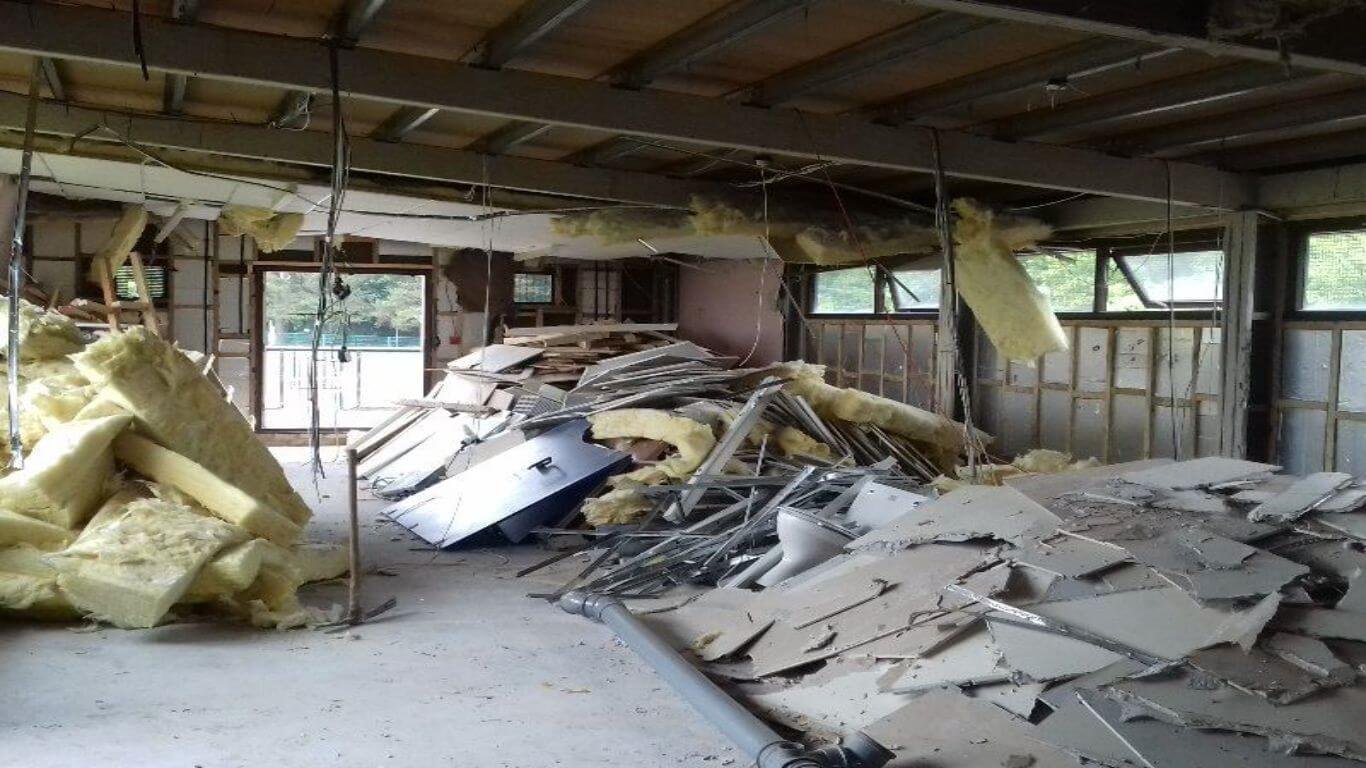
Step 3: Pre-Demolition Preparation – Now the action begins on-site, even before any demolition. We mobilize our crew and equipment to the site. The first tasks: erecting safety fencing around the property, posting warning signs and permits, and setting up temporary utilities (portable office, generator if needed). Inside the structure, if it’s a building with interiors, we start with a strip-out – removal of all non-structural elements: doors, windows, fixtures, drywall, false ceilings, HVAC ducts, etc. (This is often termed Interior Strip-Out Villa in residential projects). Stripping out not only readies the structure for heavy demo, but it also segregates materials for recycling (e.g., metal fixtures to scrap, reusable items salvaged). We also mark structural elements to remain versus those to demolish. At this stage, our engineers perform GPR Scanning on critical structural members to locate rebar and embeds, and mark safe cut lines. The site is now prepped: cleared of loose items, hazardous materials handled, and fully barricaded for the next step. (Relevant services: interior strip-out, concrete scanning, site setup.)
Step 4: Demolition Execution – The core demolition work is carried out in a controlled, stepwise manner. Depending on the project, this could involve different methods:
- For a villa demolition or small building: an excavator (or excavation services Dubai team) might start by gently pulling down the roof and walls, one section at a time, as workers keep hoses spraying water to control dust. If the villa is attached to another, we use manual and mechanical methods carefully along the shared walls to avoid damage next door.
- For a large building or industrial structure: we might use a combination of قص الخرسانة and machine demolition. For example, cut a structural beam with a diamond saw to weaken a section, then use a hydraulic breaker to collapse it inward. Precision Concrete Cutting with wire saws is employed for any thick columns or foundations as planned. We follow the engineered sequence – usually top-down for buildings (floor by floor) or sectional for spread-out structures.
Throughout execution, safety spotters are present, and debris is continuously cleared to keep the site tidy. We ensure that debris never piles up dangerously (which could overload floors) – instead, it’s either processed on the fly or moved to ground level via chutes or machinery. Stone Beam’s experienced operators and supervisors coordinate in real-time, often communicating via radio headsets, to make sure each action (cut, push, lift) is done when everyone is ready and in position. (Relevant services: mechanical demolition, controlled demolition, concrete cutting.)
Step 5: Waste Removal & Recycling – As sections of the structure come down, the focus shifts to handling the debris responsibly. We separate materials on-site: concrete debris is usually piled separately – later it may go to a crusher plant for recycling into aggregate. Metal scraps (rebar, steel beams, piping) are extracted with magnets or by hand and sent to metal recycling facilities. Wood, glass, and plastic waste are sorted as feasible. By maintaining this segregation, we meet the Construction Waste Recycling targets (remember, Dubai expects 50%+ of C&D waste to be diverted from landfillecomena.org). Stone Beam provides documentation of recycling rates at project end, which can be important for green building certifications or simply corporate responsibility records. We also properly dispose of hazardous materials (for instance, sending any asbestos or chemical waste to DM-approved treatment sites). This step often runs in parallel with demolition execution, but continues until the site is cleared of all debris. (Relevant services: waste management, recycling, debris hauling.)
Step 6: Site Clearance & Cleanup – Once demolition and debris removal are complete, we ensure the site is left in a clean, graded condition. This includes removing any temporary facilities, sweeping the plot for smaller debris, and if required, compacting the soil or backfilling any holes (especially if underground tanks or pits were removed – we fill those for safety). The site should be safe for the next phase of development, whether that’s new construction or leaving it as open land. Stone Beam prides itself on thorough cleanup – often, clients are pleasantly surprised to see an almost “broom-swept” level of cleanliness. At this stage, we also arrange for a final inspection by Dubai Municipality (for DM to close the demolition permit). The inspector will check that the site is cleared of demolition waste, no safety hazards remain (like protruding rods or open pits), and surrounding properties were unharmedstructuralsolutions.ae. Once the inspection is passed, the authorities issue a completion certificate or permit closure documentstructuralsolutions.ae. (Relevant services: site remediation, final inspection coordination.)
Step 7: Handover & Next Steps – The last step is handing over the site (and documentation) back to the client. We provide the client with all relevant papers: permit closure letter, waste disposal receipts (demonstrating recycling percentages), and any project reports or surveys conducted. If the client is moving to a construction phase, we may also liaise with their incoming contractor to share useful information (like location of any buried services capped off, etc.). We ensure the client is satisfied with the outcome – typically, seeing their old structure safely gone and a clear plot ready is a moment of relief and excitement for them. Many of our clients use this opportunity to leave a testimonial or review, noting the efficiency and professionalism of the process. And as a trusted partner, Stone Beam often continues the relationship, whether it’s providing excavation services for the next phase or being on call for any future demolition needs.
This 7-step journey demonstrates that demolition is a structured process when done by experts – each step flows into the next, with careful checks along the way. Next, let’s look at some real-world case studies where Stone Beam Demolition applied these principles to deliver successful projects.
Case Studies: Stone Beam’s Demolition Expertise
To highlight our Experience, Expertise, Authoritativeness, and Trustworthiness (E-E-A-T) in Dubai’s demolition sector, here are three mini case studies. These real-world examples show how Stone Beam Demolition tackled different challenges – from a villa teardown to a complex industrial removal – all in compliance with regulations and with innovative solutions.
Case Study 1: Full Villa Demolition with Strip-Out in Jumeirah
Project: Demolition of a 2-story villa in Jumeirah, including full interior strip-out, while preserving the original landscape (garden and perimeter trees).
Scenario: A property owner needed to demolish an old 1980s built villa to make way for a new modern home. The catch: the lush garden with mature palm trees and a perimeter stone wall had to remain untouched, as they were to be integrated into the new design. Additionally, the villa shared one wall with a neighboring villa (semi-detached structure), requiring utmost care to not disturb the neighbor’s property.
Approach: Stone Beam Demolition started with a comprehensive plan emphasizing precision and protection. First, we conducted an interior strip out of the villa. All doors, cabinets, sanitary fixtures, AC units, and false ceilings were carefully removed and recycled or salvaged. This not only prepared the structure for mechanical demolition but also increased recycling – for instance, we salvaged solid wood doors and lighting fixtures which the owner chose to donate for reuse. We obtained the Dubai Municipality demolition permit by submitting our method and safety measures (including a neighbor protection plan and a tree-protection plan for the garden). As a certified contractor experienced with villa demolition, our plan was quickly approved.
Before main demolition, the team installed protective plywood hoarding around the garden beds and trunk guards on the palm trees. We also built a temporary support on the neighbor’s side: a scaffolding with cushioned boards along the shared wall to ensure any accidental nudge wouldn’t harm the neighbor’s structure. Utility disconnects were straightforward (the villa was already vacant).
During demolition, instead of a large excavator, we used a midsize excavator with a hydraulic crusher attachment for controlled pulling of walls, chosen for its finesse and lower vibration. Starting from the roof, we collapsed the structure inward. Our crew manually detached sections adjacent to the shared wall, literally taking down that side brick by brick to avoid any shock to the neighbor’s wall. Throughout, a water spray system kept dust down within the site – important as Jumeirah is a residential area and we wanted zero complaints about dust. The safety officer monitored noise and dust; happily, readings stayed within DM’s allowed rangedm.gov.ae thanks to our mitigations.
Outcome: The villa was demolished in 10 days, right on schedule. The garden and perimeter wall were entirely unharmed – not even a scratch on the palms. We achieved a high recycling rate: approximately 85% of the materials were recycled or reused (concrete was sent to a local crushing plant to become road base, metals went to recyclers, and intact decorative items were saved). This exceeded the required 50% waste diversion easilyecomena.org. The Dubai Municipality inspector commended the cleanliness of the site during and after demolition. The project showcased Stone Beam’s commitment to precision: by treating a standard villa demo with the same care as an interior renovation (via strip-out and methodical teardown), we preserved what needed to remain and kept the client and neighbors happy. As an extra service, we also performed minor excavation to remove old foundation footings and level the plot, preparing it for the new construction. The client received their completion certificate and was able to start building the new house immediately, with the beautiful garden already in place around it.
Case Study 2: Precision Slab Removal in Al Quoz (GPR Scanning & Cutting)
Project: Dismantling a reinforced concrete mezzanine slab inside an operational warehouse in Al Quoz, using GPR scanning and precise concrete cutting to avoid structural damage.
Scenario: A manufacturing company in Al Quoz had a warehouse with a partial mezzanine floor (an elevated concrete slab covering about half the floor area) that they wanted removed to create more vertical clearance for new machinery. The challenge was that this mezzanine was tied into the warehouse’s steel frame structure. Also, the facility was partially operational – heavy demolition was not an option as it could damage equipment or interrupt business next door. The task required cutting out the slab in pieces without harming the main structure or the slab section that was to remain on the other half of the warehouse.
Approach: Stone Beam’s engineering team assessed the mezzanine drawings and did an on-site GPR concrete scan on the slab. The scan revealed the slab was 200mm thick with double-layer rebar, and importantly, identified the points where the slab was connected to the steel columns. Armed with this info, we devised a plan to cut the slab into manageable segments and lower them down safely. We secured a DM permit even though it was an internal alteration, because structural modifications in Dubai require municipal approval (including a structural engineer’s sign-off that the remaining structure would be stable – which we provided).
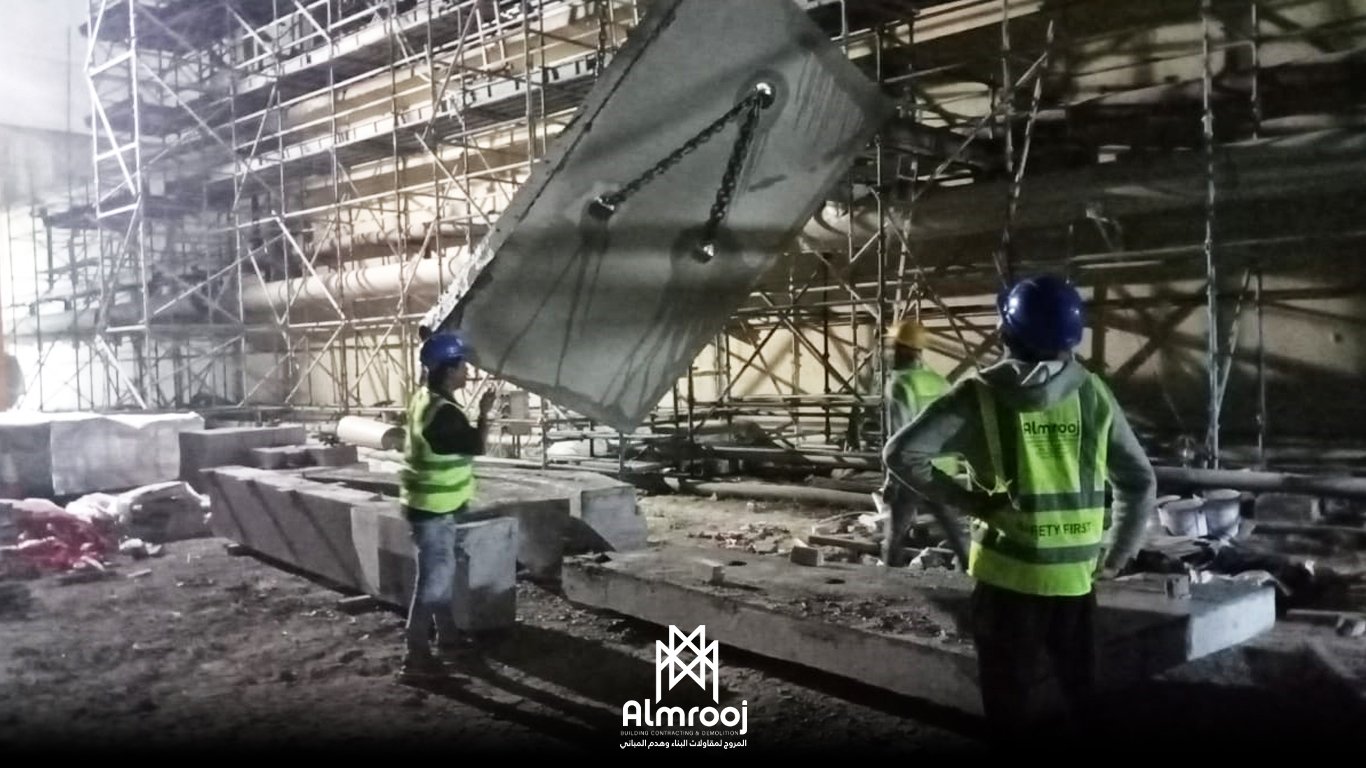
The demolition method was highly surgical: First, the client cleared all movable equipment from under the mezzanine and we erected scaffolding and safety nets under the slab to catch any small debris. Next, our crew used diamond core drills to create openings at each corner of the planned cut sections (this allowed us to thread a diamond wire for the larger cuts). We also drilled holes at connection points around columns to sever any hidden anchor rods. Then, using a combination of a diamond wire saw and a track-mounted wall saw, we cut the concrete slab into 4 large pieces (each about 4m x 5m). The wire saw was especially useful for long cuts through the thick concrete, while the wall saw handled shorter edge cuts with precision. As we cut, we attached each slab segment to a small crane (positioned through an open warehouse bay) for support. Once a segment was fully detached, it was slowly lowered down to the ground intact. This prevented any uncontrolled collapse or damage to the facility. The cutting was done mostly wet (with water cooling) to eliminate dust – vital since the client’s other operations in the building needed to stay dust-free. Noise was minimal – a huge advantage of sawing over jackhammering, which meant the neighboring units in the industrial complex weren’t disturbed (no noise complaints).
Outcome: The entire mezzanine slab was removed over a weekend shutdown, ahead of schedule. On Monday, the client resumed operations with no interruption, amazed that the large concrete structure had “disappeared” so quietly and cleanly. The precision approach ensured the main steel frame of the warehouse was not affected at all – our GPR-aided planning meant we didn’t accidentally cut into a support or cause any structural issue. The client also saved money: they initially feared the whole warehouse might need to be emptied for a messy demolition, but our targeted method confined the work area and reduced downtime. We recycled the concrete slab by transporting the cut pieces to a recycling facility. This case study illustrates why GPR scanning and advanced cutting are indispensable for selective demolition. By knowing what’s inside the concrete and cutting with diamond tools, we achieved a safe removal with millimeter accuracy. It’s a textbook example of advanced demolition in a delicate scenario, showcasing Stone Beam’s expertise in Concrete Cutting Dubai projects.
Case Study 3: Industrial Demolition of a Fuel Station (Oil & Gas)
Project: Demolition and decontamination of a decommissioned petrol fuel station in Dubai, adhering to strict environmental and safety standards in an Oil and Gas Demolition context.
Scenario: An old fuel station in a Dubai suburban area (with multiple underground fuel tanks, a canopy, and a small building) had been shut down and needed to be removed for redevelopment. Industrial demolitions like this involve not just structural demolition but also hazardous material handling – fuel residue, underground tanks, potentially contaminated soil, and old equipment. The site was near a busy road, adding a public safety aspect. The project had to comply with Dubai Municipality environmental regulations and guidelines from the Dubai Civil Defence (for fire safety during fuel tank handling).
Approach: Stone Beam Demolition approached this as both a demolition and a decommissioning project. Our plan consisted of phases:
- Decontamination & Cleaning: Before any physical demolition, we tackled the hazard. Working with a specialist subcontractor, we safely extracted the remaining fuel from the underground tanks (about 5,000 liters of residue) and degassed the tanks. Each tank was flushed with a neutralizing solution to eliminate fumes. Soil around the tank pit was tested for contamination; luckily, it was largely clean (no major leaks over the station’s life). We also removed the fuel pumps after draining lines, and we arranged proper disposal of all fuel and oily waste at a licensed facility. These steps were done under supervision of safety officers and in coordination with Dubai Municipality’s Environment Department, which often oversees such clean-ups. As an experienced industrial demolition contractor, Stone Beam ensured all permits for hazardous waste transport were obtained as required.
- Structural Demolition: Once declared gas-free, we proceeded to demolish the structures. The station had a concrete forecourt and a steel canopy. We first brought down the canopy by unbolting and cutting sections – a crane was used to lower large steel beams safely (since torch cutting was involved, fire safety watch was in place with extinguishers and a fire truck on standby per Civil Defence requirement). Next, we demolished the small building (market and office). That was straightforward – after stripping out fixtures, an excavator carefully pulled it down. The concrete paving and forecourt were broken up with a hydraulic breaker attachment. The underground tanks (after weeks of airing out) were excavated. These giant steel cylinders were lifted out of the ground one by one. We had to be cautious that even cleaned tanks can have combustible vapors, so cutting them open was done off-site at an approved facility, not on the project site.
- Safety Protocols: Throughout the demolition, safety was the top priority – even more than usual due to the prior presence of fuel. Our crew wore additional PPE like respirators during tank cleaning. No sparking tools were allowed until tanks were certified vapor-free. The site was cordoned off beyond normal, expanding the safety perimeter because of the road traffic (we didn’t want any stray debris hitting passing cars). We coordinated with traffic authorities to temporarily close a lane when the canopy beams were being craned down, ensuring public safety.
Outcome: The fuel station was successfully demolished over a 3-week period without any incidents. We disposed of about 30 tons of steel (canopy and tanks) which were recycled by a metal scrapyard. Concrete rubble was sent for recycling as well. Critically, we left the site environmentally clean – post-demolition soil tests confirmed no contamination, meaning the land was ready for new construction without costly remediation. This industrial demolition met all strict environmental safety standards: we had full documentation of waste disposal and tank decommissioning, which we submitted to authorities. Dubai Municipality closed the demolition permit after a thorough inspection, and the environmental section approved the site clearance. The client (a petroleum company) appreciated our comprehensive handling – they initially expected to have to hire multiple contractors (one for tank removal, one for demolition, etc.), but Stone Beam provided a one-stop solution. This case study underscores our capability in Industrial Demolition and specifically demonstrates how an oil and gas demolition project must be handled with an emphasis on safety, regulatory compliance, and technical know-how. From specialized cleaning methods to safe demolition practices, we delivered a project that was on-time, on-budget, and most importantly, incident-free. almrooj.ae
(The above case studies highlight Stone Beam Demolition’s versatility – from residential projects to high-tech industrial demolitions – always adhering to Dubai’s regulations and client expectations. Next, we address some frequently asked questions that many project owners have about demolition in Dubai.)
FAQs: Advanced Demolition in Dubai
Q: What is the difference between a full villa demolition and a strip-out?
A: A full villa demolition means completely tearing down the entire structure of a villa down to the ground (clearing everything including foundations in most cases). In contrast, a strip-out (or interior demolition) refers to removing only the non-structural elements of a building. For example, in a villa strip-out, you would take out fixtures, finishes, partition walls, plumbing and electrical components, etc., but leave the main structural walls, roof, and frame intact. Project owners opt for strip-out when they plan to renovate or retrofit a building without knocking it down completely. A full demolition is required when the structure is to be entirely replaced. In Dubai, both processes might need permits, but a full demolition involves more extensive planning. (Think of strip-out as gutting the building interior, and full demolition as removing the whole building.)
Q: Do I need a Dubai Municipality permit for demolition, and what are the steps to get one?
A: Yes, Dubai Municipality (DM) requires a demolition permit for any building demolition – even for removing significant parts of a structure or some internal structural modifications. To get a permit:
- Hire a Licensed Contractor/Consultant: You must engage a Dubai-licensed demolition contractor (and often an engineering consultant). The contractor prepares the application.
- Prepare Documentation: This includes property documents (title deed, location map), a demolition plan with method statement, a structural report (if it’s partial demolition), and NOCs from utilities (DEWA for electricity/water disconnection, etc.)structuralsolutions.ae. Also, a safety plan and waste management plan are required.
- Submit Application: Your consultant submits these through Dubai Building Permit System (for DM) or relevant e-portal. Pay the fee (which can range based on project size).
- DM Review: Municipality engineers review the plans. They might ask for clarifications or changes. If everything is in order, approval is granted, usually in 7–10 working daysstructuralsolutions.ae.
- Obtain Permit & Begin Work: Once approved, you receive the permit. Work can start, but DM may inspect during and after demolition. After completion, you’ll request a final inspection for permit closurestructuralsolutions.ae.
In summary, the steps are: appoint qualified professionals, compile required documents, apply via DM, and comply with any feedback until permit issuance. Stone Beam Demolition handles this entire process for clients, ensuring all regulatory boxes are ticked.
Q: What are the typical demolition safety procedures followed in Dubai?
A: Demolition safety procedures in Dubai align with international best practices but are also reinforced by DM’s Code of Construction Safety and related regulations. Key procedures include:
- Safety Planning: Every project must have a safety plan and a designated safety officeralmrooj.ae. This covers how the demolition will be executed safely and how risks will be managed.
- Site Securing: Erecting fences/hoardings around the site to keep unauthorized people out, and posting warning signs. Public protection like covered walkways or safety nets if needed.
- Utility Cut-off: Ensuring electricity, gas, water are disconnected to prevent fires, shocks, or floods.
- Controlled Demolition Methods: Using equipment and sequences that minimize risk (e.g., manual takedown near sensitive areas, using machines at safe distances, avoiding toppling walls uncontrolled).
- Dust & Noise Control: Employ water sprays to reduce dust, and limit noisy work to daytime hours. Noise and dust are monitored to stay within allowed limitsdm.gov.ae.
- Worker Protection: All crew wear appropriate PPE (helmets, gloves, safety boots, harnesses for heights, etc.), and are trained in emergency procedures. Regular safety briefings (toolbox talks) are held.
- Emergency Preparedness: Having first aid kits on-site, fire extinguishers present, and an emergency response plan (with evacuation routes and assembly points) in case something goes wrong.
By law, a demolition cannot proceed without these safety measures in place, and authorities can inspect at any time. A good demolition contractor in Dubai will make safety their first priority, as Stone Beam does.
Q: Why is GPR scanning often considered mandatory before starting building demolition?
A: GPR scanning (Ground Penetrating Radar) is not explicitly mandated by law for every demolition, but it has become a de facto requirement for safe practice, especially in structural or partial demolitions. The reason: GPR scanning reveals hidden features inside concrete structures, such as rebar layouts, post-tension cables, or embedded conduits. If you start cutting or breaking concrete blindly, you risk severing a tensioned cable (which can whip dangerously), hitting live electrical lines, or compromising the structural stability by cutting a critical rebar unknowingly. By scanning first, demolition teams can:
- Avoid damaging utilities that run through walls or slabs.
- Plan cuts to miss structural rebar or to know where extra support is needed.
- Locate voids or weaknesses in the concrete that might affect how it breaks.
In essence, GPR scanning is about eliminating surprises. Dubai’s construction scene widely uses post-tensioned slabs and complex MEP works embedded in concrete, so scanning is a standard step. Many consultants and clients will insist on it as part of due diligence. It’s a small cost and effort compared to the potential hazards and delays if something critical is hit unexpectedly.
Q: What is the average cost of concrete cutting for a doorway in Dubai?
A: The cost of concrete cutting can vary based on thickness and reinforcement, but to give a ballpark: in Dubai, concrete cutting services typically range from around AED 50 to AED 300 per linear meter of cuttingqadirconcretecutting.com. For a standard doorway (approximately 2 meters high by 1 meter wide opening), one would usually cut three sides (since the floor might be left intact) – that’s roughly 2m + 1m + 2m = 5 linear meters of cutting. Using the rate range: a straightforward wall (say 200mm thick with normal rebar) might be at the lower end, perhaps ~AED 100 per meter, so ~AED 500 total. A thicker wall or one with heavy rebar could be at the higher end, e.g. AED 200–300 per meter, totaling ~AED 1000–1500 for the opening. These figures include labor, equipment, and typically water cooling and minimal patch-up. Keep in mind, if the wall is load-bearing, you also need a structural engineer’s involvement and temporary support, which add to cost. Always get a site inspection for an accurate quote. In summary: a simple doorway cut might be a few hundred to a couple of thousand dirhams. It’s best done by professionals to ensure precision and safety.
Q: How is demolition cost estimated in Dubai?
A: Demolition cost depends on several factors. Key components of an estimate include:
- Size & Structure Type: Larger buildings or structures made of reinforced concrete are more expensive to demolish than small, simple structures. The volume of material to break down and remove matters.
- Complexity: A straightforward open site where you can bring in big machines will cost less (per unit area) than a tight urban site or partial demolition that requires labor-intensive work and surgical precision. If the project needs special techniques (like wire sawing, or manual removal in confined spaces), costs go up.
- Hazards & Prep Work: If there’s asbestos, hazardous waste, or special site protections needed (for example, working next to a live school or in a busy mall at night), the extra safety measures will add cost.
- Waste Handling: Disposal fees in the UAE can affect cost – thankfully, dumping C&D waste has modest fees, but transporting waste, especially long distances to approved facilities, is a factor. Projects that allow for on-site crushing and reuse of concrete can save money. Conversely, if everything has to be hauled to a landfill, that adds to cost.
- Permits & Engineering: Permit fees are relatively small, but the cost of mandatory engineering supervision and documentation is included. Hiring a licensed consultant or getting a structural engineer’s report (if needed) adds to the upfront cost.
- Timeline & Logistics: A rushed timeline might require more manpower or multiple machines working in parallel (which costs more). Also, working in off-hours (night work to avoid traffic, etc.) can increase costs due to labor premiums.
As a rough guide, villa demolitions in Dubai might range from AED 30k–80k, whereas a multi-story building could run into hundreds of thousands of dirhams, depending on the above factors. The best approach is to get a detailed assessment from a trusted demolition contractor. Stone Beam provides transparent quotes where each cost component (labor, machinery, hauling, etc.) is outlined, so clients understand what they’re paying for.
Q: What percentage of demolition waste can be recycled, and how is it handled in Dubai?
A: A significant portion of demolition waste can be recycled. In fact, Dubai Municipality regulations mandate at least 50% of the waste from construction/demolition be diverted from landfills through reuse or recyclingecomena.org. Advanced demolition projects often achieve higher rates. Typically:
- Concrete and Masonry – Can be crushed into aggregate for road base or other construction use. In Dubai, there are crushing facilities (often operated or authorized by the municipality) that take concrete rubble and process it. This is heavy material, and by recycling it, we reduce landfill burden significantly (concrete usually makes up the bulk of demolition weight).
- Steel and Metals – Nearly 100% recyclable. All rebar, steel beams, pipes, and metal scraps are collected and sent to scrap yards or mills. Metal recycling is well-established; in many cases, contractors can even get some rebate from scrap value which helps offset demolition costs.
- Wood – Usable timbers or doors may be salvaged. Unusable wood can be processed or at worst goes to landfill, but wood often is a smaller part of commercial demolitions (more common in interior fit-outs). Some wood waste is also used as fuel in certain industrial processes.
- Glass and Plastics – Intact items like windows may be removed and recycled (glass can be recycled, though it’s sometimes challenging to do so economically, but UAE does have recycling initiatives). Plastics (pipes, etc.) can be sorted out, though they often end up as waste if contaminated.
- Others – Items like bricks, tiles can be crushed with concrete. Drywall (gypsum) is tricky but can sometimes be recycled or used in soil amendment. Asphalt from roadworks (if part of demolition) can be recycled into new asphalt.
Dubai has made major pushes in recent years to improve C&D waste recycling. For instance, Dubai alone produces around 5,000 tonnes of construction and demolition waste per dayecomena.org, so the municipality has facilities and regulations to handle this load sustainably. As an owner, using a contractor who emphasizes recycling (like Stone Beam) means your project will likely surpass the basic 50% requirement. We also provide documentation of the waste quantities and recycling routes, which can be useful if you’re pursuing green building credits or just for your corporate sustainability records.
Q: How do I choose a reliable demolition contractor in Dubai?
A: Choosing the right contractor is crucial for safety, compliance, and peace of mind. Here are some tips and what to look for:
- Licensing and Approval: Ensure the contractor is licensed in Dubai for demolition works. They should have a track record of obtaining DM permits and be familiar with local regulations. Ask if they have Civil Defence approval as well (some projects need it).
- Experience and Expertise: Look at their portfolio – have they done projects similar to yours (villa, high-rise, industrial)? An experienced contractor like Stone Beam will proudly share case studies or references. Longevity in the business and a good safety record are strong indicators of reliability.
- Technical Capability: Modern demolition requires advanced tools. Does the contractor have (or can arrange) Concrete Cutting equipment, GPR scanners, etc.? A well-equipped team will perform more efficiently and safely. They should also have qualified engineers or partnerships with engineering firms for planning.
- Safety Practices: Don’t hesitate to ask about their safety procedures. Do they have a safety officer? What’s their accident history? A trustworthy contractor will prioritize safety and be transparent about it. You can even request to see a sample risk assessment or safety plan from a past project to gauge their thoroughness.
- Transparent Quotes: A reliable contractor provides detailed, written quotations. Be wary of quotes that are extremely low without explanation – cutting corners on price could mean cutting corners on safety or legal compliance. On the other hand, a clear quote that lists scope, inclusions (like permit handling, debris removal) and exclusions will help you avoid surprises.
- Client Feedback: Check reviews or ask for client testimonials. Word of mouth in the industry is valuable. If a contractor is known for finishing on time and within budget, that’s a good sign. Also, see how responsive they are in communication during the tender stage – prompt and clear communication usually continues into project execution.
- Value-Added Services: Some contractors offer end-to-end service (from permits to site clearance to even minor design advice for temporary works). If you find one that can manage the whole package, it reduces the coordination hassle on your side.
In summary, do your due diligence: verify credentials, speak with the team, and ensure you feel confident in their understanding of the project. The demolition phase sets the stage for what comes next on your site, so investing in the right contractor is worth it. Stone Beam Demolition, for instance, positions itself as a trusted, expert authority in Dubai – our clients have peace of mind knowing their project is in capable hands.
Q: Are there any specific regulations for demolishing industrial or oil & gas facilities in Dubai?
A: Yes, when it comes to industrial sites or oil and gas facilities, additional regulations and considerations come into play beyond standard building demolition rules:
- Environmental Regulations: Dubai Municipality and UAE environmental agencies have strict rules on handling hazardous materials. For example, if you’re demolishing a facility with chemical residues, fuel tanks (as in our Case Study 3), or even old generators with oil, you must follow proper removal and disposal procedures. You might need to submit an environmental management plan or get special permits for transporting hazardous waste. Authorities will often inspect the site for contamination before and after.
- Civil Defence & HSE: The Dubai Civil Defence may need to be notified or give approvals for demolition in sensitive facilities (especially those dealing with flammable substances). They ensure that fire safety is managed – e.g., no sparks in an oil facility until certified safe, having firefighting measures on standby, etc. Additionally, some free zones or industrial parks (like JAFZA, Technopark, etc.) have their own HSE requirements that contractors must adhere to.
- Specialist Supervision: In complex industrial demolitions, a third-party specialist might be required to supervise certain aspects (for instance, a petroleum engineer for decommissioning a fuel depot, or an asbestos abatement certified firm if asbestos is present). The demolition plan will need to incorporate these specialist processes.
- Permitting Differences: Instead of or in addition to DM, some industrial areas fall under Trakhees (for free zones) or other authorities. For example, if the site is under DDA or a free zone, you follow their permitting system which parallels DM but has its nuances. Always check which jurisdiction the site falls under.
- Technical Requirements: From a technical standpoint, regulations might require detailed engineering surveys (structural stability analysis) before demolishing large industrial structures (like silos, factories). Also, noise and vibration limits might be stricter if sensitive equipment or pipelines nearby need protection.
In short, demolishing an industrial or oil & gas site in Dubai is a multi-disciplinary task. It’s recommended to work with a demolition contractor who has experience in industrial demolition and is aware of all these regulations. They should be able to coordinate with environmental consultants and safety officials to ensure full compliance. Cutting any corners here is dangerous and can result in heavy fines or project shutdowns.
Q: What happens after demolition? Can Stone Beam help with the next steps?
A: After a successful demolition and site clearance, you essentially have a clean slate. What comes next depends on your plans:
- If you’re going to construct a new building, you’ll move into the design and new construction permit phase. Stone Beam’s role can transition to supporting site preparation, such as excavation services for foundations of the new structure (digging basements, etc.), if needed. We often work alongside or hand over to the new construction contractor seamlessly, providing any info they need about the site (for example, confirming that old foundations were removed or noting any area left as is).
- If the site will remain vacant for a while, we can offer interim solutions like leveling and compacting the soil to prevent water accumulation, or even temporary fencing and maintenance to keep it safe/clean.
- For clients who are not immediately rebuilding, we provide advice on any protective measures (like if some portions were kept, how to preserve them).
Importantly, we ensure all documentation from the demolition is in the client’s hands – including the final DM permit closure. This document is crucial for the next building permit (DM will want to see that the old structure was legally demolished before approving a new build on the plot).
So yes, Stone Beam can help with next steps either directly or via our network. Our aim is to make sure the demolition phase is a stepping stone to whatever project you have envisioned next, not a roadblock. Many clients appreciate that we remain a resource for them even post-demolition, which is part of building a long-term trust relationship.
To further explore specific services and information on our website, you may visit:
- Concrete Cutting Services in Dubai – Learn about our precision cutting techniques and equipment for openings, slab removal, and more .
- Industrial Demolition Solutions – Detailed overview of our approach to factories, warehouses, and Oil and Gas Demolition projects .
- Interior Strip-Out & Renovation Demolition – How we handle strip-out villa projects and commercial interior demolitions with minimal disruption .
- Excavation Services Dubai – Information on excavation, earthworks, and site preparation services following demolition (internal page).
- Contact Stone Beam Demolition – Get in touch with us for a consultation, quote, or inquiries about your project (contact form page).
Each of these pages will provide more depth on the mentioned topics and how Stone Beam can assist with specialized needs. Feel free to navigate through them for a comprehensive understanding of our capabilities.