

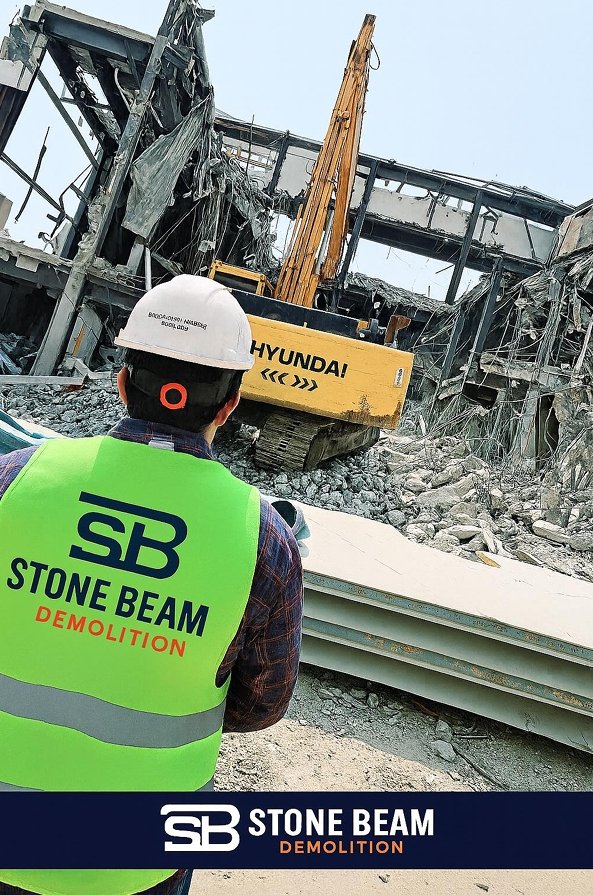
هدم وإزالة الخزانات الخرسانية والحديدية فوق الأرض وتحتها
In a fast-growing market like Dubai and the wider UAE, many sites still rely on aging concrete and steel storage tanks – for potable water, fire-fighting systems, chilled water, fuel, or industrial processes. When those tanks reach the end of their service life, leak, become non-compliant, or simply stand in the way of a new development, safe tank demolition and removal becomes critical.
Unlike standard structural demolition, tank demolition Dubai projects involve confined spaces, hazardous residues, buried structures, and complex interfaces with active utilities and operations. That’s why developers, facility managers, industrial operators, and consultants need a specialist demolition contractor with both engineering depth and regulatory experience in the UAE.
Stone Beam Demolition positions itself in this exact niche: as a modern, engineered demolition contractor in Dubai focused on safe, efficient, and authority-compliant tank removal – both above-ground and underground, concrete and steel.
This guide explains in detail:
- How concrete and steel tank demolition works in Dubai & the UAE
- The difference between above-ground and underground tank removal
- Safety, environmental, and regulatory requirements
- Advanced technologies (GPR scanning, hydrodemolition, diamond cutting, robotics)
- How Stone Beam Demolition delivers tank projects from start to finish
- What you should look for when choosing a tank demolition contractor in Dubai
1. Understanding Concrete & Steel Tank Demolition in Dubai & UAE
1.1 What is tank demolition?
Tank demolition is the engineered process of decommissioning, dismantling, demolishing, and removing storage tanks made of reinforced concrete, mild steel, or stainless steel, located:
- Above-ground
- Elevated water tanks and towers
- Ground-level circular or rectangular water reservoirs
- Fire-fighting and process tanks on podiums or rooftops
- Industrial fuel and oil tanks within bunds
- Underground (UG tanks)
- Diesel tanks for generators and fuel systems
- Fire water tanks below building podiums
- Sewage, grey water, and equalization tanks
- Industrial chemical tanks
Leading demolition contractors in the UAE list tank demolition and underground tank removal as dedicated services, underlining how specialized and regulated this activity has become in the region. Al Sakhar Building Demolition ABD+1
1.2 Why tanks need to be demolished or removed
Common triggers for tank demolition in Dubai & UAE include:
- End of design life: corrosion, concrete deterioration, steel thinning, or structural cracking
- Leaks and contamination: risk to soil and groundwater, especially with fuel or chemical tanks
- Regulatory non-compliance: updated Dubai Municipality or other authority requirements that existing tanks no longer meet Municipalities and Transport+1
- Change of use or redevelopment: tanks occupying valuable plot area or podium space needed for new structures
- Safety concerns: obsolete elevated tanks or tanks near new residential or commercial developments
- Operational upgrades: replacing old tanks with larger, more efficient, or modular systems
1.3 Types of tanks commonly demolished in the UAE
In the UAE, typical concrete and steel tanks that Stone Beam Demolition can remove include:
- Reinforced concrete water tanks
- Underground domestic water storage
- Chilled water and district cooling interface tanks
- Fire-fighting water tanks (UG and above ground)
- Potable water reservoirs in compounds and villas
- Steel tanks
- Fire water and sprinkler system tanks on podiums, roofs, or yards
- Diesel tanks for emergency generators
- Industrial process tanks and silos
- Oil and gas tanks at depots or terminals (often subject to ADNOC or other operator approvals) Stone Beam.ae+1
Each category brings different technical, safety, and environmental challenges, making it essential to use a contractor who treats every tank as an engineered demolition project, not just “breaking concrete and cutting steel”.
2. Key Challenges in Concrete & Steel Tank Demolition
2.1 Confined spaces and hazardous atmospheres
Many tanks, especially underground and closed concrete tanks, are classified as confined spaces. Risks include:
- Low oxygen levels
- Presence of combustible gases or vapours
- Toxic gases from sewage, sludge, or fuel residues
- Limited access/egress and restricted natural ventilation
Professional UAE demolition companies and HSE training providers highlight underground tank work as a high-risk category requiring specific training and control measures. ACCURATE SAFETY TRAINING+1
For Stone Beam Demolition, this translates into:
- Confined space permits and entry procedures
- Continuous gas monitoring
- Mechanical ventilation and forced-air systems
- Rescue plans and trained standby attendants
2.2 Residual liquids, sludge, and contamination
Before any demolition, tanks must be fully emptied, cleaned, and certified safe:
- Water tanks: may still contain silt, scale, or biological growth.
- Fuel or oil tanks: can contain flammable sludge, vapours, and heavily contaminated residues.
- Wastewater tanks: can include corrosive or toxic substances.
For hydrocarbon tanks in particular, major clients and specialist contractors in the UAE emphasise advanced technology, strict procedures, and approvals (e.g., ADNOC) to manage risk. Stone Beam.ae+1
2.3 Structural stability and support
Concrete tanks often have:
- Thick walls and base slabs tied into foundations
- Ring beams, columns, or roof slabs
- Complex reinforcement layouts
Steel tanks may be:
- Elevated on slender steel legs
- Seated on steel skirts or ring foundations
- Integrated with surrounding steel structures or pipe racks
Without engineered sequencing, cutting or breaking can cause uncontrolled collapse, impacting nearby structures or people. That’s why engineered tank demolition – using structural analysis and staged dismantling – is essential.
2.4 Underground tank removal complexity
Underground tank removal UAE projects add extra layers of difficulty:
- Locating the exact tank position, depth, and orientation
- Identifying live utilities around/above the tank
- Temporary shoring to prevent trench or excavation collapse
- Handling any soil contamination around the tank
- Safe lifting or in situ treatment of buried structures
Leading concrete scanning and controlled demolition providers in the UAE strongly recommend GPR scanning to locate hidden utilities and structural elements before cutting or excavation. demolitioncontractors.ae+3WEMTS+3Demolition in Dubai+3
2.5 Working in congested urban or operational environments
In Dubai’s dense built environment, tank demolition often happens:
- Inside active residential compounds or villa communities
- On podiums of occupied towers
- In live industrial facilities or data centres
- Near roads, parking structures, or public areas
This demands tight control of dust, vibration, noise, access, and debris logistics – and coordination with building management or facility operations.
3. Stone Beam Demolition’s Engineered Approach
Stone Beam Demolition brings together structural engineers, demolition specialists, and HSE experts to deliver tank demolition projects in Dubai and across the UAE with a clear, step-by-step methodology.
3.1 Stage 1 – Technical survey & condition assessment
Every project starts with a comprehensive survey, including:
- Desktop review
- As-built drawings and tank fabrication details (if available)
- Existing geotechnical, foundation, and service layouts
- Authority approvals and constraints
- Site inspection
- Visual condition of tank shell, slab, roof, or dome
- Access points, manholes, and internal baffles
- Adjacent structures and clearances
- Existing utilities, pipework, and electrical connections
- Non-destructive inspection (as needed)
- GPR scanning to locate reinforcement, post-tensioning, and buried utilities
- Ultrasonic thickness tests for steel shell and plates
- Concrete cover and rebar mapping on tank walls
This step determines whether the tank can be dismantled piece-by-piece, partially cut, or demolished in sections, and informs the temporary support and sequencing required.
3.2 Stage 2 – Authority approvals and documentation
In the UAE, demolition works – particularly involving tanks – require strict compliance with authorities such as Dubai Municipality, free zone authorities, and in some cases ADNOC, DMT or other local regulators. Municipalities and Transport+2Finest Touch Contracting+2
Stone Beam Demolition prepares and submits:
- Detailed method statements and risk assessments
- Structural calculations for temporary supports and demolition sequencing
- Crane and lifting plans (for elevated or heavy steel tank sections)
- Traffic and logistics plans (for debris, scrap, and equipment)
- HSE plans addressing confined spaces, hot works, working at height, and excavation
The objective is to ensure all approvals, permits, and NOCs are in place before site operations begin.
3.3 Stage 3 – Decommissioning & cleaning of the tank
Safe tank removal starts well before any cutting or breaking:
- Isolation of services
- Disconnecting and capping inlet/outlet pipes, overflow lines, and drains
- Isolating power, instrumentation, and control cabling
- Lock-out/tag-out procedures for pumps and valves
- Removal of liquids and sludge
- Pumping out remaining water or product
- Vacuuming and sludge removal for oil/fuel tanks
- Disposal through licensed waste contractors
- Cleaning and gas-free certification
- Internal washing and degreasing (for hydrocarbon tanks)
- Gas monitoring and gas-free certificates where required
- Verification by third-party specialists, if mandated by client or regulator
Only after this stage is complete does Stone Beam Demolition proceed with mechanical or cutting-based demolition.
3.4 Stage 4 – Engineered demolition or dismantling
Based on the tank type and location, Stone Beam selects a combination of methods:
- Mechanical demolition (excavators, breakers, shears)
- Diamond cutting and wire sawing
- Hydrodemolition for precise concrete removal Aquajets+2Fluidtech Engineering LLC.+2
- Cold cutting or controlled hot cutting for steel tanks
- Robotic demolition in confined or high-risk zones
The demolition is always sequenced so that structural stability is maintained at every step.
3.5 Stage 5 – Debris management, backfilling & reinstatement
Stone Beam’s service goes beyond just “demolishing the tank”:
- Sorting and recycling of steel scrap
- Segregation of concrete, reinforcement, and contaminated materials
- Controlled loading, transport, and disposal at approved facilities
- Backfilling of excavations with suitable material
- Layered compaction to the required density for future structures
- Surface reinstatement (paving, asphalt, concrete slabs) as per project requirements
4. Above-Ground Tank Demolition: Concrete & Steel
Above-ground tanks can be ground-level reservoirs, elevated tanks, or tanks on podiums and roofs. Each scenario has a specific approach.
4.1 Preparatory works
For any above-ground tank demolition, Stone Beam Demolition implements:
- Access and edge protection: scaffolding, guardrails, stair towers, or temporary platforms
- Lifting and crane planning: selecting cranes or mobile elevating work platforms (MEWPs)
- Protection of adjacent assets: temporary barriers, impact protection, and sheet piling if needed
- Noise, dust, and vibration controls: misting, localised breaking, scheduling noisy works for suitable time windows
4.2 Demolition of steel tanks
Steel tanks are often removed by controlled dismantling, not brute-force demolition:
- Segmenting the tank shell
- Marking cutting lines around the shell
- Using cold cutting systems where sparks must be avoided (fuel or oil tanks)
- In other contexts, using oxy-acetylene or plasma cutting with strict hot-work controls
- Top-down dismantling
- Cutting roof plates into segments
- Lowering segments safely by crane or MEWP
- Proceeding in rings downward to maintain stability
- Removing internal elements
- Cutting and removing internal bracing, baffles, and ladders
- Managing any internal coatings or linings
- Base and foundation
- Cutting base plates and removing anchor bolts
- Breaking and removing the concrete ring beam or plinth
This method minimises impact on surrounding structures and allows maximum recycling of scrap steel.
4.3 Demolition of concrete tanks
Demolishing reinforced concrete tanks requires precise control over cracking and load paths:
- Roof removal (if present)
- Diamond saw-cutting around slab edges
- Controlled breaking with excavators or robotic breakers from the top
- Leaving key supporting elements until the final stage
- Wall demolition
- Cutting vertical relief slots using wall saws
- Breaking wall panels inward so debris falls into the tank footprint
- Avoiding overturning or collapse outside the containment line
- Base slab and foundations
- Saw cutting slab into manageable panels
- Using excavators with breakers for thicker sections
- Removing or cutting reinforcement as per recycling plan
- Hydrodemolition where needed
- For partial removal, or in sensitive structures, hydrodemolition can remove concrete while leaving reinforcement or adjacent structures intact, as widely practiced by UAE specialist contractors. Aquajets+2Fluidtech Engineering LLC.+2
4.4 Elevated tanks and rooftop tanks
Elevated or rooftop tanks bring additional challenges:
- Load limits on slabs and beams
- Restricted access for cranes or heavy equipment
- Risks associated with working at height
Stone Beam addresses these with:
- Detailed structural checks on slabs and supporting members
- Use of lightweight robotic breakers and compact skid-steer loaders
- Use of mobile cranes or tower cranes where feasible
- Sequenced dismantling to keep loads within allowable limits
5. Underground Tank Removal UAE
Underground tank removal is one of the most sensitive demolition activities, combining excavation, confined space work, and potential contamination.
5.1 Locating and investigating underground tanks
Because many older facilities lack complete as-built information, Stone Beam often begins with:
- Utility records and surveys
- Ground Penetrating Radar (GPR) scanning to detect tank outlines, depth, and nearby utilities – a method strongly promoted by UAE concrete scanning specialists for safe cutting and excavation. demolitioncontractors.ae+3WEMTS+3Demolition in Dubai+3
- Trial pits to confirm findings and expose tank sections
5.2 Safe excavation and shoring
Once the tank location is established:
- Excavation is carried out in stages, respecting safe slope angles or shoring requirements, aligned with local excavation safety guidelines. ACCURATE SAFETY TRAINING
- Access ramps are provided for machinery and personnel
- Trench boxes, sheet piling, or soldier piles may be used in deeper excavations
- Continuous monitoring for ground movement near adjacent structures takes place in sensitive areas
5.3 Cleaning and decommissioning of underground tanks
For underground tanks (especially fuel or chemical tanks), the procedure includes:
- Pumping and removal of liquid product
- Sludge removal and confined space cleaning
- Gas monitoring and inerting (e.g., nitrogen, foam) where required
- Issuing gas-free certificates for cutting or hot work
- In some cases, filling tanks with water before cutting to control explosion risk
5.4 Removing vs. filling tanks in situ
Depending on client requirements and authority approvals, Stone Beam may:
- Lift and remove the tank
- Expose sufficient shell area for lifting points
- Attach certified lifting lugs or chains
- Use cranes to lift the tank out of the excavation
- Transport to a controlled area for final cutting and scrapping
- Fill and abandon in situ (where allowed)
- Cut access openings
- Clean and gas-free the interior
- Fill with inert material (sand, foam concrete, or slurry)
- Backfill and compact over the tank
Market reports and specialist demolition companies globally distinguish between underground tank removal and ground tank removal as different service categories, emphasizing how this is a recognized specialist niche. Valuates Reports+1
5.5 Backfilling and reinstatement
After tank removal or filling:
- Excavation is backfilled with approved granular material or engineered fill
- Layered compaction is undertaken to meet re-development requirements
- Surface finishes (asphalt, interlock, concrete slabs, landscaping) are reinstated
In re-development projects, Stone Beam works closely with the main contractor to ensure the ground is ready for foundations, roads, or landscaping without future settlement issues.
6. Safety, Environment, and Compliance
6.1 Regulatory framework in Dubai & UAE
Demolition and tank removal works are subject to:
- Dubai Municipality demolition and construction codes Municipalities and Transport+1
- Free zone and master developer regulations (e.g., Trakhees, Nakheel, etc.)
- HSE requirements for excavation, confined space, and hot work
- Environmental regulations related to waste, contaminated soil, and emissions
For oil and gas related tanks, ADNOC and other operators impose additional guidelines and approvals – a topic repeatedly emphasised by local demolition specialists. Stone Beam.ae+1
6.2 Stone Beam’s HSE controls
Stone Beam Demolition integrates HSE into every tank project:
- Project-specific HSE plans covering:
- Confined space entry
- Hot work permits and fire watch
- Excavation safety and shoring
- Working at height
- Traffic management and lifting operations
- Method statements clearly defining:
- Step-by-step tasks
- Responsibilities of engineers, supervisors, and workers
- Emergency response plans (fire, gas exposure, collapse, medical emergencies)
- Training & competency:
- Operators and riggers certified as per UAE regulations
- HSE training aligned with local standards for excavation and underground tank works ACCURATE SAFETY TRAINING
6.3 Environmental protection
A responsible tank demolition contractor in Dubai must address:
- Containment of spills and leaks
- Secondary containment or bunding during decommissioning
- Spill kits and absorbents on site
- Handling of contaminated materials
- Segregating contaminated soil or debris
- Testing and disposal via licensed hazardous waste facilities
- Noise and dust control
- Use of misting cannons and water sprays
- Localised mechanical breaking instead of uncontrolled impact
- Selection of hydrodemolition or diamond cutting to reduce dust and vibration in sensitive areas Aquajets+2Fluidtech Engineering LLC.+2
Stone Beam Demolition’s approach allows clients to meet environmental obligations while maintaining project schedules.
7. Advanced Technologies Used by Stone Beam Demolition
To deliver precise and controlled tank demolition Dubai projects, Stone Beam leverages modern tools and methods widely recognized across the UAE demolition industry.
7.1 GPR scanning and concrete imaging
Before cutting or demolishing concrete tanks or excavating around underground tanks, Stone Beam utilizes GPR scanning to:
- Detect reinforcement, post-tension cables, and embedded services
- Map the location and depth of underground utilities
- Minimise the risk of striking live services during coring, cutting, or excavation
Concrete scanning has become a standard service in Dubai for safe cutting and demolition, with multiple specialist companies emphasising its critical role for structural safety. demolitioncontractors.ae+3WEMTS+3Demolition in Dubai+3
7.2 Diamond coring, cutting, and wire sawing
For tanks integrated with buildings or located on podium slabs, Stone Beam uses:
- Core drilling to create openings and relieve stresses
- Wall saws and floor saws to segment slabs and walls
- Diamond wire sawing to cut thick concrete or heavily reinforced elements, even around embedded steel or at complex angles
Specialist UAE contractors highlight diamond cutting and saw cutting as key to clean, accurate demolition with minimal vibration and noise. Stone Beam.ae+3Aquajets+3Corecut Engineering+3
7.3 Hydrodemolition
Hydrodemolition uses ultra-high pressure water jets to selectively remove concrete while preserving reinforcement and adjacent structures. It is ideal for:
- Partially removing tank slabs or walls
- Demolishing deteriorated concrete without damaging sound areas
- Working near sensitive equipment or structures where vibration must be minimised
Hydrodemolition is increasingly offered in Dubai and the UAE as an advanced method for structural concrete removal. Fluidtech Engineering LLC.+1
7.4 Robotic demolition and remote-controlled equipment
For confined or high-risk areas (inside tanks, on elevated slabs, near live operations), Stone Beam includes:
- Robotic breakers for remote-controlled concrete demolition
- Compact tracked units that can be lifted to podium levels
- Reduced manpower inside hazardous zones and better operator protection
7.5 High-reach and specialized excavators
Where space allows, high-reach excavators and long-boom machines can be used to:
- Break elevated tank walls and shells from a safe distance
- Reach tall structures without the need for extensive scaffolding
- Speed up demolition while preserving safety margins
8. Realistic Project Scenarios – How Stone Beam Delivers
To illustrate how all of this comes together, here are sample case-style scenarios showing Stone Beam Demolition’s approach.
8.1 Scenario 1 – Demolition of an underground diesel tank in a Dubai commercial building
Context:
A mixed-use building in Dubai has an underground diesel tank feeding emergency generators. The system is being replaced with a rooftop tank and new piping. The old tank must be removed to allow construction of a new parking ramp.
Stone Beam’s approach:
- Survey & GPR scanning
- Locate tank geometry and nearby utilities
- Confirm tank depth and access points
- Decommissioning and cleaning
- Coordinate with MEP contractor to isolate all fuel lines
- Pump out residual diesel, flush lines, and clean internal surfaces
- Issue gas-free certificate through an approved third party
- Excavation and shoring
- Excavate in stages with shoring to protect adjacent foundations
- Provide safe access ramps and guardrails
- Tank removal
- Cut access opening in the top slab
- Attach lifting chains and use a mobile crane to remove the tank shell in sections
- Transfer tank sections to a segregated area for final cutting and scrap segregation
- Backfilling and reinstatement
- Backfill with engineered material and compact to design levels
- Hand over excavation ready for construction of the new ramp
The client receives a fully documented package including decommissioning certificates, waste transfer notes, and as-built records of the backfilled area – essential for future compliance and resale.
8.2 Scenario 2 – Removal of a deteriorated concrete water tank in a residential compound
Context:
A residential compound in Dubai has an old reinforced concrete water tank below a landscaped courtyard. It has started leaking, and the developer wants to demolish it and reconfigure the area for parking and new utilities.
Stone Beam’s approach:
- Structural and geotechnical review
- Assess the interaction between the tank and surrounding retaining walls
- Plan the demolition sequence to avoid settlement or movement
- Interior demolition
- Use robotic breakers and small excavators to break internal walls and roof slab
- Keep external soil support where needed until the final stages
- Slab and foundation removal
- Saw cut slabs into panels
- Remove panels in a controlled manner to maintain ground stability
- Backfilling and landscaping
- Backfill with engineered fill, compact in layers
- Coordinate with the main contractor on new infrastructure routes
- Prepare finished surface for new pavement and landscaping
The compound benefits from zero structural issues, minimal disruption to residents, and a clear, buildable area for future works.
8.3 Scenario 3 – Rooftop fire water tank dismantling in an occupied tower
Context:
A high-rise commercial tower in Dubai is upgrading its fire-fighting system, replacing an old steel fire water tank on the roof with a modern modular system. The old tank must be removed without affecting tenants or MEP services.
Stone Beam’s approach:
- Logistics and lifting plan
- Check slab load capacity and crane positioning options
- Schedule works during off-peak hours
- Controlled dismantling
- Drain and clean the tank
- Cut roof plates and shell into smaller segments
- Use MEWPs or man-lifts for safe access
- Lower segments by crane to a loading area
- Noise and dust management
- Use cutting methods with minimal vibration
- Coordinate timing to reduce impact on tenants
- MEP coordination
- Protect existing services on the roof
- Handover clear space for installation of the new tank system
The building management achieves an upgrade with minimal disruption, while remaining fully compliant with fire safety regulations throughout the works.
8.4 Scenario 4 – Industrial concrete process tank demolition in a live facility
Context:
An industrial client in the UAE needs to remove a heavily reinforced concrete process tank adjacent to operating equipment.
Stone Beam’s approach:
- Combine hydrodemolition on critical interfaces with mechanical breaking elsewhere
- Use protective barriers and splash containment around sensitive equipment
- Monitor vibration levels to stay within allowable limits for nearby machines
- Phase works around the facility’s production schedule
The result is a safe, low-impact demolition that allows the client to maintain production while preparing the area for new process lines.
9. Choosing a Tank Demolition Contractor in Dubai
Given the complexity and risk profile, not every demolition company is suitable for tank demolition Dubai projects. When evaluating contractors, consider:
9.1 Experience and references
- Proven project list including water tank demolition, underground tank removal, and industrial tank projects
- References or case studies from UAE-based clients
- Evidence of successfully working in complex environments (high-rise, industrial, oil & gas, etc.) Stone Beam.ae+2Stone Beam.ae+2
9.2 Technical and engineering capability
- In-house structural engineering support for sequencing, temporary works, and load checks
- Experience with GPR scanning, diamond cutting, hydrodemolition, and robotic demolition
- Ability to produce detailed method statements, lifting plans, and risk assessments
9.3 HSE and compliance record
- Strong safety statistics and dedicated HSE team
- Familiarity with Dubai Municipality, DMT, ADNOC, and other authority requirements Stone Beam.ae+3Municipalities and Transport+3Finest Touch Contracting+3
- Proper training and certification for confined space, working at height, and excavation safety
9.4 Plant, equipment, and resources
- Modern, well-maintained demolition and cutting equipment
- Access to specialized tools (e.g., hydrodemolition pumps, robotic breakers, high-reach excavators) Aquajets+2Fluidtech Engineering LLC.+2
- Sufficient manpower to meet programme requirements
9.5 Environmental and waste management
- Clear procedures for handling contaminated soil, sludge, and hazardous waste
- relationships with licensed waste treatment and disposal facilities
- Ability to provide documentation for compliance and audits
Stone Beam Demolition aligns with all these criteria, positioning itself as a leading tank demolition contractor capable of handling complex projects across Dubai and the UAE.
10. Cost & Programme Considerations for Tank Demolition Dubai
10.1 Key cost drivers
The cost of concrete and steel tank demolition depends on factors such as:
- Tank size, capacity, and material (concrete vs. steel)
- Location (ground level, elevated, rooftop, or underground)
- Accessibility for cranes, excavators, and trucks
- Complexity of decommissioning (e.g., fuel/oil tanks vs. clean water tanks)
- Extent of contaminated soil or structural interfaces
- Requirements for backfilling, compaction, and reinstatement
- Level of authority approvals and documentation needed
Specialist tank demolition providers in the UAE and abroad often differentiate between ground tank removal and underground tank removal when discussing project budgets, reflecting the added complexity of buried tanks. test+3Valuates Reports+3Digital Journal+3
10.2 Typical programme durations
While each project is unique, a simplified view is:
- Small rooftop steel tank: a few days from cleaning to removal
- Medium concrete water tank in a compound: 1–3 weeks, including backfilling
- Large underground diesel tank with contamination: several weeks, depending on environmental remediation requirements
- Large industrial or oil & gas tanks: multi-week to multi-month programmes, especially in live facilities
Stone Beam Demolition works with clients to forecast realistic durations, integrating other trades and shutdown windows into the overall schedule.
11. Why Choose Stone Beam Demolition for Tank Demolition in Dubai & UAE
Putting everything together, Stone Beam Demolition offers clients:
11.1 Engineered demolition, not trial-and-error
- Structural analysis and sequencing to control collapse mechanisms
- Use of advanced cutting, scanning, and hydrodemolition instead of only heavy breaking
- Integration of temporary works where required
11.2 Strong safety and environmental culture
- Project-specific HSE plans and risk assessments
- Strict control of confined spaces, hot work, and excavation
- Responsible management of sludge, contaminated soils, and demolition waste
11.3 Local compliance and authority experience
- Familiarity with Dubai Municipality demolition procedures and documentation Municipalities and Transport+1
- Experience coordinating with master developers and free zone authorities
- Ability to support clients in securing NOCs and approvals
11.4 Full lifecycle service
From initial survey and concept planning, through method statements, demolition, tank removal, backfilling, and reinstatement, Stone Beam provides an end-to-end solution. Clients do not have to coordinate multiple subcontractors or guess at technical details – everything is handled by one integrated demolition partner.
12. FAQ – Tank Demolition Dubai & UAE
1. How much does tank demolition cost in Dubai?
Costs vary widely depending on tank size, location, material, contamination, access, and whether underground tank removal is required. After a site survey, Stone Beam provides a detailed, itemised quotation covering decommissioning, demolition, waste disposal, and reinstatement.
2. Do I need Dubai Municipality approval to demolish a water or fuel tank?
In most cases, yes. Tank demolition usually forms part of a wider demolition or modification permit with Dubai Municipality or the relevant authority. Stone Beam assists in preparing method statements, drawings, and HSE documentation needed for approvals.
3. Can you demolish tanks inside occupied buildings or compounds?
Yes. Stone Beam regularly handles tank demolition inside occupied residential compounds, commercial buildings, and industrial facilities by using controlled methods, noise and dust mitigation, and carefully phased programmes to minimise disruption.
4. What is the difference between above-ground tank demolition and underground tank removal UAE?
- Above-ground tank demolition focuses on dismantling tanks that are visible and accessible, often involving crane lifts and height work.
- Underground tank removal requires excavation, shoring, confined space entry, and possible contaminated soil management, making it significantly more complex and regulated.
5. How do you ensure safety when working inside tanks?
Safety measures include:
- Confined space permits and procedures
- Continuous gas monitoring
- Mechanical ventilation
- Rescue plans and trained standby teams
- Use of intrinsically safe equipment where required
6. Can you remove soil contamination around old fuel or oil tanks?
Yes. Where contamination is present, Stone Beam coordinates soil testing, excavation of contaminated material, segregation, and disposal through licensed hazardous waste facilities, in line with environmental regulations.
7. Do you provide documentation after the tank is demolished?
Stone Beam provides a complete close-out package, which may include:
- Decommissioning and gas-free certificates (where applicable)
- Waste transfer notes and disposal certificates
- As-built drawings of backfilled areas
- Photographic records and HSE reports
8. How long does it take to remove an underground diesel tank?
A typical small to medium underground diesel tank may take one to several weeks, depending on cleaning, contamination level, depth, and site access. A detailed programme is prepared after site assessment.
9. Can you work around live operations in industrial facilities?
Yes. Stone Beam specialises in working in live environments, using phased workfronts, robust HSE controls, and close coordination with the client’s operations team to avoid unplanned downtime.
10. Do you handle both concrete and steel tanks?
Absolutely. Stone Beam Demolition demolishes and removes reinforced concrete tanks, elevated and ground-level steel tanks, underground tanks, and complex industrial tanks, using the most appropriate methods for each type.
If you’re planning a demolition project in Dubai , don’t settle for outdated methods or inflated prices. Stone Beam Demolition Company delivers professional and compliant services. They are competitively priced and align with the highest standards of the UAE capital.
- Get a Free, No-Obligation Quote Today Through +971 55 930 8594– info@sbdemolition.ae
Related topic
Oil Tank Demolition & Industrial Tank Services in Dubai & UAE
Concrete Cutting, Core Drilling & Diamond Wire Sawing Services
GPR Concrete Scanning & Utility Detection in Dubai & UAE
Controlled Demolition & Robotic Demolition Services
Demolition Contractor in Dubai – Buildings, Villas & Industrial Structures