

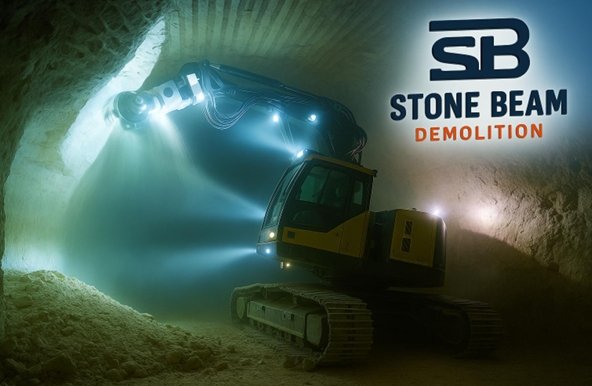
هدم الأنفاق والمنشآت تحت سطح الأرض: أساليب خاصة للسلامة والتحكم في الهبوط (Tunnel Demolition in Dubai
Why tunnel and underground demolition in Dubai is a special case
Dubai’s infrastructure is packed with tunnels, underpasses, deep basements, parking structures, utility galleries, storm-water culverts and metro facilities, often running directly beneath critical roads, towers and utilities. Demolishing or modifying these underground assets is far more complex than demolishing a surface building:
- The ground around the tunnel must stay stable.
- Adjacent towers, villas, metro lines and roads must not experience damaging settlement or heave.
- Services from DEWA, telecom providers and district cooling must remain protected.
- Work happens in confined spaces with limited access, ventilation and emergency escape.
Dubai Municipality, Dubai Development Authority (DDA), RTA and other authorities therefore require detailed demolition method statements, risk assessments, safety plans and impact studies on neighbouring assets before issuing demolition permits.HomeCubes+4Dubai Development Authority+4Stone Beam.ae+4
For owners and consultants, choosing an engineered demolition contractor is no longer optional – it is the only way to protect people, assets and schedules.
Stone Beam Demolition positions itself as an engineering-led demolition contractor in Dubai and the UAE, specialising in complex, high-risk environments such as tunnels, basements and other underground structures, using advanced tools like robotic breakers, hydrodemolition, diamond cutting and real-time monitoring systems.SBDemolition+1
What counts as “tunnels and underground structures” in Dubai?
In the context of tunnel demolition in Dubai, we are not only talking about classic bored tunnels. Underground demolition projects can include:
Typical underground assets
- Road tunnels and underpasses
- Urban underpasses beneath signalised junctions
- Freeway interchanges and ramp tunnels
- Metro and rail infrastructure
- Station boxes and cut-and-cover tunnels
- Pedestrian and service tunnels connecting to stations
- Deep basements & car parks
- Multi-level basements for towers and malls
- Podium car parks partially below ground
- Utility & service tunnels
- District cooling galleries
- Potable water and sewer tunnels
- High-voltage cable tunnels and telecom ducts
- Water-related underground structures
- Large underground water tanks
- Stormwater culverts and box culverts
- Pumping stations partially or fully below ground
Each of these has different geometry, structural systems and ground conditions, but all share one key reality: removing them changes how the soil and nearby foundations carry load, and that is where settlement control becomes critical. Research on metro tunnelling in soft ground shows how even modest changes in support can cause millimetre-scale to centimetre-scale surface settlements, which can damage buildings if not controlled.Webthesis+4Nature+4MDPI+4
Key challenges in demolishing tunnels and underground structures
Ground movement and settlement risks
When you demolish or partially remove a tunnel, box culvert or deep basement:
- You may remove a stiff element that was sharing load with the surrounding ground.
- You may excavate backfill that was providing confinement.
- You may alter groundwater conditions (e.g., dewatering, cutting old slabs).
The result can be:
- Vertical settlement of the ground surface
- Differential settlement between different foundations
- Heave (upward movement) if a heavily loaded tunnel is relieved
- Lateral movement of retaining walls, piles or shafts
Studies on metro and road tunnel works show that even a few centimetres of settlement can crack pavements, distort rails, affect piles and cause serviceability issues in adjacent buildings.Nature+2tunnelcanada.ca+2
Proximity to critical assets
In Dubai, underground demolition often takes place:
- Under or beside high-rise towers on piled foundations
- Beneath busy RTA roads, interchanges and bridges
- Adjacent to operational metro lines and stations
- Within dense villa communities with shallow foundations
- Near strategic utilities (132 kV cable tunnels, district cooling, trunk sewers)
This means any ground movement is tightly controlled and must be modelled, monitored and managed as part of the demolition plan.
Confined space, access and ventilation
Tunnels and underground structures usually present:
- Limited access points (shafts, ramps, hatches)
- Limited fresh air and exhaust paths
- Risk of gas build-up (exhaust, vapours, sewer gases)
- Restricted movement for plant and emergency rescue
This drives the use of:
- Remote-controlled demolition robots instead of manual breakers
- Ventilation systems, gas detection and continuous air quality monitoring
- Strict confined-space entry procedures and rescue plans, as required by DM’s Code of Construction Safety Practice.Dubai Municipality+2HomeCubes+2
Utilities, water and environmental constraints
- Old tunnels may carry live power, telecom, water or sewer lines.
- Groundwater may be present, especially near the coast or canals.
- Demolition must control:
- Dust (a requirement under Dubai’s Green Building Regulations and Code of Construction Safety)Dubai Municipality+1
- Noise and vibration in sensitive locations
- Slurry and wastewater from saw cutting or hydrodemolition

Dubai’s regulatory framework for underground demolition
Permits and approvals
Depending on location and asset ownership, tunnel and underground demolition in Dubai may require approvals from:
- Dubai Municipality – main authority for building and demolition permits.
- Dubai Development Authority (DDA) – for projects in certain free zones and TECOM areas.
- RTA – where tunnels or culverts are under/adjacent to public roads, bridges or metro infrastructure.
- DEWA & telecom providers – for NOCs related to utilities running through or near the structure.
- Other master developers (e.g., EMAAR, Nakheel) as applicable.
For example, DDA’s Demolition Permit service explicitly requires:
- Detailed method statement
- HSE and emergency plan and risk assessment
- Impact study on surrounding buildings
- Vibration / seismic test report (for explosive methods)
- Utility NOCs and hoarding/layout drawings.Bizvise+3Dubai Development Authority+3Dubai Municipality+3
Dubai Municipality’s codes and circulars similarly require:
- Appointment of a licensed demolition contractor
- Named safety officer and safety plan for each project
- Compliance with the Dubai Building Code, Green Building Regulations and the Code of Construction Safety Practice.Dubai Municipality+4Stone Beam.ae+4Dubai Municipality+4
What regulators expect in a tunnel/underground demolition plan
A strong submission typically includes:
- Project description
- Type of tunnel or underground structure
- Surrounding buildings, roads and utilities
- Structural assessment
- Original structural system and current condition
- How load paths will change as you demolish
- Geotechnical & settlement assessment
- Soil conditions, groundwater, existing retaining systems
- Predicted ground movements and settlement envelopes
- Demolition methodology
- Sequence, access, temporary supports, excavation stages
- Plant and equipment list (robots, excavators, cranes, pumps)
- Instrumentation & monitoring plan
- Type and location of settlement points, inclinometers, prisms, strain gauges etc.
- Trigger levels and response actions
- HSE & emergency plan
- Confined space controls, ventilation, gas detection
- Rescue arrangements, evacuation routes
- Waste & environmental plan
- Waste sorting, recycling, haulage
- Dust, noise and vibration control measures
Stone Beam Demolition develops such documents routinely for complex demolition projects, aligning them with DM/DDA requirements and Dubai Building Code provisions.SBDemolition+2SBDemolition+2
Engineering investigations before underground demolition
Before choosing the demolition method, an engineering-led investigation is essential.
1. Desktop study and records review
- Collect as-built structural drawings, geotechnical reports and tunnel operation records.
- Review utility records from DEWA, telecom providers and relevant authorities.
- Check DM / DDA / RTA conditions attached to the original construction permit or O&M manuals.
2. Site survey and condition assessment
- 3D topographic survey and control points.
- Internal tunnel inspection for:
- Cracks, leaks and deformation
- Corrosion of reinforcement and steel elements
- Previous repairs or strengthening.
- Structural capacity checks (where needed) to understand which elements can be safely removed in each stage.
3. Underground detection and mapping
Dubai’s dense underground environment makes service detection critical:
- GPR concrete scanning (Ground Penetrating Radar) to locate reinforcement, post-tensioning, embedded plates and shallow utilities.Encardio Rite
- Electromagnetic and cable locators for buried services.
- Trial pits where necessary to verify high-risk zones.
Stone Beam uses GPR scanning and 3D modelling to avoid cutting or breaking through hidden tendons, ducts or cables, which is especially important when cutting tunnel slabs or walls close to live utilities.SBDemolition
4. Geotechnical and hydrogeological assessment
For tunnel and underground demolition, geotechnical analysis focuses on:
- Soil/rock type and stiffness
- Depth of cover above roof slabs
- Existing retaining systems (diaphragm walls, secant or contiguous piles, sheet piles)
- Groundwater levels and artesian pressures.
Geotechnical studies and experience from metro stations and shallow tunnels show how changes in support conditions can significantly influence ground settlement and heave profiles.Nature+2ytmk.org.tr+2
5. Baseline monitoring and building condition surveys
Before works start:
- Install baseline monitoring:
- Surface settlement points
- Prisms on facades and road pavements
- Inclinometers and extensometers around deep excavations.Encardio Rite+2geo-instruments.com+2
- Perform building condition surveys (photos and reports) of surrounding structures to document existing cracks and defects.
These baseline records are vital for:
- Design verification
- Real-time safety management
- Protecting the owner and contractor in case of future claims.Encardio Rite+1

Special safety strategies for tunnel and underground demolition
1. Engineered phasing and temporary support
A tunnel or box structure is often integrated into the soil-structure system. Removing it in one go can trigger uncontrolled settlement or collapse.
Instead, Stone Beam typically uses:
- Staged demolition:
- Segment the tunnel into short bays.
- Remove slabs and walls in sequence, not randomly.
- Temporary props and frames:
- Steel supports installed before cutting key elements.
- Needle beams through access slots to carry loads while concrete is removed.
- Backfilling in stages:
- As voids are created, they are backfilled and compacted to restore ground support.
These strategies mirror the “staged construction and support” concepts used in NATM/urban tunnelling – but applied in reverse for safe deconstruction.Nature+2ITA-AITES+2
2. Confined-space and ventilation controls
To comply with UAE and Dubai safety standards, Stone Beam’s underground demolition plans include:
- Designation of underground areas as confined spaces.
- Atmospheric monitoring for:
- Oxygen levels
- Flammable gases
- Toxic gases (e.g., H₂S in sewer environments).
- Mechanical ventilation and fume extraction.
- Hot work control, lighting and low-voltage electrical systems suitable for damp environments.
- Rescue plans with dedicated equipment and trained standby teams.
These measures align with the Dubai Municipality Code of Construction Safety Practice requirements for safe working conditions in confined and hazardous spaces.Dubai Municipality+1
3. Vibration and noise control
Close to sensitive structures, Stone Beam chooses low-vibration methods such as:
- Hydraulic crunchers and shears
- Diamond saw cutting and coring
- Hydrodemolition for slabs and linings
- Robotic breakers operating with controlled energy and duty cycles.
Hydrodemolition, in particular, is widely recognised as a vibration-free concrete removal method that preserves reinforcement and avoids micro-cracking in adjacent structures – a major benefit in settlement-sensitive environments.KAMAT+3Conjet+3fluidtecheng.com+3
Settlement control: the heart of underground demolition
The Arabic title of this article emphasises “أساليب خاصة للسلامة والتحكم في الهبوط” – special methods for safety and settlement control.
This is the core engineering challenge in tunnel demolition.
Understanding how settlement happens during demolition
Settlement during underground demolition is influenced by:
- Depth of cover above the tunnel roof.
- Soil stiffness and layering.
- Width and length of the demolished zone.
- Rate of excavation and backfilling.
- Presence of adjacent loads (buildings, traffic, embankments).
Research on tunnel excavation and metro station construction shows that surface settlement tends to increase with higher building and traffic loads, and that the pattern of movement depends on both soil conditions and construction sequence.Webthesis+3Nature+3MDPI+3
In demolition, when we remove a stiff element such as a tunnel box or roof slab, we can:
- Reduce confinement
- Change stress distribution
- Potentially cause ground to move downwards (settlement) or upwards (heave) if previous loads are removed.
Settlement control strategy in practice
A robust settlement control plan includes:
- Predictive modelling
- Analytical and numerical models (e.g., 2D/3D finite element) to estimate ground movement ranges.
- Scenario testing: with / without temporary supports, different backfilling sequences, different groundwater control options.Nature+2ITA-AITES+2
- Structural verification
- Check allowable differential settlement for adjacent structures.
- Identify “hot spots” such as piles close to the tunnel, retaining walls and utilities.
- Mitigation measures
- Limit size of open excavations at any one time.
- Keep minimum cover above the tunnel roof until support/backfill is ready.
- Use compensated backfilling, low-shrinkage materials or controlled low-strength material (CLSM) to fill voids.
- Introduce pre-support or grouting if modelling shows excessive movement.
- Instrumentation and monitoring
- Install appropriate instruments (see next section).
- Define alert and alarm trigger levels for settlement, tilt and vibration.
- Link monitoring with pre-agreed actions (slow down works, add supports, modify sequence).
Stone Beam’s demolition method statements explicitly tie demolition sequence to trigger levels and mitigation actions, embedding settlement control into day-to-day site decision-making rather than treating it as a separate activity.SBDemolition+2Encardio Rite+2
Instrumentation and monitoring during tunnel demolition
Why monitoring is non-negotiable
Geotechnical and structural monitoring is now considered best practice – and often mandatory – for excavation and tunnelling works near sensitive assets.Sisgeo+3Encardio Rite+3ITA-AITES+3
For underground demolition, monitoring is required to:
- Verify that actual movements match or stay below predictions.
- Provide early warning when trigger levels are reached.
- Demonstrate compliance to authorities and protect the project from claims.
Typical instruments used
Based on global tunnelling and geotechnical monitoring practice:sesltd.uk.com+4Encardio Rite+4geo-instruments.com+4
- Surface settlement points
- Precise levelling or GNSS for vertical movement of pavements, plots and open ground.
- Building prisms and tiltmeters
- Optical prisms and tilt sensors on facades, columns and slabs to measure lateral movement and tilt.
- Extensometers and settlement cells
- To measure vertical movement in deeper soil layers above or beside the tunnel.
- Piezometers
- To monitor groundwater levels and pore water pressure, especially if dewatering is involved.
- Strain gauges and load cells
- On props, anchors or piles to verify load sharing and support performance.
- Vibration and noise monitors
- To keep demolition-induced vibration and noise within agreed limits.
Modern monitoring systems use automated data loggers, robotic total stations and cloud platforms to provide near real-time dashboards and SMS/email alerts when trigger levels are exceeded.Encardio Rite+2geo-instruments.com+2
Stone Beam is experienced in working with such systems on complex demolition and excavation projects in the UAE, integrating monitoring data directly into site progress and safety meetings.
Demolition methods for tunnels and underground structures
1. Mechanical demolition with excavators and attachments
Where access allows, excavators with suitable attachments remain the core of many underground demolition projects:
- Hydraulic breakers
- Concrete crushers and pulverisers
- Shears for steel elements
- Buckets and grapples for mucking out.
In tunnels, machines are often scaled down (e.g., 5–15 ton class) and used in combination with:
- Temporary ramps
- Sliding steel decks
- Heavy-duty floor protection.
2. Robotic demolition in confined spaces
In many Dubai projects, tunnel and underground demolition is carried out using remote-controlled demolition robots that can work in tight spaces with reduced risk to personnel.
Advantages:
- Operators stay outside the immediate danger zone.
- Machines are small but powerful, ideal for thick tunnel linings.
- Easily combined with ventilation and dust extraction systems.
Stone Beam incorporates such equipment, as highlighted in its advanced demolition technology materials, for work in basements, tunnels and heavily constrained structures.SBDemolition+1
3. Diamond cutting, coring and wire sawing
For controlled and selective removal, especially near sensitive structures:
- Wall saws and floor saws cut slabs and walls into manageable blocks.
- Core drilling creates openings and relieves stress around key cuts.
- Wire saws can cut through massive, heavily reinforced sections such as portal frames or thrust blocks.
These methods generate predictable loads, low vibration and accurate geometry, which supports settlement control and safety.
4. Hydrodemolition for low-vibration concrete removal
Hydrodemolition uses ultra high-pressure water jets (typically 1,200–3,000 bar) to remove concrete while leaving reinforcement and surrounding structures largely undamaged. It is widely used worldwide for bridge decks, tunnels and metro structures where vibration must be minimised.KAMAT+4Conjet+4Wikipedia+4
Key benefits in tunnel demolition:
- Minimal vibration, reducing risk of settlement-related cracking in nearby structures.
- Excellent surface for bonding new concrete if reconstruction or strengthening is planned.
- Ability to remove concrete selectively, e.g., near services or waterproofing.
Local UAE providers offer hydrodemolition equipment and pumps specifically for concrete removal in infrastructure projects, including metro and bridge works.alkhamis.ae+1
Stone Beam integrates hydrodemolition as a specialist option when DM/RTA or consultants require ultra-low vibration and high precision around critical assets.
5. Non-explosive demolition agents and expanding grouts
Where breaking massive blocks within a confined environment is required, expansive demolition grouts can be drilled and poured into pre-drilled holes to split the concrete quietly over several hours.
These are useful when:
- Noise restrictions are very tight.
- Vibration must be near-zero.
- Access for large machines is limited.
6. Explosive demolition (rare in Dubai tunnels)
Controlled explosive demolition is rarely used in the context of tunnels and underground structures in Dubai due to proximity to sensitive assets and strict regulatory controls. Where considered, authorities such as DDA require additional seismic/vibration studies and NOCs from multiple agencies including DEWA, Civil Defence, Police and RTA.Dubai Development Authority+1
Stone Beam focuses primarily on non-explosive, mechanically engineered methods that are better suited to Dubai’s dense urban environment.
Stone Beam’s engineered workflow for safe tunnel demolition in Dubai
Below is a typical high-level workflow showing how Stone Beam Demolition delivers safe, compliant tunnel and underground demolition projects in Dubai and the wider UAE.
Step 1 – Strategy & feasibility
- Understand the client’s objective: full removal, partial removal, strengthening, change of use.
- Identify constraints:
- Adjacent towers, villas or infrastructure
- Road closures and allowable traffic diversions
- Utility restrictions and working hour limitations.
- Prepare a demolition strategy matrix, comparing options (mechanical vs hydrodemolition vs heavy saw-cutting etc.) in terms of:
- Safety and settlement risk
- Programme and cost
- Regulatory approvals.
Step 2 – Detailed engineering and approvals
- Develop a full demolition method statement and risk assessment in line with DM/DDA templates.
- Run geotechnical and structural checks to predict settlement envelopes.
- Design temporary works (props, frames, working platforms, access).
- Prepare instrumentation & monitoring plan with trigger levels.
- Coordinate and submit to:
- Dubai Municipality / DDA for demolition permit
- RTA for any road impacts
- Other stakeholders as needed (master developer, utility providers).UAE Contractors Hub+3Dubai Development Authority+3Stone Beam.ae+3
Step 3 – Site setup and baseline monitoring
- Fence and secure the site; implement traffic diversions where required.
- Install:
- Settlement points, prisms, inclinometers, piezometers according to design.Encardio Rite+2geo-instruments.com+2
- Real-time data loggers and communication systems where necessary.
- Carry out baseline readings and building condition surveys.
Step 4 – Controlled demolition execution
- Begin with access creation (shafts, openings) designed to avoid uncontrolled stress release.
- Follow the staged demolition sequence:
- Remove non-structural elements.
- Cut and dismantle slabs and walls in planned segments.
- Maintain temporary supports and minimum cover thickness.
- Utilize the appropriate method mix:
- Robots and compact excavators
- Diamond cutting and coring
- Hydrodemolition for sensitive zones
- Non-explosive grouts where needed.Conjet+2fluidtecheng.com+2
Step 5 – Continuous monitoring and adaptive management
- Review monitoring data daily (or in real time for critical works).
- If any trigger is reached:
- Slow down or pause works.
- Install additional temporary supports.
- Modify the sequence or backfill earlier.
- Maintain a clear communication protocol between monitoring engineers, demolition supervisors and client representatives.
Step 6 – Backfilling, reinstatement and documentation
- Once demolition is complete:
- Backfill with engineered fill or CLSM, compacted in layers to restore ground support.
- Remove temporary supports as designed.
- Restore roads, pavements and any affected public realm.
- Provide a close-out package:
- Monitoring data and settlement plots
- As-built records of demolition and backfill
- Waste tracking and recycling records.
Short illustrative scenarios
Scenario 1 – Removing a redundant road underpass beneath a busy junction
- Context: A shallow underpass is to be filled and removed under a major RTA junction in Dubai while traffic is maintained on a temporary diversion.
- Key risks: Settlement of road, effect on nearby bridge abutments, utilities crossing above the underpass.
- Stone Beam approach:
- Install settlement points and inclinometers around abutments.geo-instruments.com+1
- Use diamond saws to segment slabs and walls, combined with small excavators and crunchers.
- Backfill in short bays, using well-compacted granular material and geogrid reinforcement, while monitoring settlement in real time.
- Maintain all movements within the tight limits imposed by RTA and the consultant.
Scenario 2 – Partial demolition of a utility tunnel below a hotel podium
- Context: A disused section of utility tunnel passes under a luxury hotel podium; part of it must be removed to enable a new foundation.
- Key risks: Settlement of hotel piles, disturbance to live utilities crossing nearby.
- Stone Beam approach:
- Detailed 3D GPR scanning to map reinforcement and services.SBDemolition
- Install extensometers in the soil above the tunnel and prisms on the hotel façade.
- Use hydrodemolition and selective diamond cutting to remove only the portion of tunnel interfering with the new foundation.
- Backfill with high-quality, low-shrinkage concrete and grout, matching stiffness to design requirements.
Scenario 3 – Upgrading a stormwater culvert under a residential road
- Context: An old box culvert is undersized; part of it must be demolished and replaced while keeping the road open.
- Key risks: Settlement of the road and adjacent villas, groundwater and flooding.
- Stone Beam approach:
- Temporary bypassing of flows and careful groundwater management.
- Staged demolition of culvert roof and walls, with temporary propping.
- Real-time monitoring of settlement gauges installed along the road centreline.
- Reconstruction using pre-cast units or cast-in-place sections, with continued monitoring until settlement stabilises.
How to choose the right underground demolition contractor in the UAE
For owners, developers and consultants in Dubai, the choice of contractor is critical.
Essential capabilities to look for
- Regulatory competence
- Track record obtaining DM/DDA demolition permits for complex projects.
- Familiarity with RTA requirements where roads or tunnels are involved.Dubai Development Authority+2Stone Beam.ae+2
- Engineering and design capacity
- In-house or partner structural and geotechnical engineers.
- Ability to produce method statements, modelling and temporary works designs.
- Instrumentation and monitoring integration
- Experience specifying and working with settlement, tilt, vibration and groundwater monitoring systems.Encardio Rite+2geo-instruments.com+2
- Advanced demolition technologies
- Remote-controlled robots, cutting and coring, hydrodemolition, GPR scanning and 3D modelling.Wikipedia+3SBDemolition+3Conjet+3
- Safety culture and HSE systems
- Confined-space expertise and emergency response capability.
- Dubai-compliant HSE plans, toolbox talks and documentation.Dubai Municipality+2Dubai Municipality+2
- Transparent communication
- Willingness to share monitoring data.
- Clear reporting and escalation procedures.
Stone Beam Demolition aligns with these criteria, positioning itself as a specialist underground demolition contractor in the UAE for projects where safety, settlement control and regulatory compliance cannot be compromised.SBDemolition+1
Frequently Asked Questions (FAQ) – Tunnel & underground demolition in Dubai
1. Do I need a demolition permit to remove a tunnel or underground structure in Dubai?
Yes. You must obtain a demolition permit from the competent authority (Dubai Municipality, DDA or the relevant free-zone authority) before any structural demolition, including underground structures, can start. Applications typically require a method statement, HSE plan, risk assessment and impact study on neighbouring buildings.Dubai Development Authority+2Bizvise+2
2. Why is settlement monitoring so important in underground demolition?
Demolishing tunnels, culverts and basements can change how the ground carries loads and how nearby foundations behave. Without monitoring, small movements can go unnoticed until cracks appear in roads, buildings or utilities. Geotechnical instrumentation – settlement points, inclinometers, extensometers and tiltmeters – gives early warning so works can be adjusted before damage occurs.Encardio Rite+3Encardio Rite+3geo-instruments.com+3
3. Can tunnel demolition be done without closing the road above?
In many cases, yes – but it requires careful engineering:
- Traffic may be shifted onto temporary diversions.
- Only short tunnel sections are opened at a time.
- Strong temporary supports and backfilling stages are used.
- Settlement is continuously monitored and kept within strict limits agreed with RTA and the consultant.
Stone Beam develops phasing plans specifically to maintain traffic wherever possible while keeping safety as the top priority.
4. Is hydrodemolition available in Dubai for tunnel works?
Yes. Several UAE providers offer hydrodemolition equipment, and the technique has been used on metro, bridge and other infrastructure projects. It is particularly valuable when low vibration, selective concrete removal and protection of reinforcement are critical. Stone Beam can integrate hydrodemolition into its demolition methodology where specified.Conjet+3fluidtecheng.com+3alkhamis.ae+3
5. How long does it take to get a demolition permit for an underground structure?
Timelines vary depending on complexity and authority, but for standard building demolitions, public guidance suggests approval can take from 1–3 weeks once a complete application is submitted. Complex tunnel or deep basement projects may require longer due to additional reviews by structural and transport departments. Starting early with a complete technical package helps avoid delays.Dubai Development Authority+2Bizvise+2
6. Who is responsible if adjacent buildings are damaged during underground demolition?
The building owner and demolition contractor share responsibility to ensure that demolition is designed and executed safely and that monitoring is in place. Authorities expect you to have:
- A documented risk assessment and impact study
- Clear trigger levels and response actions
- Proper insurance and contractual arrangements.
Instrument data and condition surveys are often critical in demonstrating whether damage is related to the works.Encardio Rite+2tunnelcanada.ca+2
7. Do Dubai regulations require a safety officer for demolition projects?
Yes. Dubai Municipality regulations and related guidance on demolition require appointing a safety officer and having a formal safety plan and HSE management system for demolition works. This applies equally to tunnel and underground demolition, where confined-space risks are high.Stone Beam.ae+2Dubai Municipality+2
8. How does Stone Beam control dust, noise and slurry in underground demolition?
Stone Beam combines:
- Localised water suppression, misting and negative-pressure extraction.
- Low-noise equipment selection (robots, hydrodemolition, saw-cutting).
- Enclosed chutes and tanks for slurry and hydrodemolition water.
- Compliance with Dubai’s Green Building Regulations and Construction Safety Code on dust and emissions.Dubai Municipality+2Dubai Municipality+2
9. Can Stone Beam also reconstruct or infill the demolished tunnel?
Yes. After safe demolition and removal, Stone Beam can coordinate or execute:
- Backfilling and compaction
- Construction of new slabs or structures
- Reinstatement of roads, pavements and landscaping.
The same engineering and monitoring team that controlled settlement during demolition can confirm that post-works ground movements are stable before handover.
10. What information should I prepare before contacting Stone Beam about an underground demolition project?
To accelerate feasibility and permitting, prepare:
- Available drawings and reports (architectural, structural, geotechnical).
- Location plan and information on surrounding buildings and utilities.
- Your objectives (full removal, partial removal, reconstruction).
- Any known restrictions (working hours, traffic, environmental constraints).
Stone Beam can then quickly propose a safe, compliant strategy tailored to your site in Dubai or elsewhere in the UAE.
If you’re planning a demolition project in Dubai , don’t settle for outdated methods or inflated prices. Stone Beam Demolition Company delivers professional and compliant services. They are competitively priced and align with the highest standards of the UAE capital.
- Get a Free, No-Obligation Quote Today Through +971 55 930 8594– info@sbdemolition.ae
Related topic