
If you’re a project owner planning building demolition in the UAE, this comprehensive guide is for you. Stone Beam Demolition – a leading demolition company in Dubai – shares expert insights from decades of experience as a certified demolition contractor in Dubai. We’ll walk you through advanced demolition in Dubai, from initial planning (permits, surveys) to execution (including villa demolition, concrete cutting Dubai, and concrete scanning Dubai with GPR) and finally sustainable waste recycling.
Our goal is to help you understand each step, comply with Dubai Municipality demolition permits, follow strict demolition safety procedures, and achieve efficient results. By the end, you’ll see why advanced methods save time, enhance safety, and even recover value through construction waste recycling Dubai. Let’s dive in.
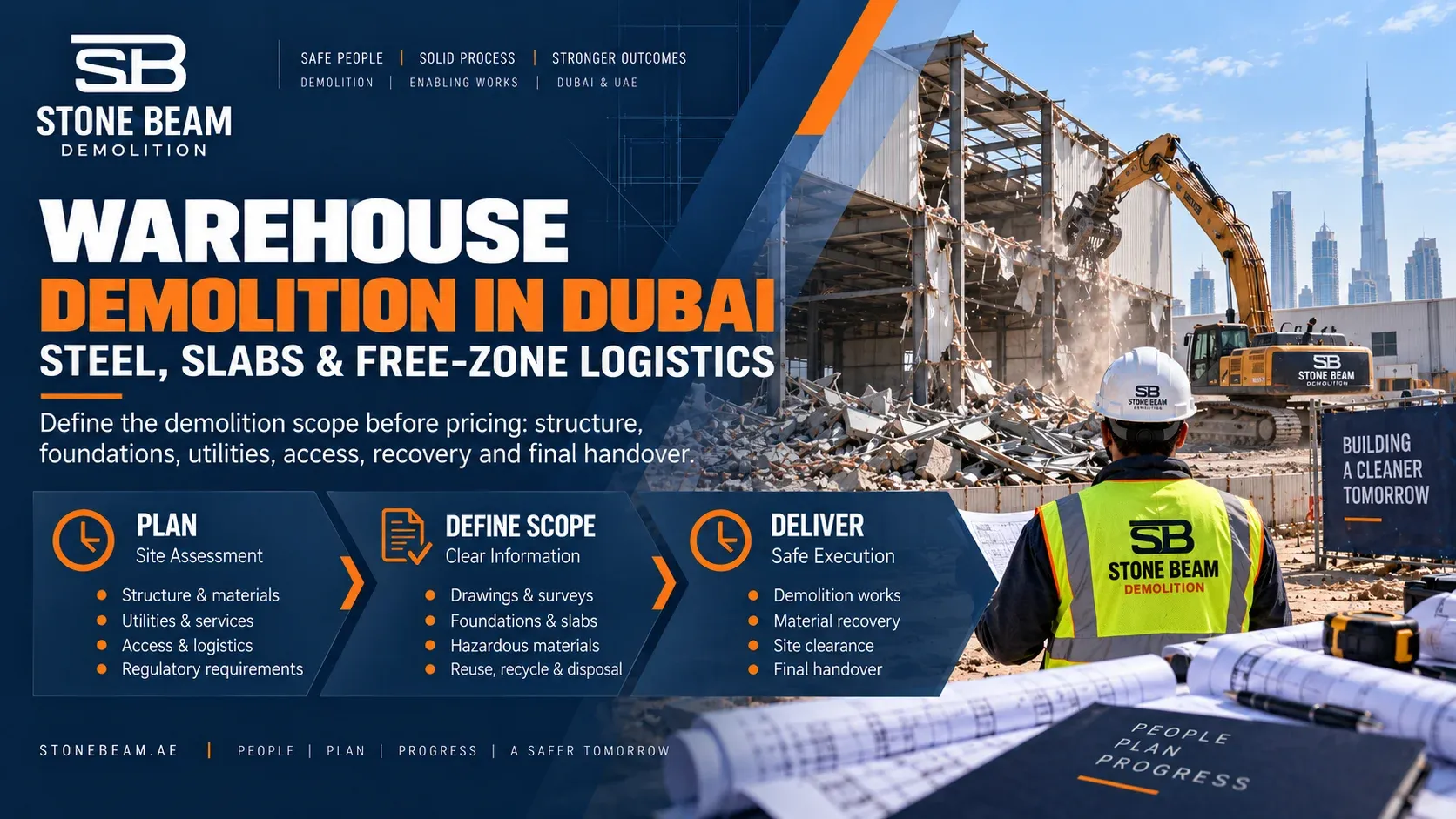
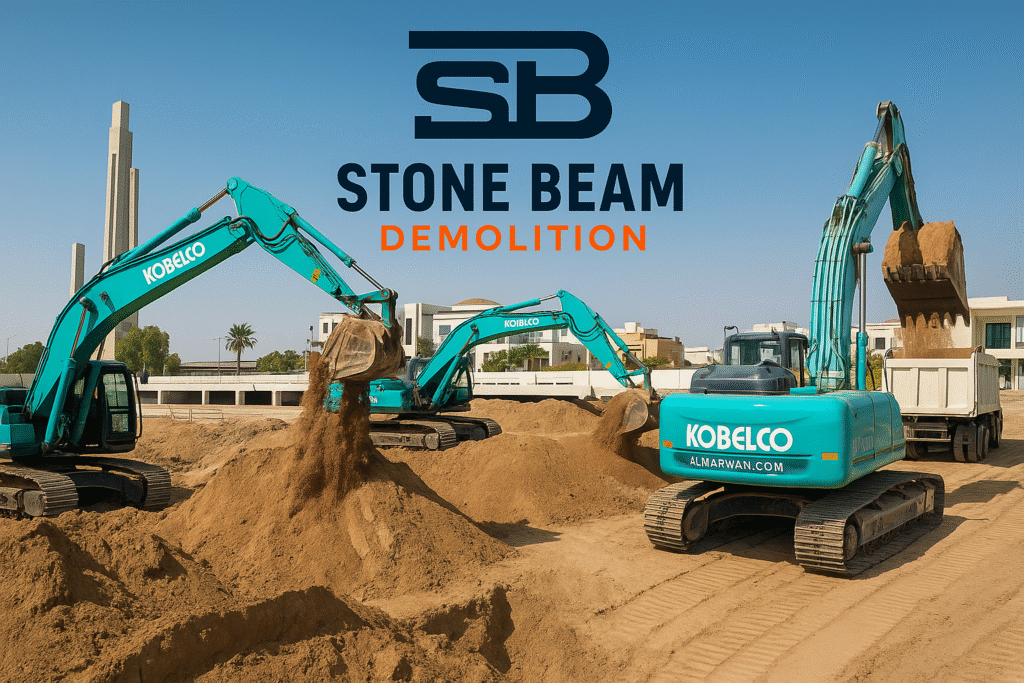
An excavator begins building demolition on a Dubai project, following careful planning and safety measures.
Planning Phase: Permits and Preparations
Proper planning is the foundation of any successful demolition. In Dubai, the planning phase is heavily regulated to ensure safety and compliance with local laws. Here’s what the planning stage involves:
- Hiring a Certified Contractor: Demolition work must be done by a Dubai Municipality-approved contractor. As a certified Demolition Contractor Dubai, Stone Beam Demolition coordinates all planning steps on your behalf. Authorities require a licensed contractor to apply for permits and supervise the project, so choosing an experienced demolition company in Dubai is step one.
- Site Assessment & Surveys: Before any physical work, a thorough site survey is conducted. Engineers will inspect the building structure, identify load-bearing elements, and locate any hazardous materials (like asbestos). For complex projects, Ground Penetrating Radar (GPR) Scanning may be used to map what’s inside concrete (rebar, post-tension cables, utilities) before cutting. For instance, GPR can detect rebars, cables, and conduits up to ~300mm deep in concrete, which prevents accidental strikes during demolition. This concrete scanning Dubai service is critical for safety and often mandated by consultants or clients prior to cutting or coring.
- Dubai Municipality Demolition Permits: All demolition projects in Dubai require a permit from Dubai Municipality (DM) before work begins. The contractor prepares a detailed demolition proposal including structural drawings, a method statement (step-by-step work plan), and safety plan, and submits these with the permit application. The DM will review plans to ensure they meet the Dubai Building Code and the Code of Construction Safety Practice. Key permit requirements include: naming a certified safety officer for the project, outlining demolition methodology, and detailing how you’ll protect workers, the public, and any adjacent structures. Only when DM approves and issues the demolition permit can work commence.
- NOCs from Utilities: In parallel with the DM permit, No Objection Certificates (NOCs) must be obtained from utility providers (DEWA for electricity/water, Etisalat for telecom, etc.). All utility services must be disconnected or rerouted before demolition. For example, we coordinate with DEWA to cut off power and water and obtain an NOC confirming disconnection. This ensures there are no live wires or pipes that could cause accidents when the building comes down.
- Neighbor Notifications & Approvals: Dubai authorities may require notification of neighboring properties, especially if the structure is attached or in a dense area. In some cases (like shared villa walls or party walls), neighbors might need to grant access or acknowledgment. Stone Beam Demolition handles these communications to maintain good community relations and avoid disputes.
- Safety Plan & Risk Assessment: A comprehensive HSE (Health, Safety, Environment) plan is prepared. This covers site fencing, signage, emergency procedures, and allocation of a safety supervisor. We identify potential risks (e.g., structural instability, falling debris, dust, noise) and plan mitigations in advance. For instance, if the building is close to a road, special barriers and an RTA permit might be needed to ensure traffic is not affected.
- Salvage and Recycling Plan: Advanced planning also involves figuring out what materials can be salvaged or recycled. Before demolition, Stone Beam will inspect for assets to recover – e.g., valuable fixtures, architectural elements, or recyclable metal. As we’ll cover later, Dubai requires at least 50% of demolition waste by volume to be diverted from landfills through reuse or recycling. Planning how to segregate waste streams (concrete, steel, wood, etc.) from the start makes the later cleanup more efficient and environmentally friendly.
By thoroughly completing the planning phase, our team ensures all legal requirements are met in compliance with DM demolition permits and that the project is set up for safe execution. Proper planning prevents delays and surprises down the road.
Demolition Techniques and Execution
Once permits and preparations are in place, the project moves to the execution phase. Advanced demolition is characterized by using the right technique for each part of the job – maximizing safety, speed, and precision. In this section, we break down various demolition methods used in Dubai and how Stone Beam Demolition applies them:
Robotic & Conventional Demolition
Demolition methods can be broadly categorized into conventional mechanical demolition and advanced (sometimes robotic or controlled) demolition.
- Conventional Demolition: This refers to the use of heavy machinery like excavators with hydraulic breakers, loaders, and cranes with wrecking balls (though wrecking balls are rare in dense urban Dubai). Conventional demolition is effective for quickly bringing down low-rise structures and is often used in villa demolition or small building removal. For example, an excavator can systematically pull down walls and roofs, working top-down. Stone Beam’s team carefully sequences mechanical demolition floor by floor to maintain control – usually starting at the top and working downward, as per our method statements. We also protect any adjacent structures; for instance, if a villa shares a wall with a neighbor, we might manually separate that wall first to prevent damage. Conventional methods are efficient but require significant expertise to manage safety (preventing uncontrolled collapse).
- Robotic Demolition: In advanced projects, robotic demolition machines (remote-controlled robots fitted with breakers or crushers) are deployed. These machines are compact and can enter interior spaces or upper floors that larger excavators cannot reach. Robotic demolition is ideal for interior strip-out, selective demolition in tight spaces, or where manual labor would be too slow or risky. The benefit is precision and improved safety – the operator can control the robot from a safe distance, reducing human exposure in unstable structures. Stone Beam Demolition often uses robotic demolition for high-risk interior work or to demolish elevated slabs without putting workers directly under a collapsing element. (Interested in more? See our Robotic Demolition service page for how these machines are revolutionizing advanced demolition in Dubai.)
Both conventional and robotic methods have their place. Often, we use a hybrid approach: robots or manual work for delicate portions (e.g., top floors, tight interiors), and excavators for the bulk teardown once the structure is lowered to a safer height.
Interior Strip Out vs Full Demolition
Not every project requires flattening an entire building. Often in Dubai, clients need partial demolition or interior gutting while preserving the main structure – for example, preparing a villa for renovation or a commercial space for a new fit-out. It’s important to understand the difference between a full demolition and a strip out (also called interior demolition):
- Full Demolition (Complete Building Removal): This is the complete takedown of a structure to ground level (and often removal of the foundation as well if preparing for new construction). Full demolition is needed when the entire building is being replaced. It involves structural demolition of all columns, beams, slabs – essentially reducing the building to rubble. In a full villa demolition, for example, Stone Beam will tear down the villa entirely but might take precautions to preserve the surrounding landscape or boundary walls if the client intends to rebuild on the same plot without damaging the garden or external features. Full demolitions require the highest level of planning and safety oversight because the structure’s stability will be fully compromised as work progresses.
- Strip Out (Interior Demolition): An interior strip out focuses on removing non-structural elements inside a building while keeping the primary structure (columns, beams, external walls, roof) intact. In a Strip Out Villa project, for instance, we remove all internal partitions, finishes (floor tiles, ceilings), MEP installations (HVAC ducts, plumbing, wiring), cabinetry and fixtures – essentially gutting the villa to its shell. The structural frame remains, which can then be renovated or remodeled. Strip outs require careful work to avoid hitting structural members. Often this is done manually or with small machines to ensure precision. It’s also common to do strip-outs as the first step of a full demolition – i.e., first strip the interior to salvage reusable items and remove hazards (like glass, piping, etc.), then proceed with structural demo.
Which do you need? If you are renovating an old property and keeping the basic frame, you need an interior strip out. If the building is unsafe or no longer needed, a full demolition is in order. In either case, Stone Beam Demolition’s team has experience with both full & interior demolition – we often start with a strip-out even for complete demolitions, to maximize salvage and minimize debris during the main teardown.
Case in point: Before completely demolishing a Jumeirah villa recently, we performed a full strip-out, carefully removing and saving ornamental doors and windows the owner wanted to reuse. By doing an interior strip out first, we preserved the villa’s perimeter fencing and garden. The result was a clean site ready for rebuilding, with the beloved landscape untouched (see Case Study 1 below for details).
Concrete Cutting & Advanced Techniques
Modern demolition projects in Dubai frequently involve cutting and removing reinforced concrete elements – such as cutting openings in a wall, removing a section of a slab, or dismantling foundations. Advanced concrete cutting techniques ensure these tasks are done precisely without compromising the rest of the structure.
- Concrete Cutting (Sawing): Using diamond-tipped saws, our crews cut through concrete walls or slabs with surgical precision. Common scenarios include cutting a new doorway or window opening, or segmenting a large slab for controlled removal. In advanced demolition, wire saws and wall saws are game-changers. A diamond wire saw uses a cable with diamond beads that can slice through very thick concrete and steel-reinforced structures of virtually any shape. The wire is looped around the element and guided by pulleys, allowing cuts in any direction. This method is fast, produces minimal dust, and leaves clean edges. For instance, when removing a reinforced concrete column in a tight space, we might wrap it with a wire saw to cut it at the base without disturbing adjacent columns. Wall sawing uses a track-mounted diamond blade saw, ideal for cutting straight openings (like doors, windows) in thick concrete walls. Stone Beam uses high-powered saws capable of cutting 40+ cm thick concrete like butter, ensuring any concrete cutting in Dubai we perform is precise and to plan.
- Core Drilling: To assist demolition or utility rerouting, core drilling is used to cut perfectly round holes in concrete (for example, to pass new pipes or cables, or to weaken a structure for easier breakage). This technique might be employed prior to demolition to create break-lines or to extract core samples for structural analysis. As a certified contractor, we ensure any core drilling is done after concrete scanning (GPR) to avoid hitting rebars or post-tension cables that could be dangerous if cut.
- Controlled Demolition (Non-Explosive): Sometimes, we need to remove concrete without impacting surrounding sections. One advanced method is controlled fracturing using expanding grout or hydraulic bursting. For example, if a thick foundation block must be removed inside a basement, Stone Beam might drill holes and use hydraulic burst cylinders that crack the concrete into chunks without flying debris or vibration. This is a quiet method and avoids heavy percussive breaking, suitable for sensitive sites. It’s part of “controlled demolition” techniques where the goal is precision over speed.
- Explosive Demolition: It’s worth mentioning that large implosions (using explosives) are rare in Dubai due to proximity of other buildings and strict regulations – and typically only considered for very tall structures or specialized cases. Most routine demolitions (villas, mid-rise buildings) are done mechanically, not with explosives. Stone Beam Demolition specializes in mechanical and controlled methods that align with Dubai’s safety-first approach. Explosives, if ever used, require extensive permits and coordination with civil defense; as of 2025, it’s more common to see innovative mechanical methods (like the High Reach demolition machines) than explosive implosions in the city.
- Ground Penetrating Radar (GPR) Scanning: We mentioned scanning in planning, but it plays a role during execution too. Before any heavy cutting or coring, our technicians perform concrete scanning (GPR scanning) to pinpoint steel reinforcements, tension cables, or hidden utilities in the concrete. Dubai’s regulations and best practices strongly encourage scanning; it is effectively mandatory for any drilling or cutting that could strike embedded objects, as hitting a live electrical conduit or a gas line can be catastrophic. GPR scanning equipment (like the Hilti PS1000 scanner) gives a real-time view of what’s inside concrete up to ~30 cm depth. By marking out the safe cut zones, we prevent accidents and costly damages. In one Al Quoz project, detailed in Case Study 2, GPR scanning identified critical rebar patterns so we could cut a slab into sections without hitting the reinforcement in wrong places. This level of precision underscores why GPR scanning is considered essential before any major building demolition – it ensures safety and compliance with structural engineers’ requirements.
Finally, excavation services often complement demolition. After above-ground structures are removed, the site may need excavation to remove foundations, underground tanks, or to grade the land for new construction. Stone Beam provides Excavation Services Dubai as part of our turnkey demolition package – using our fleet of excavators and skilled operators to dig out footings and clear the site down to the required level. We handle excavation with the same precision, making sure not to disrupt neighboring property lines or underground utilities (again, utility scans are done before digging). All excavation debris is also managed and transported per municipal guidelines.
Safety and Dubai Municipality Regulations
Safety is the cornerstone of demolition work, and it’s an area where Stone Beam Demolition refuses to compromise. The Dubai Municipality (DM) and other authorities have strict safety regulations that every demolition contractor must follow – and for good reason. Demolition, if done improperly, can endanger workers, neighbors, and the public. Here’s how we ensure demolition safety procedures are rigorously implemented:
- Project Safety Officer: Dubai regulations require a competent safety officer to be appointed for demolition projects. This person oversees all HSE matters on site. At Stone Beam, our safety officers are trained in risk assessment, first aid, and DM code compliance. They conduct daily briefings (“Toolbox talks”) to remind the crew of hazards and check that everyone is in proper PPE.
- Personal Protective Equipment (PPE): All workers must wear appropriate PPE at all times on a demo site. Typical gear includes hard hats, safety boots, high-visibility vests, gloves, goggles, and dust masks or respirators. Ear protection is also used when operating jackhammers or saws. We enforce a zero-tolerance policy – anyone on site without proper PPE is stopped from work. Dubai Municipality inspectors can visit sites randomly, and one of the first things they check is PPE compliance.
- Site Securing and Signage: Before demolition starts, the site is hoarded or fenced off. We install sturdy barriers and warning signs around the perimeter. No unauthorized person is allowed in. If the site is in a busy area, we coordinate with authorities to possibly have security personnel or flagmen managing pedestrian traffic. According to UAE safety guidelines, the site must be secured to prevent falling debris from affecting neighbors or passersby. For example, if we demolish a building in a tight urban lot, we might scaffold and wrap the structure in heavy-duty mesh to catch debris.
- Step-by-Step Demolition (Preventing Collapse): A critical safety aspect is following the correct sequence of demolition. We don’t just knock everything down randomly; we plan which elements to remove in what order so the structure doesn’t collapse unexpectedly. Generally, we remove non-structural parts first (as discussed in strip out), then structural elements floor by floor. Supports for any standing sections are left in place until it’s time to take them down. Our engineers sometimes design temporary supports or bracing if needed. This controlled approach aligns with Dubai’s “safety first” mindset – the DM can halt a project if unsafe practices (like indiscriminate structural cuts) are observed.
- Environmental Safety (Dust & Noise Control): Demolition can create dust clouds and noise, which are health hazards and nuisances. We implement dust suppression by continuous water spraying while breaking concrete. Many projects use fine mist hoses or even fog cannons to keep dust down. (In fact, “dry cutting” concrete is avoided unless equipped with special vacuums or when absolutely necessary, to comply with environmental guidelines.) Noise is mitigated by using well-maintained equipment and avoiding work at night in residential areas. We also monitor noise levels; authorities may have decibel limits that we ensure not to exceed by using noise barriers if needed.
- Fire Prevention: Especially in interior or industrial demolition, fire risk is present (sparks from cutting torches, hot machinery, or, in an old building, possible gas lines). Our team equips the site with fire extinguishers on hand, and if any “hot works” (welding, torch cutting) are done, a dedicated fire watch is assigned. On a recent project, we had a fire warden present at all times during the dismantling of a fuel station canopy, per safety plan. All flammable materials (old fuel, gas cylinders, etc.) were removed beforehand.
- Emergency Preparedness: We prepare emergency and evacuation plans, and all crew members are briefed on them. This includes having first aid kits on site, clear escape routes, and an assembly point. In case of any incident (injury, structural collapse, etc.), everyone knows how to respond. Thankfully, due to our meticulous planning, incidents are extremely rare.
- Inspections and Compliance: Stone Beam Demolition conducts regular in-house safety inspections and also welcomes external inspections by DM or EHS (Environment, Health and Safety) officials. We maintain documentation like daily logs, safety checklists, and incident reports. Dubai Municipality’s code of practice for demolition is followed to the letter. For example, DM regulations might specify that if a demolition permit expires or if work pauses, the site must be re-inspected and permit renewed – we track permit validity and ensure no lapses. Compliance isn’t just paperwork: it builds trust that our sites are safe.
- Special Case – Hazardous Materials: If during demolition we encounter hazardous substances (like asbestos insulation, which is common in older buildings), we follow strict procedures for removal and disposal by licensed specialists. Dubai has regulations for asbestos removal (e.g., requiring approved enclosures and PPE with negative air machines). We include such plans in our method statements so that no one is exposed to harmful dust. Similarly, for an Oil and Gas Demolition (like a decommissioned petrol station in Case Study 3), environmental safety is paramount – ensuring no fuel or chemicals are left in tanks, and getting NOCs from Civil Defense for handling flammable substances.
In summary, safety is a non-negotiable aspect at every stage. By complying with DM demolition safety procedures and international best practices, Stone Beam Demolition protects its workers and the community. It’s also about reputation – our clients trust that we will execute the project “safely and by the book.” As a result, we have an impeccable safety record and have never had a major incident on site.
Waste Management and Recycling
Demolition doesn’t end when the building is down; it ends when the site is clear and safe for whatever comes next (new construction, landscaping, etc.). This final phase involves handling enormous amounts of debris. Advanced demolition practices emphasize sustainability – recycling and reusing materials rather than just dumping everything. In Dubai, this isn’t just good practice, it’s often required by regulation and economic sense. Let’s explore how Stone Beam Demolition manages construction and demolition waste:
- Waste Segregation On-Site: From the moment demolition begins, we separate debris by type. Steel, concrete, wood, glass, gypsum, etc., are sorted into different piles or containers. This makes recycling easier. For example, all the rebar and structural steel pieces are pulled out (often using an excavator with a magnet or grapple) and piled together; concrete rubble is kept clean (free of wood or trash) for crushing; wood from interiors is separated (if untreated, it might be recyclable or can be chipped). By striping out materials first (as mentioned in interior demolition), we already remove fixtures and finishes, which reduces contamination of the main concrete rubble.
- Recycling Concrete and Masonry: Concrete rubble is one of the heaviest waste components. Instead of sending it to landfill, we typically send concrete and blocks to local crushing facilities. In Dubai, there are recycling plants that crush concrete debris into aggregate which can be reused for road base, new concrete, or other construction uses. According to Dubai Municipality regulations, new construction projects must attempt to use recycled aggregate where possible – a drive to promote a circular economy in construction. By recycling concrete, we not only comply with these sustainability goals but also reduce dumping fees.
- Metal Scrap Recycling: Steel and metal scrap (from rebars, structural steel beams, pipes, etc.) is highly recyclable. We send metal to scrap yards where it’s melted down and reused. Often, the value of scrap steel can be subtracted from project costs (it’s like giving value back to the client). Copper wiring, aluminum frames, and other metals are similarly salvaged. It’s not uncommon that the recycling rate for metal from a demolition is nearly 100%, as metal is too valuable to waste.
- Wood, Glass, and Others: Clean wood (like timber formwork or lumber that’s not painted with lead paint) can sometimes be repurposed or at least shredded for mulch or biomass fuel. Glass from windows is usually not easily recyclable due to mixed materials (frames, etc.), but we do collect large glass panes carefully (to avoid shattering hazards) and send to specialized waste handlers. Gypsum drywall, if kept separate and clean, can be recycled into new drywall or used in cement manufacturing. We strive to find a recycling stream for each material. Construction waste recycling in Dubai is an evolving industry – facilities exist for many materials, and we stay updated with the latest options.
- Handling Hazardous Waste: Any hazardous waste (like asbestos, contaminated soil, chemical residues from industrial demolitions) is handled according to UAE laws. We involve licensed hazardous waste contractors to safely remove and dispose of these in designated treatment facilities. For example, if demolishing an old industrial site with oil-contaminated soil, we’d excavate that soil and send it to an approved treatment center rather than a normal landfill.
- By the Numbers – Compliance with DM Recycling Targets: Dubai Municipality has set targets for recycling. As per Green Building Regulations, at least 50% of demolition waste by weight or volume must be diverted from landfills. Stone Beam consistently meets or exceeds this. In many of our projects, we achieve 70-90% recycling rates by weight. Concrete and masonry (which are heavy) being recycled boosts the percentage significantly. We document all waste leaving site with weighbridge receipts and recycling certificates – not only to prove compliance if asked by DM, but also to quantify the sustainability achievements to our clients.
- Construction Waste Transportation: We use municipality-approved trucks and hauliers to transport debris. In Dubai, trucks carrying C&D waste must be covered to prevent dust or spillage on roads. They must also dispose of waste only at approved facilities (like Dubai Municipality’s designated dumping sites or recycling plants). Our team arranges the logistics so that debris removal is continuous during the demolition. You’ll see trucks moving in and out, especially once the bulk demolition is underway – we don’t let piles accumulate dangerously. A clean site is a safe site.
- Site Clearance and Handover: After demolition, we perform a thorough site clearance. This includes removing all debris, sweeping the plot, and sometimes even grading and leveling the soil if required. We ensure any underground elements (old foundations, basements) requested to be removed are gone. When we hand over the site, it’s typically “construction ready” – meaning the next contractor can come in to start new foundation work without impediment. Clients often appreciate that we also clear any temporary facilities we brought (site office, toilets) and our job is truly done when the plot is clear.
- Transparency and Documentation: Stone Beam prides itself on transparency. We provide clients with a waste management report post-demolition, detailing quantities of materials recycled vs disposed. This not only builds trust but also can help clients with their own sustainability goals or Green Building certification documentation (e.g., LEED requires reporting of recycled waste percentages). Our commitment to Construction Waste Recycling Dubai isn’t just lip service – we actively seek to improve and innovate. For instance, in some projects we’ve coordinated with concrete recycling facilities to crush material on-site (when space allowed) to reduce transport, or we’ve donated salvaged items (doors, bricks) to organizations that can reuse them.
In essence, advanced demolition means thinking beyond demolition – considering the full lifecycle of materials. By doing so, Stone Beam Demolition not only complies with regulations but often finds cost savings (e.g., lower disposal fees, revenue from scrap) that we can pass on to clients in the form of more competitive quotes. It’s truly a win-win for the client and the environment.
After an industrial demolition, debris is sorted into piles: metals, concrete, and general waste, ready for recycling. An on-site supervisor (background) inspects the area, ensuring a clean and safe site clearance.
Traditional vs Advanced Demolition (Comparison Table)
Demolition techniques have evolved significantly. “Traditional” demolition (which might involve basic manual labor and a wrecking ball or standard excavator, with minimal planning) differs from advanced demolition (which uses precise engineering, modern equipment like GPR, diamond cutting, and robust planning). Below is a comparison highlighting key differences in cost, time, safety, and recycling between traditional and advanced demolition approaches:
| Aspect | Traditional Demolition | Advanced Demolition |
| Cost | Lower upfront cost (fewer specialized tools), but can incur hidden costs from delays or accidents. Minimal salvage value recovered. | Slightly higher upfront due to advanced equipment and planning, but more cost-effective overall – fewer surprises, less damage to surroundings, and salvage of materials (scrap metal credit, etc.) can offset costs. |
| Timeframe | Often slower and prone to delays. E.g., manual methods take longer, and unforeseen obstacles (undiscovered rebar/utilities) can halt work. | Faster completion thanks to efficient planning and technology. For instance, diamond cutting and robotic demolition significantly cut down time. Precise planning avoids downtime – overall project schedule is more predictable and usually shorter. |
| Safety | Relies heavily on operator skill; higher risk of accidents. Limited preliminary scanning, so chance of hitting unknown utilities or structural collapses is higher. Safety measures may be basic. | Safety-first approach with detailed risk assessment. GPR scanning prevents cutting into live utilities, and engineered demolition sequences reduce collapse risk. Fewer workers put in harm’s way (e.g., robots replace some manual labor). Compliance with strict demolition safety procedures throughout. |
| Impact on Surroundings | More vibration and uncontrolled dust/noise. Traditional methods (like percussion breakers without water suppression) can disturb neighbors and cause collateral damage (cracks in adjacent structures). | Minimized impact – e.g., wire sawing produces very low vibration and less dust. Water suppression and noise control are integral. Adjacent structures are monitored (often no damage at all). Advanced methods allow work in dense urban sites with minimal complaints. |
| Waste & Recycling | Little emphasis on recycling; most debris might go to landfill. Recyclables not well segregated on site, so valuable materials could be wasted. | High recycling rates. Materials are sorted and sent to appropriate recycling facilities. In Dubai, advanced contractors meet the ≥50% waste diversion mandate. This reduces environmental footprint and can reduce disposal costs. |
| Compliance | May risk non-compliance if shortcuts are taken (e.g., starting without proper permits, or inadequate safety per DM code) – this can lead to fines or work stoppage. | Fully compliant with Dubai Municipality permits and regulations at each step. Documentation and permits are in place before work. This means no legal interruptions and a smoother process with authorities’ approval. |
| Technical Capability | Limited methods – e.g., might not handle thick concrete or tricky demolitions well (could resort to brute force, which has limits). Complex structures pose a problem. | Advanced techniques to handle any challenge – from cutting ultra-thick concrete with diamond wire to using cranes for precision lifts of heavy sections. Able to tackle complex projects (high-rises, industrial plants) that traditional methods could not safely do. |
| Transparency & Planning | Often lacks a detailed plan; more “tear down and see” approach. Project owners may be in the dark about progress or unexpected changes. | Detailed planning provided to client. The process from start to finish is mapped out, and clients are kept informed. Surprises are rare; when they occur, the contractor has contingency plans ready. This builds trust and confidence. |
As shown, advanced demolition offers clear advantages in modern urban environments like Dubai. While it may involve more upfront coordination, it pays off in efficiency, safety, and often total cost when considering avoided damages and the value of recycled materials. That’s why Stone Beam Demolition champions advanced methods – our goal is to deliver projects faster, safer, greener, and with no surprises.
7-Step Demolition Project Journey (Infographic)
To illustrate how a typical demolition project unfolds, here is “The Journey of a Successful Demolition Project” in 7 key steps. Think of this as a text-based infographic – a step-by-step roadmap from the first contact with our team to the final site handover. Each step includes the relevant services and considerations involved:
- Initial Consultation & Site Visit – It all starts with you reaching out to Stone Beam Demolition (your trusted Demolition Contractor Dubai). We discuss your project goals (e.g., remove a villa, partial strip out, industrial site clearance) and schedule a site visit. During the site visit, our experts assess the structure, take measurements, and identify any sensitive aspects (adjacent buildings, live utilities, hazardous materials). Service Keywords: Demolition Company in Dubai, Consultation, Site Survey.
- Customized Plan & Quotation – Next, we develop a demolition plan tailored to your project. This includes the method (manual, mechanical, or robotic demolition mix), equipment needs (excavators, cranes, concrete cutting tools), estimated timeline, and waste management strategy. We ensure the plan aligns with Dubai Municipality demolition permits requirements and safety standards. Along with the plan, you receive a transparent quote detailing costs. We emphasize transparency – e.g., if recycling steel will credit some value back, we note that. Service Keywords: Quotation, Planning, Dubai Municipality Permits, Stone Beam Demolition expertise.
- Permitting & Approvals – Once you approve the plan, we handle all necessary approvals. This step involves preparing the paperwork for the Dubai Municipality Demolition Permit, including engineering drawings and the method statement for how the building will be taken down safely. We also obtain required NOCs: e.g., DEWA NOC for utility disconnections (electricity, water) and any other authority clearances (civil defense for fuel stations, etc.). During this phase, we schedule the work timeline and mobilize resources. No demolition begins until all permits are in hand – in compliance with DM regulations to the letter. Service Keywords: Dubai Municipality Permits, NOC, Demolition Safety Procedures, Planning Phase.
- Pre-Demolition Preparations – Before the big teardown, we do preparatory works on site:
- Erect site hoarding/fencing and safety signage around the property.
- Perform interior strip out if needed: remove doors, windows, fixtures, MEP systems. Salvage usable items as requested.
- Conduct GPR scanning on structural elements and mark embedded services (to guide cutting and ensure no surprises).
- Disconnect utilities physically (after NOCs) – ensure power is off, water pipes drained, gas lines purged.
- Position machinery and equipment on site, establish a site office if needed, and brief the team on the safety plan.
Essentially, we tee up the site so that actual demolition can proceed smoothly.
- Structural Demolition Execution – Now the core action happens. Following the engineered sequence, our crew and machines bring down the structure safely:
- If it’s a building demolition, we might start with the roof and top floor, using breakers or cutting sections and lowering them by crane (if needed).
- For a villa demolition, an excavator may carefully pull walls inward, section by section.
- Utilize concrete cutting for any precision removals (e.g., cutting a wall into pieces to avoid collapse or to preserve a shared wall).
- Continuously manage debris – trucks haul it out concurrently.
- Ensure dust suppression (water sprays) and monitor structural stability as we go. Safety officer supervises at all times.
- This stage continues until the building is completely down to the ground. If there’s a basement or foundations to remove, those are broken out with mechanical means (after ensuring no underground services remain).
Throughout execution, experience and adaptability are key: our team adjusts techniques as needed if field conditions differ from assumptions, all while keeping safety and control paramount.
- Debris Removal & Recycling – As the structure comes down, debris handling is in full swing. We separate metals, concrete, and general waste as described in the waste management section. Trucks transport materials to recycling facilities or approved dumps:
- Concrete rubble -> to crushing/recycling (to be reused as aggregate).
- Metal scrap -> to steel recyclers.
- Timber and other waste -> to appropriate disposal or recycling streams.
We keep the site organized; by the end of demolition, only sorted piles (if any) remain, ready for final removal. Stone Beam provides documentation of where materials were taken, which is part of the project close-out package. This step ensures you meet any regulatory obligations (e.g., prove that hazardous waste was disposed of correctly, or recycling targets met).
- Site Clearance & Handover – The final step is making the site clean and safe for the next phase (whether it’s new construction or leaving it as open land). Our crew will:
- Remove any remaining debris, sweep the plot, and even out the ground.
- Demobilize all equipment and temporary facilities.
- Conduct a walkthrough with you (the client) or your representative to ensure satisfaction – the site should match the condition specified (often “levelled to grade”).
- Hand over relevant documents: permit closure documents, recycling report, and any warranties or inspections if applicable (for instance, DM might require a final inspection to sign-off that demolition was completed per the permit).
At this point, you’ll have a clear site. If you’ve engaged us for additional services like shoring or excavation for the next project, we seamlessly transition to those tasks. Otherwise, our job is done, and you’re ready to move forward with confidence.
Pro Tip: We often advise clients to involve us early in the planning of the next construction phase if possible – sometimes we can leave certain things (like temporary shoring or specific grading) to assist the upcoming contractor, saving time. Our goal is not just demolition, but enabling your overall project to succeed.
This 7-step journey demystifies the process and shows how we incorporate all aspects – from client experience, regulatory compliance, to technical execution – into a smooth workflow. Advanced demolition is a coordinated effort. Each step above is crucial, and Stone Beam Demolition’s role is to guide you through all seven with expertise, so you feel at ease from start to finish.
Mini Case Studies: Experience in Action
One of the best ways to understand the value of advanced demolition techniques is through real-world examples. Below, we present three mini case studies based on Stone Beam Demolition’s projects in Dubai. These highlight our experience, expertise, and commitment to safety and compliance (E-E-A-T) in different scenarios: a residential villa, a technical structural challenge, and an industrial demolition.
(Note: Client names are omitted for privacy, but these scenarios are very much real.)
Case Study 1: Villa Strip-Out in Jumeirah
Project: Complete Demolition of a 2-story villa in Jumeirah, with a full interior strip-out and preservation of external landscape and perimeter.
The Challenge: The owner planned to demolish an old villa and build a new one on the same plot. However, they had a beautiful garden and some heritage palm trees around the house, as well as a boundary wall shared with a neighbor. They wanted the demolition without harming these existing features. Also, the villa’s interior had valuable teak wood doors and décor pieces they wished to salvage for the new house.
Our Approach: Stone Beam Demolition devised a plan focusing on precision and care. First, we executed a comprehensive strip-out: our team manually removed all doors, windows, kitchen cabinets, sanitary fittings, and even floor tiling. We carefully unmounted the teak wood doors and decorative panels; these were tagged and safely stored for the client (they later refurbished and re-used them, saving cost on the new build). We also took out the AC units and water heaters to be handed over to the client (some were repurposed in staff accommodations).
Next, we addressed the garden protection. We erected protective plywood hoarding around tree trunks and over the lawn areas. The idea was to shield them from flying debris or heavy machinery contact. All demolition machine movements were confined to a narrow pathway which we created using steel plates laid over the ground to prevent soil compaction.
For the structural demolition, we opted for a top-down manual/mechanical combo. The roof slab was cut into large pieces using a diamond saw and those pieces were gently lifted down by a mobile crane. This controlled approach prevented heavy impacts on the ground (protecting underground irrigation lines in the garden). Once the top was removed, an excavator with a shear attachment systematically chewed down the walls and columns, one section at a time. Our crew was on standby with water hoses to suppress dust – this was especially important as it was a residential area and we scheduled noisy work during mid-day to avoid disturbing neighbors early or late.
The shared boundary wall with the neighbor’s property was left intact. We had earlier discussed with the neighbor and secured an agreement that if any minimal damage happened to the wall plaster, we’d fix it – but due to our careful method, the wall stood unaffected. We actually braced the boundary wall from our side with temporary supports while demolishing the villa next to it, just as a precaution.
Compliance & Safety: All necessary permits were obtained, including the DM permit and a permit from the local community developer (some areas in Jumeirah require community approvals too). A safety officer was on site full-time. No incidents occurred. We conducted noise level monitoring at the site boundary to ensure we stayed within acceptable limits – readings were all good thanks to the quieter demolition techniques used (diamond sawing significantly reduced jackhammer noise).
Result: The villa was demolished and cleared within 4 weeks, exactly on schedule. Not a single tree or shrub was lost – when we were done, the plot was empty except for the garden and fence which looked just as they did before (minus a bit of dust, which we washed off). The client was thrilled to have their beloved landscape preserved. Additionally, because we salvaged many fixtures, the client saved an estimated AED 50,000 on the new villa construction (by reusing those teak doors and some appliances). This project showcased how an experienced demolition company in Dubai can deliver personalized solutions, combining strip out services and careful demolition to meet unique client goals.
Case Study 2: GPR Scanning & Concrete Cutting in Al Quoz
Project: Dismantling a section of a reinforced concrete structural slab inside an operational warehouse in Al Quoz, using GPR scanning and precise concrete cutting to avoid damaging the rest of the structure.
The Challenge: An industrial warehouse had a mezzanine floor slab (approx. 200 sqm) that needed to be removed to accommodate new machinery with height requirements. The slab was part of the building’s structure. The tricky part: the warehouse was still operational in other areas, and the slab to be removed was connected to columns that supported an adjacent office area. So we had to partially demolish the slab without compromising structural support to the remaining parts of the building. Essentially, it was a surgical demolition job. Moreover, the slab was heavily reinforced and rumors were it contained post-tension cables (which, if cut improperly, can be extremely dangerous).
Our Approach: First step – investigation. We performed extensive GPR scanning on the slab’s underside and top. Sure enough, we identified both traditional rebar and post-tensioning cables in the slab. We mapped their layout precisely using marking chalk. With input from the client’s structural engineer, we determined which cables could be de-tensioned and which sections of rebar could be cut without affecting adjacent structure. We coordinated to have a specialist post-tension engineer on standby to safely release tension from the necessary tendons (this is critical; you cannot just cut through live PT cables as they might snap violently).
Next, we established a cut plan: using a diamond wall saw, we would cut the slab into segments roughly 2m x 2m. But before any cutting, we had to support the slab segments. We installed temporary props (adjustable jack posts) from the ground up to the slab, forming a grid of supports so that once cut, a segment would not drop uncontrolled. Essentially, we turned it into a cut-and-lift operation.
Using the wall saw mounted on a track, our operators cut along the outlined grid lines, avoiding the marked cables until after de-tensioning was confirmed. The precision was such that we kept tolerance within centimeters, ensuring the cut did not encroach into areas meant to remain. After all perimeter cuts were done, each 2x2m slab piece was rigged to a small mobile crane (which we had mobilized inside the warehouse through a large door) and lifted out one by one. The pieces weighed about 1 to 2 tons each. The crane placed them on the ground, where we later broke them into smaller chunks for disposal.
During cutting, we employed water cooling for the saw which created slurry. Because it was an indoor environment, we had slurry vacuums running to immediately suck water and keep the work area clean (avoiding slip hazards or water damage to stored goods in the warehouse). Plastic sheets were hung around the work zone as well to contain any stray dust or water splash.
Safety & Compliance: This project underscored why GPR scanning is mandatory in critical cuts – without it, hitting a pressurized cable could have led to a serious accident or structural failure. By scanning, we adhered to best practices and likely saved the project from disaster. We worked off-hours (night shifts) in the warehouse to minimize disruption to the client’s ongoing operations. DM permit was less of an issue here as this was an internal modification, but we still had method statements and engineer approvals, especially because it involved structural alterations. Dubai’s building regulations require that any structural demo in an occupied building be reviewed by an engineer – we had that in place.
Result: The slab removal was executed with zero incidents and the adjacent office and building structure were unaffected. The client’s engineer inspected the remaining building and gave a thumbs-up that our methods caused no undue stress to it. We removed about 60 tons of concrete from that slab. The pieces were carted out in trucks at night over a week. Impressively, we achieved this with no complaints from the industrial area neighbors, as all noisy cutting was done indoors and at night (and we are mindful of noise levels even at night).
The project took a bit longer (3 weeks) than a brute-force approach might have (maybe could be 1 week to just smash it out), but any brute force method would have been impossible here due to the precision needed. The client was extremely satisfied – they could continue using the rest of their warehouse during the process, and their new machinery pit was ready as planned. This case showcases advanced techniques (GPR & diamond cutting) enabling a complex partial demolition that traditional methods could not achieve without extreme risk.
Case Study 3: Industrial Fuel Station Demolition
Project: Demolition of a decommissioned fuel station (petrol pump) in Dubai, including removal of the canopy, fuel dispensers, underground storage tanks, and associated structures. Emphasis on environmental safety and regulatory compliance.
The Challenge: Fuel (petrol) stations are sensitive sites due to the presence of flammable materials and potential soil contamination. This station had been closed and the fuel pumps were dry, but the underground fuel storage tanks (USTs) still needed to be cleaned and extracted. Additionally, all pipes, the forecourt concrete slab, and a convenience store building were to be demolished. We had to adhere to strict environmental and safety protocols to avoid any fuel leakage, explosion risk, or soil contamination during removal. The project also required coordination with multiple authorities: Dubai Municipality, Civil Defense, and the fuel company’s own safety inspectors.
Our Approach: Planning was extensive. We first engaged a specialist subcontractor for tank cleaning. Before any demolition, each underground tank (there were 4, each 15,000 liters capacity) was opened, vented, and any sludge or residual fuel was safely removed and transported for hazardous waste disposal. The tanks were then filled with a foam inert gas to eliminate any combustible vapor. Only after the tanks were certified gas-free by experts did we proceed to excavate and remove them. This is a must-follow practice for fuel station demo – safety first to prevent any chance of explosion.
We tackled the fuel canopy next – the large steel canopy over the pump area. Instead of cutting the columns and letting it fall (which could be dangerous), we did a controlled dismantling. A crane was brought in to support the canopy roof. Workers elevated in a man-lift cut the canopy into sections (using cold cutting methods where possible to avoid sparks; when hot cutting was needed, we had fire watch and extinguishers at hand). The crane then lifted away each section. The steel was lowered gently to the ground for cutting into transportable pieces.
The pump dispensers and piping were removed carefully. All pipes were assumed to have some residual fumes, so we continuously checked with handheld gas detectors. We plugged or capped pipes during removal to avoid any spillage of remaining liquids. These components were treated as hazardous material until proven otherwise, and we disposed of them through licensed channels.
Once the above-ground structures and equipment were gone, we excavated around the tanks and lifted out the big cylindrical tanks – each was placed on a trailer and sent off for proper disposal/cleaning (sometimes these can be recycled after cleaning, but that’s up to the receiving facility).
The convenience store building on site was a relatively simple demolition after all this: a small structure which we demolished with an excavator. However, inside it had an old diesel generator with a day fuel tank – that too was removed with hazmat precautions.
Environmental Safety: We had environmental engineers take soil samples after removing the tanks. Minor fuel contamination was found in soil immediately around the tank area (common in old stations). We excavated an extra 1 meter of soil in those spots and disposed of that soil as hazardous waste, to ensure the site would be clean for future use (the client planned to turn it into a parking lot). We sprayed the excavated pit with special bacteria (a bioremediation step) that can further break down any petroleum residue – going above and beyond basic requirements.
Dust and noise were less of an issue here given the site’s location (it was not in a residential area). Still, we adhered to normal dust control and did noise-friendly scheduling for heavy breaking of the concrete forecourt.
Coordination: We obtained all necessary permits, which in this case included a NOC from the petroleum company and Dubai Civil Defense approval (they sometimes oversee fuel station decommissions to ensure fire safety). A Civil Defense officer actually visited during the tank removal to inspect, which we welcomed. Because of our thorough approach, we passed all inspections smoothly.
Result: The fuel station was demolished and the site cleared in about 6 weeks. No incidents, no fires, no spills – a spotless safety record on this challenging job. The authorities signed off the site, and the client was free to proceed with redevelopment. We managed to recycle most of the materials: the steel canopy and pipes went for scrap recycling, the concrete from the forecourt and building was sent to a recycler, and only the truly contaminated waste (sludge, contaminated soil) went to specialized disposal. Overall, about 85% of the station’s material by weight was recycled – notable since these projects can often generate “difficult” waste.
The client, an oil company, was very pleased as we met their strict global EHS standards. They used this project as a benchmark for safe fuel station demolition in their other operations around the region. This case study demonstrates Stone Beam Demolition’s capability in industrial demolition – especially an Oil and Gas demolition scenario – handling environmental hazards, complex stakeholder coordination, and technical demolition all in one project. It reinforced our reputation as an expert demolition contractor in high-stakes projects requiring ultimate trustworthiness.
Each of these case studies highlights key aspects of our service: meticulous planning, use of advanced techniques (from diamond cutting to robotic and careful dismantling), strict compliance with safety and DM regulations, and a client-focused approach (preserving what’s important, minimizing disruption). Experience matters in demolition – and by choosing a contractor with proven experience like Stone Beam, project owners ensure their project is in capable hands.
FAQs
In this section, we address common questions related to advanced demolition in Dubai. We’ve formulated the answers to be concise and direct – ideal for quick info and featured snippets. If you have a question not covered below, feel free to contact our team for more information.
What is the difference between a full Villa Demolition and a Strip Out?
A full villa demolition means completely tearing down the entire structure – the building is taken down to ground level (and often foundations removed), leaving a clear plot. In contrast, a strip out (interior demolition) involves removing only the internal, non-structural elements of a villa (such as internal walls, flooring, fixtures, kitchen, MEP systems), while keeping the main structure (exterior walls, roof, and structural frame) intact. Essentially, full demolition is total removal, whereas strip out prepares the villa’s shell for renovation by gutting the interior without bringing down the whole house. Owners choose strip-out when they plan to renovate or reconfigure the villa’s interior but not demolish the entire building.
What is the average cost of concrete cutting for a doorway in Dubai?
The cost to cut a standard doorway opening in a concrete wall can vary based on thickness, reinforcement, and site conditions. On average in Dubai, creating a doorway (roughly 2m high by 1m wide) might cost a few hundred to a couple of thousand AED.
For example, core cutting rates range around $0.6 to $7.7 per linear foot of concrete cut. A typical door opening could therefore be in the low thousands of Dirhams once you factor in scanning, cutting, and finishing. Prices depend on whether the wall is load-bearing (requiring extra support), the need for GPR scanning, and the concrete’s hardness/rebar content. It’s best to get a specific quote – Stone Beam Demolition provides free estimates – as each case can differ.
What are the steps to get a Demolition Permit from Dubai Municipality?
To obtain a Dubai Municipality (DM) demolition permit, follow these key steps:
- Hire a DM-approved contractor – The application must be submitted by a licensed demolition contractor (they will handle the process on your behalf).
- Prepare documentation – This includes technical drawings of the building, a detailed method statement (demolition plan outlining how the structure will be safely demolished), a waste management plan, and a safety plan.
- Submit the application via DM e-Services – The contractor submits the documents through the DM online portal along with the required forms.
- Obtain NOCs from relevant authorities – Before DM approves, you need No Objection Certificates from utilities (e.g., DEWA for electricity/water disconnection, Etisalat/Du for telecom, etc.) and any other concerned bodies (like Civil Defense for special structures). These NOCs confirm that services will be safely disconnected and there are no objections to demolish.
- Pay permit fees – DM will calculate the fees (based on building area, etc.) which the contractor pays.
- DM review and approval – DM engineers review the submission. If everything is in order (all plans and safety measures comply with code), they issue the demolition permit. This permit may come with conditions (like specifying working hours or requiring supervision by a consultant in certain cases).
- Begin demolition as per approved plan – The demolition must then be carried out strictly according to the permitted method and safety plan. Upon completion, DM may inspect the site to officially close the permit.
In summary: hire the right contractor, prepare and submit detailed plans, get utility NOCs, and secure DM’s green light before any demolition work. Stone Beam Demolition ensures all these steps are taken care of for our clients, making the permit process smooth.
Why is GPR Scanning mandatory before starting building demolition?
GPR scanning (Ground Penetrating Radar) is considered essential before cutting or heavy demolition in concrete structures because it reveals hidden hazards. GPR can detect things like rebar, post-tension cables, electrical conduits, and pipes embedded in concrete. If you accidentally cut through a live electric line or a pressurized gas pipe during demolition, it can cause serious injury, service outages, or even explosions.
Similarly, cutting a structural rebar or tension cable without knowing can weaken the structure unpredictably. By scanning, demolition engineers map out what’s inside walls and slabs so they can avoid damaging critical components or utilities. In Dubai, while not explicitly “law” for every case, many consultants and authorities require concrete scanning reports as part of the safety plan (especially for partial demolitions or renovations). It’s effectively a standard practice. In short, GPR scanning prevents dangerous surprises, ensuring the demolition is safe, compliant, and doesn’t inadvertently knock out essential services or structural supports.
How much does a demolition project cost in Dubai (for a villa or building)?
Demolition costs in Dubai depend on several factors: the size and height of the structure, the construction material (reinforced concrete vs. lighter steel structure), site accessibility, the complexity of the job, and waste disposal requirements. To give a ballpark, demolishing a single-story villa could range from around AED 30,000 to AED 80,000. A larger two-story villa might be between AED 80,000 to AED 150,000. For multi-story buildings, costs are higher – it could be AED 200,000 and up, scaling with number of floors and complexity (high-rise demolitions can reach into millions of Dirhams).
These estimates include mobilization of equipment, labor, permits, utility disconnections, and debris removal. If the structure contains hazardous materials (like asbestos) or is in a tight location requiring more manual work, costs increase. On the other hand, any salvage value (like recyclable metal) can slightly offset the cost. Stone Beam Demolition provides detailed quotations breaking down all these aspects, so you know exactly what you’re paying for. We also advise on ways to optimize costs (for example, doing an interior strip-out first to reduce demolition complexity). Each project is unique, so while these figures give a rough sense, it’s always best to get an assessment for your specific site.
How long does it take to demolish a house or building?
The duration of a demolition project varies by the structure’s size and the project scope. For a standard Dubai villa (say 3000-4000 sq.ft built-up area), demolition and site clearance typically takes 1 to 2 weeks from start of physical work. This includes a few days of tearing down and a few days of debris removal and cleanup. If it’s just an interior strip-out, it might be even faster (several days). For a medium-sized building, like a G+4 apartment block, expect around 3 to 4 weeks. High-rise demolitions can take several months because they often must be taken down floor-by-floor very carefully (sometimes one floor per week or so).
Keep in mind, these timelines are after all permits are obtained. The preparatory phase (permits, utility cutoffs) can also take a few weeks. Stone Beam Demolition will give you a schedule in our proposal, which factors in all these steps. We always plan with safety and local regulations in mind – sometimes working hours are restricted (e.g., no night work in residential areas), which can extend the schedule a bit. But generally, we strive to complete demolition as efficiently as possible so you can move on to the next phase of your project quickly.
What safety measures should a demolition contractor follow?
A reputable demolition contractor should follow a comprehensive set of safety measures:
- Proper Permits & Plans: Work only after securing a municipality permit and having an approved safety plan.
- Trained Personnel: Workers should be trained in demolition techniques and safety procedures. A competent safety officer must be on site.
- Personal Protective Equipment (PPE): All crew must wear helmets, safety boots, high-vis vests, gloves, eye protection, and masks or respirators when needed. Harnesses are mandatory when working at heights.
- Site Securing: The site must be fenced off from public access, with warning signs posted. Debris falling outside the site bounds should be prevented (using scaffolding, nets, or exclusion zones).
- Utility Disconnections: Electricity, gas, water, etc., should be shut off and verified before starting. Accidental live wires or gas lines can be deadly.
- Controlled Demolition Techniques: Follow the engineered sequence of demolition to avoid premature collapse. Don’t remove a supporting element too early. If needed, add temporary supports for stability.
- Dust & Noise Control: Use water sprays to suppress dust, and keep noise within permitted times. This protects both workers (from silicosis, hearing loss) and the surrounding community.
- Emergency Preparedness: Have first aid kits on site, and an emergency response plan (with exit routes, emergency numbers, and an assembly point). All workers should know what to do if something goes wrong.
- Monitoring: Continuously monitor the structure’s behavior. If cracks or unexpected movements are noticed, work should pause and the situation re-evaluated.
- Compliance Audits: Allow and participate in safety audits by authorities or internal teams. Document all safety checks and incident reports.
In summary, safety is a systematic effort. If you visit a Stone Beam Demolition site, you’ll see all these measures in action – it’s part of why clients trust us. Always ensure your chosen contractor places safety as the top priority, as we do.
Are there specific demolition safety procedures in Dubai that differ from other places?
Dubai’s demolition safety procedures align with international best practices, but there are a few notable local specifics:
- Dubai Municipality Code: There is a dedicated code and guidelines for demolition by Dubai Municipality, requiring things like a safety officer on site, detailed method statement submission, and notification of adjacent property owners.
- Working Hours: By regulation (and as indicated on permits), noisy demolition work might be restricted to certain hours, especially in populated areas. Nighttime work often needs special permission.
- Heat & Weather Considerations: Given Dubai’s climate, there are regulations like the Midday break rule (no outdoor work in peak summer heat afternoon times). Contractors must ensure workers are protected from heat stress (plenty of water, rest breaks).
- Dust Control: Because of the sensitivity of air quality, Dubai authorities enforce dust control stringently. Contractors can be fined if they create large dust plumes without mitigation.
- Waste Transport Manifests: Dubai requires tracking of construction waste. Demolition contractors need to use registered vehicles and dump sites and often have to report the waste quantities and destinations.
- Asbestos Handling: If asbestos is present, DM has specific approved specialists and processes for removal (including disposal at approved hazardous waste sites).
- Authority Inspections: It’s common for DM inspectors or EHS officials from development zones (like Trakhees in freezones) to spot-check demolition sites. Compliance with permit conditions is checked – for example, confirming that the contractor is the one who obtained the permit (no subbing to unapproved contractors), and that safety measures in the method statement are indeed in place.
In essence, while the core safety principles (PPE, structural safety, etc.) are universal, Dubai’s enforcement is quite rigorous. There is a strong culture of safety and any lapses can result in work stoppage or fines. That’s actually beneficial for clients – it ensures you hire a contractor who will do things the right way. Stone Beam Demolition is deeply familiar with Dubai’s specific safety and regulatory environment, so we make sure all local requirements are met or exceeded.
What happens to the debris after demolition – can it be reused or recycled?
After demolition, the debris doesn’t just go to a dump (at least not with an advanced contractor). Most debris is sorted and sent for recycling or reuse:
- Concrete and Masonry: Crushed into aggregate and reused in new construction (road base, etc.). Dubai Municipality mandates aiming for 50%+ waste to be recycled, which concrete recycling helps achieve.
- Steel and Metals: 100% recycled. Metals from rebar, steel beams, pipes, and cladding are sent to scrap processors who melt them down for new metal products.
- Wood: If in good condition, sometimes components (doors, frames) are salvaged for reuse. Otherwise, untreated wood can be recycled into mulch or biomass fuel. Treated wood may be disposed of or used as waste-to-energy.
- Glass: Large panes might be recyclable, but often glass is contaminated or broken and ends up being disposed of. Efforts are underway to improve glass recycling.
- Plastics and Other Materials: Plastics (pipes, etc.) may be sorted out and recycled if possible. Drywall (gypsum) can sometimes be recycled, or it might be sent to landfill if not separated.
- Hazardous materials: As mentioned earlier, anything hazardous (asbestos, chemicals) is isolated and handled by specialized facilities.
Contractors like us provide documentation of material disposition. You as a client can request a recycling report. It’s encouraging to note that modern demolition aims to be as sustainable as possible – not only is this eco-friendly, it also can reduce disposal costs. In many cases, yes, parts of your old building literally become part of new projects (recycled aggregate or re-rolled steel).
How can I choose a reliable demolition contractor in Dubai?
Selecting the right demolition contractor is crucial for a safe and successful project. Here are some tips:
- Check Licensing and Approval: Ensure the contractor is Dubai Municipality-approved for demolition works. An approved contractor will have a valid license and often a track record in the region.
- Experience and Expertise: Look at their portfolio – have they done projects similar to yours (villa, high-rise, industrial)? Experienced contractors can anticipate challenges and have proven solutions (as seen in our case studies).
- Safety Record: Inquire about their safety record and policies. A trustworthy contractor will proudly discuss their safety measures, training, and any accolades (like safety awards or ISO certifications in safety management).
- References and Reviews: Ask for client references or check testimonials. Hearing from past clients in Dubai can give insight. You can also check if they have been involved in any publicized incidents or violations (hopefully not).
- Methodology: During the proposal stage, see if the contractor provides a detailed method statement or at least explains how they’ll approach your project. This shows professionalism. Avoid those who just say “we’ll demolish it” without details – lack of a plan is a red flag.
- Compliance and Permits: A reliable contractor will handle the DM permit process for you and know the ins and outs of local regulations. If a contractor asks you to get the permit yourself or seems unaware of required NOCs, that’s a bad sign.
- Equipment and Technology: Top contractors invest in modern equipment (like concrete cutting saws, GPR scanners, robotic demolition machines). This not only improves efficiency but reflects their commitment to advanced methods. It’s fair to ask what equipment they will use.
- Transparent Quote: Price matters, but be wary of significantly low bids – it could mean they plan to cut corners. A reliable contractor’s quote will be competitive but also realistic, including all expected costs (permits, utility coordination, debris hauling, etc.). They should be willing to break down the costs and answer your questions.
Ultimately, trust your gut and the evidence. Stone Beam Demolition encourages clients to do this homework – we are confident that our credentials, experience, and client feedback stand out. By choosing a contractor carefully, you ensure your project will be executed with professionalism and minimal headaches.
Conclusion & Next Steps
Demolition is a critical phase of any construction or renovation project – it sets the stage for what comes next. In a dynamic environment like Dubai, choosing the right approach to demolition can make all the difference in time, cost, safety, and sustainability. Let’s recap the key takeaways from this guide:
- Advanced demolition techniques (like GPR scanning, diamond wire cutting, and robotic demolition) have raised the bar for efficiency and safety. They allow even the most complex projects to be executed with precision.
- Dubai Municipality’s regulations are stringent – from mandatory permits and safety procedures to waste recycling requirements. Working “by the book” isn’t optional; it’s essential for legal compliance and community trust. As demonstrated, Stone Beam Demolition ties every project phase to these requirements, ensuring full compliance and peace of mind for our clients.
- Embracing a sustainable approach through waste segregation and recycling is not just environmentally responsible, but also cost-effective and often required. Advanced demolition in Dubai is as much about deconstruction (carefully taking apart and repurposing) as it is about demolition.
- Our experience (E-E-A-T) shines through in real case studies – whether it’s delicately preserving a garden during a villa teardown, performing a surgical structural cut inside a building, or safely dismantling an old fuel station, Stone Beam Demolition has done it. We leverage that experience to benefit every new client, avoiding pitfalls and delivering optimal results.
- For project owners and managers, transparency and communication are key. We aim to educate and involve you – that’s why we provided this in-depth guide. An informed client working with an expert contractor is the recipe for a successful project.