Stone Beam Demolition

Dubai Municipality Demolition Exam G+4: The Ultimate Guide for Engineers, Contractors & Property Owners

Emergency Call - 24/7
Dubai Municipality Demolition Exam

Dubai is one of the fastest-growing cities in the world, with an urban landscape that is constantly evolving. Skyscrapers rise, older structures make way for new developments, and the cycle of construction and demolition never stops. In this dynamic environment, demolition is not merely the act of tearing down a building — it is a highly regulated, safety-critical engineering discipline that demands specialized knowledge, rigorous planning, and strict compliance with municipal regulations.

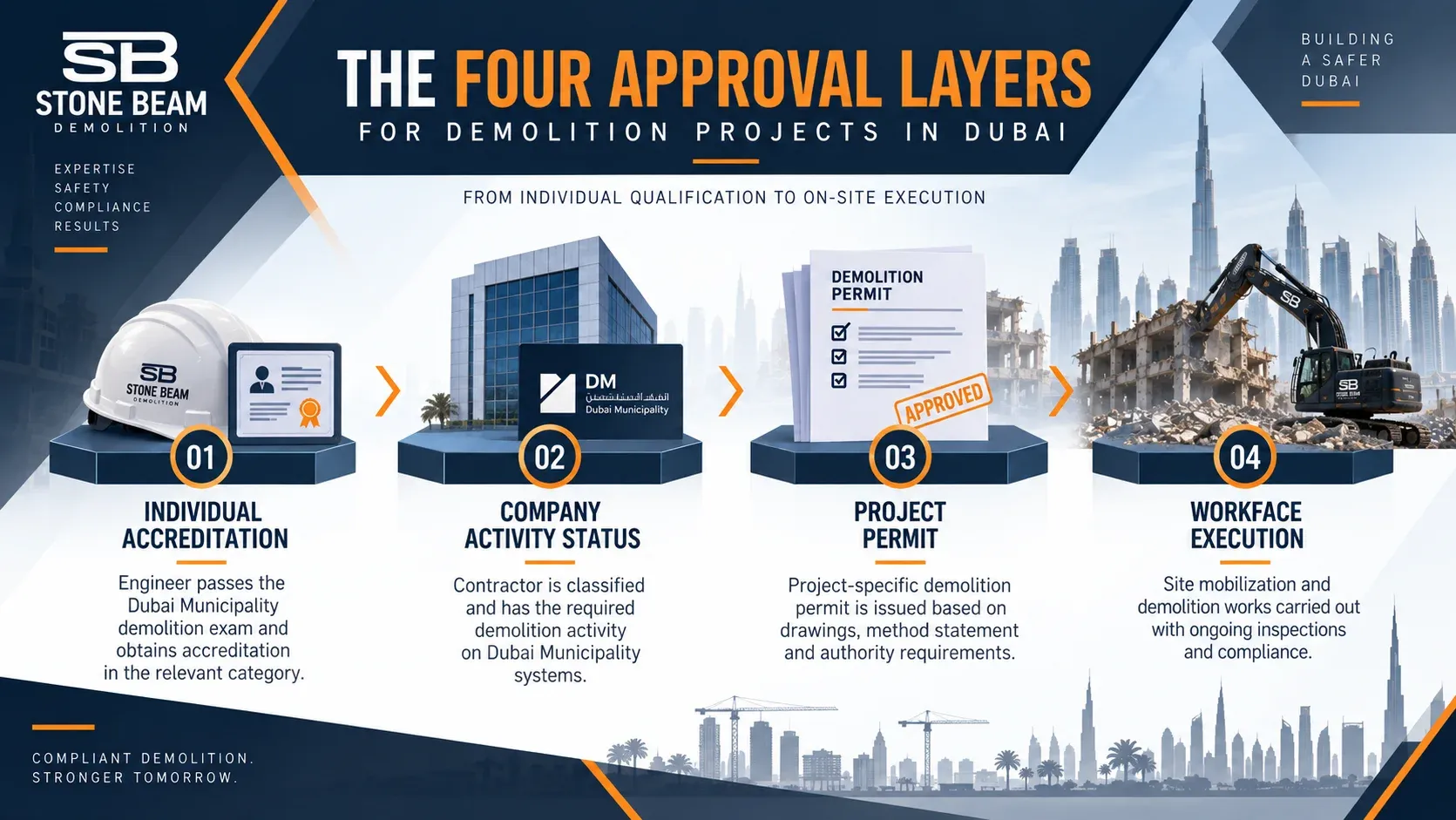
The Dubai Municipality has established a comprehensive qualification system known as the Dubai Engineering Qualification (DEQ) system to ensure that only competent, well-trained engineers oversee demolition projects. At the heart of this system lie the demolition competency exams, which are categorized by building height and project complexity. Among these, the G+4 exam occupies a critical middle ground — covering buildings up to four floors above ground level, which represent the majority of residential villas, low-rise commercial buildings, and mixed-use structures across Dubai.

This comprehensive guide, brought to you by SB Demolition (www.sbdemolition.ae), covers every aspect of the Dubai Municipality G+4 demolition exam and the practical knowledge required to execute demolition projects safely and legally in Dubai. Whether you are an engineer preparing for certification, a contractor seeking a reliable demolition partner, or a property owner planning a redevelopment project, this guide is your definitive resource.

TABLE OF CONTENTS

Table of Contents

Understanding the Dubai Engineering Qualification (DEQ) System

What Is the DEQ System?

The Dubai Engineering Qualification (DEQ) system is a regulatory framework established by Dubai Municipality under the Building Permits Department. Its primary purpose is to classify and certify engineers, consultants, and contractors working in the construction and demolition sectors within the Emirate of Dubai. The system ensures that all technical personnel meet minimum competency standards before they are authorized to supervise or execute building and demolition works.

The DEQ system applies to multiple engineering disciplines including civil, structural, architectural, mechanical, and electrical engineering. For demolition specifically, the system requires engineers to demonstrate in-depth knowledge of demolition planning, safety regulations, hazardous materials management, structural assessment, and the Dubai Building Code (DBC).

The Three Levels of Demolition Certification

Dubai Municipality classifies demolition qualification exams into three distinct levels based on building height and project complexity. Each level has its own eligibility requirements, exam content, and scope of authorized work:

Level Project Scope Experience Required Pass Rate
G+1 Buildings up to Ground + 1 floor (low-rise villas, small commercial) Minimum 7 years of relevant engineering experience Minimum 80% score required to pass the exam
G+4 Buildings up to Ground + 4 floors (mid-rise residential, commercial, mixed-use) Minimum 10 years of relevant engineering experience Minimum 90% score required to pass the exam
Unlimited High-rise buildings (10+ floors) and complex demolition projects Minimum 15 years of relevant engineering experience Minimum 90% score with advanced evaluation criteria

As the table illustrates, the G+4 level represents a significant step up from G+1, requiring substantially more experience and a higher pass threshold. This reflects the increased complexity and risk associated with demolishing multi-story structures where structural sequencing, public protection, and equipment management become critical factors.

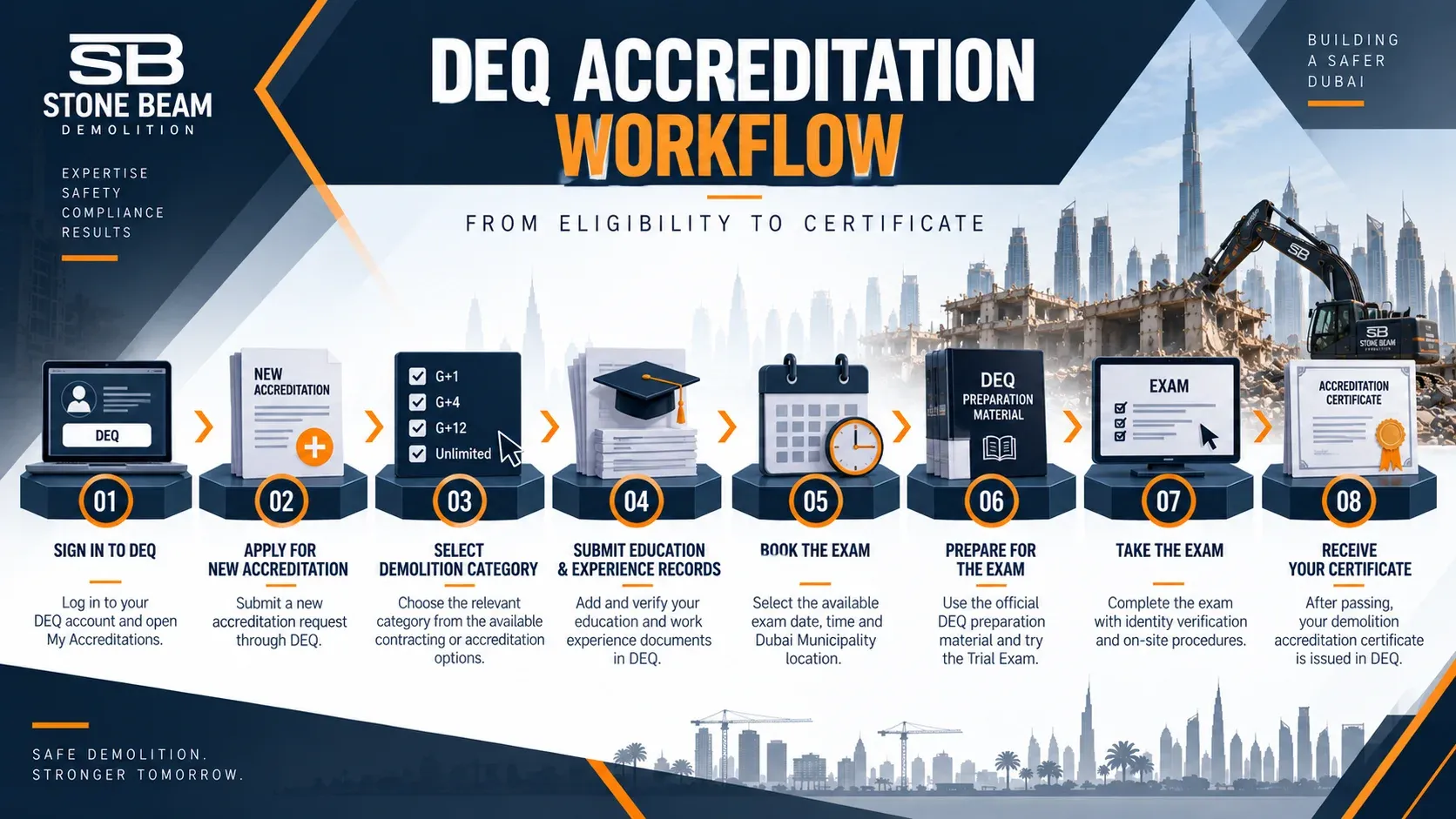
Registration Requirements for the DEQ Exam

Before an engineer can sit for any DEQ demolition exam, they must satisfy several prerequisites established by Dubai Municipality:

  1. Hold a Bachelor’s degree in Engineering from an accredited university recognized by the UAE Ministry of Education.
  2. Be registered with the Society of Engineers in the UAE (Emirates Society of Engineers).
  3. Be registered with the engineering society in their home country (where applicable).
  4. Possess verified professional experience of the required duration (7, 10, or 15 years depending on level).
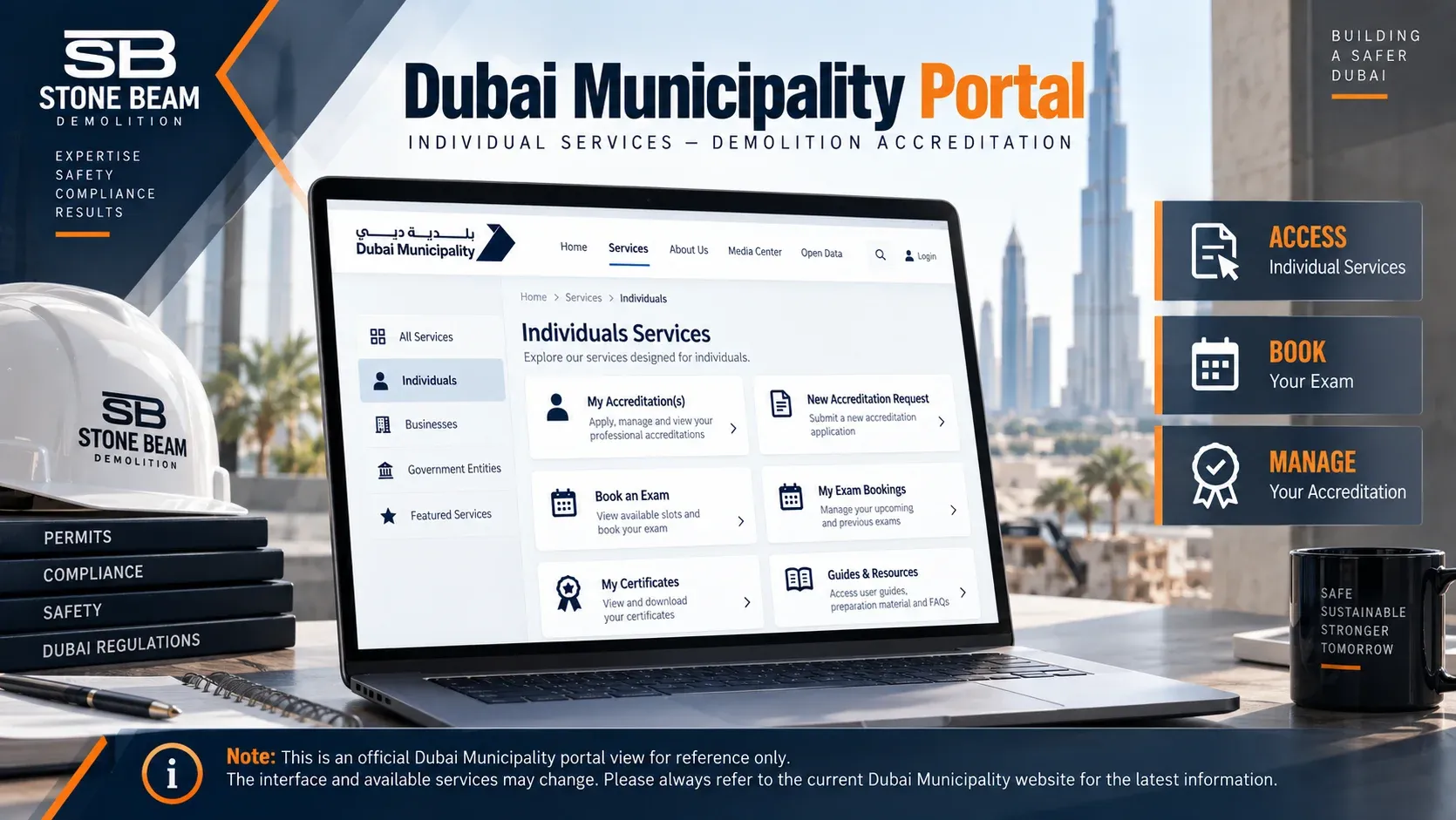
  5. Submit all required documentation through the DEQ online portal, including copies of the trade license, passport, residence visa, and educational certificates.
  6. Pay the applicable examination fees as specified by the Building Permits Department.

Once all documentation is verified and approved, the engineer will receive notification of their exam date. The exam is conducted electronically at designated testing centers under the supervision of senior municipal engineers.

The G+4 Demolition Exam: Complete Breakdown

Exam Format and Structure

The G+4 demolition exam is a comprehensive multiple-choice assessment designed to test the engineer’s theoretical and practical knowledge of demolition operations for buildings up to four floors. The exam covers a wide range of topics aligned with the Dubai Building Code and international best practices. Engineers typically have a fixed time window to complete all questions, and the exam is administered on-screen at approved testing facilities.

The exam questions are designed to test not just memorization, but practical understanding and the ability to make sound engineering decisions under real-world conditions. Many questions present scenario-based situations where the engineer must identify the correct course of action based on regulations and safety protocols.

Core Exam Topics

The G+4 exam covers the following major knowledge domains:

Dubai Building Code (DBC) Fundamentals

The Dubai Building Code is the regulatory backbone of all construction and demolition activities in the Emirate. Engineers must understand its scope, structure, and key provisions including building heights, setbacks, floor area ratio (FAR) calculations, fire safety requirements, accessibility standards, and common violations. The DBC sets the legal framework within which all demolition work must operate.

Permits, NOCs, and Regulatory Compliance

Before any demolition work can commence in Dubai, a comprehensive set of permits and No Objection Certificates (NOCs) must be obtained from multiple government authorities. The exam tests the engineer’s knowledge of which authorities must be contacted, what documentation is required, and the correct sequence of approvals. Key NOC-issuing authorities include:

  • DEWA (Dubai Electricity and Water Authority) — for disconnection of electrical and water services
  • RTA (Roads and Transport Authority) — for road access, traffic management, and transport considerations
  • Dubai Civil Defence — for fire safety and emergency access requirements
  • Sewerage and drainage authorities — for disconnection and protection of sewer lines
  • Traffic Police — for traffic diversions and public road closures
  • Telecommunications authorities — for protection of fiber optic and communication cables

Engineers must understand that no demolition work may proceed without valid NOCs from all relevant service authorities, and that service lines shown on drawings must be verified against actual site conditions before any work begins.

Pre-Demolition Engineering Survey

A qualified and Dubai Municipality-approved engineer must conduct a comprehensive structural survey of the building before demolition begins. This survey must document the building’s layout, structural condition, floor plans, wall configurations, and the probability of sudden collapse of any component. The survey must also assess hazards from neighboring structures and identify sensitive adjacent facilities such as hospitals, schools, or critical infrastructure where noise, dust, and vibration must be carefully controlled.

The engineering survey forms the foundation upon which the demolition plan is built. Without a thorough survey, it is impossible to select the appropriate demolition method, determine the correct sequence of removal, or identify hidden risks such as weakened structural members, underground utilities, or unexpected material compositions.

Demolition Planning and Method Statements

The exam extensively tests knowledge of demolition plan preparation. A certified demolition plan must include: the proposed demolition method, the sequence of removal operations (always top-down for structures above G+1), safety procedures for each phase, temporary support and shoring requirements, equipment specifications, waste management plans, and the method for separating from adjacent buildings.

Critically, once a demolition plan is approved by the supervising engineer, no modifications to the method may be implemented without obtaining fresh approval. This requirement ensures that all stakeholders remain aligned on the approach and that any changes are properly risk-assessed before execution.

Service Isolation and Utility Management

All utility services must be identified, disconnected, and verified from the main source outside the building boundary before demolition begins. This includes electrical power, gas, water supply, steam systems, sewerage, and any other service connections. If any utilities must remain active during demolition (for example, water for dust suppression), they must be rerouted and protected.

The exam tests engineers on the specific procedures for each type of utility disconnection, the verification methods required, and the documentation that must be maintained as evidence of proper isolation.

Hazardous Materials Management

Demolition sites frequently contain hazardous materials that pose serious health risks to workers and the public. The exam covers three primary hazardous material categories in detail:

Lead (Pb): Lead exposure risks arise primarily from cutting and burning steel structures coated with lead-based paint. When concentrations are likely to exceed the permissible exposure limit of 50 µg/m³, respiratory protection equipment (RPE) must be provided to all workers in the affected area. Air monitoring must be conducted to verify exposure levels.

Asbestos: Asbestos dust and fibers are generated during demolition of structures containing asbestos-based paints, thermal insulation, firebreaks, or asbestos-cement boards. All asbestos-containing materials (ACMs) must be removed by specialized licensed contractors before general demolition begins. Workers must use respirators equipped with High Efficiency Particulate Air (HEPA) filters. The removal must follow strict containment and disposal protocols.

Silica: Crystalline silica dust is generated when concrete, brick, and masonry are demolished. Prolonged exposure can cause silicosis, a serious and irreversible lung disease. Engineering controls such as wet cutting, dust suppression systems, and local exhaust ventilation must be implemented. Workers must wear appropriate respiratory protection equipment throughout the demolition process.

The mandatory sequence for hazardous materials is always: Survey → Control/Remove → Demolish. No demolition work may commence until all identified hazardous materials have been properly assessed and managed.

Safety Requirements and Public Protection

Site Hoarding and Perimeter Security

Dubai Municipality mandates comprehensive site security measures for all demolition projects. The site must be enclosed by hoarding not less than 1.8 meters (6 feet) in height. The hoarding must be maintained throughout the entire duration of the project and must be secured and locked at the end of each working day. A protective screen matching the height of the building being demolished must be erected to protect neighboring properties and pedestrians.

An exclusion zone of at least 6 meters (20 feet) must be established around the demolition perimeter. This zone must be clearly marked and no unauthorized persons may enter it during active demolition operations. Warning signs and directional signage must be prominently displayed at all entry points and along the perimeter.

Canopies, Walkways, and Overhead Protection

For multi-story demolition projects including G+4 buildings, overhead protection must be provided at all worker and pedestrian entry points. Canopies and sidewalk sheds must project at least 2.4 meters (8 feet) from the building facade and must be at least 0.6 meters (2 feet) wider than the entrances or openings they protect. These structures must be engineered to withstand the impact of falling debris and materials.

Stairwell openings must be covered for a minimum of two floors below the active demolition level to catch any falling materials and prevent them from reaching lower levels where workers may be present.

Worker Access and Egress

The demolition plan must define specific routes for worker access and egress, including designated staircases, ramps, and corridors. All other openings must be closed and secured as unsafe. A separate, well-illuminated pathway must be maintained to provide safe access to the active demolition level at all times.

Workers walking on beams after slab removal must use planks measuring 5×25 cm at intervals not exceeding 40 cm. Walkways must be at least 45 cm wide using planks with a minimum thickness of 5 cm or equivalent structural members.

Debris Chutes and Material Handling

Debris chutes used for material removal must comply with strict engineering requirements:

  • Fully enclosed at an inclination of at least 45 degrees
  • Guarded entrance openings with a maximum height of 1.2 meters
  • Strong gates at the discharge point to control material flow
  • All unused openings must be securely closed
  • Designed to withstand impact loads from falling debris
  • Wheel stops at edges with minimum thickness of 10 cm and height of 15 cm

Material must never be dropped from height without proper containment. “Falling Materials” warning signs must be posted at every material drop point. Debris accumulation on floor slabs must not exceed the structural capacity of the slab.

Night Work and Work Stoppages

Night demolition work requires special permits and must include all additional safety requirements such as adequate lighting, increased supervision, and enhanced worker protection measures. When demolition work is stopped for any reason — whether at the end of a shift or due to weather conditions — no unstable structural elements may be left standing. The site must be fully secured with a guard posted to prevent unauthorized entry or tampering with equipment.

Personal Protective Equipment (PPE)

All workers on a demolition site must be provided with and required to wear appropriate personal protective equipment at all times. The minimum PPE requirements include:

  • Safety helmets (hard hats) rated for impact protection
  • Steel-toe safety boots
  • Heavy-duty work gloves appropriate to the task
  • Eye protection (safety goggles or face shields)
  • Ear protection (earplugs or earmuffs) when noise levels exceed 90 dBA
  • Respiratory protection when dust, fumes, or hazardous materials are present
  • High-visibility vests for all personnel on site
  • Fall protection harnesses when working at height

The supervising engineer is responsible for ensuring that all workers are properly trained in the use of PPE and that all equipment is inspected and maintained in serviceable condition.

Approved Demolition Methods in Dubai

Dubai Municipality recognizes several demolition methods, each with specific applications, limitations, and safety requirements. The choice of method depends on the building’s height, structural system, location, proximity to adjacent structures, and the presence of sensitive facilities nearby. For G+4 buildings, the most commonly used methods are detailed below.

Manual Demolition (Hand Demolition)

Manual demolition involves the systematic removal of building components using hand tools and light equipment. This method is typically employed for small structures, interior demolition, or the initial separation phase when a building is adjacent to other structures that must be preserved.

Key requirements for manual demolition include:

  • Trained workers with proper PPE including dust masks and eye protection
  • Work proceeds strictly from top to bottom, removing each floor completely before moving to the next
  • Structural stability must be maintained at all times — no load-bearing elements may be removed prematurely
  • Removed materials are lowered via debris chutes or crane — never thrown from height
  • The adjacent structure separation zone must extend at least 3 meters (10 feet) from the neighboring building

Manual demolition is the safest method for work near sensitive structures but is also the most labor-intensive and time-consuming. It requires extensive training and close supervision to prevent accidents.

Mechanical Demolition (Hydraulic Equipment)

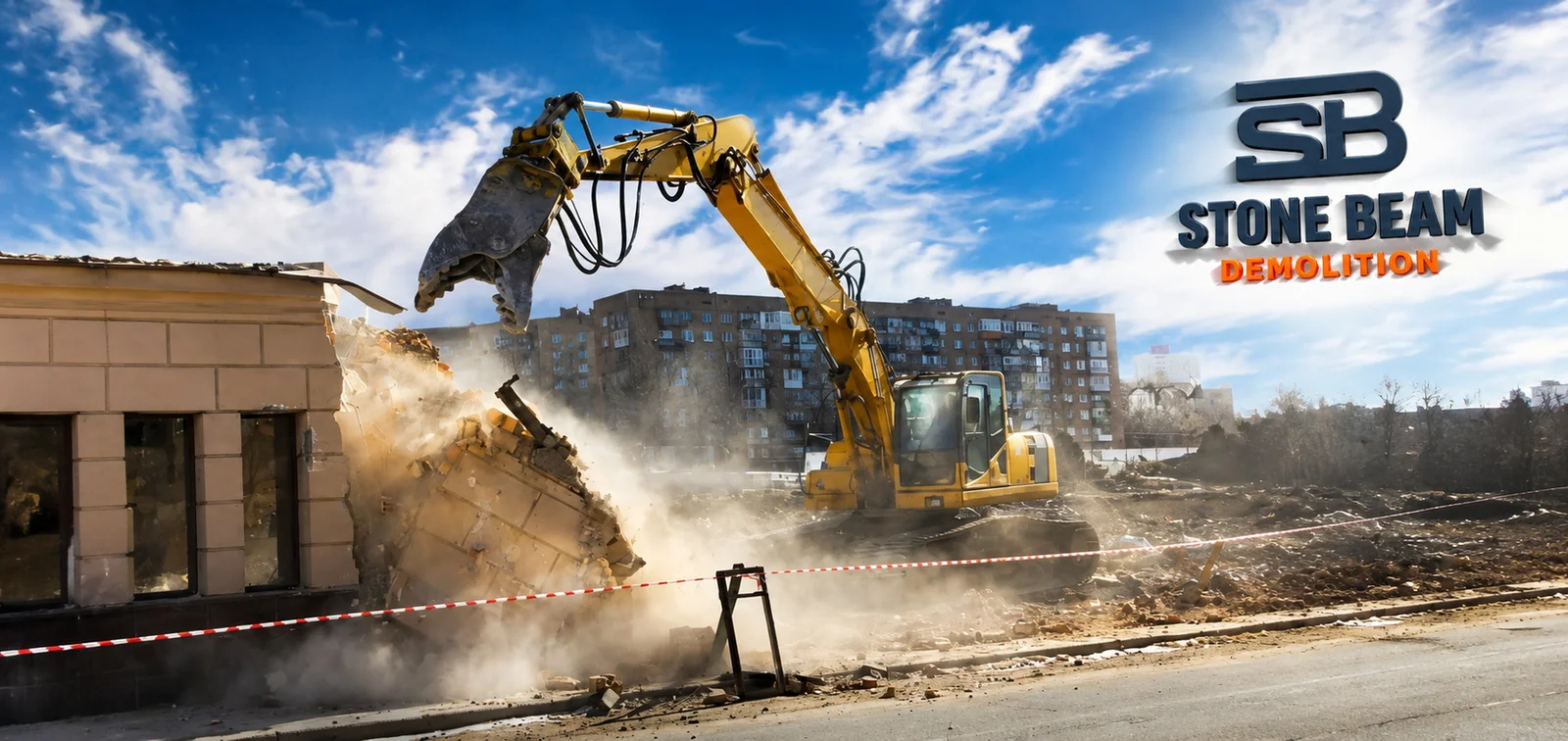
Mechanical demolition uses heavy hydraulic equipment such as excavators fitted with breakers, crushers, shears, and pulverizers. For G+4 buildings, high-reach demolition excavators are typically employed to reach upper floors from ground level or from stabilized intermediate floors.

Critical requirements for mechanical demolition include:

  • Buildings exceeding Ground + 1 floor must NOT be demolished horizontally using excavators (shovel demolition is prohibited)
  • Demolition must proceed vertically from top to bottom, working inward toward the building core
  • Mechanical hammers must NOT be used to separate parts adjacent to neighboring buildings due to vibration risk
  • Floor slabs must be structurally verified before placing any heavy equipment on them
  • Equipment operators must be certified and trained in demolition-specific operations
  • A minimum safe distance must be maintained between operating equipment and any structural elements that have not yet been demolished

The mechanical method offers significant advantages in speed and efficiency for G+4 buildings but requires careful structural assessment and continuous monitoring to prevent uncontrolled collapse.

Controlled Pulling

Controlled pulling involves using steel wire ropes to pull down structural elements in a predetermined direction after they have been strategically weakened. This method is sometimes used for isolated structures where there is sufficient clear space for the structure to fall safely.

Requirements include:

  • Steel wire ropes with a minimum diameter of 38 mm
  • Ropes secured at high anchor points with calculated weakening according to an engineering plan
  • All cornices, decorative elements, and protruding features must be removed before pulling
  • The fall zone must be cleared of all personnel and equipment
  • Pull direction and safe zone must be clearly established and communicated to all site personnel

Wrecking Ball

The wrecking ball method uses a heavy steel ball suspended from a crane to impact and break structural elements. While less common for G+4 buildings in urban Dubai, the exam tests knowledge of its requirements:

  • Ball weight must not exceed 50% of the crane’s rated load capacity at half radius
  • Alternatively, ball weight must not exceed 25% of the rope’s breaking strength (whichever is less)
  • Short boom and rope configuration to minimize swing arc
  • A swivel joint must be installed to prevent rope twisting
  • Adequate clear zone around the building to accommodate debris scatter

Toppling (Controlled Collapse)

Toppling involves strategically weakening a structure’s base so that it falls in a predetermined direction. This method requires extensive engineering analysis and is used only when sufficient clear space is available.

The minimum safe distance on the planned fall line must be at least 1.5 times the building height. Complete evacuation of the fall zone and control of the surrounding perimeter are mandatory. This method is rarely used in dense urban areas of Dubai but may be applicable for isolated structures in development zones.

Health, Environmental, and Occupational Hazards

Noise Management

Demolition equipment generates noise levels that frequently exceed the permissible daily exposure limit of 90 dBA over an 8-hour shift. The supervising engineer must identify all tasks that expose workers to excessive noise levels and ensure that appropriate hearing protection is provided. Warning signs must be posted in high-noise areas, and workers must be trained to use their hearing protection correctly.

For projects near sensitive facilities such as hospitals, schools, or residential areas, additional noise mitigation measures may be required, including the use of quieter equipment, acoustic barriers, and restricted working hours.

Vibration Control

Pneumatic and hydraulic demolition equipment generates vibrations that can exceed the permissible exposure limit of 2.8 m/s² over an 8-hour shift. Prolonged exposure to high vibration levels can cause Hand-Arm Vibration Syndrome (HAVS), resulting in permanent damage to blood vessels and nerves in the fingers and hands.

Control measures include using anti-vibration gloves, selecting equipment with lower vibration output, implementing job rotation to limit individual exposure time, and conducting regular health monitoring of exposed workers.

Confined Space Entry

Tanks, vessels, and enclosed spaces on demolition sites may contain toxic gases, flammable vapors, or oxygen-deficient atmospheres. Before any worker enters a confined space, the space must be ventilated, the atmosphere tested with calibrated gas detection equipment, and a confined space entry permit issued. Rescue procedures and equipment must be in place before entry is permitted.

Dust Suppression

Demolition operations generate significant quantities of airborne dust, which can affect both workers and the surrounding community. Dust suppression measures required by Dubai Municipality include:

  • Continuous water spraying at active demolition faces
  • Perimeter misting systems to contain dust migration
  • Covering of debris during transport
  • Regular cleaning of access roads and surrounding streets
  • Use of sealed debris chutes to minimize dust escape

Waste Management and Environmental Compliance

All demolition waste must be managed in accordance with Dubai Municipality’s environmental regulations. Key requirements include:

  • Segregation of demolition waste by material type (concrete, steel, wood, hazardous materials)
  • Storage on-site must not exceed slab load capacities
  • Licensed waste transport vehicles must be used for all off-site disposal
  • Hazardous waste must be handled by specialized licensed contractors
  • Recycling and material recovery are encouraged where feasible
  • No materials may be burned on site under any circumstances

Protecting Adjacent Buildings and Sensitive Facilities

One of the most critical aspects of demolition in Dubai’s dense urban environment is the protection of adjacent structures and sensitive facilities. The exam places significant emphasis on this topic, and engineers must demonstrate thorough understanding of the following requirements.

Structural Separation

Before using any mechanical equipment for demolition, the portion of the building adjacent to neighboring structures must be manually separated for a distance of at least 3 meters (10 feet). Mechanical hammers and vibrating equipment are strictly prohibited during this separation phase to prevent damage to adjacent buildings through vibration or impact.

Pre-Demolition Condition Survey of Adjacent Structures

A detailed condition survey must be conducted on all neighboring buildings before demolition begins. This survey serves a dual purpose: it documents the existing condition of adjacent structures (establishing a baseline for any damage claims) and identifies any vulnerabilities that could be exacerbated by demolition activities. The survey must be submitted to the relevant municipal authority and the building owner must be notified before work commences.

Sensitive Adjacent Facilities

When demolition takes place near sensitive facilities such as hospitals, schools, places of worship, critical infrastructure, or densely populated buildings, additional precautions must be taken:

  • Modified demolition methods to minimize noise, dust, and vibration
  • Enhanced monitoring of vibration levels with real-time alerts
  • Increased supervision and additional safety personnel
  • Restricted working hours to avoid peak occupancy periods
  • Enhanced communication with facility management

Special Considerations: Fire-Damaged and Unstable Buildings

Buildings that have been damaged by fire, explosion, or natural disasters present unique demolition challenges. Structural integrity may be severely compromised, making standard demolition methods dangerous. The exam tests engineers on the specific precautions required:

  • Comprehensive structural assessment by a specialized engineer before any entry or demolition activity
  • Temporary shoring and bracing to stabilize weakened elements before workers enter the structure
  • Continuous monitoring for signs of progressive collapse during demolition
  • Enhanced PPE requirements including respiratory protection for potential smoke damage residues
  • Modified demolition sequences that prioritize removal of the most unstable elements first
  • Reduced equipment loads on compromised floor slabs
  • Increased exclusion zones around areas of potential sudden collapse

SB Demolition has extensive experience in the demolition of fire-damaged structures and employs specialized techniques to ensure safe and controlled removal even in the most challenging conditions.

Licensing, Insurance, and Legal Compliance

Demolition License Requirements

No demolition work may commence or continue without a valid demolition license issued by Dubai Municipality. The license application must include the approved demolition plan, proof of insurance, evidence of NOCs from all service authorities, and documentation of the supervising engineer’s DEQ qualification at the appropriate level.

If the demolition license or insurance policy expires during the project, all work must immediately cease. The contractor must apply for renewal before the expiry date to avoid costly work stoppages and potential penalties.

Insurance Requirements

Contractors must maintain comprehensive insurance coverage throughout the demolition project, including:

  • Third-party liability insurance covering damage to adjacent properties and injury to the public
  • Workers’ compensation insurance for all on-site personnel
  • Equipment and machinery insurance
  • Environmental liability coverage for hazardous materials incidents

Documentation and Record-Keeping

Throughout the demolition project, detailed records must be maintained including daily work logs, safety inspection reports, incident reports, waste disposal manifests, NOC copies, insurance certificates, equipment inspection records, and worker training documentation. These records must be available for inspection by municipal authorities at any time.

Why Choose SB Demolition for Your Project?

At SB Demolition, we don’t just demolish buildings — we deliver certified excellence on every project. As Dubai’s trusted demolition partner, we combine deep engineering expertise with unwavering commitment to Dubai Municipality standards. Here’s what sets us apart:

Fully Certified Engineering Team

Our team includes engineers qualified at all DEQ levels — G+1, G+4, and Unlimited. This means we can handle any project in Dubai, from a single-story villa to a complex high-rise structure, with the same level of expertise and regulatory compliance.

End-to-End Permit Management

We handle the entire permitting process on your behalf, from initial NOC applications to final license approval. Our established relationships with DEWA, RTA, Civil Defence, and all other relevant authorities ensure faster approvals and fewer complications.

Advanced Safety Systems

Safety is not just a checkbox for us — it’s our operational philosophy. We deploy advanced monitoring systems for vibration, dust, and noise, and our site safety record reflects our commitment to zero-incident operations.

Hazardous Materials Expertise

Our specialized teams are trained and licensed to handle asbestos, lead, and other hazardous materials in full compliance with Dubai Municipality’s environmental regulations. We ensure complete survey, containment, and safe removal before any general demolition begins.

Comprehensive Waste Management

We implement sustainable demolition practices, maximizing material recovery and recycling while ensuring all waste is properly segregated, transported, and disposed of through licensed facilities.

Protecting What Matters

We understand that every demolition project exists within a broader context of neighboring buildings, businesses, and communities. Our approach prioritizes the protection of adjacent structures, minimizes disruption to neighbors, and maintains clear communication with all stakeholders throughout the project.

On-Time, On-Budget Delivery

With detailed project planning and experienced project management, we deliver demolition projects on schedule and within budget. Our transparent pricing and regular progress reporting ensure you always know where your project stands.

Exam Preparation Tips for the G+4 Demolition Test

Preparing for the Dubai Municipality G+4 demolition exam requires a structured approach. Based on our experience and feedback from engineers who have successfully passed the exam, we recommend the following preparation strategy:

  1. Study the Dubai Building Code (DBC) thoroughly — it is the primary reference for all exam questions. Focus especially on chapters related to demolition, safety, and structural requirements.
  2. Review past exam questions and practice tests. While specific questions change, the topic areas remain consistent across exam sessions.
  3. Gain practical field experience on actual demolition sites. Theoretical knowledge alone is insufficient — the exam tests practical judgment and decision-making.
  4. Study hazardous materials regulations in detail, including exposure limits, PPE requirements, and the survey-control-demolish sequence.
  5. Understand the complete permit and NOC process, including which authorities are responsible for which services.
  6. Master the safety requirements for public protection, site hoarding, debris management, and worker access.
  7. Practice time management during mock exams — the real exam has a time limit, and hesitation on difficult questions can cost you.
  8. Join study groups with other engineers preparing for the same level — discussing scenarios and regulations with peers reinforces understanding.
  9. Consider enrolling in a specialized preparation course offered by accredited training centers in Dubai.
  10. Stay current with any updates or amendments to the DBC and municipal regulations, as the exam reflects the most recent version.

FAQs

Q: How long does it take to obtain a demolition permit in Dubai?

A: The timeline typically ranges from 2 to 6 weeks depending on project complexity, the number of NOCs required, and the completeness of the submitted documentation. SB Demolition’s permit management team helps accelerate this process through pre-submission reviews and established authority relationships.

Q: Can demolition work be performed at night in Dubai?

A: Yes, but it requires a special night work permit from Dubai Municipality. Additional safety requirements apply, including adequate artificial lighting, increased supervision, enhanced PPE, and noise restrictions in residential areas. Not all projects are eligible for night work permits.

Q: What happens if the demolition license expires during the project?

A: All demolition work must cease immediately. The contractor must apply for license renewal before the expiry date. Similarly, if the insurance policy lapses, work must stop until valid coverage is restored. Continuing work with an expired license or insurance constitutes a serious regulatory violation.

Q: What is the difference between the G+4 and Unlimited demolition exams?

A: The G+4 exam qualifies engineers to supervise demolition of buildings up to four floors above ground. The Unlimited exam covers high-rise buildings exceeding 10 floors and complex demolition projects. The Unlimited level requires a minimum of 15 years’ experience and tests advanced topics including detailed structural sequencing for tall buildings, temporary structural support design, and enhanced public protection strategies for high-rise demolition.

Q: Is it mandatory to remove asbestos before demolition?

A: Absolutely. All asbestos-containing materials (ACMs) must be identified through a pre-demolition survey and removed by licensed specialist contractors before any general demolition work begins. This is a non-negotiable requirement under Dubai Municipality regulations and is also a critical exam topic.

Q: What are the penalties for demolishing without proper permits?

A: Unauthorized demolition is a serious violation under Dubai law. Penalties can include substantial fines, work stoppage orders, project delays, blacklisting from future projects, and potential criminal liability for the contractor and supervising engineer. The reputational damage alone can be career-ending.

Q: Can I use the same demolition method for all G+4 buildings?

A: No. The demolition method must be selected based on a detailed assessment of each specific building, including its structural system, condition, location, proximity to adjacent structures, and the presence of hazardous materials. What works for a standalone villa will not be appropriate for a building sandwiched between occupied properties. Each project requires its own engineered demolition plan.

Q: How does SB Demolition ensure the safety of neighboring buildings?

A: We conduct comprehensive pre-demolition condition surveys of all adjacent structures, implement vibration monitoring with real-time alerts, use controlled demolition methods, manually separate sections adjacent to neighboring buildings, and maintain continuous communication with neighboring property owners and occupants throughout the project.

Q: What qualifications does SB Demolition’s team hold?

A: Our engineering team holds DEQ qualifications at all three levels (G+1, G+4, and Unlimited), ensuring we are authorized to supervise demolition projects of any size and complexity in Dubai. Our team also holds specialized certifications in hazardous materials handling, confined space operations, and advanced safety management.

Q: How do I get a quote for my demolition project?

A: Simply visit Stone Beam Demolition or contact our team directly. We offer free initial consultations and comprehensive project assessments. Our team will visit your site, evaluate the scope of work, and provide a detailed, transparent quotation with no hidden charges.

Conclusion

Demolition in Dubai is a highly regulated, safety-critical engineering discipline that demands specialized knowledge, rigorous planning, and strict compliance with Dubai Municipality regulations. The G+4 demolition exam represents a critical professional milestone for engineers working in this field, and the knowledge tested in the exam directly translates to safer, more efficient demolition operations on real-world projects.

At SB Demolition, we live and breathe these standards every day. Our team of certified engineers, experienced project managers, and skilled operators delivers demolition projects that are safe, compliant, on-time, and on-budget. From the initial permit application to the final site clearance, we manage every detail so you can focus on your next development.

Whether you need a villa demolished to make way for a new build, a commercial block cleared for redevelopment, or a complex multi-story structure taken down in a dense urban environment, SB Demolition is your trusted partner in Dubai.