




Airport demolition in Dubai requires a defined removal scope, protection of retained airport operations, the relevant statutory and operator approvals, and engineering release of each workfront. Runway removal adds pavement, buried-service and foreign object debris (FOD) interfaces. Demolition completion, pavement reconstruction and permission to reopen an operational area are separate decisions.
For airport owners, consultants and main contractors, the critical question is not simply how to break concrete. It is what can be removed, which functions must remain operational, who authorises each activity and what evidence is required at handover.
This guide explains the scope and responsibility decisions needed to plan an airport-related demolition package and prepare a comparable request for quotation (RFQ). For a wider view of civil-asset removal, see infrastructure demolition planning.
By Eng. Awad Ashour|Stone Beam Demolition
What Does Airport Demolition Include?
Airport demolition may involve terminals, concourses, aircraft hangars, multi-storey parking buildings, runway or taxiway pavement, aprons, underground infrastructure and selected utility systems.
These assets do not share a universal demolition method. The suitable approach depends on their structural condition, retained functions, access, neighbouring operations, specialist interfaces and required handover.
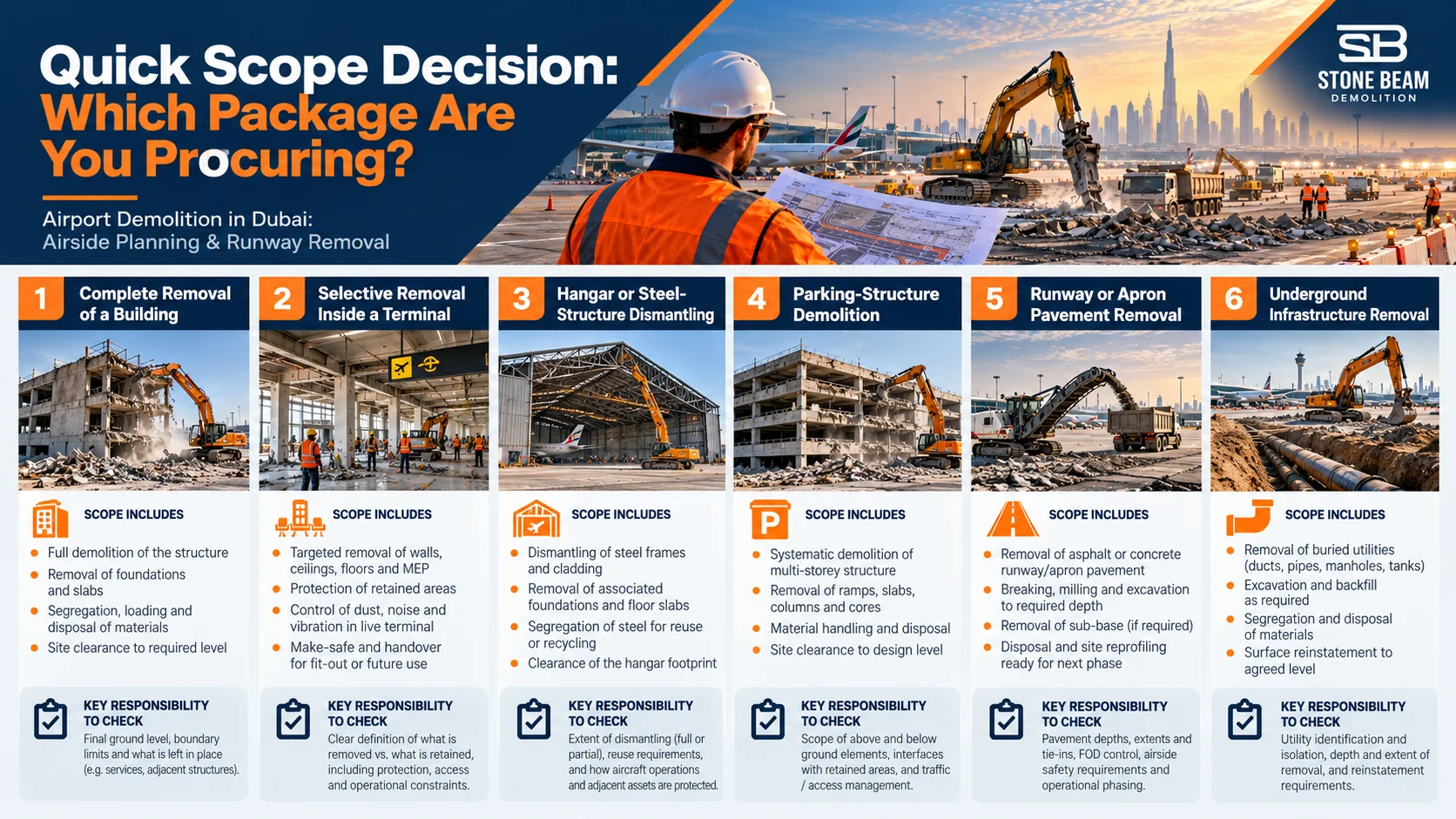
Quick Scope Decision: Which Package Are You Procuring?
| If the required outcome is… | Define this first | Separate responsibility to check |
|---|---|---|
| Complete removal of a building | Superstructure, foundations and retained connections | Structural design, adjacent protection and statutory approvals |
| Selective removal inside a terminal | Remove/retain schedule and live systems | Building operator, service owners and structural engineer |
| Hangar or steel-structure dismantling | Structural boundaries and material-handling scope | Structural and lifting specialists |
| Parking-structure demolition | Floors, ramps, foundations and access routes | Neighbouring-asset protection and handover |
| Runway or apron pavement removal | Pavement footprint, layers and depths | Pavement engineer, operator and service owners |
| Underground infrastructure removal | Asset identity, ownership and removal limits | Relevant utility and specialist clearance |
A request for “airport demolition” without those distinctions can lead to quotations covering substantially different work.
Airport Asset Classification Register
Before preparing the BOQ and method statement, classify each affected asset as:
- REMOVE: Identified for removal under the approved scope.
- RETAIN: Required to remain after the work.
- PROTECT: Requiring protection while nearby demolition is undertaken.
- SPECIALIST RELEASE REQUIRED: Subject to an engineering, utility-owner or operational decision before disturbance.
These categories are not mutually exclusive. A pavement section may be designated REMOVE while adjacent airfield ground lighting (AGL) is both PROTECT and SPECIALIST RELEASE REQUIRED.
| Asset | Possible demolition scope | Retained interface | Essential decision |
|---|---|---|---|
| Terminal or concourse | Strip-out, selected structural sections or defined building removal | Passengers, baggage, MEP and adjacent buildings | Confirm retained functions and structural boundaries |
| Hangar | Steel framing, cladding, slabs or foundations | Aircraft maintenance facilities and live systems | Confirm engineering and asset-owner releases |
| Parking building | Decks, ramps, frame and foundations | Roads, neighbouring buildings and services | Define full versus partial removal |
| Runway, taxiway or apron | Specified asphalt or concrete layers | Pavement edges, drainage, AGL and operational areas | Confirm removal footprint, depth and pavement release |
| ATC or navigation-related asset | Identified redundant components | Communications and navigation systems | Obtain specialist confirmation of redundancy and release |
| Underground infrastructure | Defined ducts, structures or redundant services | Live networks and adjacent foundations | Identify asset ownership and required clearances |
The register should be tied to asset IDs, drawings and responsibility records, not left as a generic description.
Terminals and Concourses: Closed Does Not Mean Redundant
A terminal can cease passenger operations while retaining baggage, security, communication or electrical systems that support another facility.
The client should identify those dependencies before choosing between interior strip-out, selective structural removal and complete demolition.
Where structural elements are affected, the responsible engineer determines the required assessment and release. A renovation or refurbishment label does not make the work non-structural.
Hangars and Steel Structures
Hangar demolition can involve long-span structural systems, extensive integrated services and restricted access beside operating facilities.
The scope must distinguish dismantling from lifting, storage, recovery, transport and disposal. Structural stability and lifting arrangements require competent design and approval specific to the asset.
See steel structure demolition for related service context.
Parking Buildings and Access Structures
Multi-storey parking facilities introduce reinforced concrete decks, ramps, supporting structures, foundations and road interfaces.
A quotation for complete demolition should not leave below-ground structures or debris removal undefined. Likewise, selective removal requires a clear boundary with the structure that remains.
Runways, Taxiways and Aprons
Runway removal may mean taking out an asphalt surface, a designated concrete layer, full-depth pavement or associated redundant components.
The contract must identify exactly which outcome is required. A pavement-removal package does not automatically include pavement redesign, reinstatement, testing or reopening.
ATC, Navigation and Underground Systems
Air traffic control (ATC), navigation, fuel and communications systems require decisions from their authorised owners and specialists.
An asset cannot be regarded as redundant solely because it appears unused or disconnected. Survey information and service drawings assist identification but do not independently authorise removal.
What Changes When Demolition Takes Place Beside Live Airport Operations?
The key change is that demolition becomes an operational-interface project as well as a construction project.
Work may affect aircraft-related operations, terminal services, maintenance facilities, passenger routes, security-controlled areas and access to neighbouring assets. Each affected interface must have an identified owner.
Landside vs Airside
The initial classification is whether the work lies within landside or airside-controlled areas. The project must then identify operations and services that cross those boundaries.
Landside construction is not automatically independent of airport operations. A car park, terminal or utility corridor outside an airside boundary may still support systems used within it.
Airside activities introduce operator-controlled access and workfront conditions. The applicable requirements must be obtained from the airport operator for the specific location.
Airside Interface Matrix
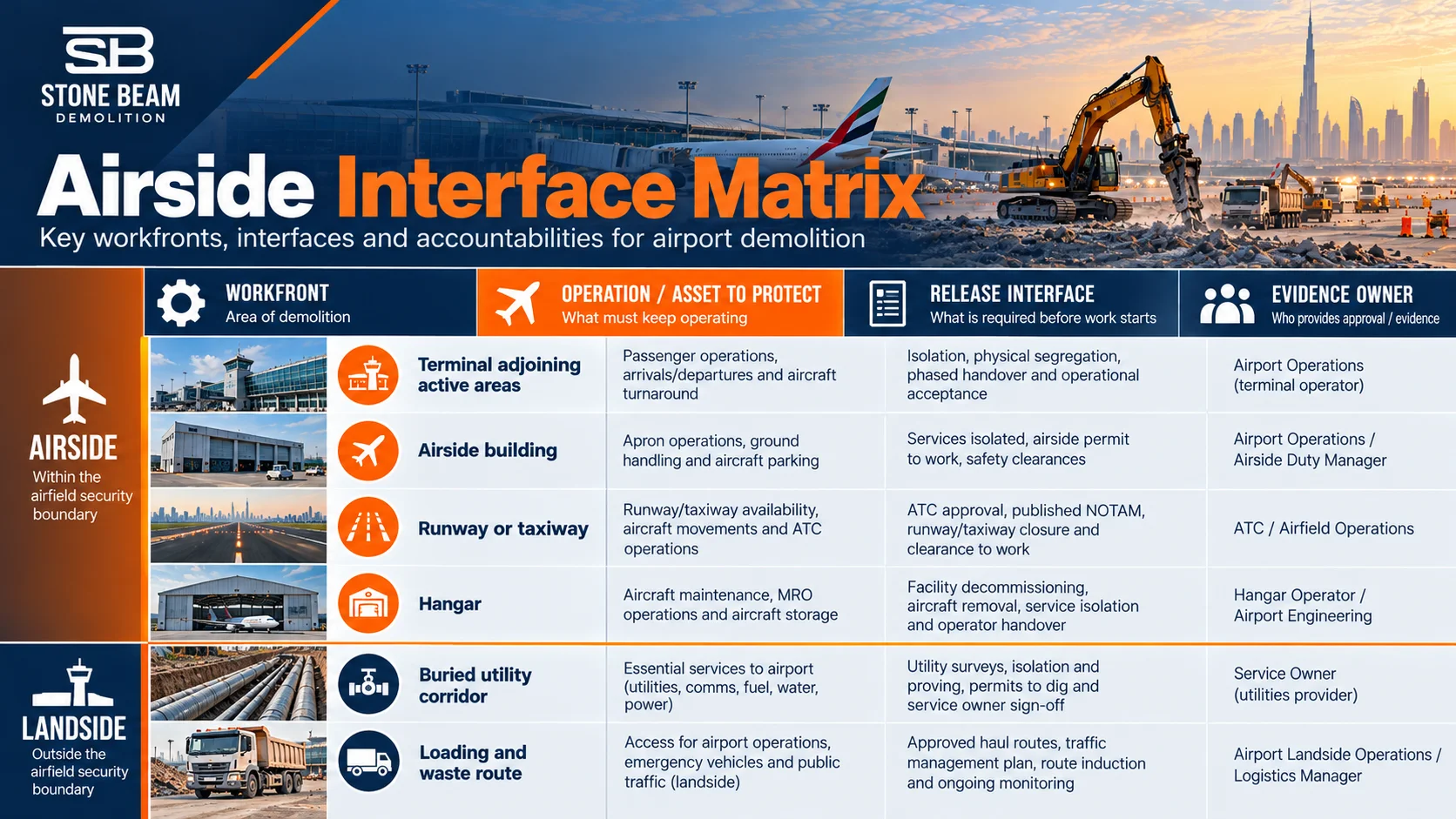
| Workfront | Operation or asset to protect | Release interface | Evidence owner |
|---|---|---|---|
| Terminal adjoining active areas | Passenger and baggage services | Building/asset owner and relevant operator requirements | Airport operator / asset owner |
| Airside building | Adjacent airside activities | Operator work authorisation and workfront release | Operator / designated supervisor |
| Runway or taxiway | Retained movement-area assets and systems | Operator and pavement-engineering decisions | Operator / pavement engineer |
| Hangar | Maintenance functions and neighbouring facilities | Facility-owner and operator interface clearance | Facility owner / operator |
| Buried utility corridor | Power, fuel, drainage and communications | Utility-owner and specialist release | Relevant utility owner |
| Loading and waste route | Security boundaries, vehicles and roads | Approved project logistics arrangements | Main contractor / logistics coordinator |
This matrix is a scope-planning tool. It does not replace the actual airport operator’s procedures or permits.
What Is FOD Control During Demolition?
Foreign object debris (FOD) includes loose material capable of creating risks for aircraft operations.
In demolition planning, the concern extends beyond large pieces of broken concrete. Smaller fragments, packaging and material carried beyond the workfront can also require control under the operator’s FOD arrangements.
The project must define the work boundary, responsibilities, required evidence and the party authorised to accept an operational handback. The exact controls belong to the operator-approved procedures.
Structural, Environmental and Operational Risks
Structural risks include unknown modifications, instability of retained elements and interaction with adjacent structures.
Environmental and occupational health risks include dust, noise, vibration and potentially hazardous materials. Their assessment depends on the affected people, equipment and surrounding assets.
Operational risks include interference with live services, unauthorised access, restricted work windows and uncontrolled movement of debris.
Chemical and fire interfaces may arise around fuel installations, stored substances and electrical assets. Assessment, isolation or clearance of specialist systems must be assigned to appropriately authorised parties.
The project’s risk assessment and approved method must address actual conditions. Universal vibration, dust or noise limits should not be copied from an unrelated project.
Who Approves Airport Demolition Works in Dubai?
Airport demolition can involve different approval functions: the competent statutory authority, the airport operator, the utility owners and the responsible engineering specialists.
These decisions should be recorded separately because one approval does not necessarily replace another.
Dubai Municipality, DDA and Trakhees
The statutory route depends on the specific plot and regulatory jurisdiction.
Dubai Municipality (DM) publishes demolition-related services for works within its jurisdiction.
Dubai Development Authority (DDA) provides a demolition-permit service for DDA-regulated plots. Its published requirements include a demolition-area plan, relevant NOCs, a method statement, HSE and emergency documents, risk assessments, and a study of the effect on neighbouring buildings.
Those requirements relate to the relevant DDA service. They must not be applied automatically to every airport plot.
Reference: DDA Demolition Permit.
Trakhees also publishes a Demolition and Removal NOC service for works under its jurisdiction. The applicable route must be confirmed for the specific property.
The competent authority should be identified through the plot and permit records before an application or tender programme is finalised.
Airport Operator Permits and Workfront Releases
Dubai Airports operates an Airside Permit to Work system. Its earlier contractor portal displays a notice directing users to the new DA Airside Permit to Work platform.
The operator must confirm which permissions, restrictions and release records apply to the proposed airport and workfront. The existence of a permit portal is not evidence that an individual project has been authorised.
For procurement, distinguish three decisions:
- Statutory approval: Permission for the relevant demolition scope from the competent authority.
- Operational authorisation: Permission and conditions established by the airport operator for the affected work area.
- Engineering release: Approval of the relevant structural, pavement or specialist intervention.
The actual documentation and release sequence depend on the project.
DEWA, Other Utilities and RTA
Dubai Electricity and Water Authority (DEWA) publishes an electricity and water demolition-NOC service. Its official guidance distinguishes applications integrated through the Dubai Building Permit System for DM projects from other application routes.
That utility process is not a substitute for the appropriate demolition permit or engineering release.
Fuel, communications, drainage and airfield systems may have separate asset owners and clearance requirements.
Where public roads or rights-of-way are affected, the Roads and Transport Authority (RTA) interface must also be considered according to the applicable project requirements.
Workfront Release: What Does Each Record Prove?
| Record | Responsible party | What it establishes | What it does not establish |
|---|---|---|---|
| Statutory demolition permit | Competent authority / applicant | Approval within the permit’s stated scope | Airport operational access |
| Airside or operator work authorisation | Airport operator / authorised applicant | Permission subject to operator conditions | Structural design approval |
| Utility clearance | Utility or asset owner | Defined status of identified services | Absence of every concealed service |
| Structural release | Structural / temporary-works engineer | Approved structural intervention | Permission to enter a controlled operational area |
| Pavement-engineering release | Pavement engineer / design authority | Approved pavement intervention | Authority to reopen a runway |
| Demolition method statement | Contractor and designated reviewers | Planned method and assessed controls | Proof of completed work |
| Workfront readiness record | Project-designated parties | Recorded prerequisite status | Release beyond its defined limits |
The workfront register should specify the document reference, applicable zone, status, limitations and responsible person.
What Must Be Ready Before a Demolition Workfront Is Released?
A demolition workfront is not ready merely because the labour, plant or working window is available.
The release decision depends on the approved scope, existing-condition information, structural assessment, known utilities, proposed method, access restrictions, responsibilities and project-specific permissions.
Workfront Readiness Checklist
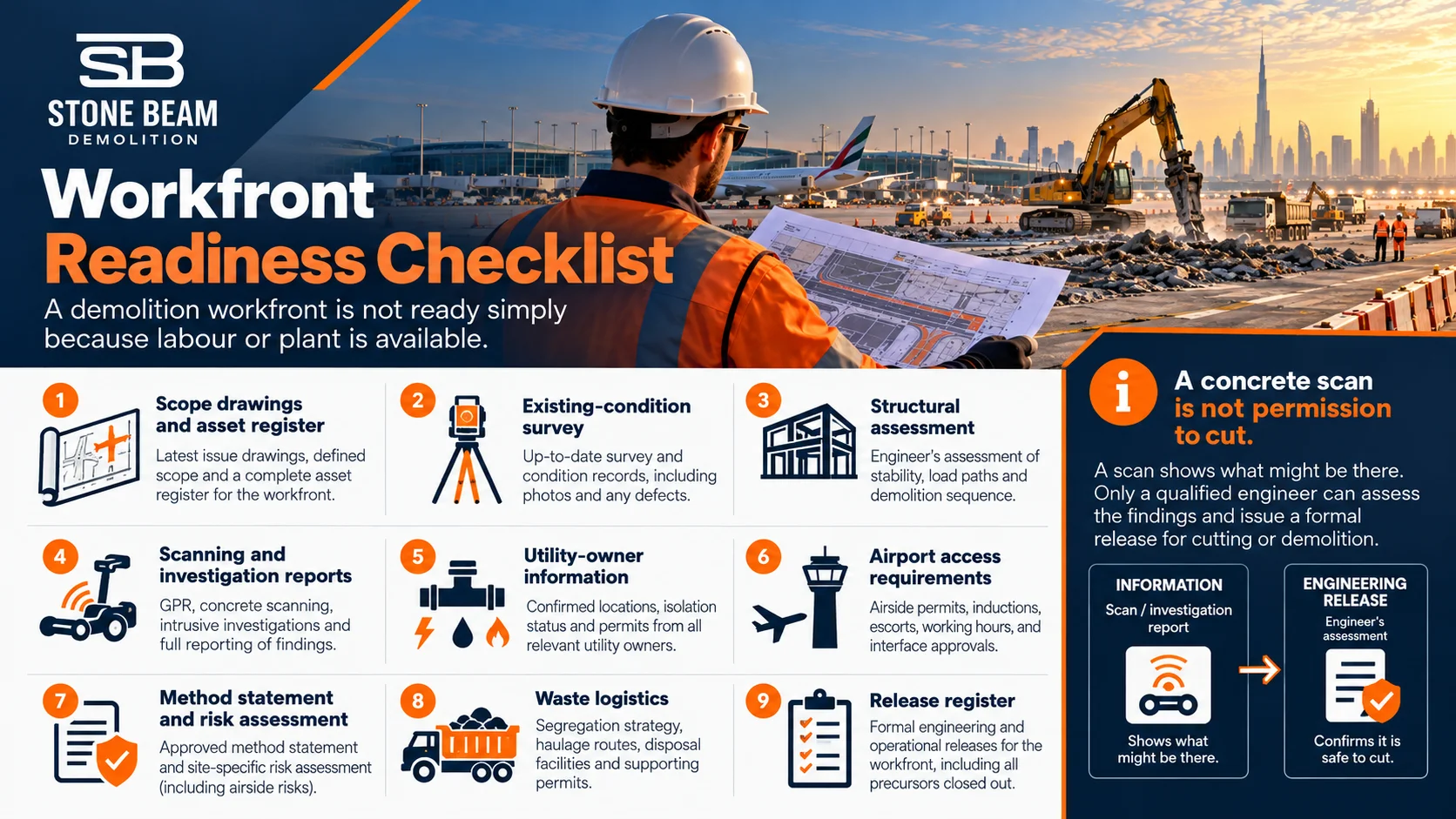
| Required record | Question it resolves | Responsible role |
|---|---|---|
| Scope drawings and asset register | What will be removed or retained? | Client / consultant |
| Existing-condition survey | What is known and unverified? | Survey / engineering team |
| Structural assessment | What intervention is approved? | Structural engineer |
| Scanning and investigation reports | What was examined and what are its limitations? | Survey specialist / engineer |
| Utility-owner information | Which systems require specialist clearance? | Asset owner / specialist |
| Airport access requirements | Which workfront and conditions are authorised? | Airport operator |
| Method statement and risk assessment | Does the planned method address the scope and risks? | Demolition contractor / reviewers |
| Waste logistics | Who handles, loads, transports and records materials? | Assigned contract parties |
| Release register | Which prerequisites have been accepted? | Designated release authority |
Unknown or inaccessible areas should be recorded explicitly. An assumption must not silently become an accepted site condition.
Why a Concrete Scan Is Not Permission to Cut
Ground-penetrating radar (GPR) and other concrete-scanning techniques can provide information about embedded features within their stated coverage and detection limits.
However, a scan cannot guarantee that every tendon, service or concealed condition has been detected. Results must be interpreted alongside drawings, investigations and relevant engineering information.
For cutting or coring, the responsible engineer must assess and release the proposed intervention. This is particularly important for post-tensioned concrete, where the structural engineer and PT specialist determine the necessary approvals.
See concrete scanning before cutting for the related service.
Which Demolition Method Is Suitable for an Airport Asset?
Method selection depends on the asset and the engineering conditions, rather than on one technique being universally preferable.
The table below is a high-level procurement comparison, not an execution method statement.
| Method category | Potential application | What changes suitability? |
|---|---|---|
| Mechanical demolition | Approved structural or pavement removal | Structural condition, access, retained operations and debris management |
| Diamond cutting | Defined concrete separation or openings | Structural release, thickness, access and handling responsibilities |
| Steel dismantling | Hangar or steel-component removal | Stability, lifting interface and intended material recovery |
| Selective strip-out | Terminal or support-building refurbishment | Retained services and structural versus non-structural boundary |
| Specialist pavement removal | Defined runway, taxiway or apron pavement | Pavement layers, retained surfaces and engineering acceptance |
A method may need to be combined with other operations under the project-specific approved plan. Equipment access or availability alone does not determine suitability.
Explosive demolition is not presented as a Stone Beam service. Similarly, specialist hazardous-material removal and aviation-system works should not be inferred from the company’s general demolition scope.
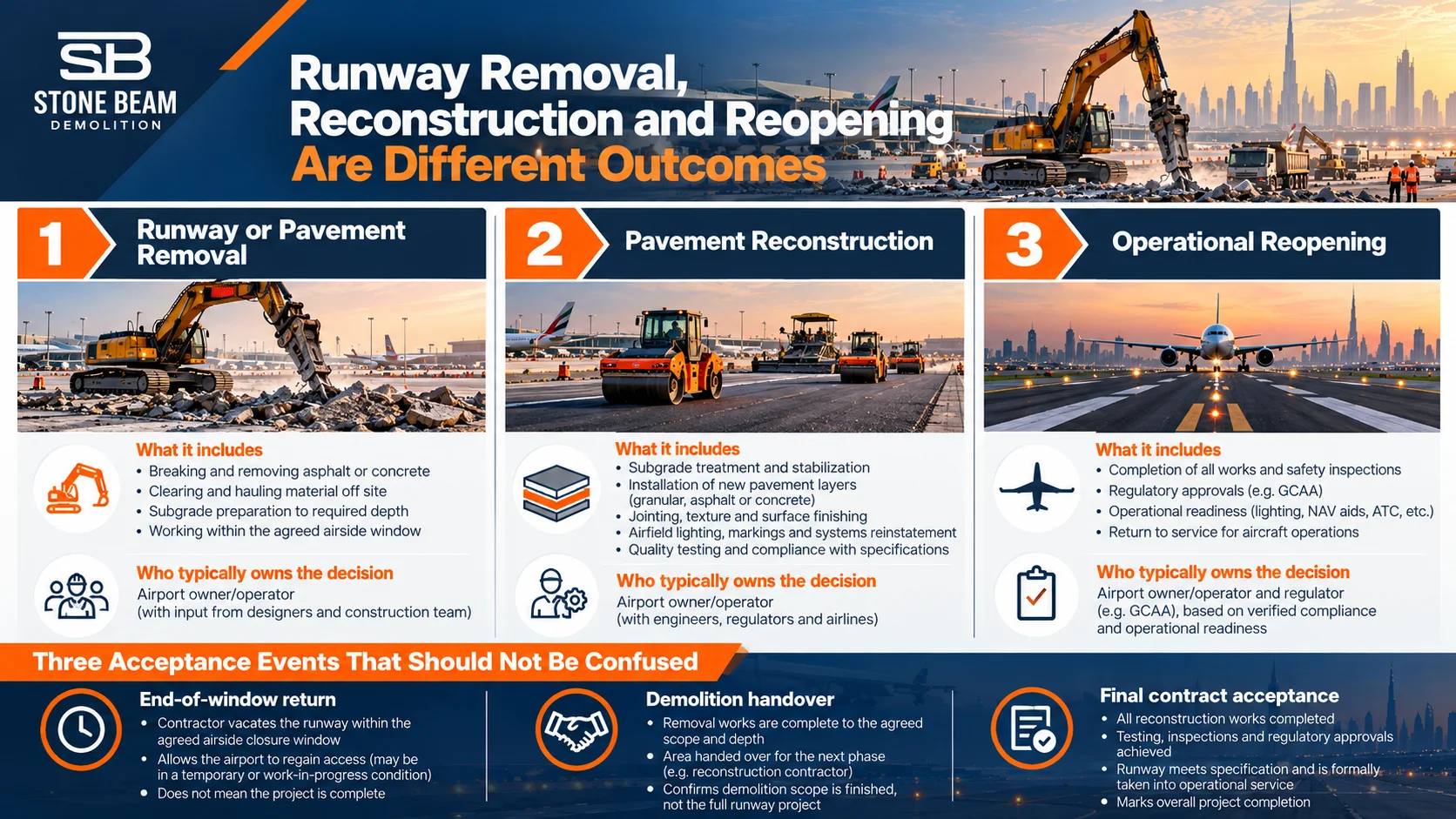
Where Does Runway Demolition End and Pavement Reconstruction Begin?
Runway removal, pavement reconstruction and operational reopening are different outcomes.
The demolition contractor may be engaged to remove designated pavement layers and deliver a defined workfront condition. Pavement engineering, new construction, testing and operator acceptance can be assigned to separate parties.
Runway Pavement Removal Scope Table
| Requested outcome | Required demolition definition | Separate scope unless included | Handover evidence |
|---|---|---|---|
| Surface removal | Material, footprint and removal layer | Replacement surfacing | Approved removal records |
| Concrete breakout | Designated sections and retained edges | Pavement reconstruction | Condition and completion records |
| Full-depth removal | Approved depth and underlying interfaces | Subgrade treatment or redesign | Survey and scope acceptance |
| Redundant AGL removal | Identified systems and specialist release | Live-system modification or commissioning | Asset-owner records |
| Drainage removal | Specified structures and connections | New drainage design and testing | Recorded removal boundary |
| Breaking and stockpiling | Workfront and approved stockpile destination | Loading and off-site haulage | Material-handling record |
| Loading and disposal | Waste stream, carrier and destination | Reinstatement | Transport and receiving-facility evidence |
| Demolition-area handover | Required physical condition | Operational reopening | Client acceptance record |
The scope must also establish who protects retained pavements, confirms unidentified services and manages variations arising from concealed conditions.
Dubai International Airport: Southern Runway Rehabilitation
The 2019 Southern Runway Rehabilitation at Dubai International Airport is a useful example of how construction works and operational return are distinct activities.
Dubai Aviation Engineering Projects (DAEP) describes preparatory coordination before the runway closure, resurfacing works, associated taxiway and airfield-lighting upgrades, and testing before the runway returns to operation.
The key lesson for demolition procurement is that completion of physical pavement activities is not automatically the final operational milestone.
This was a DAEP-documented runway rehabilitation programme, not a Stone Beam project. Its programme must not be treated as a standard duration for runway demolition.
Reference: DAEP Southern Runway.
How Should FOD Control and Workfront Close-out Be Documented?
A project must establish the evidence required to demonstrate that the contractor has fulfilled its assigned controls, alongside the operator’s separate requirements for accepting an operational area.
A close-out record can help organise that information, but it does not replace the operator’s actual inspection or release process.
Illustrative FOD Close-out Record
| Record item | Information required |
|---|---|
| Workfront reference | Defined location and authorised work package |
| Operating-window reference | Applicable operator authorisation |
| Completed activity | Actual work and affected area |
| Debris and materials | Recorded material streams and handling destination |
| Control evidence | References to applicable approved checks and records |
| Outstanding observations | Unresolved matters and responsible parties |
| Contractor close-out | Submitted record and responsible supervisor |
| Operator acceptance | Separate operator review or release reference |
| Record archive | Location of retained evidence |
This is a proposed documentation structure, not an airport-authorised FOD form.
International Example: Heathrow Terminal 1
Heathrow Airport reported on 29 April 2026 that demolition of Terminal 1 was progressing even though infrastructure within the former terminal continued to support other airport operations.
The case illustrates why a building closed to passengers may still contain services that must remain available.
This is UK project context, not Dubai regulatory guidance or work attributable to Stone Beam.
Reference: Heathrow Demolition of Terminal 1.
How Long Does Airport Demolition Take?
Airport demolition has two different programme components: readiness and execution.
Readiness includes surveys, scope decisions, engineering assessments, permits, specialist releases and access planning. Execution covers the authorised physical works and their agreed close-out.
At an operational airport, limited or intermittent working windows can affect the overall programme independently of the amount of concrete or steel to be removed.
Seven Planning Decision Gates
The project team should verify the following decisions. These are management gates, not a universal structural-removal sequence.
- Scope: Has the removal and retention boundary been agreed?
- Information: Are known conditions and investigation gaps documented?
- Approvals: Are the required authorities, specialists and decision owners identified?
- Workfront: Have the applicable prerequisites been formally released?
- Execution control: Do site conditions remain within the approved scope?
- Demolition handover: Is the specified physical outcome documented?
- Acceptance: Are the relevant contract and operator decisions complete?
A schedule should identify the party responsible for each decision and the dependencies affecting the next stage.
Three Acceptance Events That Should Not Be Confused
| Event | What it means | Decision owner |
|---|---|---|
| End-of-window return | The area meets applicable operator conditions following a work window | Airport operator or designated release authority |
| Demolition handover | The removal scope reaches its specified physical condition | Client / consultant / main contractor |
| Final contract acceptance | The contractual completion requirements are fulfilled | Employer / contract administrator |
An airport may accept a contractor’s demolition handover while pavement reconstruction or operational tests remain outstanding.
Similarly, the end of a working window is not necessarily final contractual completion.
What Drives Airport Demolition Cost in Dubai?
There is no reliable universal AED-per-square-metre rate for airport demolition.
A limited pavement-removal contract, a structural terminal-demolition package and works next to live operations may involve substantially different obligations.
The main cost drivers are the defined assets, construction materials, access restrictions, work windows, engineering interfaces, protection requirements, waste handling and acceptance conditions.
Compare Scope Before Comparing Price
Consider two illustrative quotations for the same designated concrete-removal area.
| Scope item | Quote A | Quote B |
|---|---|---|
| Breaking the concrete | Included | Included |
| Moving debris to an on-site stockpile | Included | Included |
| Loading onto vehicles | Excluded | Included |
| Off-site transport | Excluded | Included |
| Receiving-facility evidence | Excluded | Included |
| Airport access arrangements | Clarification required | Clarification required |
| Utility and pavement protection | Clarification required | Clarification required |
| Reinstatement and testing | Excluded | Excluded |
The difference in price cannot be evaluated fairly until the omitted and uncertain responsibilities have been normalised.
The RFQ should therefore identify whether access equipment, lifting, temporary works, loading, hauling, disposal, testing and reinstatement are included, excluded or separately provided.
It should also identify what will trigger a variation if the actual conditions differ from the approved information.
For further guidance, see requesting a demolition quotation.
How Can Demolition Waste and Recycling Claims Be Verified?
A waste-management strategy should identify the material streams, transporter, receiving destination and evidence needed for handover.
Dubai’s waste-management legislation provides local regulatory context, but specific duties and acceptance requirements must be checked against the activities involved.
A useful evidence chain connects:
| Record | What it establishes |
|---|---|
| Waste stream classification | Which material is being managed |
| Workfront identification | Where the material originated |
| Quantity and measurement basis | What was measured, estimated or received |
| Transport record | Which party moved the material |
| Destination record | Where the material was delivered |
| Facility acceptance | What the destination recorded as received |
| Recovery evidence | What reuse or recycling outcome can actually be supported |
Targets and estimated recoverable quantities are not measured results. Transporting material to a facility is not by itself proof that it was recycled.
See demolition waste management for the broader waste-service context.
What Demolition Experience Can Stone Beam Demonstrate?
Stone Beam Demolition is a Dubai-based contractor specialising in demolition, concrete cutting and site enabling works.
Stone Beam Technical Services L.L.C. holds a Dubai Municipality practice permit for Wrecking & Demolition Works (G+12) and Concrete Restoration.
This company-level credential is not permission for a specific airport project and does not establish capability beyond its stated category.
Stone Beam works under a documented HSE and environmental management framework covering workfront readiness, supervision, emergency planning and environmental controls.
Its typical planning approach includes site visits and structural assessment, scanning and service review, method statements and risk assessments, engineered phasing, project-specific monitoring where required, and controlled debris removal and handover.
A Completed Parking-Building Demolition
Stone Beam completed the demolition of a parking building in Dubai Investment Park 2, closed out with a Dubai Municipality completion certificate dated 29 July 2026.
The record supports completed building-demolition experience. It was not an airport project and did not establish airside demolition or runway-removal experience.
For airport-related enquiries, any proposed package must be assessed against the company’s documented capabilities and the relevant statutory, operational and specialist requirements.
What Should an Airport Demolition RFQ Include?
To prepare a defined and comparable scope, the client or consultant should provide:
| RFQ information | Why it is needed |
|---|---|
| Plot location and competent authority | Establishes the statutory interface |
| Airside / landside workfront boundary | Establishes airport operator interfaces |
| Remove / Retain / Protect asset schedule | Defines the required demolition outcome |
| Structural and pavement drawings | Supports engineering and quantity assessment |
| Existing-condition and investigation reports | Identifies verified information and remaining unknowns |
| Utility owners and available service records | Identifies specialist release responsibilities |
| Working windows and access conditions | Establishes logistical and operational constraints |
| Temporary works and lifting responsibilities | Defines the engineering and handling scope split |
| Waste loading, hauling and disposal | Establishes commercial boundaries and evidence |
| Reinstatement and testing limits | Distinguishes demolition from later activities |
| Handover and acceptance criteria | Defines what completion means |
Missing information should be listed with an action owner. Where an assumption could materially change the scope, it should be resolved or recorded as a quotation qualification.
Frequently Asked Questions
How much does airport demolition cost in Dubai?
The cost depends on the assets, quantities, engineering requirements, operational restrictions, access, waste handling and handover. A useful comparison begins with identical scope boundaries and responsibility allocations, not generic market rates.
What is the sequence of airport demolition?
There is no universal structural-removal sequence. The project must define the scope, investigate existing conditions, obtain relevant approvals, release workfronts and document completion. The detailed execution method requires project-specific engineering approval.
Can demolition take place while an airport remains partially operational?
Selected work can take place beside retained operations where the relevant authority, operator and specialists approve the conditions. The essential question is whether the proposed work affects functions that must remain available.
Is implosion used for airport demolition?
Implosion is a specialist demolition technique, but it is not offered as a Stone Beam service in this guide. Method selection must account for the structure, neighbouring assets, operational conditions and specialist approvals.
What hazardous materials may be encountered?
Depending on the asset’s age and previous use, possible concerns include asbestos-containing materials, fuel contamination and other regulated substances. Identification and management require suitable investigation and authorised specialists; they cannot be established from the building type alone.
How long does major airport demolition take?
The duration depends on project scope, approvals, readiness, work windows, logistics and handover. Separate readiness and physical execution periods in the programme rather than applying timelines from an unrelated airport project.
Has Stone Beam completed an airport demolition project?
The currently approved company records do not establish a completed airport demolition project. They do establish completed parking-building demolition in Dubai Investment Park 2. That evidence is relevant to building removal, not aviation-specific operations.
How can I request an airport-related demolition quotation?
Provide the asset schedule, location, drawings, airport access restrictions, existing service information, assigned specialist responsibilities and required handover condition. Clarifying those inputs makes the proposal more accurate and commercially comparable.
References and Further Reading
The sources below were checked or reviewed for this article on 9 October 2026, except where current detailed requirements could not be confirmed. For any actual project, the responsible authority or airport operator must confirm the current applicable procedure.
Dubai Regulatory and Operator Sources
- Dubai Municipality Services municipal service catalogue; confirm the relevant demolition route for the plot.
- Dubai Development Authority Demolition Permit published permit requirements for DDA-regulated works.
- Dubai Development Authority Demolition Completion separate DDA completion process.
- Dubai Airports Airside Permit to Work Notice notice linking to the updated permit platform; detailed requirements are operator-controlled.
- DEWA Demolishing Permits, Electricity and Water published electricity and water demolition interface.
- Trakhees Demolition and Removal NOC official service locator; current applicability and details require confirmation.
- RTA Building Construction or Demolition Permit right-of-way service locator; project applicability requires confirmation.
- Government of Dubai Law No. 18 of 2024 Regulating Waste Management legal reference; no project-specific numerical requirement is inferred from it.
Airport Projects Used as Context
- Dubai Aviation Engineering Projects DXB Southern Runway Dubai runway rehabilitation and operational return, not a Stone Beam project.
- Heathrow Airport Demolition of Terminal 1 UK example of retained operational infrastructure, not Dubai regulatory guidance.
Planning a Demolition or Infrastructure Removal Package in Dubai?
Planning a demolition, strip-out or cutting package in Dubai? Send us your drawings, the scope you want removed and retained, site access details and your target handover condition. Our engineering team will review the inputs and come back with the questions and information needed to price the defined scope. Request a review.