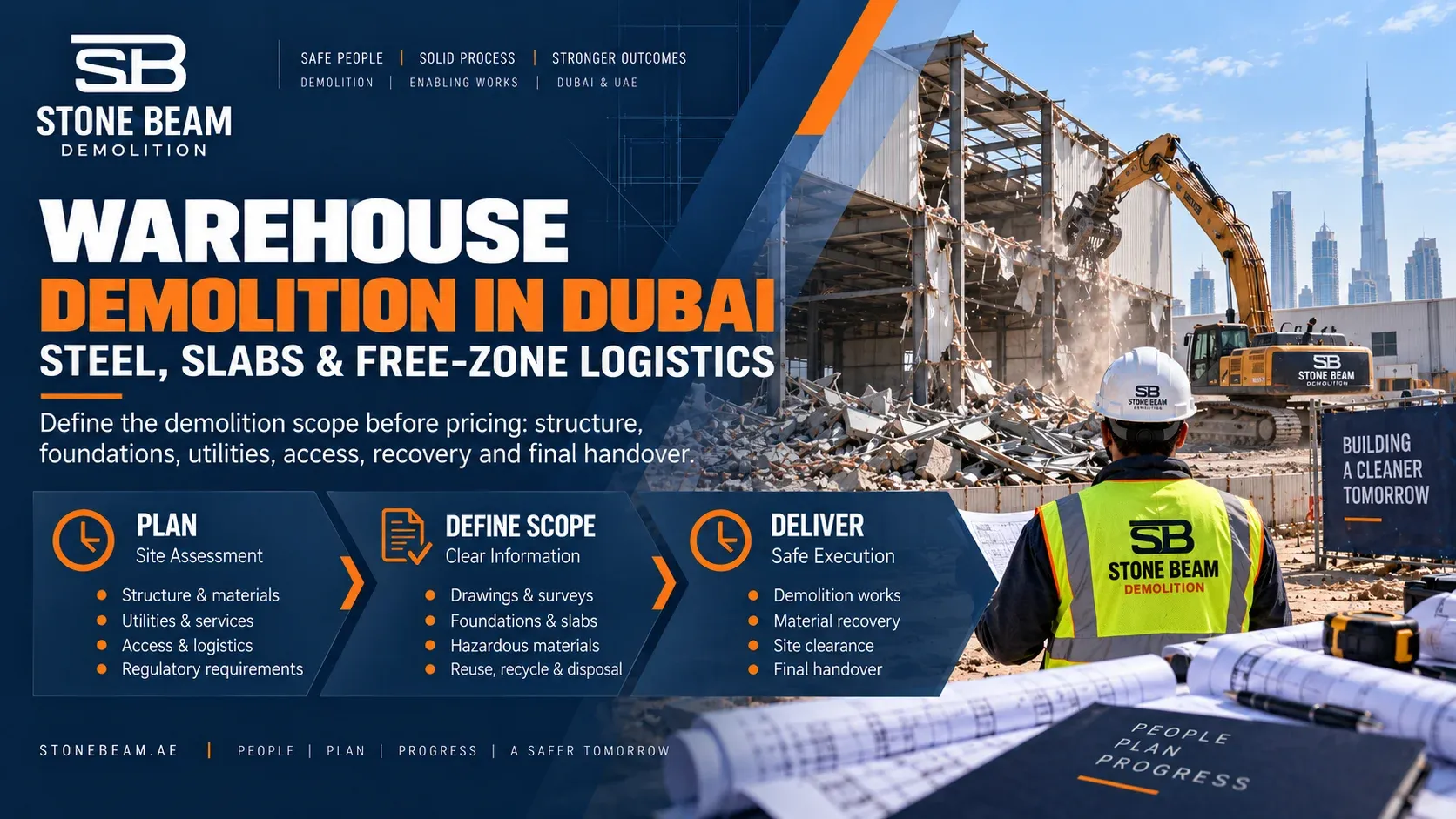


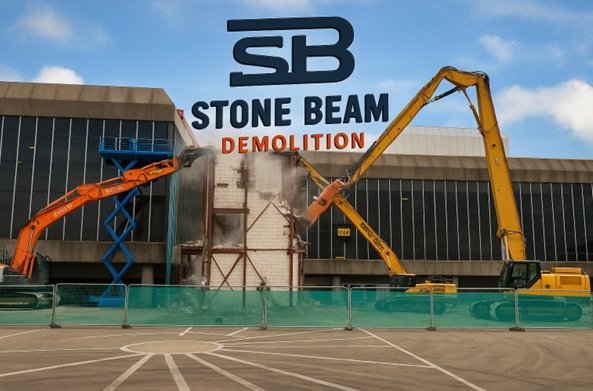
Demolishing or partially demolishing a mega shopping mall demolition Dubai UAE – a complex on the scale of Dubai Mall, Mall of the Emirates, or other regional centres – is one of the most challenging types of demolition anywhere in the world. You are working around tens of thousands of daily visitors, active retail tenants, luxury brands, five-star hotels, cinemas, ice rinks, car parks, and highly sensitive MEP systems – all while meeting very strict Dubai Municipality and authority regulations.
This guide explains, in practical detail, how Stone Beam Demolition plans and executes shopping mall demolition in Dubai, whether it is:
- Full demolition of an ageing mall to rebuild a new mixed-use development
- Phased removal of wings, car parks, or podium slabs
- Strip-out and heavy internal demolition for mall extensions and re-merchandising
- Structural alterations (creating new atriums, escalator openings, voids, or double-volume retail units) in live malls
Why mega-mall demolition is different from ordinary building demolition?
Scale and structural complexity
Mega malls like Dubai Mall, Mall of the Emirates, and similar regional centres typically include:
- Long-span post-tensioned slabs and beams over large atriums and retail halls
- Multi-level car parks, ramps and helixes
- Bridges and link structures connecting hotels, towers and parking decks
- Very heavy rooftop MEP (chillers, plant rooms, cooling towers, solar arrays, signage)
Demolishing long-span or prestressed elements is inherently risky: forces are “locked” into the structure, and cutting or removing the wrong member can trigger sudden collapse. This is why serious projects use step-by-step structural analysis of each demolition stage, similar to what is done for prestressed bridges.
Live environment and continuous operations
Unlike a remote industrial building, a mall is rarely completely empty:
- Retail tenants still operating in unaffected wings
- Hotels, offices, and residential towers integrated with the mall
- Basement parking that must remain open
- Critical back-of-house routes for deliveries and waste
Dubai clients typically expect “business as usual” for most of the mall during refurbishment or phased demolition. That means:
- Strict segregation between demolition zones and public areas
- Night-shift or off-peak working for noisy activities
- Heavy emphasis on dust, noise, and vibration control
Heavy regulation and multi-agency approvals
In Dubai, demolition of any significant structure requires approvals and permits from authorities such as Dubai Municipality, Dubai Development Authority (DDA), free zone authorities, Civil Defence and sometimes RTA for traffic and access. For malls specifically, there are also waste segregation and recycling obligations and building use requirements under the Dubai Building Code and technical guidelines.
Regulatory Framework for Shopping Mall Demolition Dubai UAE
Core permits and approvals
Typical approvals needed before a mall demolition can start include:
- Demolition permit from Dubai Municipality or DDA (or the relevant free zone authority)
- NOCs from utility providers (DEWA, telecoms, district cooling, gas, etc.)
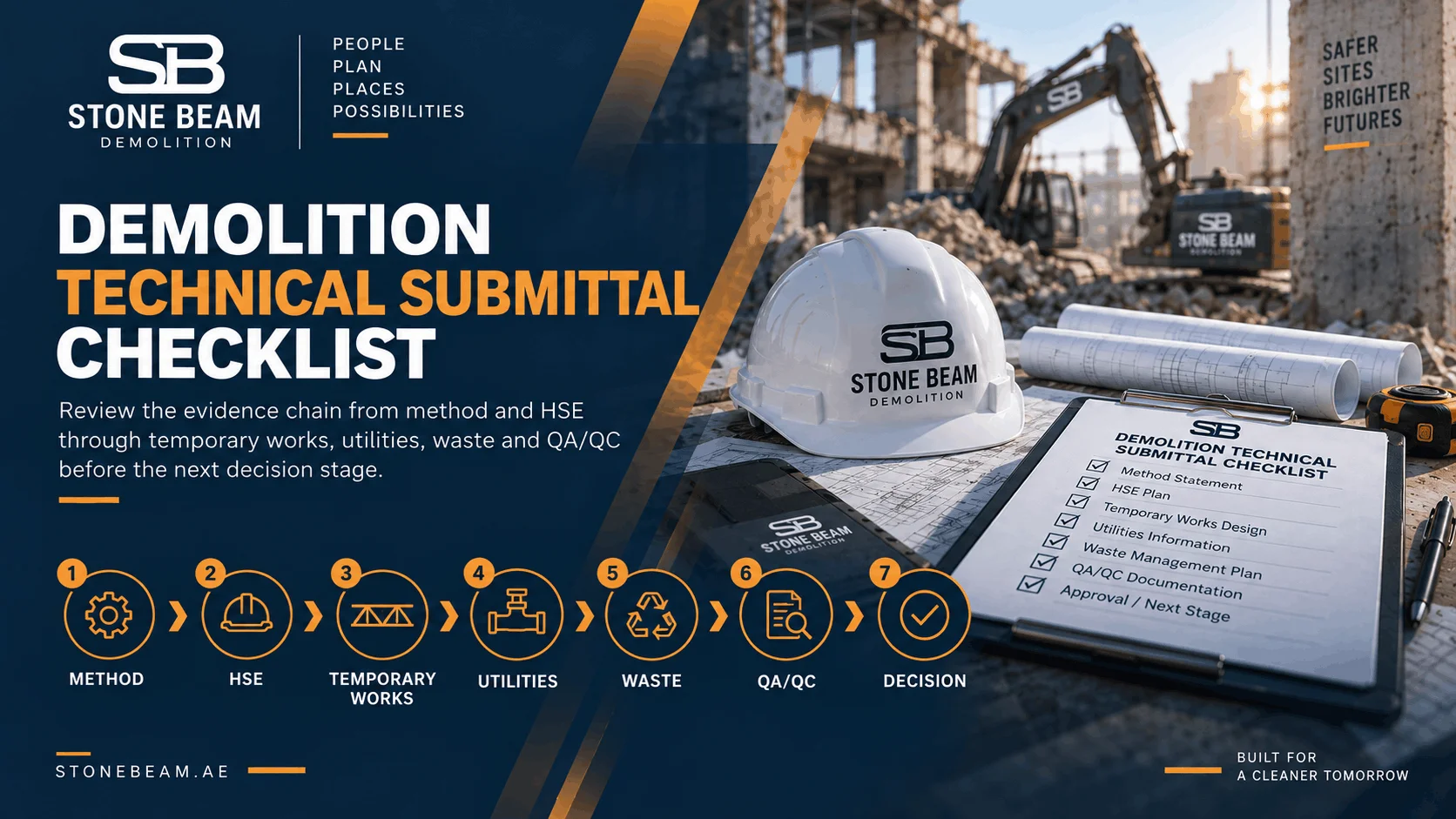
- Structural report and demolition method statement, stamped by a licensed consultant
- Health, Safety & Environment (HSE) plan, including risk assessment and emergency procedures
- Waste management and recycling plan, aligned with DM’s mandatory segregation guidelines for construction & demolition waste
Some authorities (for example DDA and DM) explicitly require a named safety officer and safety plan for demolition projects, emphasising worker and public safety.
Stone Beam’s compliance approach
Stone Beam Demolition structures each mall project around:
- Early coordination with the client’s consultant to align demolition design with Dubai authority requirements
- Clear demolition sequencing drawings, including temporary works, shoring, and protection details
- Interface plans for shared structures (e.g., hotel podiums, office towers that will remain)
- Appointment of a dedicated HSE Manager and Safety Officers, trained on demolition-specific hazards
Pre-demolition studies: the foundation of a safe mall demolition
Before a single wall or slab is cut, Stone Beam carries out a comprehensive set of investigations. This is where much of the practical, real-world safety and efficiency is “designed in”.
Engineering and structural surveys
A qualified structural engineer should perform a full building and structural survey:
- Review original drawings, as-built records, post-tensioning layouts, and any major modifications
- Identify primary load paths, transfer beams, long-span trusses and high-risk elements
- Assess damage (fire, corrosion, settlement, overloading, unauthorised modifications)
- Identify areas requiring temporary propping or shoring before demolition
Best practice is to assume that drawings may not be perfectly accurate – ducts, tendons and rebar can deviate from design. Detailed structural assessment and modelling of staged demolition, as used for prestressed bridges, helps predict stress redistribution and avoid unexpected failures.
Utility and MEP mapping
Shopping malls are dense with services:
- Medium and low-voltage power
- Massive chilled water and HVAC systems
- Firefighting networks and sprinklers
- Gas, compressed air, IT and BMS networks
Stone Beam combines as-built review, site tracing, and GPR scanning services in UAE to locate critical utilities and embedded elements before cutting. This reduces the risk of:
- Cutting live power or fire mains
- Flooding due to chilled water or potable lines
- Interrupting systems serving areas of the mall that must remain operational
Hazardous material and HSE baseline
From both international practice and local Arabic HSE guidance on demolition, a pre-demolition survey should address:
- Asbestos in old fireproofing, insulation, and ceiling materials
- Lead-based paints on steel structures
- Respirable crystalline silica in concrete dust
- Confined spaces such as tanks and plant rooms with low oxygen or toxic gases
- High noise (dBA) and vibration exposure for workers using heavy tools
The survey informs:
- Removal of hazardous materials by specialist contractors before major demolition works
- Respiratory protection, hearing protection and vibration-control PPE requirements
- Environmental controls and monitoring around the mall
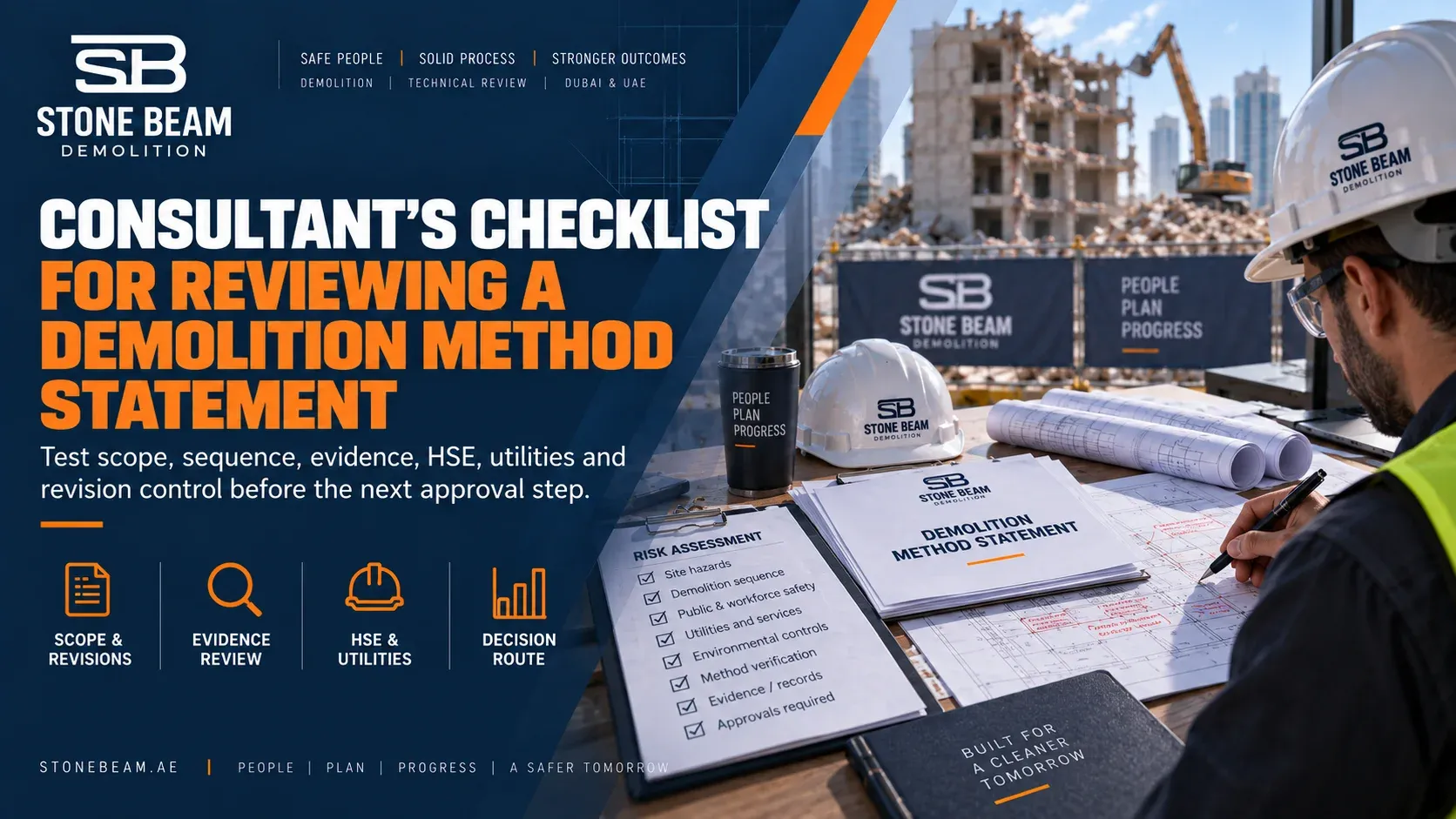
Demolition planning and method statement
A professional demolition plan for a mega mall will normally include:
- Overall demolition strategy and phasing
- Detailed sequential demolition steps, floor by floor or zone by zone
- Temporary works and propping (including design calculations)
- Access, egress, traffic management and crane locations
- Worker, public, and adjacent-property protection measures
- Waste management, sorting streams and recycling routes
- Emergency response and evacuation procedures
Stone Beam translates this into clear drawings and step-by-step method statements that can be understood by engineers, supervisors and site operatives.
Choosing the right demolition strategy for a live mega mall
There is no “one size fits all” approach. Stone Beam usually evaluates multiple strategies, combining several methods in one project.
Full closure vs phased / live-environment demolition
- Full closure and complete demolition
- Rare for prime Dubai malls, but relevant for smaller or outdated centres
- Allows use of more aggressive techniques (e.g., large high-reach excavators, rapid slab removal)
- Shorter programme but loss of rental/revenue during works
- Phased structural demolition with partial mall operation
- Example: demolishing one wing while the rest of the mall remains open
- Requires robust physical segregation, temporary fire escapes, and re-routed customer flows
- Usually relies on quiet, low-vibration methods and more night work
- Internal strip-out and heavy refurbishment / re-merchandising
- Most common scenario in Dubai: controlled demolition of slabs, escalator openings, atrium voids, water features and shopfronts while mall remains live
- Several specialist contractors in Dubai have done such works in Dubai Mall food courts, Mall of the Emirates and other major malls, using controlled demolition, coring and concrete cutting.
Stone Beam leans toward selective, engineered demolition with maximum reuse of existing structures when possible.
Demolition methods suitable for malls and commercial centres
Shopping mall demolition uses a toolkit of methods. The key is to choose the right combination for safety, control, speed and environmental impact.
Top-down mechanical demolition (excavators & high-reach)
For car parks, detached sections, or fully closed malls, Stone Beam uses:
- Crawler excavators with hydraulic breakers, crushers and shears
- High-reach excavators for façades and taller attached structures
- Controlled “bite and pull” of slabs, beams and walls
Mechanical demolition is highly productive but generates noise, dust, vibration and debris, as highlighted in both research and industry guidance.
In a live mall environment, this method is:
- Used mainly in isolated zones or external areas
- Combined with heavy hoardings, scaffold fans and debris netting
- Scheduled in night shifts when public areas are empty
Demolition robots for confined and sensitive areas
Remotely controlled demolition robots (e.g. Brokk-type machines) are ideal inside shopping malls: they are compact, manoeuvrable, and keep operators at a safe distance.
Typical uses in malls:
- Breaking out slab strips for new escalators or atriums
- Removing mezzanines and internal beams in limited-access zones
- Working on suspended slabs where machine weight and vibration must be tightly controlled
Advantages:
- Higher safety – operator is away from fall hazards and falling debris
- Electric power – suitable for indoor use with less emissions
- Compatible with concrete crushers, breakers and small drilling units
Selective demolition and strip-out
Before heavy structural work, Stone Beam usually performs full soft strip:
- Removal of shopfronts, partitions, ceilings, raised floors
- Disconnection and removal of non-critical MEP, cabling, ductwork and equipment
- Removal and segregation of reusable items (chillers, AHUs, lighting, escalators, finishes)
Controlled strip-out is common practice in Dubai malls during refurbishment, with contractors providing heavy and soft demolition, coring and concrete cutting, and off-site debris removal.
This phase:
- Reduces fire load and hidden hazards
- Improves access for structural works
- Maximises recovery of high-value components for reuse or resale
Concrete cutting and coring (diamond saws & wire)
For precision works in live environments, diamond concrete cutting is often the primary method:
- Floor and wall saws for slab openings, new shafts and doorways
- Diamond wire sawing to segment thick transfer beams, cores or heavily reinforced elements
- Core drilling for penetration, anchoring, and reinforcement investigation
These techniques create clean, controlled cuts with very low vibration and – with water cooling – minimal airborne dust.
They are ideal when:
- Only part of a slab must be removed while the remaining portion stays in service
- Adjacent areas (cinemas, hotels, luxury boutiques) must not be disturbed
- The structure includes heavy reinforcement or post-tensioning that must be cut in a specific sequence
Stone Beam Demolition pairs cutting with carefully engineered lifting plans to crane down segments safely without overloading the remaining structure.
Hydrodemolition for selective concrete removal
Hydrodemolition uses ultra-high-pressure water jets to remove concrete without damaging reinforcement. It is widely used for bridge and structural concrete rehabilitation and increasingly used for selective structural alterations.
In shopping malls, hydrodemolition can be used for:
- Removing deteriorated or contaminated concrete from parking decks and ramps
- Exposing reinforcement for strengthening or modification without inducing micro-cracks
- Sensitive structural alterations where vibration must be kept extremely low
Key benefits:
- No mechanical impact, therefore very low vibration – perfect near sensitive finishes and equipment
- Clean, rough surface ideal for new concrete bonding
- Rebar is cleaned and preserved rather than damaged
The main challenge is managing slurry and contaminated water. Stone Beam designs pumping, collection, filtration and sedimentation systems to comply with Dubai Municipality’s environmental requirements for waste and wastewater.
Explosive demolition (usually NOT suitable)
While demolition by explosives is efficient for large structures, the vibration, airblast, flying debris and dust make it generally unsuitable for major malls in dense Dubai environments.
Authorities and surrounding stakeholders typically do not accept the risk profile for:
- Malls integrated with towers, hotels and infrastructure
- Sites near Metro lines, highways and high-value properties
Stone Beam’s philosophy is therefore to favour controlled mechanical and cutting-based methods for mega-malls, keeping explosive techniques as a last resort and only in very specific, isolated circumstances.
Managing demolition in a live operational retail environment
This is where many mall projects succeed or fail. Stone Beam’s planning focuses on segregation, protection, logistics and communication.
Zoning, hoarding and access control
Key principles:
- Establish a 6 m exclusion zone around structural demolition areas, secured with solid hoardings and clear signage, as recommended by safety guidance.
- Use solid hoardings (not just mesh) between public areas and demolition zones to control dust and noise.
- Provide overhead protection (gantries, fans, protective decks) above any pedestrian routes near works.
- Lock and monitor all entry points to demolition zones – no unauthorised access.
Fire, life safety and evacuation
During mall demolition, fire and life safety becomes more complex:
- Fire escape routes may be temporarily blocked or rerouted
- Active systems (alarms, sprinklers, smoke control) must remain functional in live zones
- Temporary systems may be required in demolition zones
Stone Beam works with the client’s safety consultant and Dubai Civil Defence to:
- Map temporary evacuation routes and assembly points
- Provide additional signage and lighting for altered paths
- Ensure safe separation between hot works and public areas
Dust, noise and vibration management
Demolition work can easily exceed acceptable levels for shoppers, tenants and nearby sensitive receptors. Dubai guideline values for workers and the public require active control of noise and dust emissions.
Stone Beam employs:
- Water mist cannons and localised damping at breaking points
- Uses of low-noise demolition robots and crushers instead of heavy breakers, where possible
- Acoustic screens and wall linings on hoardings
- Vibration monitoring at key structural elements and adjacent tenancies
Where necessary, the most disruptive works are scheduled at night or off-peak hours, with clear communication to tenants.
Waste, logistics and truck movements
A mega-mall demolition produces enormous volumes of:
- Concrete and reinforcement
- Blockwork and bricks
- Glass, aluminium, cladding
- MEP scrap and fixtures
Dubai requires mandatory segregation of construction and demolition waste into categories such as concrete, metal, timber, plastics, and general waste, with specific recycling targets.
Stone Beam’s approach:
- On-site sorting yards within the mall’s back-of-house or external areas
- Dedicated waste truck routes and schedules to avoid peak mall traffic
- Digital tracking of truck trips, weighbridge tickets and disposal locations, integrated into client reporting
- Coordination with licensed recycling facilities and waste-to-energy plants where available
Structural engineering and risk control
Working with long-span and prestressed slabs
Malls often use post-tensioned (PT) slabs and beams to achieve column-free retail spaces and atriums. When modifying or demolishing PT structures:
- Cutting tendons releases stored energy that can cause sudden cracking or element failure
- Removing the wrong slab bay can change load paths and overload remaining beams or columns
Lessons from prestressed bridge demolition show that the safest method is often to dismantle in reverse order of construction, with detailed analysis of each step.
Stone Beam works with specialist structural consultants to:
- Develop stage-by-stage FEM models for complex demolitions
- Plan tendon de-stressing, temporary shoring and slab segmentation
- Monitor deflection and cracking as works progress
Temporary works and propping
Temporary works are non-negotiable for safe mall demolition. Examples:
- Heavy needle beams and props to support slabs adjacent to openings being cut
- Shoring under transfer beams before cutting supported walls or columns
- Back-propping under slabs where demolition machinery will operate
These supports are designed, checked and inspected just like permanent structures, and are clearly shown in Stone Beam’s method statements and shop drawings.
Monitoring and real-time control
For high-risk areas, Stone Beam can introduce:
- Crack and deflection monitoring on critical beams/columns
- Vibration and noise sensors with alarms
- Load cells on temporary supports for real-time force tracking
Such approaches mirror best practices used internationally for sensitive demolitions, providing early warning of unexpected behaviour.
Stone Beam’s engineered approach to shopping mall demolition
To make all of this practical, Stone Beam follows a structured seven-step process on mall and mega-centre projects.
Step 1 – Feasibility and strategy workshop
- Joint workshop with client, consultant, FM team and mall management
- Define business constraints: which zones must stay live, time windows, no-go areas
- Identify key risks: PT slabs, shared structures, high-value tenants, traffic interfaces
Step 2 – Surveys, scanning and modelling
- Structural, architectural and MEP surveys
- GPR scanning services in UAE to map PT tendons, rebar, ducts and embedded services
- 3D model (BIM) of existing structure and proposed demolition phases
Step 3 – Demolition design and authority submissions
- Prepare detailed demolition method statement, sequence drawings and temporary works design
- Coordinate with authorised consultancy office to produce structural reports and calculations for authority submission
- Support the client in obtaining demolition permits and NOCs
Step 4 – Enabling works and segregation
- Build hoardings, scaffold fans and overhead protection
- Install temporary fire routes, signage and lighting
- Create access ramps, crane pads and logistics routes
Step 5 – Soft strip and decommissioning
- Disconnect and make safe all non-essential services in the demolition zones
- Complete soft strip and selective demolition of non-structural elements
- Segregate, tag and remove reusable and recyclable components
Step 6 – Structural demolition and alteration
- Implement structural demolition in small, controlled stages
- Use the right combination of methods:
- Demolition robots & mini excavators
- Diamond cutting and coring
- Hydrodemolition where appropriate
- High-reach or heavy excavators in isolated zones
- Continually verify behaviour against the demolition plan and update methodology if monitoring shows deviations
Step 7 – Handover, documentation and sustainability reporting
- Provide as-built documentation of residual structures, including updated PT tendon layouts where applicable
- Deliver waste and recycling reports, including tonnages per material stream
- Handover structural verification reports for any retained portions of the mall
This approach aligns with top-tier demolition companies in Dubai and the UAE that emphasise safety, engineering and sustainability as key differentiators.
Realistic case-style scenarios for Stone Beam in mega-mall demolition
These scenarios illustrate how Stone Beam Demolition can handle complex shopping mall demolition and alteration projects in Dubai.
Scenario 1 – Creating a new luxury atrium in a live wing
Objective:
Convert several standard retail units and corridors into a double-volume luxury atrium with a skylight in an operating mall.
Challenges:
- PT slab above ground floor retail
- High-end finishes and shopfronts nearby
- Cinemas and hotel rooms above that must remain open
Stone Beam approach:
- Perform GPR scanning to map tendons and reinforcement.
- Design slab openings and tendon de-stressing sequence with the structural consultant.
- Use diamond saw cutting to define opening boundaries and demolition robots to break out infill sections.
- Install heavy temporary propping below before cutting any tendons.
- Carry out noisy works at night; manage dust with local extraction and screens.
- Complete edge strengthening and new structural framing for the atrium void.
Result: The mall gains a new high-value atrium while remaining operational, with minimal disruption to tenants.
Scenario 2 – Demolishing a multi-storey parking block attached to a mall
Objective:
Remove a 5-level car park attached to an older mall to make way for a new tower.
Challenges:
- Shared slabs and structural connections with the mall podium
- Active mall access routes and service roads nearby
- High volumes of debris and truck movements
Stone Beam approach:
- Engineer structural separation between the car park and the mall, using saw cutting and selective demolition around the interface.
- Install temporary supports where needed to preserve mall stability.
- Demolish the car park using a combination of high-reach excavators and top-down mechanical demolition.
- Implement a digital truck tracking system and dedicated routes to minimise impact on live mall traffic.
- Segregate concrete and steel for recycling in line with DM’s waste guidelines.
Scenario 3 – Heavy internal demolition for a food court upgrade
Objective:
Replace an existing food court and water features with a new F&B concept and structural layout.
Challenges:
- Complex MEP, including kitchen exhausts and grease lines
- Water features and pools integrated into slabs
- Requirement to keep surrounding retail open
Stone Beam approach:
- Decommission water systems and ensure waterproofing integrity around adjacent areas.
- Use controlled demolition, coring and concrete cutting to remove water feature basins, edge beams and seating plinths.
- Schedule heavy works overnight and during quieter periods.
- Coordinate with mall operations to maintain safe customer circulation and temporary food offerings in other areas.
Result: A modernised food court delivered with almost no downtime for the rest of the mall.
Scenario 4 – Partial demolition of an ageing community mall
Objective:
Demolish half of an older community mall while keeping the supermarket anchor and some key tenants trading.
Challenges:
- Ageing structure with unknown modifications
- Mixed construction types and possible hazardous materials
- Tight site in a residential neighbourhood
Stone Beam approach:
- Conduct thorough structural and hazardous material surveys (including asbestos and lead-based paint checks).
- Develop a top-down manual and mechanical demolition sequence, keeping the retained supermarket structurally isolated and protected.
- Use smaller, quiet machinery and intensive dust/noise control due to nearby residences.
- Coordinate with authorities and the client to manage traffic, parking and temporary signage.
Sustainability and circular economy in shopping mall demolition
Dubai is driving a strong agenda on waste minimisation and recycling, including specific requirements for malls to manage and recycle waste streams.
Stone Beam integrates circular economy principles in mall demolition by:
- Identifying recoverable assets: elevators, escalators, chillers, AHUs, lighting, façade elements, shopfronts
- Designing demolition so that components are dismantled rather than smashed, preserving resale value
- Segregating concrete, metals, glass, plastics, timber and general waste at source
- Working with certified recyclers to turn concrete rubble into aggregate for road sub-base or new construction
- Providing clients with sustainability reports showing recycling rates and carbon-saving estimates
This approach aligns well with both global best practice and Dubai’s long-term environmental vision.
How to choose a mall demolition contractor in Dubai?
If you are the owner, developer or consultant for a shopping mall or large commercial centre, selecting the right contractor is critical.
Look for a mall demolition contractor in Dubai who can demonstrate:
- Authority compliance and approvals
- Proven track record obtaining DM / DDA demolition permits
- Clear understanding of demolition-related technical guidelines and building code requirements
- In-house engineering and method statements
- Ability to produce staged demolition sequences, temporary works designs and PT de-stressing plans
- Specialist equipment and methods
- Demolition robots, high-reach excavators, diamond cutting and coring rigs, hydrodemolition capability
- Live-environment experience
- References for selective demolition and strip-out in operational malls, hotels, airports or similar environments
- HSE culture and training
- Detailed risk assessments covering noise, dust, vibration, hazardous materials and working at height
- Digital reporting and transparency
- Daily site reports, monitoring dashboards, digital waste tracking and photo records
Stone Beam Demolition positions itself precisely in this space: a modern, engineered demolition company in Dubai, combining advanced techniques with detailed HSE and sustainability standards.
FAQs
1. Is Dubai Mall being demolished?
No. At the time of writing, Dubai Mall is not under demolition. References to Dubai Mall in this article are purely to illustrate the scale and complexity of mega-mall demolition and the type of engineering controls required when working on similar structures.
2. Can a mall remain open while demolition is happening?
Yes – many mall projects in Dubai are carried out in phases while parts of the mall stay operational. This requires:
- Robust hoardings and segregation
- Careful routing of customers and fire escapes
- Night-shift schedules for noisy work
- Strict dust, noise and vibration controls
A detailed demolition and HSE plan, approved by authorities, is essential.
3. What permits do I need for shopping mall demolition in Dubai?
You typically need:
- A demolition permit from Dubai Municipality / DDA or the relevant free zone
- Structural reports and stamped demolition method statements
- Utility NOCs (DEWA, telecoms, district cooling, gas, etc.)
- A project-specific HSE plan and waste management plan
Your demolition contractor and consultant should support you in preparing and submitting all documentation.
4. Which demolition methods are best for a live mall?
In live malls, controlled, low-vibration methods are usually preferred:
- Diamond cutting and coring
- Demolition robots and small electric equipment
- Carefully sequenced slab and beam removal with cranes
- Hydrodemolition for selective concrete removal
Large-scale explosive or very heavy impact methods are usually avoided due to risk and disturbance.
5. How do you control dust and noise during mall demolition?
Control measures include:
- Localised water mist and extraction at the workface
- Acoustic hoardings and temporary linings
- Use of low-noise equipment where possible
- Scheduling the loudest works at night or off-peak times
- Providing PPE and hearing protection to workers
Noise and dust thresholds are defined in HSE guidelines, and monitoring is often required on sensitive projects.
6. What happens to demolition waste from a shopping mall?
Dubai Municipality requires segregation and recycling of construction and demolition waste, with separate streams for concrete, metal, timber, general waste and sometimes plastics and glass.
Stone Beam typically:
- Segregates waste at source
- Sends concrete and blocks to recycling plants
- Sends steel and metals to scrap recyclers
- Provides full waste tracking and recycling reports to the client
7. How long does a mall demolition project take?
Timeframes vary widely depending on:
- Size and complexity of the mall
- Whether the mall is fully closed or partly live
- Extent of structural changes vs full demolition
- Authority approval timelines
A small community mall might take a few months; a mega-mall partial demolition and refurbishment can run over several phases and years.
8. How much does shopping mall demolition in Dubai cost?
Costs depend on:
- Structural complexity (PT slabs, transfer structures, towers above)
- Access and logistics constraints
- Required methods (robots, cutting, hydrodemolition vs simple mechanical)
- HSE, monitoring, and environmental requirements
A serious budget can only be prepared after surveys and a conceptual demolition plan. However, investing in engineered demolition usually reduces risk and unexpected cost compared to “cheap” but unsafe approaches.
9. Do I need GPR scanning before cutting slabs?
For malls with long spans, PT slabs or complex MEP, yes, GPR scanning is strongly recommended. It helps:
- Locate tendons, ducts and rebar
- Avoid cutting critical structural or service elements
- Reduce risk and rework
This is now standard practice for high-value projects in the UAE.
10. Why choose Stone Beam Demolition for mall projects?
Because Stone Beam offers:
- Dubai-specific demolition expertise and authority-compliant documentation
- Advanced methods (robots, high-reach excavators, diamond cutting, GPR scanning, hydrodemolition)
- Proven capability in live-environment demolition and strip-out
- Strong HSE culture with detailed planning and monitoring
- Clear reporting on progress, safety and waste / sustainability