

ADNOC operates its comprehensive Health, Safety and Environment Management System (HSEMS) structured around 8 elements, codified as ADNOC COP (Code of Practice) COPV1-09. Every contractor working within ADNOC facilities or on ADNOC-related projects must comply. The elements most relevant to tank demolition are:
- Element 2 (Safety): Requires formal Permit-to-Work (PTW) systems covering hot work permits, confined space entry permits, crane lift permits, excavation permits, and electrical work permits — all essential for tank demolition.
- Element 4 (Environment): Mandates Pollution Prevention and Control through the decommissioning phase, plus a Demolition Environmental Management Plan (DEMP) identifying impacts, applicable legislation, monitoring procedures, and corrective actions.
- Element 5 (Risk Management): Requires HAZID, HAZOP, HIRA, JSA, Bowtie Analysis, and ALARP demonstrations before any work commences.
- Element 7 (Contractor Management): HSE prequalification, ongoing monitoring, and performance tracking are mandatory.
ADNOC enforces Life-Saving Rules directly relevant to tank demolition: work with a valid permit, obtain authorization before confined space entry, verify isolation and zero energy, control flammables and ignition sources, and follow rules for H₂S environments. Violations carry immediate consequences.
Contractor prequalification requires extensive documentation
Registration is via the SAP Ariba Supplier Hub. The process takes approximately 90 days and requires:
- Valid UAE Mainland Trade License (Abu Dhabi DED)
- ISO 9001, ISO 14001, and ISO 45001 certifications
- Audited financial statements and organizational charts
- HSE Performance Statistics for 3 years (man-hours, fatalities, LTIs, LTIF, TRIR)
- HSE Policy signed by top management, HSEMS documentation
- Supreme Petroleum Council (SPC) approval — mandatory for onshore/offshore oil and gas activities
- Anti-Bribery and Child Labor Policy
All contractor personnel must complete the ADNOC HSE Induction and training per the Unified ADNOC HSE Training Matrix covering first aid, H₂S/gas testing, confined space safety, working at height, rigging/slinging, and chemical handling. NEBOSH, IOSH, and OSHA certifications are recognized.
UAE federal and Abu Dhabi regulatory framework
The regulatory landscape includes multiple overlapping authorities:
Federal Law No. 24 of 1999 (Protection and Development of the Environment) is the principal environmental law. It requires Environmental Impact Assessments for projects affecting the environment, mandates precautions during demolition to prevent waste and dust dispersion, and establishes penalties of AED 5,000–500,000 with imprisonment of 2-5 years for serious violations.
Federal Law No. 12 of 2018 (Integrated Waste Management) governs hazardous waste segregation, treatment, and disposal. Oil-contaminated materials are pre-classified as hazardous waste by the Environment Agency – Abu Dhabi (EAD).
The Abu Dhabi Department of Energy (DoE) Fuel Storage Tank Regulations 2023 specifically address tank decommissioning requirements: fuel removal, piping isolation, interior cleaning, hazardous waste disposal per federal and local requirements, rendering tanks vapor-free, and disconnecting all connecting lines. When fuel leaks may have contaminated soils or groundwater, operators must submit a written closure plan with site assessment procedures.
The OSHAD/ADOSH System Framework (Version 4.0, administered by ADPHC) contains Codes of Practice directly applicable to tank demolition: CoP 1.0 (Hazardous Materials), CoP 1.1 (Asbestos Management), CoP 21.0 (Permit to Work Systems), CoP 27.0 (Confined Spaces), CoP 28.0 (Hot Work Operations), and CoP 34.0 (Safe Use of Lifting Equipment).
Federal Cabinet Resolution No. 39 of 2006 bans the import and production of asbestos in the UAE. Removal must be supervised by an ADPHC-registered Asbestos Supervising Consultant, with air monitoring mandatory during works and disposal as hazardous waste per Tadweer Guideline 16/1.
Tank demolition processes, types, and safety protocols
The full spectrum of tanks requiring demolition in oil and gas
Oil and gas facilities contain a wide variety of tank types, each presenting distinct demolition challenges:
By product: Crude oil storage tanks (the most common large-scale tanks, 20,000–100,000 m³ capacity), refined product tanks (gasoline, diesel, jet fuel, naphtha), LPG/LNG tanks (pressurized or cryogenic, built to API 620), condensate tanks, produced water tanks (may contain residual hydrocarbons and H₂S), fire water tanks, chemical storage tanks, separator vessels, pressure vessels (heater/treaters, knock-out drums), and slop/waste tanks.
By construction type: External Floating Roof Tanks (EFRT) — open-topped with single-deck or double-deck pontoon floating roofs, used for large crude storage up to 105m diameter. Internal Floating Roof Tanks (IFRT) — fixed roof with internal aluminum or steel floating cover for volatile products. Fixed/Cone Roof Tanks — welded steel with conical roof, most common for smaller tanks. Dome Roof Tanks and Open Top Tanks for non-volatile liquids.
Key construction standards: API 650 governs design, fabrication, and erection of vertical welded steel storage tanks at atmospheric pressure (max 18 kPa, 200°F). API 620 covers large low-pressure storage tanks (18–103 kPa) including cryogenic/LNG service. API 653 addresses inspection, repair, and alteration of existing tanks.
The tank demolition process follows a rigorous sequence
Phase 1 — Pre-demolition assessment: Site inspection evaluating access, ground-bearing capacity, proximity to live infrastructure, structural condition, height, diameter, and wall thickness. Tank history investigation reviewing MSDS records and previous product storage. Pre-demolition hazardous materials survey for asbestos insulation, lead paint, and PCBs.
Phase 2 — Cleaning and degassing: All remaining liquids pumped out via vacuum trucks. Lockout/Tagout (LOTO) of all energy sources. Line blinds installed on connected piping. High-pressure hydroblasting of interior surfaces. Sludge removal via vacuum extraction. Degassing using forced-air ventilation, nitrogen purging, CO₂ displacement, or steam cleaning. VOC vapor destruction through thermal oxidation or carbon adsorption.
Phase 3 — Gas-free certification: Testing with calibrated combustible gas indicators, oxygen meters, and multi-gas monitors. Criteria: oxygen 19.5–22% by volume, LEL reading <10% (preferably 0%), toxic gases within permissible exposure limits. Certificate issued confirming no flammable atmosphere — metal recycling centers will not accept tanks without this documentation. Critical note: even after venting, gas pockets can accumulate, requiring additional checks immediately before demolition.
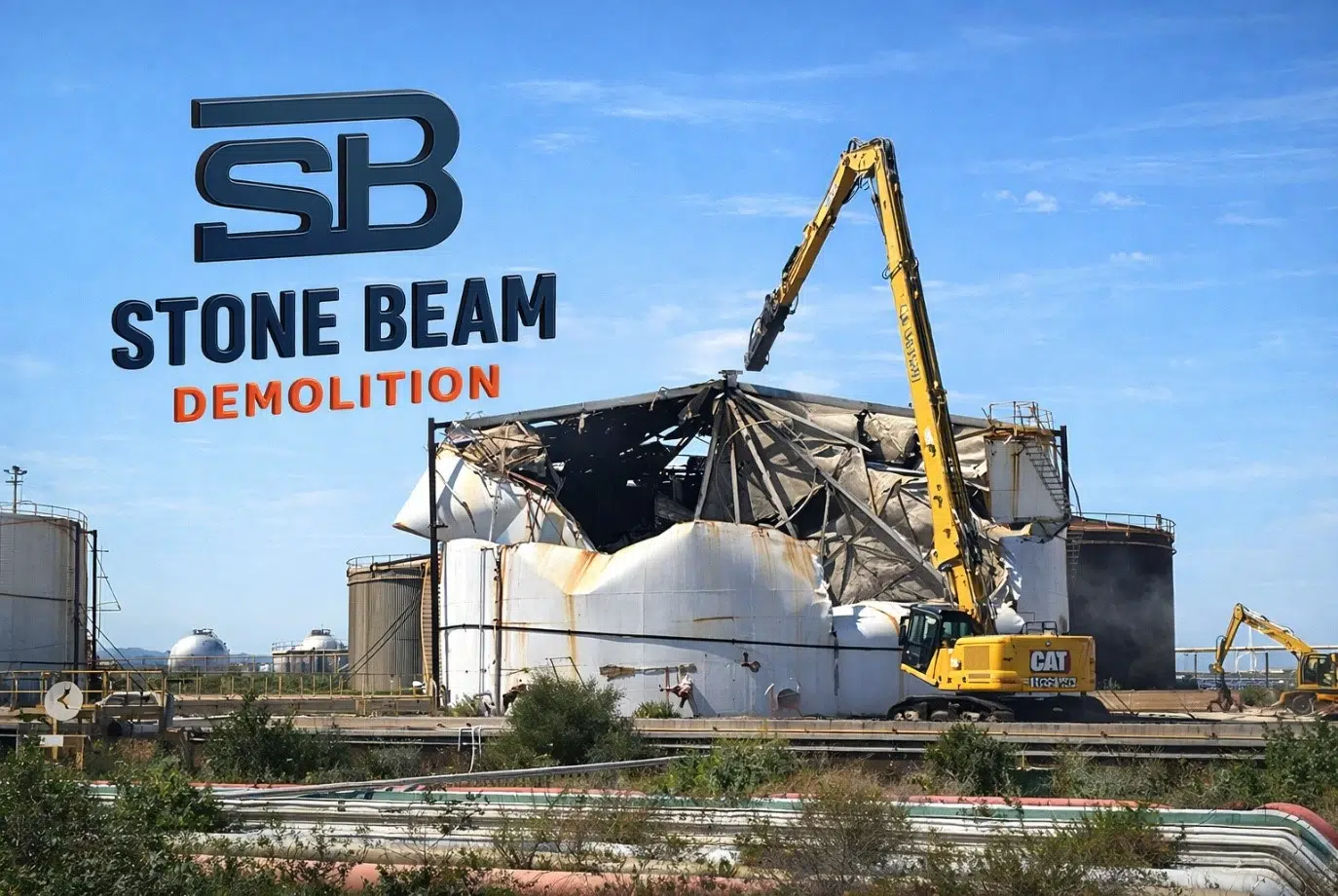
Phase 4 — Demolition execution: The preferred method is mechanical demolition using excavators with 360-degree hydraulic shears, working top-down. This reduces working-at-height risk and manual handling hazards. Alternative methods include cold cutting (reciprocating saws, hydraulic cutters, diamond wire), hot cutting (oxy-acetylene, plasma — only when gas-free certified with continuous LEL monitoring), and piecemeal manual dismantling with scaffolding/MEWPs for restricted-access situations.
Demolition sequence: Roof first (floating roof landed on legs, cut in sections; fixed roofs cut from perimeter inward) → shell plates (cut in vertical strips or horizontal courses, top-down) → floor plates → concrete foundation (hydraulic breakers) → bund/dike walls → below-grade piping.
Safety protocols address explosive atmospheres and toxic exposures
The primary hazards in tank demolition include explosive/flammable atmospheres from residual hydrocarbon vapors, toxic gases (H₂S at 500+ ppm is immediately fatal; benzene is a carcinogen), oxygen deficiency from nitrogen inerting, pyrophoric iron sulfide deposits that spontaneously ignite upon air exposure, structural collapse from corroded tanks, and confined space hazards.
LEL monitoring follows a two-tier alarm system: low alarm at 10-20% LEL, high alarm at 25-50% LEL. All hot work is absolutely prohibited if LEL ≥10%. Instruments must be calibrated monthly and bump-tested before each use. Oxygen must be monitored first — inerted atmospheres can give false low LEL readings.
PPE requirements include supplied-air breathing apparatus, flame-resistant clothing, H₂S personal monitors, fall protection harnesses, and chemical-resistant gloves. Emergency response requires standby rescue teams for all confined space entries, written emergency action plans, and fire suppression equipment on-site.
Related services that strengthen the page’s topical authority
Site remediation follows demolition as an essential service
Site remediation involves identifying, evaluating, and treating contaminants in soil, water, and air at demolished sites. The process typically follows three phases: Phase I ESA (non-intrusive desktop review per ASTM E1527), Phase II ESA (intrusive soil/groundwater sampling when contamination is suspected, typically costing $6,000–$25,000), and Phase III (remediation implementation).
Soil remediation techniques include excavation and disposal (“dig and haul”), bioremediation using microbial activity to break down hydrocarbons, thermal treatment to volatilize contaminants, soil vapor extraction, and chemical oxidation. Groundwater remediation uses pump-and-treat, air sparging, or monitored natural attenuation. Post-demolition site restoration involves confirmation sampling, backfilling with certified clean fill, compaction, grading, and regulatory closure documentation.
Hazardous material handling requires specialized certifications
Tank demolition commonly encounters asbestos-containing materials (insulation, gaskets, fireproofing), lead-based paint (on pre-1978 tanks), PCBs (in transformers and capacitors), hydrocarbon contamination (BTEX compounds, PAHs), H₂S, pyrophoric iron sulfide, mercury (in instruments), and NORM (Naturally Occurring Radioactive Material) in older production facilities.
Asset recovery transforms waste into revenue
A well-executed demolition can recover up to 95% of metal materials from a site. Ferrous metals (structural steel, shell plates, piping) and non-ferrous metals (copper wiring, aluminum floating roofs, brass valves, stainless steel vessels) are segregated using magnetic separation and XRF analysis. Scrap metal revenue can offset up to 30% of project costs. Reusable equipment (generators, pumps, heat exchangers, valves, control systems) is cataloged for resale at prices exceeding scrap value. Concrete foundations can be crushed on-site for reuse as aggregate.
The competitive landscape is remarkably weak
Only 8 competitors were identified, none with quality content
The research identified 8 companies offering some form of tank demolition or oil and gas demolition services in the UAE/GCC. Their content quality and SEO optimization are uniformly poor:
Kiwan Group (kiwan.ae) — the strongest oil and gas competitor with proven ADNOC relationships (projects valued AED 1.2M–18M), Grade 1 classification, and dedicated service cards for “Old Refinery And Oil Tanks Demolition.” However, their website has no detailed service page content, no blog, and no long-form SEO content. Service descriptions are image cards only.
Global Scrap Trading (globalscraptrading.org) — the only competitor prominently advertising ADNOC approval, CICPA passes, and ICV certification. Their end-to-end value proposition (demolition + scrap trading) is strong, but content is keyword-stuffed and lacks depth.
Al Mrooj (almrooj.ae) — shares ownership with Stone Beam (same phone number). Has the only dedicated tank demolition page in the UAE market — a ~400-word blog post with grammatical errors (“Carrie out” instead of “carried out”). This thin page ranks simply because no competitor has created anything better.
Al Sakhar/ABD (demolition.ae) — owns the premium domain but has basic, thin content with decommissioning described in a single sentence. GB Demolition, Al Nasr Demolition, Tekzone, and Al Waqar round out the competitive set with similarly weak online presences.
SERP analysis reveals a massive content vacuum
For “tank demolition UAE,” the search results feature almrooj.ae’s thin page at #1, UK-based companies, scaffolding services, forum discussions, and US companies — no quality local content exists. For “oil tank demolition Dubai,” sbdemolition.ae already appears through general demolition and decommissioning pages, but not through dedicated tank demolition content. For “industrial demolition Abu Dhabi oil gas,” Kiwan and Global Scrap Trading rank with their homepages.
The bottom line: creating a comprehensive, 2,500+ word tank demolition page would fill a content vacuum that no UAE competitor has addressed. Stone Beam‘s existing content strategy (3,000-5,000 word pages with case studies, FAQs, and technical depth) already far exceeds every competitor’s approach.
Keyword strategy built on commercial intent and low competition
Primary keywords should anchor the page’s core structure
| Keyword | Est. Global Volume | UAE Intent | Difficulty | Priority |
| tank demolition | 500–1,000/mo | Commercial/Transactional | Medium | ★★★★★ |
| oil tank demolition | 200–500/mo | Commercial/Transactional | Low-Medium | ★★★★★ |
| fuel tank demolition | 100–300/mo | Commercial/Transactional | Low | ★★★★★ |
| oil and gas demolition | 200–500/mo | Commercial/Informational | Medium | ★★★★★ |
| tank decommissioning | 500–1,500/mo | Commercial/Informational | Medium | ★★★★★ |
UAE-specific search volumes for these terms are estimated at 10–50 monthly searches each, but the conversion value per inquiry is exceptionally high (contracts range from $100K to $10M+). The low competition means even modest volume drives significant business value.
Long-tail and location-modified keywords should be woven throughout
Priority long-tail targets: “tank demolition services UAE,” “oil tank demolition Abu Dhabi,” “fuel tank demolition Dubai,” “ADNOC approved demolition contractor” (the single most important qualifier for Abu Dhabi oil and gas work), “oil and gas demolition company UAE,” “crude oil tank demolition,” “LPG tank demolition,” “tank decommissioning services Middle East.”
LSI keywords build topical authority
The article must naturally incorporate these semantic signals across three categories:
Process terms: gas-free certification, confined space entry, hot work permit, cold cutting techniques, tank cleaning and degassing, sludge removal, decontamination, soil remediation, tank inerting, vapor control, LEL monitoring.
Industry terms: brownfield redevelopment, asset decommissioning, facility demolition, structural dismantling, pipeline demolition, scrap metal trading, ferrous and non-ferrous metal recycling.
Regulatory terms: ADNOC HSE requirements, ISO 45001, ISO 14001, ISO 9001, NEBOSH certified, API 650, API 2015, OSHAD-SF, CICPA, ICV certification.
FAQs
1. How is an oil tank demolished?
Oil tank demolition usually starts with isolation, draining, cleaning, degassing, and testing the tank atmosphere before any cutting or dismantling begins. After the tank is confirmed safe, contractors typically dismantle it in sections using cold cutting or controlled hot work, remove contaminated residues, and then transport the scrap and waste through approved channels. For higher-risk sites, the method statement is usually stricter and tied to site-specific HSE controls and emergency procedures.
2. What is the cost of tank demolition?
The cost depends on tank size, whether it is above-ground or underground, how much residual product or sludge remains, access conditions, contamination risk, required permits, and waste disposal needs. In practice, there is no single standard UAE price because regulatory scope, owner requirements, and hazardous-waste handling can significantly change the total. For content purposes, it is safest to say that tank demolition is quoted case by case after site inspection and risk assessment.
3. How long does tank demolition take?
Small, accessible tanks may be completed in a few days, while large industrial tanks can take several weeks once cleaning, gas freeing, permits, isolation, dismantling, waste handling, and site clearance are included. The timeline increases when the tank contains hazardous residues, sits inside a live facility, or requires owner approvals and controlled work windows.
4. What safety measures are needed for tank demolition?
The essential controls include full isolation, residual product removal, gas freeing, atmospheric testing, confined-space controls where applicable, hot-work controls, fire prevention, emergency response planning, trained crews, and proper PPE. OSHA states that hot work must not be done on used tanks until they are cleaned thoroughly enough to ensure no flammable material or toxic-vapor-producing residues remain, and hot work in confined spaces requires atmosphere testing first. HSE also warns that confined spaces carry risks from toxic fumes, low oxygen, and fire.
5. What certifications are needed for oil tank demolition in UAE?
There is no single universal “UAE oil tank demolition certificate” that covers every project. In practice, contractors usually need the legally required trade licensing for their emirate and activity, competent safety documentation, trained personnel for confined-space and hot-work tasks where relevant, and any project-owner or operator approvals. On ADNOC-related work, supplier registration and relevant prequalification are part of the access path, and ADNOC emphasizes contractor compliance with its HSE requirements and training expectations.
6. What is the difference between tank decommissioning and demolition?
Tank decommissioning means taking a tank permanently out of service in a controlled, compliant way. That may include emptying, cleaning, isolating, making it safe, and either leaving it in place or preparing it for later removal. Tank demolition goes further: it is the physical dismantling and removal of the tank structure itself. In simple terms, decommissioning makes the asset safe and inactive; demolition removes it. This distinction follows the typical sequence reflected in tank-cleaning, isolation, and demolition safety guidance.
7. What permits are needed for tank demolition in UAE?
Permits vary by emirate, site, and owner. In Dubai, demolition work falls under the municipality’s construction works framework, which includes a demolition permit structure for buildings and related works. On industrial sites, tank demolition may also require site-specific work permits such as hot-work, confined-space, isolation, and waste transport/disposal approvals, plus owner or operator approval before work starts. In Abu Dhabi, waste handling and transportation must use licensed environmental service providers, with segregation, tracking, and manifest requirements.
8. What happens to scrap metal from demolished tanks?
After dismantling, scrap metal is usually segregated, inspected for contamination, cleaned if required, and then sent to approved recycling or disposal channels. ADNOC states that, where applicable, a proportion of waste is sold to approved third parties for recycling or reuse, while hazardous waste goes through controlled treatment and disposal routes. In Abu Dhabi, waste transport and handling must be done by licensed environmental service providers with documentation and manifest controls.
9. What ADNOC requirements exist for demolition contractors?
For ADNOC-related work, contractors should expect more than general market practice. ADNOC materials indicate that UAE statutory legislation comes first, followed by ADNOC standards, regulations, and codes of practice, then ADNOC HSE standards and project specifications. ADNOC also requires supplier registration and prequalification through its Supplier Hub, and it publicly emphasizes contractor compliance with HSE requirements, risk management, emergency response, and training. In practical terms, demolition contractors working on ADNOC assets should be ready with strong HSE systems, approved work methods, competent supervisors, and full compliance with owner-specific permit-to-work requirements.
A careful note for your page: on the UAE-specific questions, it is better to write “requirements vary by emirate, site owner, and project risk” rather than sounding absolute, because Dubai Municipality, Abu Dhabi environmental controls, and ADNOC owner requirements can all apply differently depending on the job.