



Demolition contractor prequalification in Dubai confirms three things before price comparison: the bidder is eligible for the relevant demolition activity, the submission proves relevant capability, and the commercial scope is comparable with competing bids. A low price is not meaningful when permits, access, temporary works, disposal, or specialist interfaces are allocated differently.
Do not assume a universal Dubai demolition prequalification scorecard. The official sources reviewed for this article govern contractor licensing, registration and project permit submissions; they do not publish one citywide client tender weighting. Client and consultant procurement controls sit on top of the applicable authority requirements.
Prequalify legal eligibility first, evidence second, and scope comparability third. Apply scoring only after every material exclusion and responsibility boundary is visible.
Last reviewed: 5 September 2026
Prepared by Stone Beam Technical Services L.L.C.
What does demolition contractor prequalification decide before tender award?
Prequalification is a screening decision. It answers whether a bidder is credible enough to enter a reliable tender comparison, not whether that bidder has already earned the award.
The buyer needs a minimum information set before price has any meaning. That set covers legal eligibility, relevant experience, competent people, technical approach, HSE controls, available resources, commercial capacity, and a clear responsibility split.
Prequalification, tender evaluation, and project approval are different decisions. Mixing them creates false confidence and weakens the audit trail.
| Decision stage | Core question | Typical evidence | Output |
| Prequalification | Is the bidder eligible and credible for this scope? | Licence/activity record, relevant references, key staff, HSE and resource evidence | Qualified, clarify, or reject |
| Tender evaluation | Are the technical and commercial offers comparable? | Method concept, programme basis, inclusions, exclusions, assumptions, price and risk allocation | Preferred compliant bid or clarification |
| Project approval / mobilisation | Has the defined project obtained the required releases? | Authority approvals, NOCs, accepted submissions, isolations and project controls | Released workface or hold |
What is the regulatory baseline for demolition contractors in Dubai?
Start with the contracting activity the company is licensed and authorized to practise. Dubai Municipality places contracting activities, including Wrecking & Demolition Works, inside a regulatory framework covering activity classification, licensing standards, technical-staff requirements and practice authorization.
The current Dubai Municipality licensing standards list dedicated criteria for Wrecking & Demolition Works. Dubai Municipality’s Consultants, Contractors and Suppliers Data page also states that contracting companies must meet approved contracting standards and registration requirements before being authorized to practise.
Jurisdiction matters. In areas governed by Dubai Development Authority, a contractor registration process exists in addition to the underlying trade licence. DDA states that its registration does not replace the trade licence.
Project approval is a later layer. DDA’s demolition permit service asks the contractor for project documents including the demolition method statement, HSE and emergency plan, risk assessments, relevant NOCs, hoarding information, and an impact study for neighbouring buildings. Those are permit-stage project submissions, not a universal prequalification list for every Dubai tender.
What belongs in a demolition contractor prequalification checklist?
A useful demolition contractor prequalification checklist asks for evidence that changes the buying decision. It avoids document collecting for its own sake.
The checklist below separates the evidence category from the decision it supports. Requirements such as insurance limits, financial thresholds, ISO certificates, or scoring weights belong to the client or tender standard unless an authority source makes them mandatory for the specific jurisdiction and activity.
| Check | Evidence to request | What the buyer is testing | Red flag |
| Legal eligibility | Current trade licence, relevant activity/classification, jurisdiction registration where needed | Whether the bidder is eligible for the procured demolition activity | Activity mismatch, expired record, unclear classification |
| Relevant work evidence | Project references, appointment records, completion or handover evidence where available | Whether prior work is relevant in structure, scale, access and demolition type | Marketing list without role, scope or evidence |
| Key personnel | Project lead, site engineering, supervision and HSE competence records | Whether named people match the risk and interfaces of the scope | Generic CV bank with no project allocation |
| Technical approach | Method concept, sequence logic, retained-structure interfaces, access and waste route | Whether the bidder understands the work rather than only the quantities | Generic method copied across unrelated projects |
| HSE controls | Project HSE approach, risk-control structure, training/competence evidence, requested performance records | Whether the bidder has a workable management system for the tendered risk | Claims without source records or no link to the actual workface |
| Resources | Proposed plant categories, specialist subcontractors, labour/supervision plan, availability basis | Whether resources are available and suitable when needed | Ownership claim used instead of an availability plan |
| Commercial capacity | Tender-required insurance, bonds, financial or contractual information | Whether the bidder can accept the stated commercial obligations | Missing tender-required evidence or unexplained exceptions |
| Scope clarity | Inclusions, exclusions, assumptions and responsibility matrix | Whether the price is based on the same work as competing bids | Major interfaces hidden inside “by others” wording |
What evidence is strong enough to support a contractor claim?
A claim is not evidence. A company profile, project list, certificate, or equipment schedule becomes useful only after the buyer checks what it proves, who issued it, whether it is current, and whether its scope matches the tender.
Use an evidence ladder: claim, document, verification, decision. This prevents a polished prequalification file from being treated as proof of facts it does not establish.
Project evidence also needs the correct status. An appointment letter proves the appointment. A purchase order proves a contracted scope. Neither proves completion unless a completion or handover record supports that outcome.
Client references and testimonials are supporting trust signals, not substitutes for scope evidence. Review them alongside the project record rather than as the qualification decision itself.

Which scope gaps make demolition quotations impossible to compare?
Most bid-comparison errors start before the price table. One bidder prices a complete obligation while another excludes major interfaces, so the lowest total is not the lowest comparable cost.
For demolition work, the buyer needs the responsibility boundary to be explicit before commercial ranking. The following items deserve written allocation because they change method, programme, risk, or price.
- Authority applications, NOCs, permit fees, and responsibility for resubmissions.
- Utility identification, isolation, disconnection, temporary services, and release evidence.
- Temporary works, propping, scaffolding, hoarding, protection screens, and retained-element support.
- Site access, gate passes, working-hour restrictions, traffic interfaces, and loading windows.
- Waste segregation, loading, haulage, receiving facility, tickets, and final disposal records.
- Monitoring, surveys, scanning, testing, engineer reviews, and specialist reports.
- Shop drawings, as-builts, method submissions, handover records, making good, backfill, and final site condition.
If the project is a villa, building, mall, live facility, or infrastructure package, the responsibility split changes again. For villa-specific procurement, the villa demolition in Dubai service context helps define the access, neighbour, and boundary conditions that belong in the scope.
At this point in the buying process, the buyer also needs to distinguish a full demolition-contractor scope from a narrow removal package. The demolition contractor in Dubai service page carries the broader commercial company-selection intent rather than this procurement checklist.
How do you normalize demolition bids without false precision?
Normalize scope before score. The process is simple: freeze the demolition boundary, map responsibilities, close exclusions, test technical fit, then compare the commercial basis.
Do not create a universal weighted score unless the client already has an approved procurement model. A 30/30/40 or 20/40/40 split looks objective but only moves hidden judgement into arbitrary percentages.
A better comparison matrix records whether each obligation is included, excluded, client-supplied, subcontracted, or still unclear. Clarification continues until the material rows are aligned.
| Scope / responsibility | Bidder A | Bidder B | Evidence supplied | Clarification action |
| Permits and NOCs | Included | Excluded | Tender note + authority route | Confirm applicant, fees and resubmission responsibility |
| Scaffolding / temporary works | Client-supplied | Included | Scope sheet / method concept | Define design, supply, access and removal boundary |
| Waste haulage and records | Included | Included with quantity cap | Disposal method / commercial schedule | Confirm cap, route and record requirement |
| Utility isolation | Excluded | Excluded | Interface schedule | Name responsible party and release evidence |
| Monitoring / specialist surveys | Allowance | Excluded | Method / provisional item | Define trigger, scope and commercial treatment |

What changes the procurement decision, scope certainty, and commercial risk?
The strongest prequalification decision focuses on uncertainty with cost, delay, safety, or contractual consequences after award.
Relevant project evidence must match the interfaces in the new scope. Evidence from open-site mechanical demolition, for example, does not by itself establish competence for partial structural demolition inside an occupied building. The buyer tests the prior scope against the retained structure, access, live services and specialist interfaces that control the new project.
The same principle applies to HSE. A generic policy is less useful than a clear management approach tied to the actual workface, access, isolation, waste, neighbouring assets, and emergency interfaces. Deeper OHS-management content belongs in the dedicated Stone Beam OHS guide rather than being duplicated here.
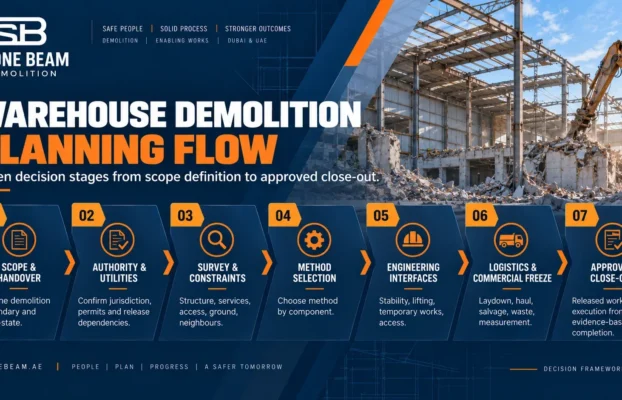
Technical depth also has limits at the prequalification stage. The buyer needs enough method logic to identify competence and hidden assumptions. Final demolition sequence, temporary works, structural decisions, and release conditions remain part of the engineering and approval process for the individual project described in the advanced demolition planning guide.
For deeper controls, use the dedicated demolition OHS management guide. For the full survey-to-execution workflow, use the advanced demolition planning guide.
What must be clear before shortlist, award, or mobilisation?
Use three different hold points. Do not let a qualification decision silently become an award decision, and do not let an award silently become permission to start demolition.
- Prequalification hold: legal eligibility, relevant capability, key personnel, HSE structure, resource basis, and major evidence gaps are resolved enough for tender comparison.
- Tender clarification holds: scope, exclusions, assumptions, programme obligations, interfaces, and commercial qualifications are aligned enough to identify the best compliant offer.
- Mobilisation release: the applicable permits, NOCs, accepted technical submissions, isolations, access conditions, and required releases are in place for the defined workface.
These hold points protect different decisions. They also create an audit trail when a later variation arises from an exclusion that was visible before award.
What information is needed before the final engineering, commercial, or approval decision?
A contractor cannot price or plan a demolition package reliably from a title and floor area alone. The final decision needs enough project information to remove avoidable ambiguity.
- Project location, governing authority, community or asset-owner interface.
- Demolition boundary, retained elements, temporary retention requirements, and handover condition.
- Available drawings, structural information, surveys, photographs, and known hazardous or live interfaces.
- Utility status, isolation responsibility, access constraints, working windows, traffic or neighbour restrictions.
- Waste and disposal requirements, monitoring expectations, reporting obligations, and client-supplied resources.
- Tender form, programme requirements, insurance/bond conditions, provisional items, and pricing basis.
The buyer does not need every final method detail before prequalification. The buyer does need enough information to tell whether two bidders are solving the same problem.
What red flags require clarification before an award?
A red flag is not automatic rejection. It is a reason to stop scoring and request evidence or clarification before the bid moves forward.
- The licence or activity record does not clearly match the demolition scope being procured.
- Project references list names and values but do not show the bidder’s role, exact scope, or outcome status.
- The proposed method ignores retained structures, live services, neighbouring assets, access, or waste logistics that appear in the tender documents.
- Major cost interfaces are excluded without a named responsible party.
- Plant ownership is promoted as proof of capacity while availability, operators, access, or suitability remain undefined.
- HSE statistics, certificates, approvals, or “approved contractor” claims are presented without a verifiable source and scope.
- The programme starts before known permit, isolation, access, or technical-release dependencies have been allocated.
How is the final prequalification decision recorded?
Record the decision in plain procurement language: qualified, qualified after named clarifications, or not comparable on the current submission. Avoid decorative scores that hide unresolved evidence.
The record states the evidence reviewed, material clarifications, scope assumptions, responsibility changes, and any issue that must transfer into the tender or contract. That makes the decision defensible when the commercial team, consultant, HSE team, and project team review the same bidder later.
Project review: Send the location or jurisdiction, demolition boundary, drawings, site photographs, utility status, access constraints, adjacent structures, and required handover condition when requesting a demolition quotation or scope review. Use Stone Beam’s demolition contractor in Dubai service page as the commercial next step. The final method, programme, permit route, and commercial proposal are confirmed after the survey and against authority requirements and site conditions.