

A construction demolition plan is the engineering and control framework for removing a structure or defined parts of it. It sets the demolition boundary, chosen method, sequence, pre-start conditions, protection measures, utility controls, waste route and review points. The method statement converts that framework into clear site steps, responsibilities and hold points.
In Dubai, the required submission and approval route changes with jurisdiction, asset owner and scope. DDA, DEWA and Trakhees each publish different demolition-related services or document requirements. A single copied template is therefore not a substitute for checking the actual project route.
The practical rule is simple: define the structure, retained assets, utilities, access and governing authority before writing the sequence.
What is a construction demolition plan?
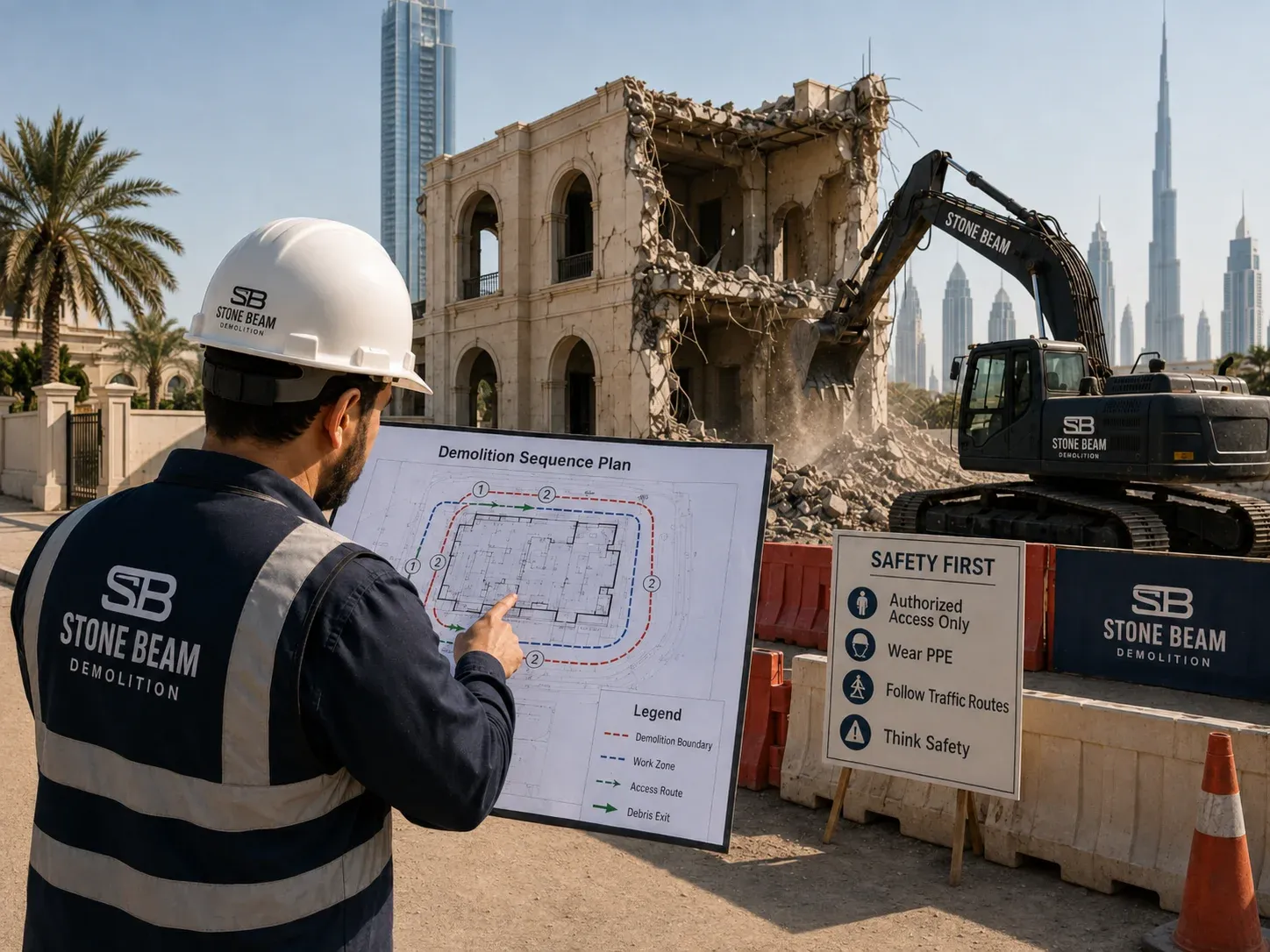
A construction demolition plan explains the logic behind the work before the site sequence is issued. It identifies what is being removed, what must remain stable, which services or neighbours create constraints, how materials leave the site, and which decisions require release before intrusive work begins.
The word “plan” also confuses. On some projects it means a marked drawing showing the demolition boundary. In broader engineering use, it means the controlled planning framework. The method statement then records how that framework will be executed and checked.
For the wider end-to-end workflow, use the advanced demolition planning guide. This article stays narrower: it explains the demolition plan as a document and decision system.
Demolition plan vs method statement: what is the difference?
The demolition plan sets the project logic. The method statement turns that logic into an executable sequence. A risk assessment supports the method statement by identifying hazards and controls, but it does not replace the plan or the method statement.
| Aspect | Demolition plan | Method statement | Risk assessment |
| Primary purpose | Defines the strategic removal approach and constraints. | Defines the site sequence, responsibilities and controls. | Identifies hazards, consequences and control measures. |
| Main question | What are we removing, what must remain, and what conditions govern the job? | How will each released activity be carried out and checked? | What can harm people, assets or the environment, and how is exposure controlled? |
| Timing | Developed during engineering and readiness planning. | Issued and revised before the affected site activity. | Prepared alongside the method and updated when hazards or controls change. |
| Level of detail | Boundary, method logic, interfaces, sequencing philosophy and decision gates. | Task steps, responsibilities, resources, hold points and inspection controls. | Hazards, risk controls and residual-risk treatment. |
| Revision trigger | Material change to scope, structure, access, utilities, neighbour condition or authority route. | Change to sequence, plant position, workface, temporary works, isolation or accepted controls. | New hazard, changed exposure or ineffective control. |
What information is needed before the demolition method is chosen?
Method selection starts with evidence, not equipment preference. The input set changes with the project, but the following information drives most demolition planning decisions:
- The exact demolition boundary, including retained floors, walls, façades, basements, foundations and external works.
- Available structural drawings, surveys and visible condition, including signs of alteration, damage or uncertain load paths.
- Utility records and physical isolation status for electricity, water, telecoms and other services that cross or serve the work area.
- Adjacent properties, occupied spaces, public interfaces and live assets that require protection or continued access.
- Site access, plant positioning, lifting routes, floor-loading constraints, truck gates and debris movement routes.
- Authority, master-developer, consultant and owner requirements that control submissions, work windows or releases.
- Hazardous-material information and any specialist surveys needed before intrusive work.
- Waste streams, segregation requirements, receiving route, loading constraints and the required handover condition.
Where hidden reinforcement, post-tensioning or services affect cutting or partial removal, concrete scanning in Dubai is one investigation option. Scanning informs the engineering decision; it does not authorise a cut.
How do engineers choose a demolition method?
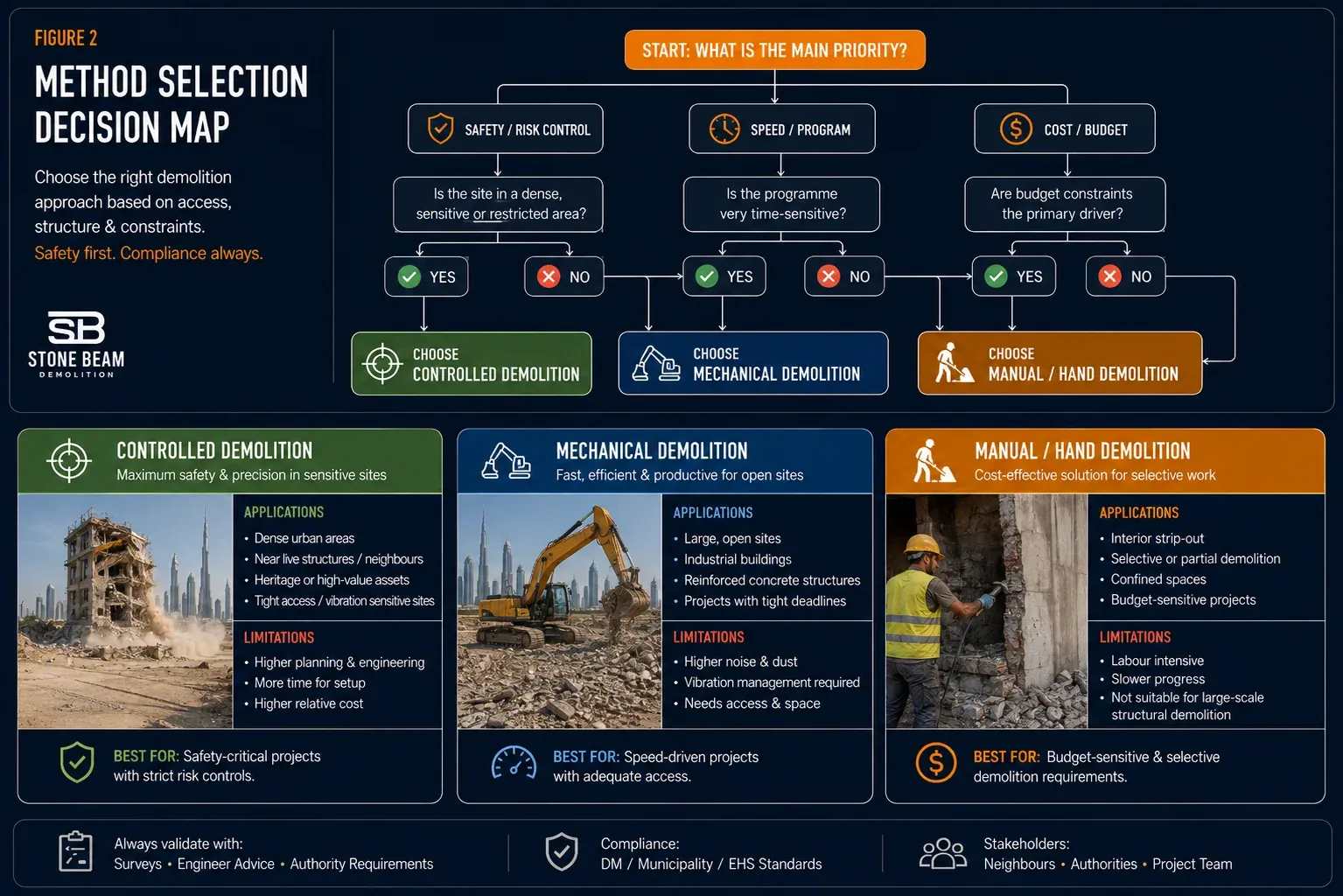
The correct method is the one that fits the structure, retained load path, access, environment and disposal route with a controllable sequence. The comparison below is a selection framework, not a universal prescription.
| Method family | Useful applications | Key limitations/questions |
| Manual/light tools | Selective non-structural removal, finishes, small interfaces and restricted access. | Labour exposure, productivity, dust/noise, debris handling and the risk of treating structural work as “simple breaking”. |
| Mechanical demolition | Larger-volume removal where access, reach, ground/floor capacity and exclusion space are adequate. | Plant position, debris loading, reach, neighbour protection, utility status and controlled collapse risk. |
| Sawing/coring / controlled cutting | Precise separation lines, openings, retained edges and staged removal. | Structural review, reinforcement/PT/service investigation, slurry or dust control and safe removal of cut pieces. |
| Remote/robotic demolition | Confined or sensitive areas where remote operation improves separation between operator and workface. | Access, power, floor loading, attachment suitability and OEM-specific limits. |
| Dismantling / deconstruction | Steel or component removal where connections, lifting and reuse/recovery influence the sequence. | Connection stability, lifting design, temporary restraint and laydown space. |
A separate demolition methods in Dubai guide owns the broader method-comparison intent. If the question has moved from education to a live scope, the demolition company in Dubai page is the commercial route for a project-specific review.
How does the plan move from readiness to execution?
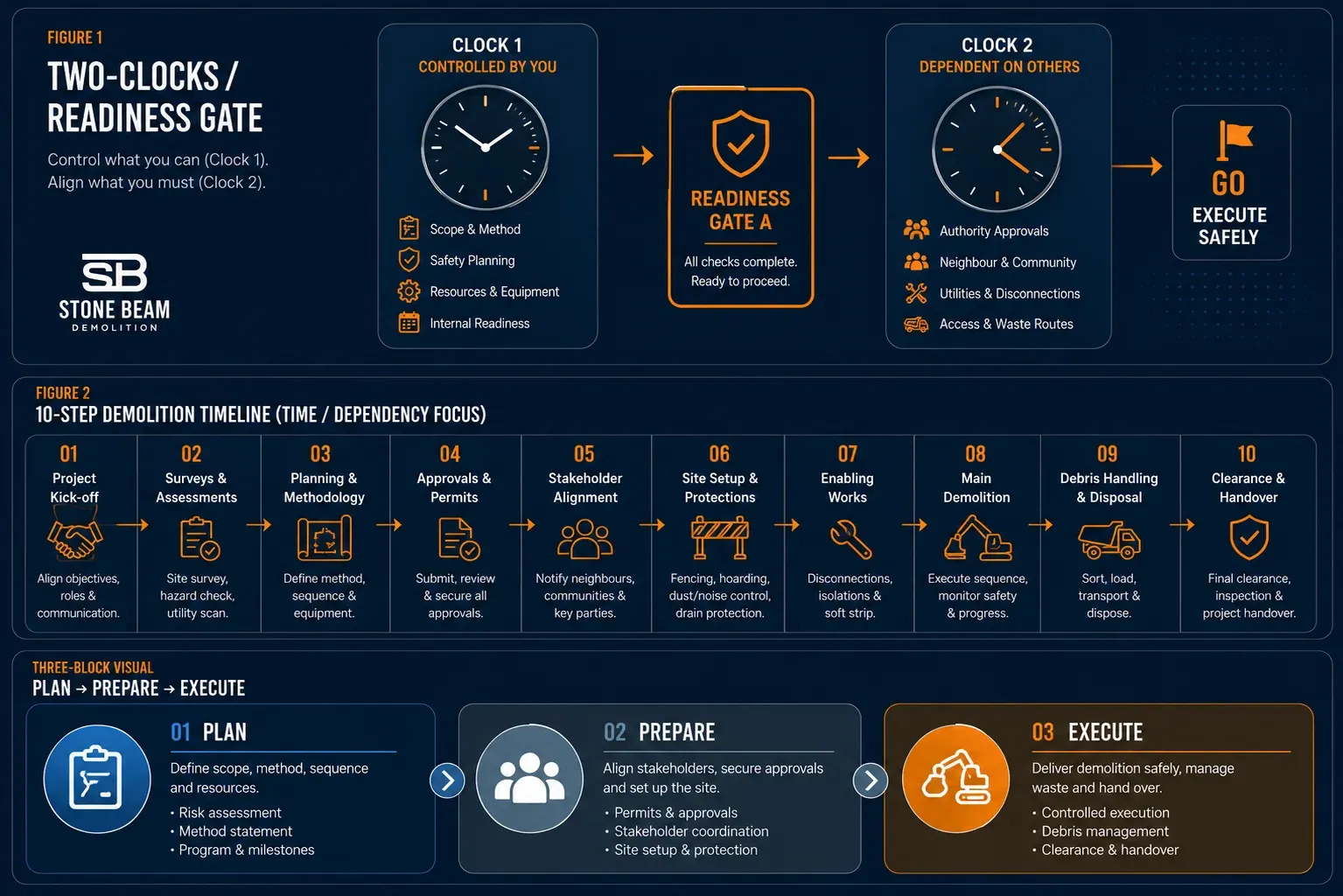
Stone Beam uses a Two-Clocks model to keep readiness separate from physical execution. It is an editorial planning framework, not the name of an authority process.
| CLOCK 1 — READINESS Scope • surveys • jurisdiction • NOCs • utility status • engineering • HSE • access • logistics |
READINESS GATE A Applicable releases and controls closed for the defined workface |
CLOCK 2 — EXECUTION & HANDOVER Protection • released demolition • debris handling • inspection • close-out |
Some preparation streams run in parallel. A release-dependent activity does not start merely because another task is ready. A permit is one readiness input; it is not, by itself, proof that every isolation, structural decision, access condition or project-owner release is closed.
What should a demolition method statement include?
A useful method statement is structured around the decisions that supervisors and reviewers need to control. The section names differ between projects, but the document must make the following topics explicit:
- Document control, revision status, scope and demolition boundary.
- Applicable drawings, surveys, authority conditions, technical references and project specifications.
- Roles, responsibilities, communication routes and competent-review responsibilities.
- Resources, access, logistics, workface constraints and material-removal routes.
- Pre-start conditions, isolations, permits, NOCs and hold points that govern the affected activity.
- Protection of retained structures, neighbours, public interfaces, finishes and live assets.
- The planned demolition sequence, including how each stage preserves stability and access.
- Method-specific work steps, equipment selection logic and controls for cutting, breaking, lifting or dismantling.
- HSE, emergency arrangements and the supporting risk assessment.
- Dust, noise, vibration, water/slurry and environmental controls required by the project.
- Waste segregation, internal movement, loading, transport and receiving/disposal route.
- Quality checks, inspections, records, change control, close-out and handover requirements.
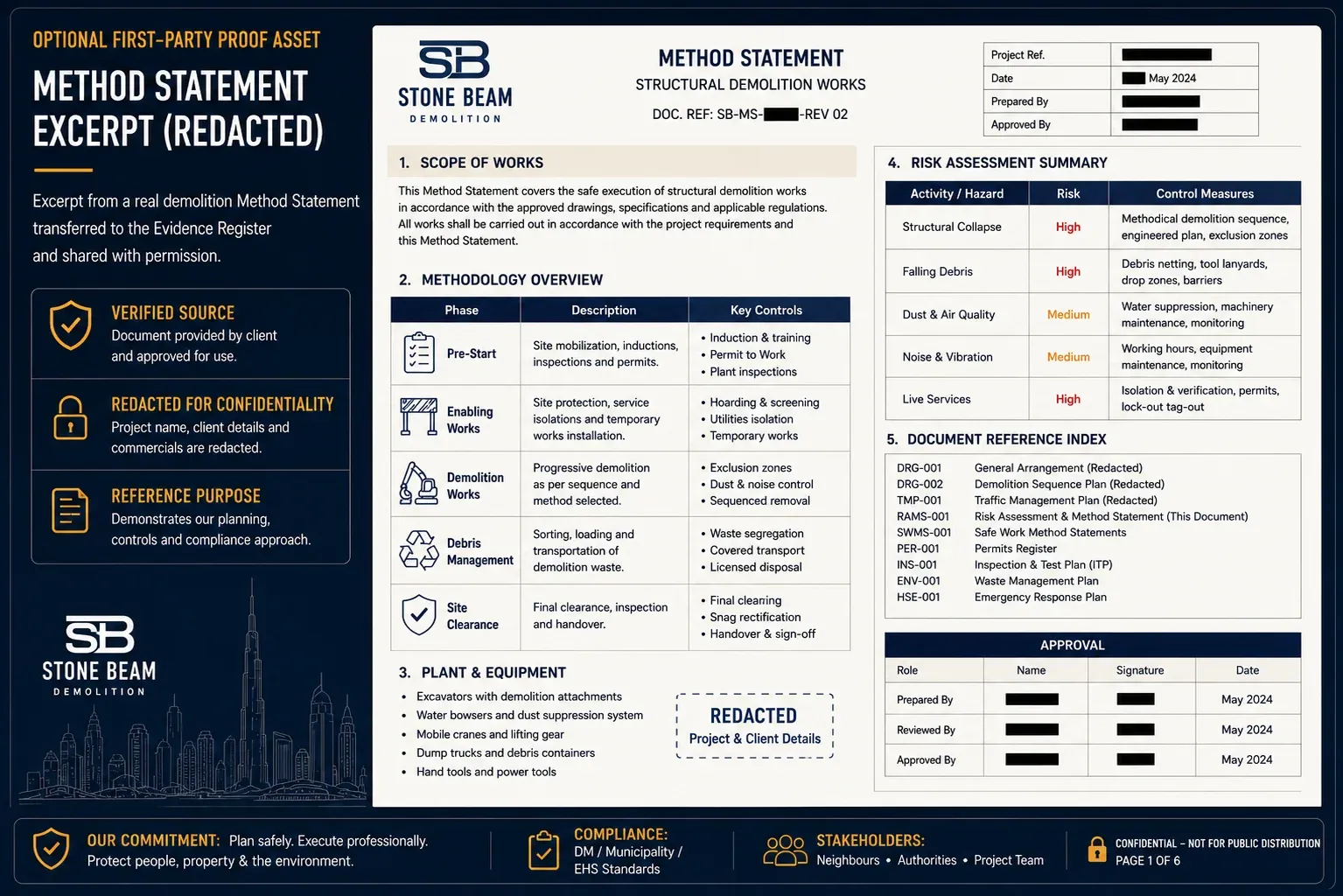
This architecture aligns with the section families found in a real Stone Beam internal method statement reviewed for this article. The project file itself is not republished here. Its identifiers, equipment details and compliance statements require separate evidence and permission checks before public use.
How do Dubai approvals and NOCs shape the document?
There is no single demolition submission checklist for every Dubai plot. For DDA-governed projects, the current DDA Demolition Permit service lists a method statement, specific HSE and emergency plan with risk assessments, relevant NOCs, fence or hoarding layout, a neighbouring-building impact study and a site photograph among its submission documents.
Utility control also has its own route. DEWA Demolishing Permits — Electricity / Water and DEWA’s demolition deactivation service show why documentary status and physical service condition must be checked rather than assumed.
Other Dubai jurisdictions use different systems. Trakhees/PCFC publishes a separate Demolition and Removal NOC service. The plan must therefore name the governing route instead of writing “Dubai requires” when the rule belongs to one authority.
Authority documents define submission requirements. They do not replace structural engineering, temporary-works design, utility isolation or the project owner’s permit-to-work system.
What controls belong in the demolition sequence?
A sequence is more than an order of breaking. It must explain how stability, access, protection, debris movement and inspection are preserved as the structure changes.
- Confirm the released demolition boundary and protect the retained side before intrusive work starts.
- Close the required service isolations, access controls and project-specific releases for the affected workface.
- Establish hoarding, exclusion controls, debris routes and protection for people and adjacent assets.
- Carry out the approved removal sequence in stages that keep the remaining structure and temporary works within the engineered condition.
- Remove debris without creating uncontrolled stockpiles, blocked escape routes or loading outside the planned handling strategy.
- Inspect defined hold points before the next stage changes the load path, separation line or access arrangement.
- Record changes and stop relying on the old sequence when a material assumption is no longer true.
For technical planning, BS 6187:2011 remains the current BSI code of practice for full and partial demolition. It is a technical reference; it is not a Dubai permit rule.
How do access, neighbours and live assets change the plan?
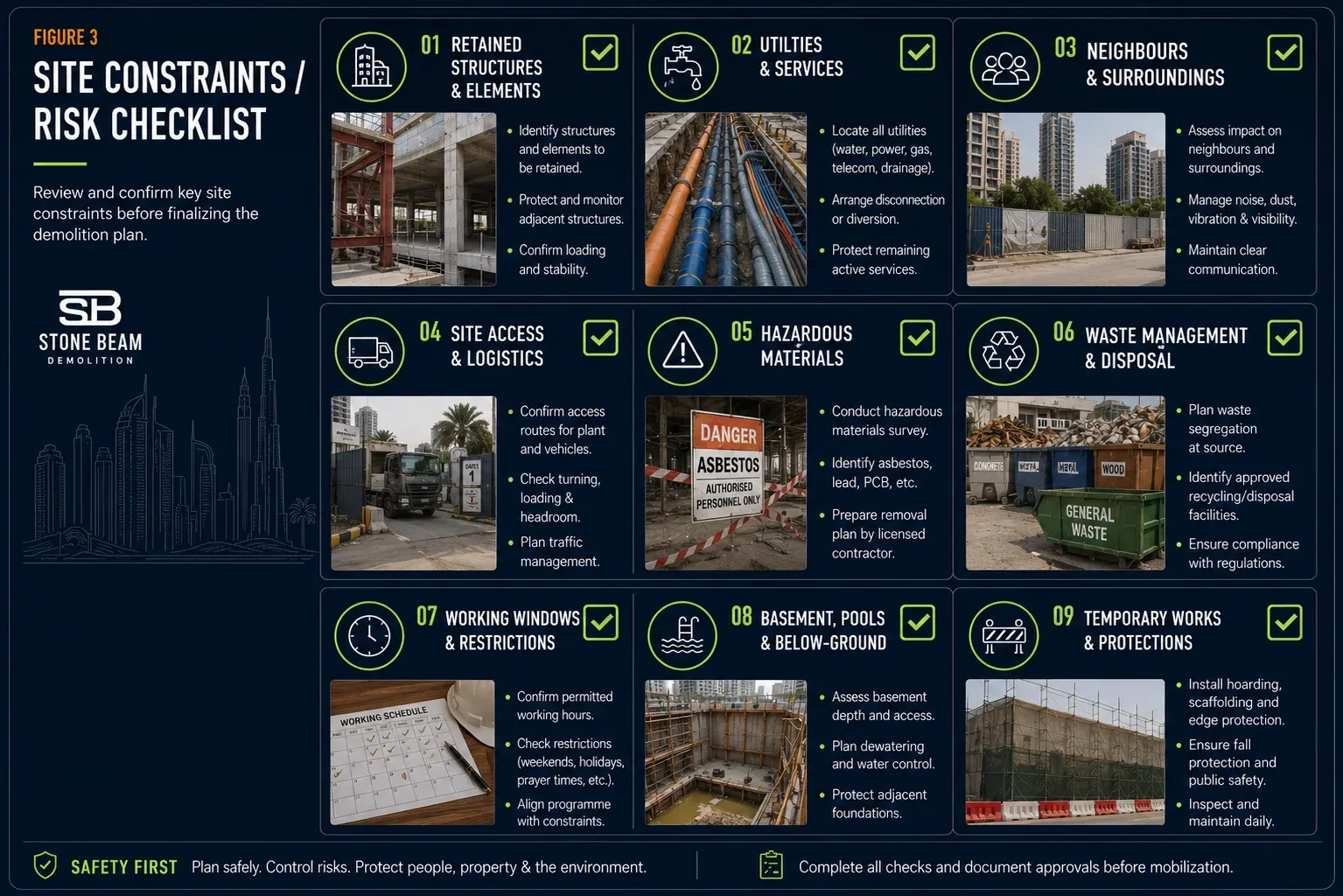
Access and third-party exposure can change the demolition method before structural strength becomes the deciding factor. A large machine has little value if it cannot reach the workface, stand on a verified support condition or remove debris through the available route.
| Constraint | Planning question | Effect on document |
| Tight access or low headroom | Workface reach, plant size, internal movement, debris route and lifting/removal options. | Method may shift toward staged cutting, smaller plant, remote equipment or more manual handling after engineering review. |
| Occupied neighbour or live facility | Falling debris, dust, noise, vibration, emergency access and separation from operations. | Protection, monitoring, work windows and smaller release zones gain more weight in the plan. |
| Retained structural element | Load path, separation line and stability during each stage. | Sequence and temporary works become design decisions, not generic site preferences. |
| Shared or uncertain services | Service ownership, route, isolation and retained supply. | Hold points stay in the method until the service condition is confirmed. |
| Restricted truck/gate windows | Loading location, waste staging and receiving route. | Demolition output must be matched to safe debris movement instead of producing material faster than it can leave. |
Villa projects add boundary, community and neighbour constraints. The villa demolition in Dubai page is the commercial owner for villa-specific scope; this article retains document-level intent.
How are temporary works and structural stability handled?
Temporary works are project design outputs, not article recipes. The method statement must identify where stability depends on propping, shoring, bracing, falsework, restraint or staged load transfer, then reference the approved temporary-works process and drawings.
Current BSI temporary-works references are BS 5975-1:2024 for management procedures and BS 5975-2:2024 for falsework design and implementation. This article does not publish prop capacities, spacing, tie patterns or a “typical arrangement.” Those values belong to the project design and check.
The same boundary applies to post-tensioned slabs, transfer structures and load-bearing openings. Investigation and scanning support the decision, but the structural reviewer defines the permitted removal sequence.
How are waste, inspection and handover planned?
Waste planning begins before demolition starts because the debris route affects workface productivity, access and housekeeping. The method statement must define segregation, internal movement, loading, transport responsibility and the receiving/disposal route without inventing a recycling percentage.
Dubai Municipality’s Waste Department technical guidelines include current guidance for construction and demolition waste. The site-specific route still depends on the project authority, waste classification and approved receiving arrangements.
For broader waste strategy and destination ownership, use the construction and demolition waste in Dubai page rather than duplicating that cluster here.
Close-out also belongs in the plan. The project may require staged inspections, photographs, records, completion documentation or an authority completion route. DDA, for example, publishes a separate demolition-completion service for projects in its jurisdiction.
What changes the programme, cost or selected method?
A demolition plan is a controlled document. The programme, cost and method change when a governing assumption changes. The table below shows the main triggers and the information needed before a final opinion is issued.
| Trigger | Why it matters | Information needed before final decision |
| Unknown structural alteration or damage | Original load path or removal sequence may no longer match reality. | Updated survey, drawings/records, structural review and revised sequence. |
| Live or unverified service | Workface cannot be treated as isolated. | Utility records, physical verification, isolation/release evidence and revised hold point. |
| Access or plant-position change | Selected equipment or debris route may no longer fit. | Measured access, support condition, lifting/haul route and alternative method review. |
| New neighbour/live-asset constraint | Protection or work-window assumptions change. | Asset-owner conditions, monitoring/protection plan and revised release zone. |
| Temporary-works change | Load transfer or stability condition changes. | Temporary-works redesign/check and updated sequence. |
| Hazardous material discovery | Intrusive demolition may require specialist assessment and separate controls. | Competent survey/assessment, classification and approved handling route. |
| Authority or consultant comment | Submission basis or sequence requires revision. | Closed comment, revised controlled document and acceptance/release record. |
| Waste receiving or truck constraint | Debris cannot leave at the planned rate or route. | Updated logistics, staging limits and receiving/disposal confirmation. |
Outdoor work in the UAE also has seasonal labour controls. The MOHRE Midday Break applies to work under direct sun during the published summer period. It is one example of a programme constraint, not a Stone Beam duration promise.
Illustrative decision example
Assume an owner wants to remove one wing of an existing Dubai building while an adjacent wing remains in use. The drawings are incomplete, a service route crosses the demolition boundary, truck access is restricted, and part of the retained structure shares the same structural grid.
- The team freezes the demolition boundary and obtains the available structural, utility and site records.
- A competent structural review identifies the retained load path and the points where separation or temporary works need engineered treatment.
- The utility route becomes a hold point. The method statement does not assume that a drawing proves physical isolation.
- Method options are compared against access, retained-structure stability, debris removal and occupied-neighbour constraints.
- The plan separates readiness from execution. Authority, utility, access and engineering releases are closed for the defined workface before structural removal starts.
- The method statement records the released sequence, protection measures, debris route, inspections and change-control triggers.
- If an unexpected structural alteration is uncovered, the affected stage stops and the controlled document is revised before work continues.
The lesson is not which machine wins. The lesson is that the selected method must survive the combined test of structure, access, services, neighbours, waste logistics and approval conditions.
Key takeaways
- A demolition plan is the decision framework; the method statement is the controlled site-execution document.
- The demolition boundary, retained load path, utilities, access, neighbours and waste route must be understood before the sequence is trusted.
- Dubai requirements are jurisdiction-specific. DDA, DEWA and Trakhees each illustrate different authority or utility interfaces.
- Temporary works and structural stability are engineering decisions. Generic prop spacing or “safe” arrangements do not belong in a public guide.
- A method statement must change when a material assumption, workface, isolation, sequence or project control changes.
- The strongest document is not the longest one. It is the one that makes responsibilities, releases, sequence and hold points clear to the people using it.
Frequently asked questions
Is a demolition method statement required in Dubai?
It depends on the governing route. DDA currently lists a method statement and supporting HSE/risk documents for its demolition-permit service. Other Dubai jurisdictions or asset owners use their own submission and permit systems.
Who prepares and reviews a demolition method statement?
The contractor develops the execution document with project engineering and HSE inputs. Structural, temporary-works, utility or specialist passages require review by people competent for those subjects, together with any consultant or authority review required by the project.
Is a demolition plan the same as a risk assessment?
No. The plan sets the engineering and project-control framework. The method statement defines how the released work will be executed. The risk assessment identifies hazards and controls that support that method.
Does a demolition permit mean work can start immediately?
Not by itself. The defined workface still depends on the applicable utility condition, structural decisions, access controls, owner or consultant releases, HSE controls and other project requirements.
When should a method statement be revised?
Revise the affected section when scope, sequence, structure, utility status, plant position, access, temporary works, neighbour condition, authority comment or another material control changes.
Can one demolition method statement template be reused on every project?
A template can organise headings and revision control. It cannot replace the project-specific surveys, authority route, structural decisions, isolations, access constraints, protection measures and sequence.
Planning a demolition project in Dubai?
For a project-specific review, prepare the location and governing jurisdiction, demolition boundary, available drawings, recent site photos, retained-structure information, utility status, access constraints, neighbour or live-asset interfaces, waste responsibility and required handover condition.
Stone Beam can review that information through its demolition company in Dubai service page. The final method, programme, permit route and commercial proposal follow the actual surveys, authority requirements, engineering review and agreed scope.