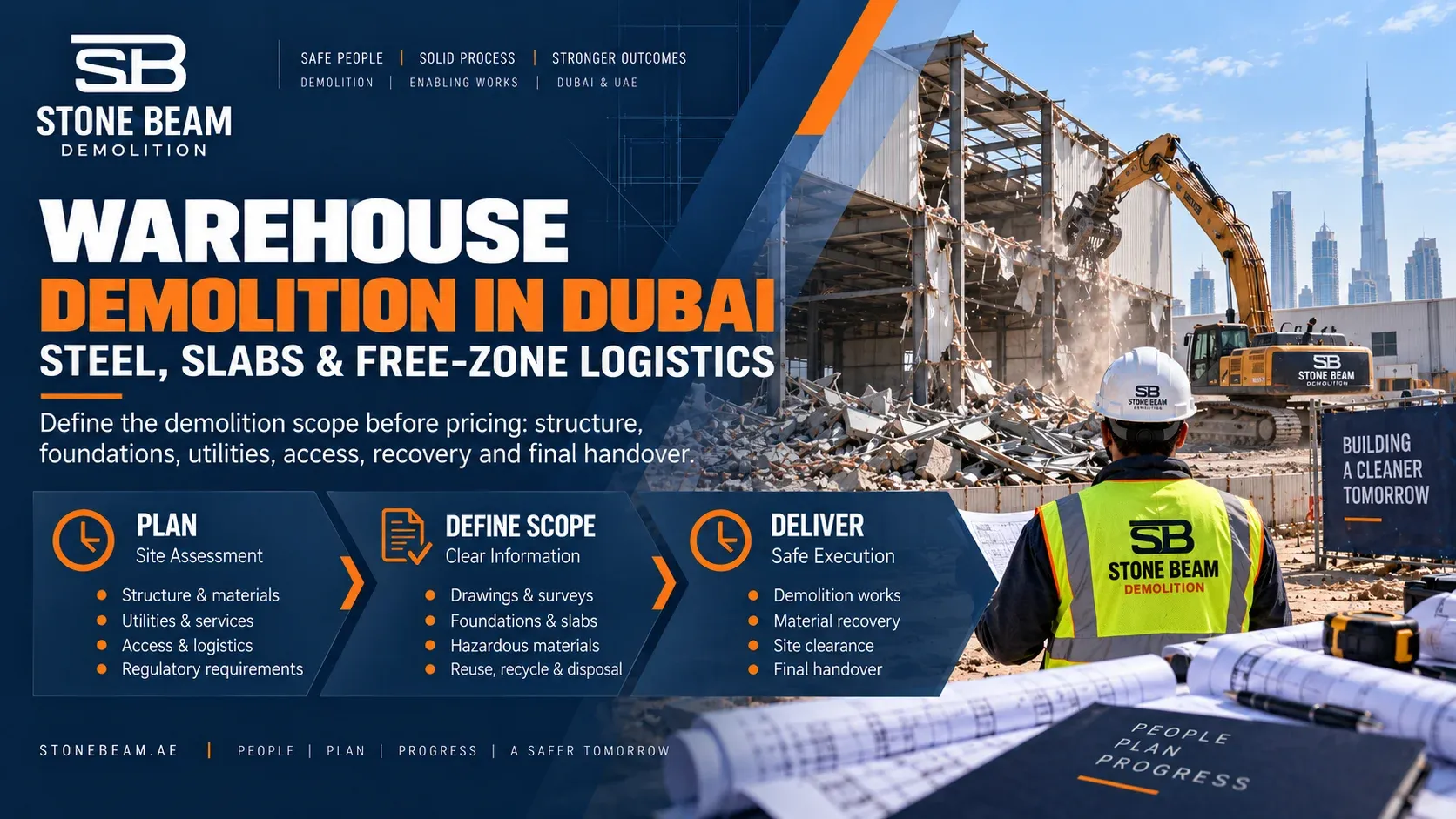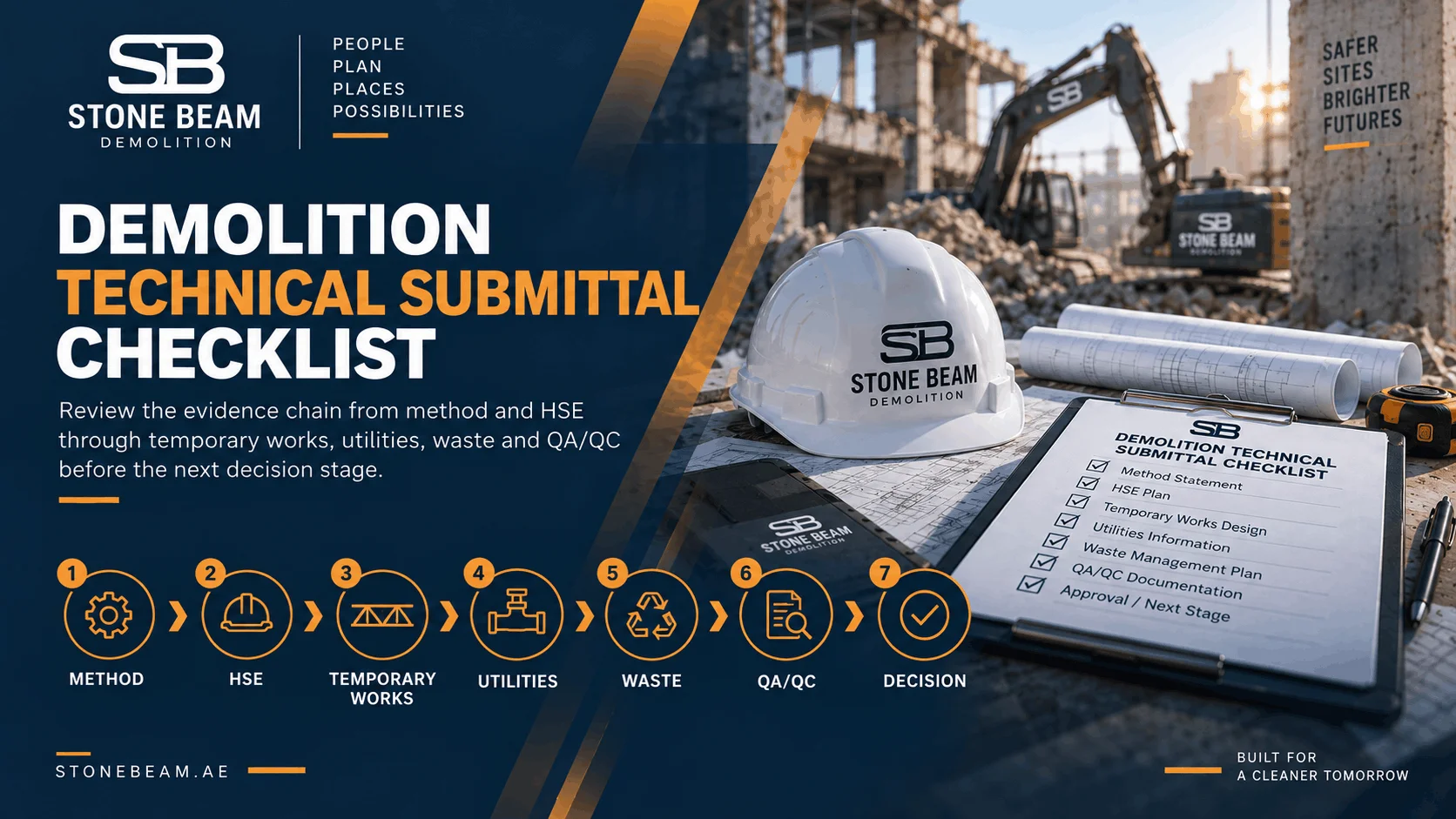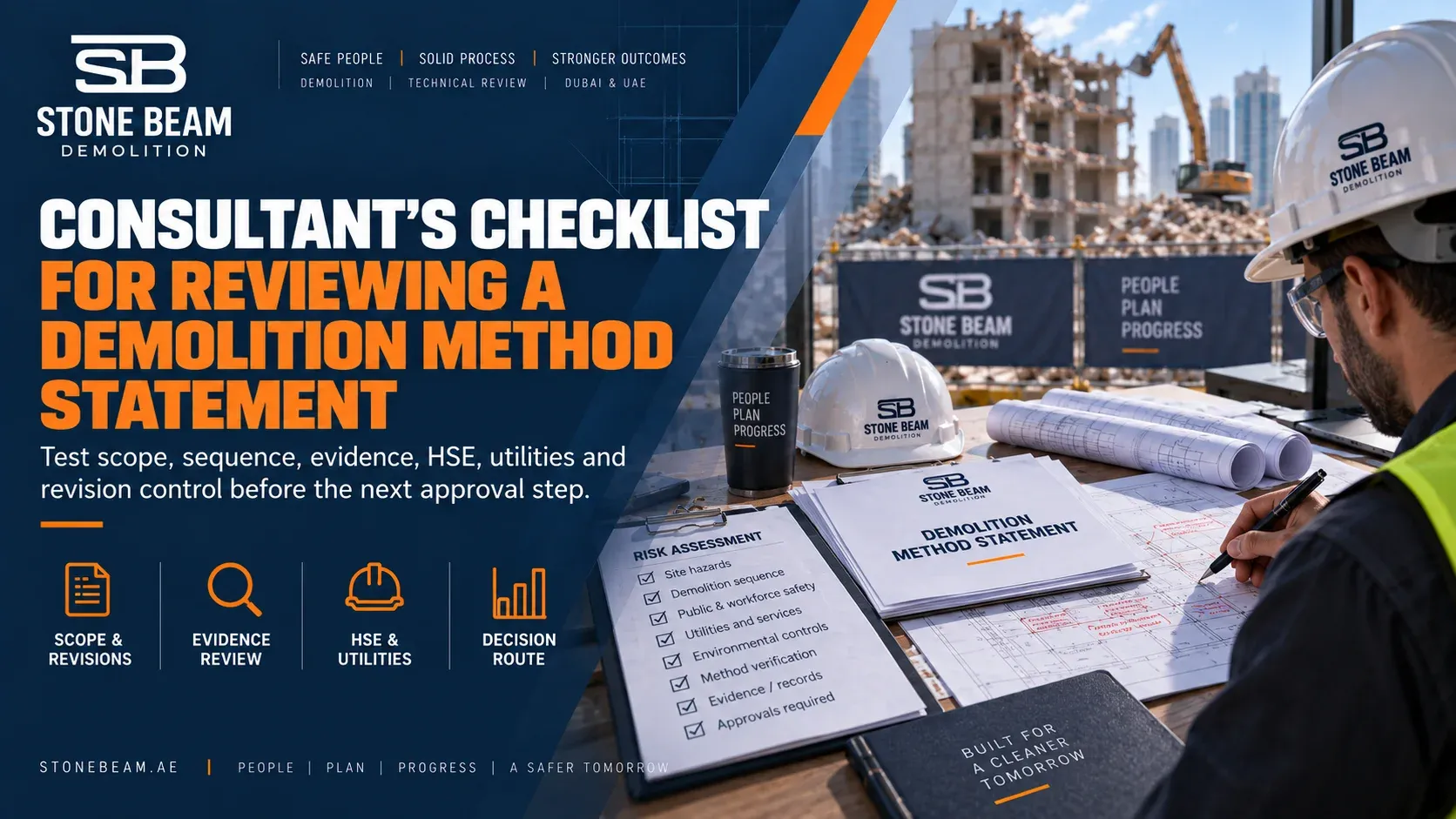



Stone Beam provides factory and industrial demolition in Dubai for defined structural, asset and site-clearance scopes. A project scope covers only the items expressly stated in the brief: steel or reinforced-concrete structures, machinery interfaces, slabs, foundations, pits, waste handling and final handover.
Dubai industrial sites do not follow one approval route. Location and jurisdiction determine the applicable authority, free-zone, master-developer and utility interfaces. Dubai Development Authority (DDA), PCFC / Trakhees and other authorities operate distinct routes, while DEWA has separate demolition-permit and service-deactivation interfaces. A corporate practice qualification does not replace a project-level permit, NOC or release.
Practical rule: separate decommissioning, asset or steel dismantling, structural demolition, below-ground removal, waste responsibility and final handover before comparing quotations. Two prices based on different boundaries are not prices for the same job.
Need a quotation? Send the site location, available drawings, structural system, machinery or asset list, known utility or process status, retained areas, access constraints and required handover condition. Stone Beam uses these inputs to define the quotation boundary and identify missing project inputs before price is compared.
Prepared by Stone Beam Technical Services L.L.C.
Last reviewed: 17 September 2026
| Verified corporate demolition qualification The reviewed Dubai Engineering Qualification practice-permit certificate for Stone Beam Technical Services L.L.C. records an active permit for Wrecking & Demolition Works — G+12, with expiry shown as 13 November 2026. This is corporate practice qualification; each project still requires its own applicable permits, NOCs, releases and scope controls. |
What factory and industrial demolition includes
Factory demolition is the controlled removal of an industrial facility or a defined part of it after the project boundary, asset status and applicable releases are established. The scope is not automatically “everything inside the fence”. It is a contract boundary that must identify what is removed, what remains, what is handled by others and what end-state the owner expects.
| Asset / element | Scope question | Possible boundary | Why it matters |
|---|---|---|---|
| Factory building / superstructure | Full or partial removal? Any retained bays, offices, façades or fire-separated areas? | Include defined structural zone; retain defined areas; separate specialist scope where needed. | Changes method, access, temporary-state questions, quantity and handover. |
| Steel frame | Dismantle for recovery, cut for removal, or demolish as part of the overall structure? | Whole-facility scope or a separate steel-dismantling package. | Affects recovery expectations, lifting interfaces, programme and scrap ownership. |
| RC frame / walls | Full removal or selected structural elements only? | Defined RC demolition zone; retained elements protected under project-level engineering. | Determines structural review and method-selection needs. |
| Machinery / production line | Retain, relocate, specialist dismantle, scrap or exclude? | Owner/specialist package or demolition-contractor interface. | Changes access, workfront release, logistics, price and handover. |
| MEP / process systems | Who decommissions or releases them, and what physical removal is included? | Release by responsible party; removal boundary separately stated. | Prevents demolition scope from silently absorbing process-safety responsibilities. |
| Slabs / machine bases | Retain, remove or partly remove? | Defined thickness/extent where records or surveys support pricing. | Materially changes demolition quantity, equipment selection and final level. |
| Foundations / pits / underground | Included, retained, filled or separately treated? | Exact below-ground boundary and final condition. | Often determines the difference between structural demolition and full site-clearance scope. |
| Waste / scrap / salvage | Who owns recoverable material and who arranges disposal? | Explicit ownership, credit, transport and record boundary. | Direct commercial effect and close-out obligation. |
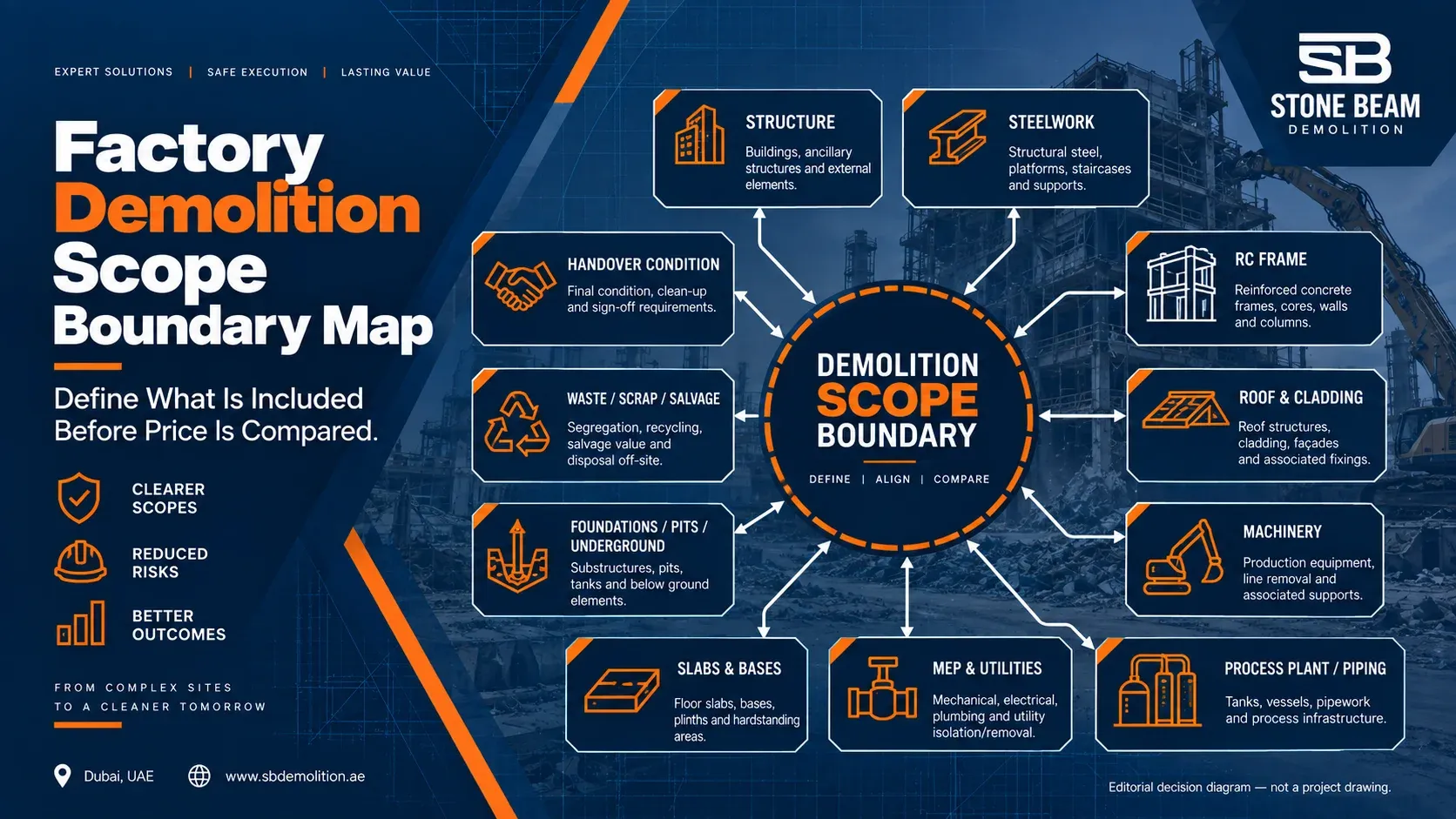
Factory Demolition Scope Boundary Matrix
Use this matrix before tendering or quotation comparison. “Included” is never assumed simply because an item exists on site; the owner, consultant or responsible project role must define the boundary that applies.
| Item | Included / excluded decision | Who must confirm | Commercial effect | Handover effect |
|---|---|---|---|---|
| Factory superstructure | Full / partial / retained zones | Owner / consultant | Primary quantity and method basis | Agreed structure removed or retained |
| Steelwork | Dismantle / demolish / retain | Owner + engineering team | Recovery, access and specialist interfaces | Specified steel removed or retained |
| RC frame | Remove / retain / partial | Consultant / structural role | Method and review requirements | Defined RC scope closed |
| Roof / cladding | Include / separate package / retain | Owner / consultant | Access and sequencing interface | Weatherproofing or removal end-state defined |
| MEP | Remove after release / separate package | Owner + responsible MEP/utility role | Release and specialist scope | Agreed services removed or retained |
| Process plant / piping | Owner/specialist decommissioning then demolition interface | Process owner / competent specialist | Potentially outside the demolition contractor scope | Release and removal boundary evidenced |
| Machinery | Retain / relocate / dismantle / scrap / exclude | Asset owner | Access, logistics, price and workfront | Disposition completed to agreed state |
| Production line | Same decision as machinery, by line/area | Asset owner | Changes floor access and programme when included | Defined line status at handover |
| Tanks / vessels | Separate specialist/decommissioning decision unless expressly included | Owner / competent process role | Hazard and specialist interface | Only agreed released scope removed |
| Machine bases | Retain / remove / trim | Owner / consultant | Heavy concrete quantity and level | Final level defined |
| Slabs | Retain / full remove / local remove | Owner / consultant | Quantity, haulage and final surface | Final slab condition defined |
| Foundations | Retain / remove to defined extent | Owner / consultant | Below-ground quantity and excavation | Final depth/condition defined |
| Pits / trenches | Retain / remove / fill if in scope | Owner / consultant | Below-ground and backfill scope | End-state defined |
| Underground structures | Locate / exclude / remove if defined | Owner / consultant + utility stakeholders | Uncertainty and interface risk | Known scope closed or excluded |
| Utilities | Deactivate/divert/release by responsible party; removal separately defined | Utility / owner / authority as applicable | Readiness and scope dependency | Release record plus physical end-state |
| Scrap | Contractor / owner / credited / excluded | Commercial owner | Direct commercial effect | Ownership transfer recorded |
| Waste | Contractor haulage / client haulage / separate package | Owner / contractor | Logistics and disposal cost | Agreed records and clean site |
| Backfill | Included / excluded / specification by project | Owner / consultant | Material, testing and programme | Agreed level/condition |
| Final grading | Included / excluded / separate civil scope | Owner / consultant | Plant and end-state cost | Final profile agreed |
| Handover documents | Define required records before award | Owner / consultant | Close-out workload | Evidence package delivered |
Factory demolition vs facility decommissioning
Factory demolition and facility decommissioning are connected but different jobs. Decommissioning addresses how an operational asset reaches an agreed released state; demolition addresses the physical removal of structures or assets within the released scope. Some projects require both, but the responsibilities must remain separate.
| Decision point | Factory / industrial demolition | Facility decommissioning |
|---|---|---|
| Purpose | Physically remove defined structures/assets and achieve the demolition handover boundary. | Retire, isolate, make safe or transfer operational/process systems to an agreed release condition. |
| Operational / process systems | Demolition acts only on the defined released scope. | Process, utility and operational status is a central responsibility. |
| Isolation status | Required release is an input to demolition readiness, not a generic demolition procedure. | Defines and evidences the applicable isolation/deactivation/release process. |
| Machinery | Remove only if included; otherwise protect, retain or hand over to specialist packages. | Prepares machinery or process assets for retirement, transfer or removal. |
| Structural work | Primary demolition scope where included. | Secondary unless explicitly combined. |
| Outcome | Agreed physical removal and site end-state. | Agreed retired/released asset or facility state. |
| Release relationship | Receives the released workfront defined by project controls. | Creates or contributes to the release needed before demolition starts. |
| Handover evidence | Removal scope, waste/close-out records and agreed final condition. | Isolation/deactivation/release evidence appropriate to the facility and jurisdiction. |
For deeper shutdown and release-to-demolition boundaries, see Stone Beam’s Facility Decommissioning UAE service owner.
How are machinery and production assets treated?
Machinery is a commercial boundary before it is a demolition activity. Assign each major asset or production line a disposition: retain, relocate, specialist dismantle, transfer, scrap, or exclude from Stone Beam’s scope. That decision affects the workfront, access, logistics, programme, quotation basis and handover.
| Asset decision | Boundary | Commercial consequence |
|---|---|---|
| Retain in place | Protect and define exclusion/interface zone | Restricts access and changes adjacent demolition constraints. |
| Relocate | Owner or specialist removal package before/alongside demolition | Requires route, timing and workfront coordination. |
| Dismantle | Separate dismantling package or expressly included asset scope | Changes labour, tooling, lifting interfaces and recovery expectations. |
| Transfer / sale | Ownership and release date defined by owner | Demolition cannot assume the asset is scrap. |
| Scrap | Ownership, credit and removal responsibility stated in the quotation | Scrap value must not be assumed without a commercial basis. |
| Exclude | Recorded exclusion with physical boundary | Prevents hidden scope and protects quotation comparability. |
Where the job is specifically frame dismantling rather than whole-factory demolition, use the Steel Structure Dismantling UAE owner for connection-level and frame-specific scope.
How does structural and below-ground scope change the project?
A steel-frame factory, a reinforced-concrete production building and a mixed industrial structure do not create the same demolition problem. The decision is not “which machine is biggest”; it is which elements are included, what remains, what the structure is, what access exists, and what final level the owner requires.
- Steel-frame facilities: define whether the frame is demolished, dismantled for recovery, partly retained or separated from cladding and equipment packages.
- Reinforced-concrete facilities: define the structural removal zone, retained elements, slab extent and heavy bases without publishing a generic demolition sequence.
- Mixed steel/RC facilities: freeze the interface between frames, cores, slabs, mezzanines, equipment supports and retained construction.
- Below-ground scope: state whether slabs, machine bases, foundations, pits, trenches and underground structures remain, are removed, or are treated by another package.
- Retained structures: identify what must remain serviceable and route any project-level stability or temporary-works question to the competent project roles.
| Engineering limitation This page is a decision and evidence framework, not a project-level demolition sequence, structural design, temporary-works design, lift plan, isolation procedure, gas-freeing procedure, hot-work procedure or confined-space method. Those decisions remain with the competent project roles and applicable authority/client controls. |
Technical references such as BS 6187:2011 and BS 5975-1:2024 serve as technical references for competent project teams, but they are technical references—not UAE law and not substitutes for project-level design or authority requirements.
What must be confirmed before factory demolition starts in Dubai?
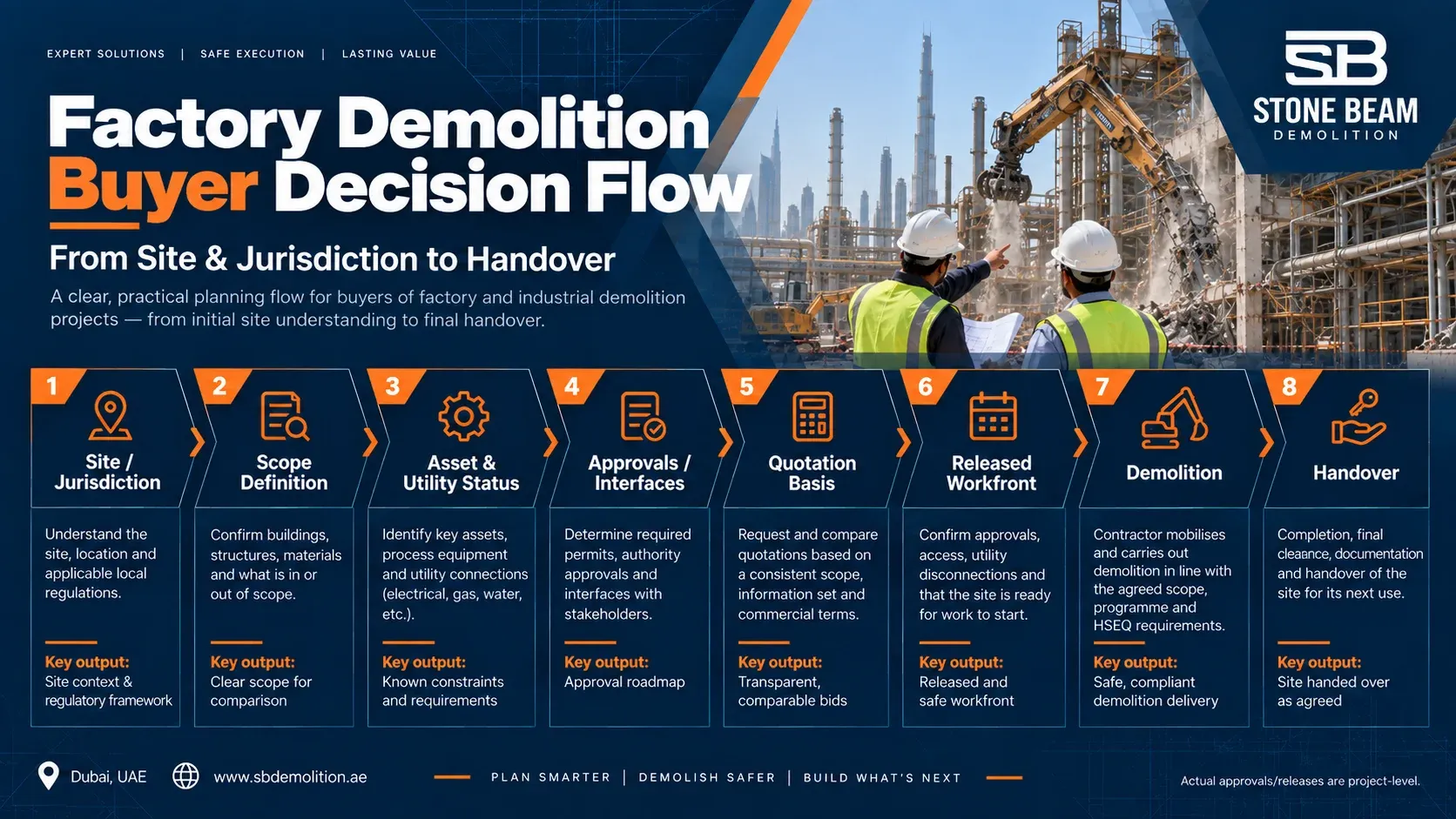
There is no single universal Dubai checklist for every factory. Before intrusive or structural demolition begins, the team must identify the project’s actual jurisdiction, project-permit/NOC route, utility status, master-developer or site conditions, engineering/HSE controls and the owner/consultant release needed for the defined workfront.
| Readiness question | What to confirm | Why it matters |
|---|---|---|
| Corporate qualification | Is the contractor’s corporate demolition activity current and relevant? | Company qualification supports appointment; it does not replace the project permit. |
| Project permit / NOC | Which authority or free-zone route governs the site? | Use the actual jurisdiction; do not generalise DDA or Trakhees requirements across Dubai. |
| Utilities | What services remain live, deactivated, diverted or released? | Documentary status and physical condition are separate project checks. |
| Master developer / site controls | Are access, truck routes, working windows or site releases required? | These alter logistics and mobilisation. |
| Engineering / HSE release | Are retained-structure, temporary-state or specialist risks closed for this workfront? | Competent project roles decide; this page does not prescribe the method. |
| Owner / consultant scope release | Is the demolition boundary frozen enough to proceed? | Avoids demolition starting against an undefined asset or handover boundary. |
For DDA-controlled sites, DDA publishes a Demolition Permit route with its own submission requirements. DEWA’s Demolishing Permits — Electricity/Water service states that projects requiring a Dubai Municipality demolition permit are routed through Dubai BPS, while projects licensed by other authorities use DEWA channels. DEWA also publishes a separate Deactivation of Electricity/Water (Move-out) — Demolish service. PCFC/Trakhees-controlled areas use the Demolition and Removal NOC route. These are jurisdiction and utility interfaces, not one universal Dubai checklist.
| Readiness principle A permit alone does not define the entire released workfront. Applicable utility, engineering, HSE, access and owner/consultant dependencies must also be closed for the scope that is about to proceed. |
What information is needed for a reliable factory demolition quotation?
A reliable quotation begins with the same scope boundary for every bidder. Send the information below before asking contractors to compare price or programme:
- Exact site location and facility name or safe project reference.
- Applicable authority, free-zone, master developer or site-management route if known.
- Available architectural, structural and MEP/process drawings.
- Structural system: steel, reinforced concrete, precast, mixed or other known construction.
- Approximate building size, height and major work zones.
- Retained areas, live neighbours and assets that must remain.
- Machinery and production-line disposition: retain, relocate, dismantle, transfer, scrap or exclude.
- Known utility status and which party is responsible for deactivation, diversion or release.
- Known process-system status and responsible decommissioning party.
- Slab, machine-base and foundation removal requirement.
- Pits, trenches, basements, tanks or underground structures that are in or out of scope.
- Site access, haul routes, gate limits and loading constraints.
- Working-hour or operational restrictions that affect access or production.
- Scrap and salvage ownership.
- Waste haulage, receiving/disposal responsibility and required records.
- Required handover condition: retained slab, cleared plot, backfill, grading or another defined end-state.
- Programme constraints, shutdown windows, handover milestones or dependencies supplied by the client.
If procurement needs a deeper RFQ boundary checklist, use the supporting guide Factory Demolition Scope of Work. For broader demolition-planning logic, see the Advanced Demolition Guide.
What affects factory demolition costs in Dubai?
Factory demolition cost cannot be reduced to one credible AED/m² figure without a comparable dataset and a frozen scope. The price is driven by what is included, the facility’s construction and interfaces, access and logistics, waste responsibility and the end-state the client is buying.
| Cost driver | How it changes the quotation basis |
|---|---|
| Scope boundary | Full vs partial demolition; retained structures; specialist packages; below-ground scope |
| Structural system | Steel, RC, precast or mixed construction; heavy bases and slabs |
| Facility size / height | Quantity and access geometry—not a universal rate table |
| Retained or live interfaces | Operating neighbours, retained assets and workface restrictions |
| Machinery / process assets | Disposition, specialist removal and workfront release |
| Foundations / pits / underground | Removal extent, excavation, backfill and final levels |
| Access / haulage | Gate dimensions, truck routes, loading areas and working windows |
| Waste / scrap | Ownership, haulage, disposal/receiving route and documentation |
| Programme constraints | Shutdown windows, milestone pressure and sequencing dependencies |
| Final handover | Retained slab vs cleared below-ground scope, backfill, grading and records |
Stone Beam does not publish a universal factory-demolition rate or “instant price” on this page because the current first-party evidence does not support a defensible Dubai market average for this scope.
How is the demolition method selected?
The method follows constraints. Depending on the released scope and project conditions, the solution ranges across mechanical demolition, selective removal, controlled demolition, steel dismantling, cutting/separation or remote/robotic equipment. The page does not prescribe a project sequence; the final method comes after the structural system, retained assets, access, utility/process status and handover boundary are understood.
| Method family | Decision-level use |
|---|---|
| Mechanical demolition | Broad structural removal where access, stability controls, logistics and surrounding conditions permit. |
| Selective / controlled removal | Localised or retained-asset conditions where the work needs tighter separation from what remains. |
| Steel dismantling | Frame-specific recovery or controlled removal where a dismantling scope is justified. |
| Cutting / separation | Defined interfaces, openings or separations that support the project-level demolition method. |
| Remote / robotic equipment | Restricted or specialist workfaces where the project team determines it is appropriate. |
How are scrap, salvage and demolition waste defined?
Scrap and waste are commercial responsibilities, not afterthoughts. The quotation needs to state who owns recoverable steel or equipment, whether any credit is included, who loads and transports material, who is responsible for receiving/disposal routes, and what close-out records the client expects. Stone Beam does not claim a universal recycling percentage without project records.
Dubai Municipality publishes Waste Department technical guidelines including construction and demolition waste guidance. The project team must still follow the applicable route and contractual responsibilities for the specific site. For the wider subject, see Construction & Demolition Waste Dubai.
What does “factory demolition complete” actually mean?
“Complete” must be defined before award. One agreed boundary stops after the superstructure is removed; another requires slabs, machine bases, foundations and pits to be removed, the site backfilled, and an agreed records package handed over. Do not silently assume either boundary.
| Handover item | Possible completion boundary |
|---|---|
| Superstructure | Removed to agreed boundary / retained zones left as defined |
| Slabs | Retained / locally removed / fully removed |
| Machine bases | Retained / removed to defined extent |
| Foundations | Retained / removed to defined extent |
| Pits / trenches | Retained / removed / filled where expressly in scope |
| Utilities | Released/deactivated/capped by responsible parties as applicable; physical end-state recorded |
| Debris / waste | Cleared to the agreed scope with required records |
| Backfill / grading | Only if expressly included and defined by the project |
| Handover evidence | Agreed inspection, disposal/receiving, release and close-out records |
In DDA jurisdiction, DDA’s Demolition Completion service demonstrates that formal completion/close-out is a distinct authority step in that jurisdiction. That DDA route must not be presented as a universal Dubai completion process.
How do Dubai industrial areas change the demolition brief?
Industrial sites across Jebel Ali/JAFZA, Dubai Industrial City, Dubai Investment Park, Al Quoz, Ras Al Khor, Al Qusais Industrial Area and Dubai South do not share one approval, access or logistics context. The project brief must identify the actual plot jurisdiction, site controls and haul/access constraints before the commercial scope is frozen.
The useful question is not “which district name belongs in the title?” It is: which jurisdiction governs the site, what access/haul constraints exist, what remains live or retained, and what project-level release is required before the defined workfront begins.
Why Stone Beam for factory and industrial demolition?
Stone Beam’s approach to an industrial demolition enquiry starts with the scope boundary before method and price are frozen. The objective is to make interfaces visible: what is demolished, what is retained, what a specialist must release, what sits below ground, who owns scrap and waste, and what the final handover must prove.
- Corporate demolition qualification: the reviewed DEQ practice-permit certificate records Wrecking & Demolition Works — G+12 for Stone Beam Technical Services L.L.C., with the permit status shown active and expiry shown as 13 November 2026.
- Engineering-led boundary definition across structure, machinery, retained assets, below-ground scope, logistics and handover.
- Authority-aware planning that distinguishes jurisdiction, corporate qualification, project permits/NOCs and workfront release.
- Documented HSE and environmental-control frameworks without claiming they prove execution on every project.
- Evidence discipline: no completed factory case study, equipment ownership, recycling rate, price or programme is claimed on this page without supporting first-party evidence.
Stone Beam’s founder, Eng. Awad Ashour, has more than 15 years of demolition experience in the UAE. Learn more about the current team on the Stone Beam team page. For broader contractor qualification and service enquiries, see Demolition Company Dubai.
Request a factory or industrial demolition scope review
For a useful first review, send the site location, available drawings, structural system, machinery/asset list, known utility or process status, retained areas and access constraints. Also send the below-ground boundary, waste/scrap responsibility and required handover condition. Stone Beam can then review the demolition boundary and prepare the quotation basis around the actual project.
| Choose the next step Request a Factory Demolition Site Assessment • Send Factory Drawings for Review • Request an Industrial Demolition Quotation • Discuss Your Factory Demolition Scope |
Contact Stone Beam through the project enquiry page and include the project inputs that materially affect scope, feasibility and price.