



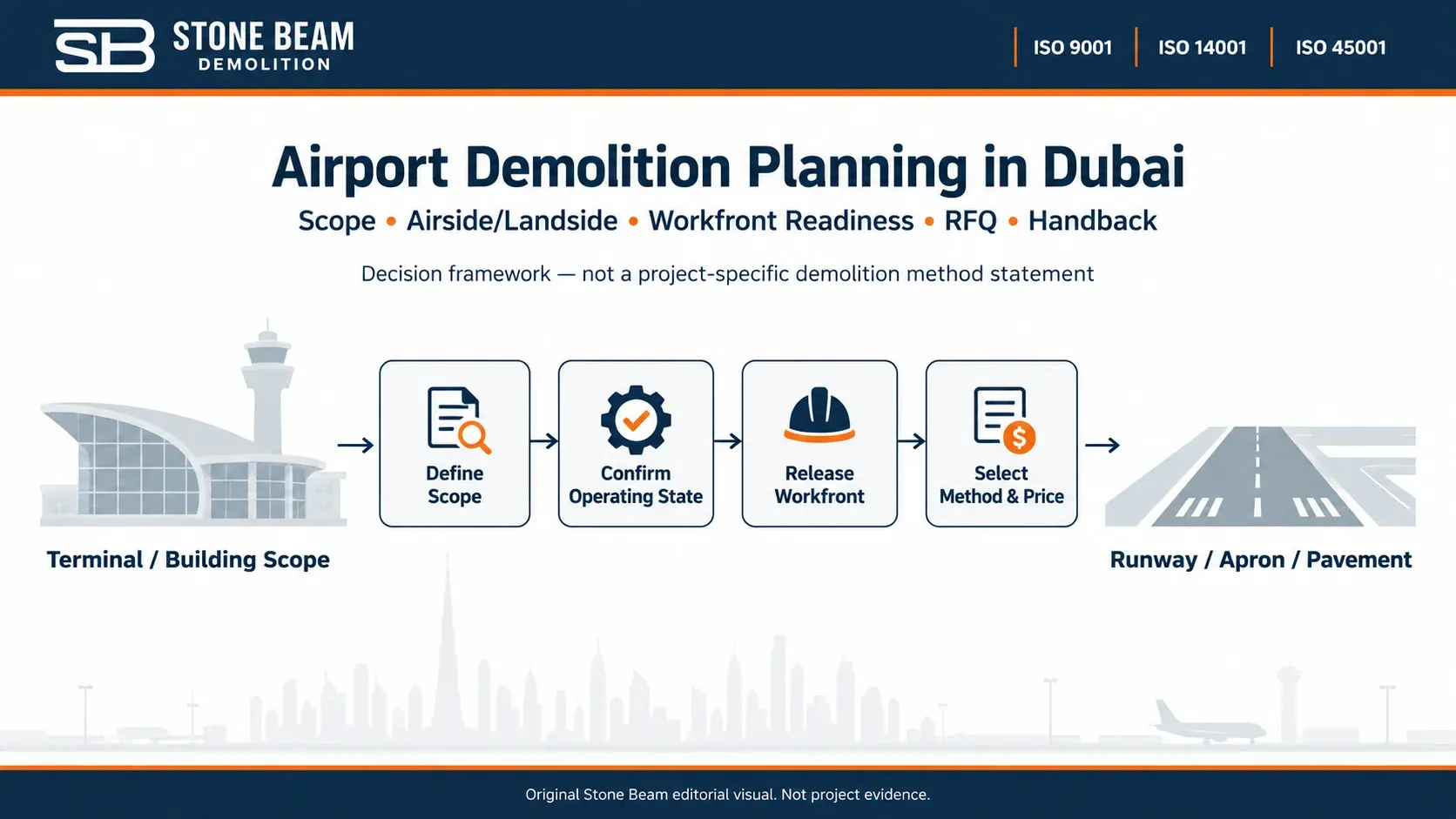
Airport demolition in Dubai should not be priced or method-selected until the scope, operating state, workfront release, retained and embedded systems, logistics and handback condition are defined. The job is therefore a controlled interface between demolition scope, airport operations and released workfronts – not a simple building-removal exercise. Before physical work begins, the project team should know exactly what is being removed, what must remain operational, who owns each interface and what evidence releases the workfront.
Dubai Municipality provides a permit service for full or partial building demolition under its jurisdiction. Dubai Municipality – Permit to Carry Out Demolition Works Airport-side work can also sit within aerodrome-operator and UAE civil-aviation controls. GCAA aerodrome-work safety requirements place responsibility on the aerodrome operator to protect aircraft operations and the work itself, including an airfield work-permit system involving relevant stakeholders. GCAA aerodrome works safety
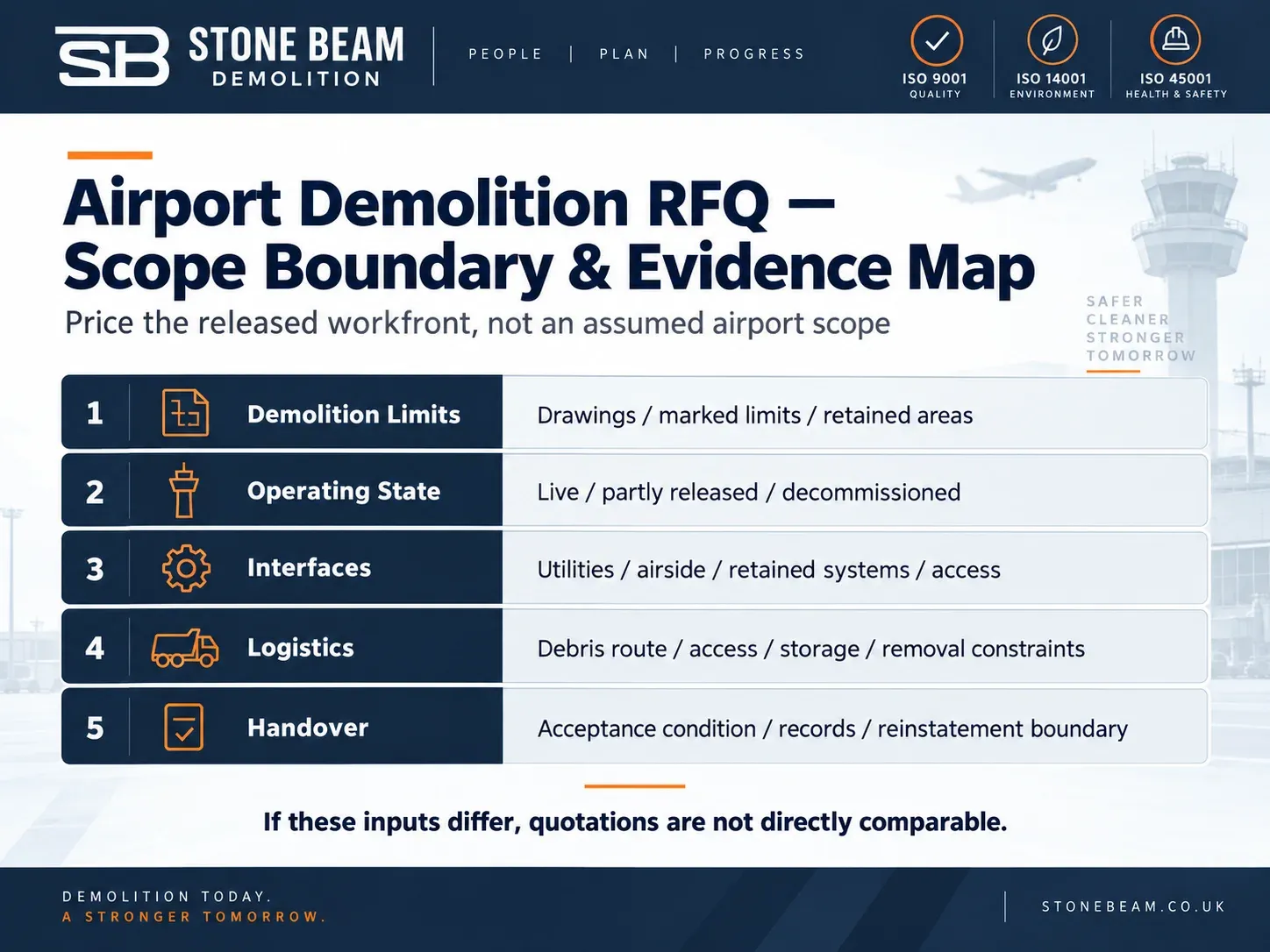
Practical rule. Price the released workfront, not an assumed airport scope. Drawings, retained operations, isolations, access conditions, pavement limits, temporary-works responsibilities, debris routes and handover criteria should be defined before a demolition method or commercial rate is treated as comparable.
Last reviewed: 21 September 2026
Author: Stone Beam Demolition
Publisher: Stone Beam Technical Services L.L.C.
What Does an Airport Demolition Scope Include?
“Airport demolition” can describe several different packages. The first commercial and engineering task is to separate them, because each package has different interfaces, records and acceptance conditions.
| Scope family | What must be defined before method or price |
|---|---|
| Terminal / building removal | Structural or non-structural areas, retained zones, MEP interfaces, access, public/operational separation and final handover condition. |
| Runway / taxiway / apron pavement | Defined pavement limits, joints/interfaces, embedded systems, edge conditions, access route, material handling and reinstatement boundary. |
| Ancillary structures | Canopies, service buildings, plant rooms, equipment bases, signs, barriers and other airport-side assets within the stated demolition limit. |
| Selective modifications | Openings, local removals or strip-out where part of an airport refurbishment rather than full demolition. |
| Below-ground / utility interfaces | Foundations, ducts, drainage, pits and service corridors only to the extent confirmed by records, surveys and the approved scope. |
A single quotation should not silently combine these scope families. A runway-removal package, a terminal strip-out package and a full building-demolition package may all sit on the same airport, but they are not commercially or technically interchangeable.
Why the Airside-Landside Boundary Changes the Plan
The airside-landside boundary is not just a location label. It identifies who controls access, workfront release, communications, operating interfaces and the conditions for closing and reopening an area.
Dubai Airports’ contractor-services portal confirms an Airside Permit to Work system and currently directs users to the current DA APTW platform. Dubai Airports Airside Permit to Work This establishes an operator-controlled work-permit interface; it does not create a universal demolition procedure for every airport project.
For landside or building-demolition elements, the applicable building authority, developer, consultant, utilities and project-specific NOCs may form a different release chain. The demolition contractor should therefore map both the physical boundary and the decision boundary before mobilising intrusive work.
Is the Airport Live, Partly Released or Decommissioned?
The same physical demolition scope can require a different programme depending on the operating state of the surrounding airport asset. A useful tender or method brief should state the operating condition explicitly rather than assuming “airport work” means one standard regime.
| Operating state | Planning consequence |
|---|---|
| Live operations continue nearby | Highest interface sensitivity. Workfront release, access, retained routes/systems, communications and reopening criteria can control the calendar. |
| Partly released / phased workfront | The package may move through separate areas or possessions. Each release should have defined boundaries and handback criteria. |
| Fully decommissioned asset | Operational aviation interfaces may reduce, but building, utility, structural, HSE, environmental and authority requirements still remain project-specific. |
Current Dubai operational example – not demolition guidance. A GCAA AIP Supplement effective from 25 June 2026 documents phased temporary taxiway closures at Dubai International for airfield improvement works, with effective closure dates notified by NOTAM and/or Airside Advice Notice. GCAA AIP Supplement 20/2026 The useful lesson is only that operating-area availability can be phase-controlled. It is not a demolition sequence, possession-duration benchmark or method instruction.
The Two-Clocks Model for Airport Demolition
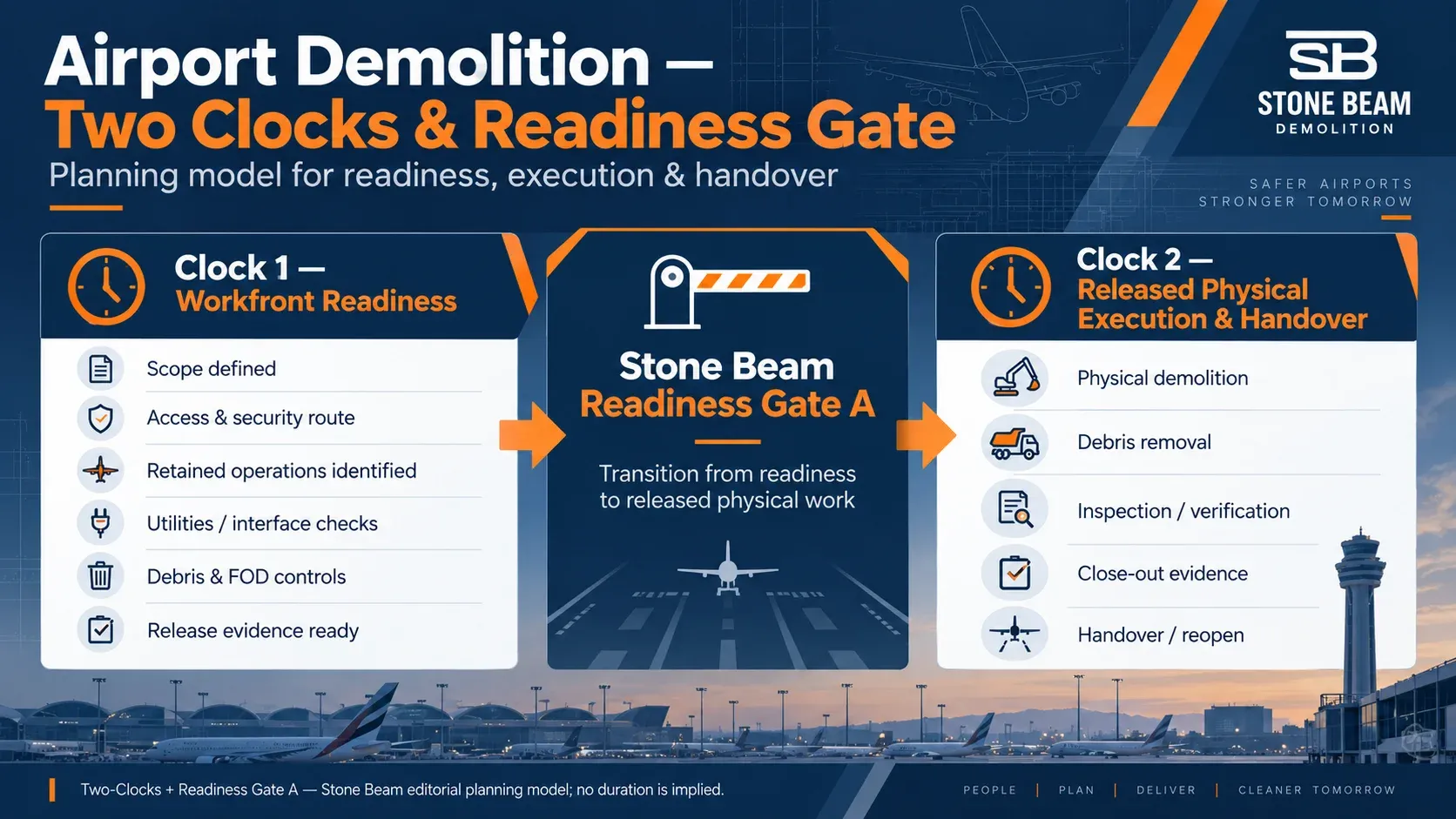
Stone Beam uses the Two-Clocks model as an editorial and planning framework. It is not the name of a UAE authority procedure. Its value is to prevent one common mistake: treating physical production time as the total owner calendar time.
| Programme layer | What it represents |
|---|---|
| CLOCK 1 – Pre-mobilisation readiness | Scope definition; records and surveys; authority/operator/consultant interfaces; access and logistics; isolation or release evidence; temporary-works responsibilities where applicable; method/RAMS review; required permits/NOCs; workfront release. |
| READINESS GATE A | The point at which the applicable conditions for that workfront are sufficiently closed for the planned intrusive or demolition activity to proceed. |
| CLOCK 2 – Physical execution & handback | Site establishment; released demolition/removal; segregation and load-out; close-out inspection; records; reinstatement interfaces where in scope; agreed handback. |
| Core programme principle: Physical demolition time is not automatically the total airport project time. External releases can control the start of a workfront even when labour and equipment are available. |
Who Controls Each Airport-Demolition Interface?
Responsibilities should be mapped before the demolition method is frozen. The exact party names vary by project, but the decision categories are predictable.
| Interface | Typical decision owner | Why it matters |
|---|---|---|
| Demolition limit / retained assets | Client / consultant / asset owner | Defines what is removed, retained and handed back. |
| Airside access / operating interface | Aerodrome operator and project-specific stakeholders | Controls access, work-permit and operational-release conditions. |
| Civil aviation regulatory framework | GCAA within its regulatory remit | Sets the national aerodrome regulatory context; project/operator implementation remains specific. |
| Building demolition permit | Applicable building authority / jurisdiction | Confirms full or partial building-demolition permit route where applicable. |
| Utilities / isolations | Relevant utility or asset owner plus project team | Provides project-specific release or isolation evidence. |
| Temporary works / structural stability | Competent project engineer(s) | Project-specific engineering responsibility; not replaced by a website guide. |
| Waste route / receiving records | Project team, transporter and approved receiving route as applicable | Defines logistics, traceability and close-out evidence. |
Airport Demolition Constraint Matrix
The matrix below is intended for early scope review. It identifies evidence to request before turning a broad airport-demolition enquiry into a method or price.
| Constraint | Evidence to request | Decision owner | Demolition / quotation consequence |
|---|---|---|---|
| Live movement-area interface | Operating status, released boundary, access/work-permit basis | Aerodrome operator / project stakeholders | May control access, phasing and handback. |
| Retained terminal / occupied zone | Marked limits, retained routes/systems, access restrictions | Client / consultant / operator as applicable | Changes separation, protection and logistics planning. |
| Runway / taxiway / apron pavement | Drawings, investigation records, removal limits, embedded systems | Client / consultant / asset owner | Determines quantity definition and suitable removal approach. |
| Utilities / embedded services | Records, survey/verification plan, isolation or release evidence | Relevant asset owner / utility / project team | Can prevent intrusive removal until released. |
| Temporary stability / partial removal | Structural information and project-specific engineering review | Competent engineer | Controls whether the proposed removal state is acceptable. |
| Debris route / FOD exposure | Logistics route, containment/cleanliness requirements, workfront rules | Operator / HSE / project team | Affects handling method, housekeeping and release criteria. |
| Final handback | Acceptance criteria and records required | Client / consultant / operator as applicable | Defines when the package is actually complete. |
What Must Be Known Before Runway or Airfield Pavement Removal?
Runway, taxiway and apron removal should not start from a generic thickness, saw-cut grid or production rate. The tender should first define the actual pavement system and the boundary of the released work.
- Approved or reliable drawings and the exact removal limits.
- Available pavement build-up, reinforcement, joint and repair records, supplemented by project-specific investigation where needed.
- Known or suspected lighting, ducting, drainage, fuel, communications or other embedded/adjacent systems.
- Interface with retained pavement and any reinstatement responsibility.
- Plant access, load-out route, workfront restrictions and the required condition at handback.
- Who owns investigation, isolation/release, temporary works, testing and acceptance.
Where records are incomplete, the project team should define an evidence-gathering route before intrusive demolition. For related Stone Beam technical content, see concrete scanning before intrusive removal and controlled concrete cutting. These pages support the investigation and separation questions; they do not prescribe an airport pavement design.
How Is Terminal Demolition Planned Near Continuing Operations?
Terminal demolition near continuing operations is mainly a boundary-management problem. The package should identify retained public/operational areas, structural and MEP interfaces, access routes, removal routes, work hours or release windows, noise/dust sensitivity, fire/life-safety interfaces and the required close-out condition.
The demolition sequence should then be developed from the actual structural arrangement and operational constraints. A website article should not publish a universal floor-by-floor sequence, temporary-support arrangement or structural release rule for a terminal because those decisions depend on project-specific engineering and approvals.
How Should FOD, Dust, Debris and Retained-System Risks Be Framed?
In an aviation-sensitive environment, the correct public guidance is to identify control objectives and ownership – not to publish universal thresholds. GCAA aerodrome-work safety requirements place the aerodrome operator at the centre of protecting aircraft operations and the work itself, including the airfield work-permit interface. GCAA aerodrome works safety GCAA FOD provisions also require the aerodrome operator to manage FOD risk and ensure third-party working practices do not increase that likelihood. GCAA FOD requirements
- FOD: prevent demolition debris, fragments, tools or loose material from creating an operational hazard.
- Dust and debris: define containment, housekeeping and removal expectations for the released workfront.
- Retained systems: identify what must stay live or protected before intrusive work is released.
- Access and traffic: separate construction logistics from operational routes as required by the project.
- Close-out: inspect and release the area against the agreed acceptance criteria before reopening or handback.
Exact monitoring limits, suppression methods, closure distances, protection details and acceptance thresholds belong in the project-specific engineering, HSE and operator-approved documentation.
How Is the Demolition Method Selected?
Method selection should follow evidence rather than equipment preference. The appropriate combination of selective dismantling, saw cutting, coring, mechanical breaking, lifting, pavement removal or other techniques depends on the released scope, retained assets, access, stability, embedded systems, logistics and handover requirement.
The decision is therefore better framed as: evidence -> constraints -> responsibilities -> feasible methods -> project review/approval -> released execution. For a broader method-selection comparison, see demolition methods in Dubai. For the end-to-end planning workflow, see Stone Beam advanced demolition guide.
What Belongs in an Airport Demolition RFQ?
A useful RFQ should make the workfront comparable between bidders. The following information materially improves scope clarity without dictating the contractor’s final project-specific method:
- asset and demolition limits, with retained areas clearly marked;
- available structural, pavement, utility and services records;
- operating state and known access/release constraints;
- responsibility matrix for permits, NOCs, work permits, isolations, surveys, temporary works and protection;
- working-area and logistics constraints, including debris route and loading interface;
- waste classification/traceability expectations and any client-specific reporting;
- required handover condition, reinstatement interfaces and close-out evidence;
- commercial exclusions or provisional items where information is not yet available.
| Quotation principle: Two bids are not genuinely comparable if one includes workfront release, protection, debris logistics or reinstatement that the other excludes. |
What Drives Airport Demolition Cost in Dubai?
There is no defensible universal AED/m2 airport-demolition rate in this guide. A useful estimate is built from the specific scope and constraints, not from a headline benchmark.
| Cost driver | Why it changes the price |
|---|---|
| Scope definition | Terminal/building, pavement, below-ground, selective vs full removal, reinstatement boundary. |
| Operating restrictions | Live interfaces, release windows, work permits, access/security conditions and handback requirements. |
| Structural / pavement information | Known build-up, retained elements, partial-removal state, investigation needs and temporary-works responsibility. |
| Method and logistics | Access for plant, cutting/breaking/lifting interfaces, internal haul route, loading point and off-site transport. |
| Utilities and retained systems | Verification, isolation/release, protection and coordination responsibilities. |
| Waste / receiving route | Segregation, transport, receiving records and any project-specific material recovery requirement. |
| Programme and interfaces | Number of releases/workfronts, sequencing constraints and dependencies controlled by others. |
| Close-out | Inspection, documentation, cleaning, reinstatement interfaces and acceptance requirements. |
A contractor can price accurately only to the level that the workfront is defined. Where critical information is missing, the commercial offer should identify assumptions, exclusions and provisional elements instead of hiding uncertainty inside a universal rate.
How Are Waste, Recovery and Close-Out Documented?
Waste planning should distinguish physical handling from performance claims. The project can define segregation, load-out, receiving routes and required records without inventing a recycling percentage.
Stone Beam does not use a generic airport recovery-rate claim in this guide. Any achieved recovery or recycling percentage should come from project-specific measured records with a defined denominator. For broader waste-planning content, see construction and demolition waste planning in Dubai.
Close-out should be defined at tender stage: the required condition of the workfront, outstanding interfaces, waste/transport records, inspection evidence, marked-up information where required, and the party authorised to accept handback.
How Should a Buyer Evaluate a Contractor for Aviation-Sensitive Work?
The strongest contractor-selection question is not “Who claims airport experience?” but “Who can show the evidence, competence and interface discipline required for this exact workfront?”
- Confirm the contracting legal entity and the relevant demolition practice/registration evidence.
- Check what project-specific airport/operator approvals or work permits are required; do not treat a corporate demolition qualification as a substitute.
- Ask for evidence of comparable scope at the exact status claimed – tender, appointment and completion are different evidence levels.
- Confirm the competence route for structural, temporary-works, HSE and airport-operations decisions.
- Review the proposed scope boundary, exclusions, responsibilities and handback definition before comparing price.
- Verify insurance scope and project-specific requirements rather than assuming one annual policy covers every airport condition.
| Stone Beam credential note: The reviewed Dubai Engineering Qualification practice-permit certificate for Stone Beam Technical Services L.L.C. records an active permit for Wrecking & Demolition Works – G+12, with expiry shown as 13 November 2026. This is a corporate demolition credential; it is not evidence of airport-project approval or airport-project completion. |
For the company’s broader commercial demolition capability and enquiry route, see Demolition Company Dubai. For another infrastructure-focused demolition context, see Bridge Demolition UAE.
Limitations of This Guide
This page is a decision-support guide, not an airport operator manual, demolition method statement, structural design, temporary-works design, permit instruction or price schedule. The applicable authority, operator, consultant, asset owner and competent engineer must determine project-specific requirements.
Stone Beam does not claim in this page that it has completed an airport-demolition project. A named airport case study should be added only if the underlying appointment/execution/completion evidence and publication permissions are available.
Questions Clients Ask About Airport Demolition in Dubai
Does a demolition contractor’s Dubai qualification replace airport approvals?
No. A corporate demolition practice qualification and a project-specific airport/operator approval or work-permit route are different evidence layers. The project team must confirm both where applicable.
Can airport demolition be priced per square metre?
A unit rate may be useful for a defined, comparable work item, but it should not be treated as a universal airport benchmark. Operating restrictions, pavement/structural build-up, logistics, retained systems, workfront releases and handover scope can materially change the price.
How long does airport demolition take?
The calendar should be split into readiness time and physical execution time. The duration depends on the actual scope and on releases controlled by the client, operator, authorities, utilities, consultants and project engineering. A generic airport duration would be misleading.
Can runway and taxiway removal use one standard demolition method?
No. The method should follow the actual pavement system, embedded interfaces, retained areas, access conditions, required break-out boundary and project review/approval route.
Discuss an Airport or Infrastructure Demolition Scope
For a technical scope review, send the available drawings, demolition limits, operating constraints, access information, known utility interfaces and required handover condition to Stone Beam. The review can then separate confirmed scope from information gaps, identify the approvals or specialist inputs that sit with other parties, and make quotation assumptions and exclusions visible before a final method or price is treated as comparable.