
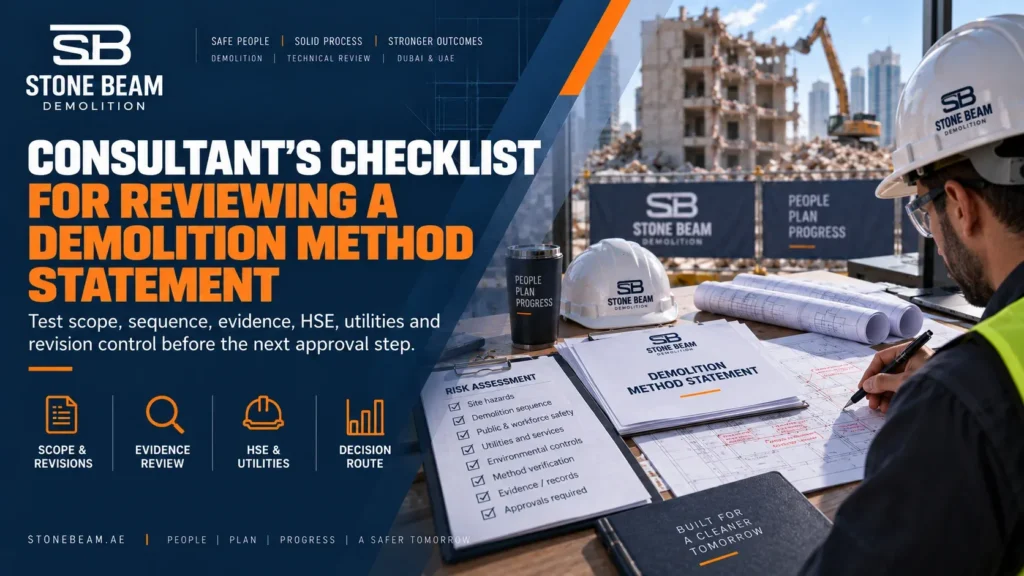
Do not accept a demolition method statement because it looks complete. Test whether the proposed sequence matches the structure, drawings, surveys, temporary works, utility status, risk controls and site logistics. Then separate evidenced facts, unresolved assumptions and items that need specialist review before release.
In Dubai, the approval route depends on the project jurisdiction and asset interfaces. Dubai Municipality, DDA, Trakhees and utilities such as DEWA operate different processes, so match each claimed approval or release to the authority or service owner that governs the workfront.
Practical rule: connect each material statement in the demolition method statement review to current evidence, the responsible reviewer and any residual risk that remains open.
By Stone Beam Technical Services L.L.C.
What should a demolition method statement review verify first?
Start with four questions before reading the document line by line:
- Does the method statement describe the correct scope, structure and demolition boundary?
- Does every important statement point to current supporting evidence?
- Does the sequence remain coherent when checked against structural, temporary-works, utility, HSE and logistics interfaces?
- Does the submission identify unresolved assumptions and route them to the right reviewer or external release?
A polished document with weak evidence is still a weak submission. The review is an evidence test, not a formatting test.
How do you start with document control and scope?
Start by proving that the reviewer and the contractor are talking about the same work. Check the drawing revision, demolition limits, retained elements, exclusions, interfaces and document revision history before assessing the technical sequence.
A method statement that references superseded drawings creates an immediate control problem. A submission that leaves the demolition boundary unclear creates the same problem, even when the proposed method looks reasonable.
The wider planning context belongs in Stone Beam’s advanced demolition planning guide. This page stays on the review decision for the submitted method statement.
Document-control checks
- Current method-statement revision and status.
- Current drawings and mark-ups referenced by the submission.
- Clear demolition boundary, retained elements and exclusions.
- Cross-references to surveys, calculations, NOCs, temporary-works records and risk assessments.
- Revision history that records material changes to the method.
Does the method statement match the structure and site evidence?
The method statement must reflect the known structure, not an assumed generic building. Review available drawings, surveys, inspection findings, retained assets, adjacent properties and known live-service interfaces.
Unknown conditions also need a control route. The document must show how the team handles a discovery that invalidates the planned sequence or a supporting assumption.
For a villa, commercial building or partial demolition, the scope boundary changes the evidence needed. Stone Beam’s villa demolition service page illustrates why above-ground, basement and foundation scope must not be blurred into one undefined package.
Is the demolition sequence technically coherent?
Review whether the submission explains each demolition stage and points to the engineering basis required for that stage. Look for unsupported jumps, conflicting drawing notes, missing temporary-support references or other assumptions that need a competent structural or temporary-works review. This checklist does not validate the design itself.
The selected demolition technique also has to fit the stated constraint. Use the separate demolition methods comparison for method selection; here the question is whether the submitted method is justified by the project evidence.
BS 6187:2011 is a technical source for demolition planning, responsibilities and structural-stability management. It is not UAE law. BS 5975-1:2024 addresses management procedures for temporary works. Project design still requires the appropriate competent review.
If the review shows that the proposed demolition package lacks a credible contractor-side method or supporting evidence, compare that gap against the capability expected from a demolition company in Dubai before the submission progresses.
Are authority and utility conditions reflected correctly?
Do not treat one authority’s document list as a universal Dubai checklist. The applicable route depends on the project jurisdiction and asset interfaces.
Within Dubai Municipality jurisdiction, the current Permit to Carry Out Demolition Works service covers permits for full or partial demolition. Circular 3-13-1 (effective 8 July 2025) adds a consultant-appointment and supervision framework for specified higher-risk categories. It requires a Dubai Municipality-licensed consultant of at least G+12 for the triggered cases and assigns duties including site/structural-system assessment, detailed demolition planning with the contractor, supervision, safety follow-up and completion-certificate follow-up. Apply those duties only where the circular’s trigger conditions are met; they are not a universal checklist for every demolition project.
Within DDA jurisdiction, the Dubai Development Authority Demolition Permit service lists a method statement, a specific HSE and emergency plan with risk assessments, relevant NOCs, hoarding information, a neighbouring-building impact study and site photographs among its required documents.
For electricity and water interfaces, the DEWA Demolishing Permits service is a separate utility route. DEWA’s current service states that projects requiring a Dubai Municipality demolition permit are submitted through Dubai BPS, while other authority scenarios use DEWA channels.
Inside PCFC/Trakhees jurisdiction, the Trakhees Demolition and Removal NOC procedure requires a demolition NOC submission, allows incomplete rejected applications to be resubmitted, and assigns the submission review to CED Structural & Architectural Engineers.
The review task is simple: match every authority or utility statement in the method statement to the actual record for that project. A sentence such as “services isolated” is not equivalent to the supporting release or NOC.
Does the risk assessment match the method?
The risk assessment and method statement should describe the same workfront. Compare the sequence, equipment, interfaces, work area, access route, exclusion controls and emergency actions across both documents.
A generic risk assessment is easy to spot when the hazards do not correspond to the stated sequence or site condition. Review the related demolition OHS management guide for the management-system layer; the method-statement review focuses on alignment with the actual work steps.
Are plant, access, logistics and waste movements credible?
A method statement is incomplete when the sequence works on paper but the plant, workface or debris route does not fit the site. Review access, lifting interfaces, working position, material handling, vertical transport, loading route and retained-area protection.
Waste handling belongs to the same logic. The debris route must match the workforce and site constraints. Stone Beam’s construction and demolition waste guide covers that topic in more detail.
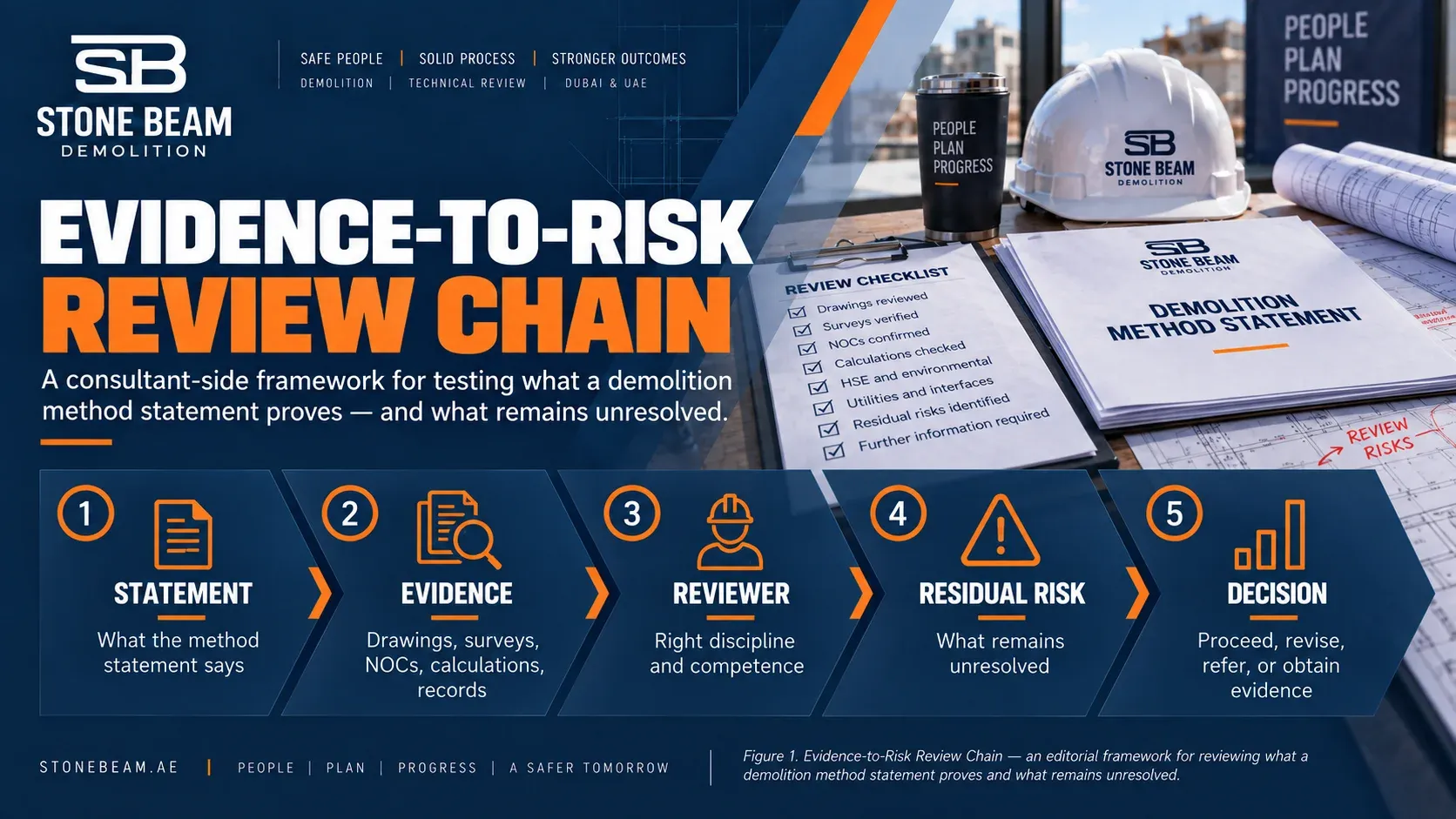
What evidence should support each method-statement claim?
Use the evidence-to-risk matrix below. The key question is not “Is the document attached?” but “What decision does this record actually support?”
| Review area | Evidence to inspect | What it proves | What it does not prove | Consultant action |
|---|---|---|---|---|
| Scope / drawings | Current approved or controlled drawings, demolition mark-ups | Boundary, retained elements and reference geometry | Actual hidden condition or field verification | Match revisions; return conflicts |
| Structural basis | Survey, assessment, design review or supporting engineering record | Basis used for the proposed sequence | Authority approval or future site condition | Route structural items to competent reviewer |
| Temporary works | Controlled design/check record and referenced drawings | Defined temporary condition and management route | Adequacy of the whole demolition scheme | Confirm status, revision and reviewer |
| Utility status | Current NOC, deactivation/clearance or service-owner record | Documentary status for the named service | Absence of undocumented or concealed services | Cross-check record, scope and physical verification |
| Risk controls | Risk assessment aligned to work steps | Hazards and planned controls for the described activity | Structural adequacy | Check one-to-one alignment with sequence |
| Plant / resources | Plant schedule, access/position basis, lifting or handling records | Proposed resource and intended work position | Automatic suitability for every structural state | Check interfaces and supporting evidence |
| Project proof | Appointment, completion, handover or equivalent record | Experience only to the level recorded | Suitability of the current method by itself | Verify status, relevance and permission |
| Insurance | Current policy schedule and relevant wording | Financial coverage within stated terms | Technical competence or blanket project approval | Check activity, period, limits and exclusions |
What are the main red flags in a demolition method statement?
The strongest red flags are contradictions and missing evidence, not spelling mistakes. Flag a material statement for revision, clarification or competent specialist review when it has no traceable basis.
- The method statement references the wrong project, workfront or drawing revision.
- The demolition boundary conflicts with drawings or the stated handover scope.
- The sequence relies on structural or temporary-work assumptions with no controlled supporting reference.
- The risk assessment describes different equipment, access or work steps from the method statement.
- Utility isolation is asserted without a matching current record for the affected service.
- Plant is listed without a credible access, operating-position or handling basis.
- Consultant comments are marked closed but the revised drawings, RA or method text do not reflect the change.
- A material discovery has no stop, reassessment or revision route.
Who is responsible for what during the review?
A consultant review works best when responsibilities are separated by role and competence. Exact contractual responsibility stays with the project documents, but the review route below is a useful control model.
| Role | Review boundary | Evidence / action |
|---|---|---|
| Owner / client | Scope definition, owner-held information and owner-side decisions | Provide the agreed inputs and decisions required by the contract |
| Consultant / project engineer | Coordination review against project requirements | Identify gaps, route discipline reviews and record comments |
| Main contractor | Site-wide interfaces, logistics and workfront coordination | Align the specialist method with site controls and shared constraints |
| Demolition specialist | Execution methodology and supporting demolition records | Prepare, revise and coordinate the submitted method within its scope |
| Specialist reviewer | Structural, temporary works, HSE, utility or other discipline judgment | Review technical claims within demonstrated competence |
| Authority / utility | Permit, NOC or service-owner decision within jurisdiction | Issue or reject the relevant external record |
How should the method-statement review affect the submittal or award decision?
Use the method-statement review to decide whether the submitted demolition approach is credible enough for the next submittal or award step. Keep the boundary clear: the DMS is one evidence layer, not a substitute for separate checks on legal eligibility, specialist competence, HSE systems, insurance, resources or relevant project evidence.
- Corporate / authority eligibility: Check the exact activity, status, jurisdiction and validity. A corporate credential does not replace a project permit.
- Technical capability: Look for a method that is traceable to the structure, constraints and evidence rather than a generic template.
- HSE capability: Check the management system and the work-specific controls separately.
- Insurance: Read the scope, period, limits and exclusions. Do not use the policy as proof of engineering competence.
- Project evidence: Distinguish appointment, nomination, planned method and completed scope. Each record proves a different level of experience.
- Resources and delivery controls: Confirm access to the proposed resources and the coordination needed to use them on the defined workfront.
What information is needed to close the demolition method statement review?
Ask for information that closes a specific review gap, not a generic pile of documents. The DMS review becomes more reliable when the reviewer has these inputs:
- Defined scope, demolition boundary and handover condition.
- Current drawings and the available structural or condition information.
- Applicable authority jurisdiction and the status of relevant permits or NOCs.
- Utility and retained-service status for the affected workfront.
- Referenced temporary-works, structural or specialist reviews.
- Risk assessment and emergency controls that match the work sequence.
- Plant, access, material-handling, lifting and debris-route assumptions.
- Where the review also informs appointment or award, the separate evidence for contractor eligibility, relevant experience, insurance and required resources.
- Responsibility matrix and comment/revision register for unresolved interfaces.
Illustrative review example
Illustrative only: A submission states that electricity and water are isolated, then schedules mechanical demolition beside an existing service route. The only supporting record is an old service drawing. The reviewer does not convert the sentence into an accepted fact. The comment asks for the current utility status, the relevant release evidence and alignment of the method and risk controls with that status.
How should consultant comments and revisions be closed?
Close the change, not merely the comment. A material review comment often affects more than one document. Check the revised method, drawings, risk assessment and supporting references together before marking the issue closed.
A revision register also needs to show what changed. This creates traceability when later site information forces another method change.
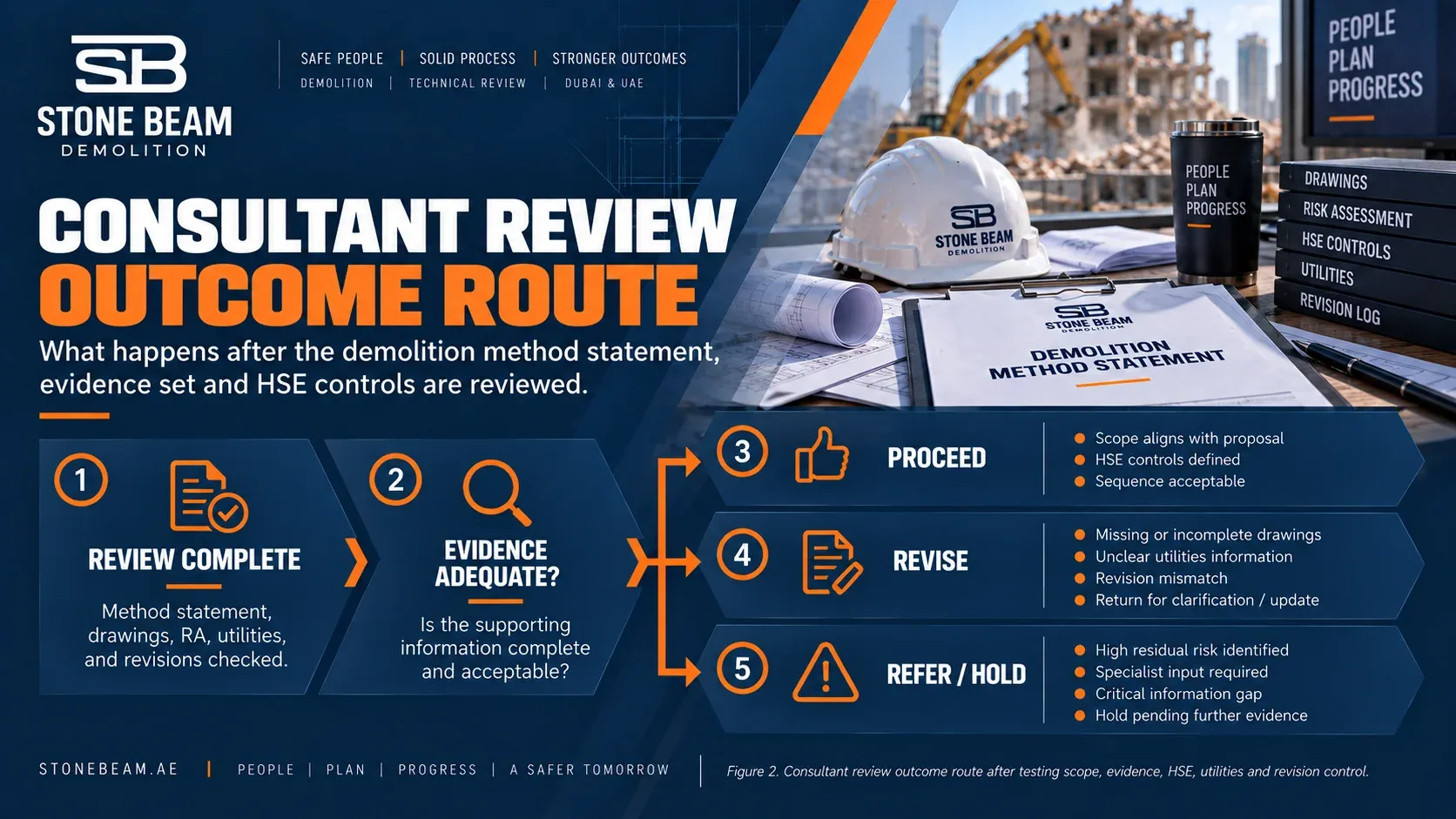
| Review outcome | When it fits | Next action | What it does not mean |
|---|---|---|---|
| Proceed to the next review step | The stated method is traceable to current evidence and no material review gap remains within the reviewer’s scope. | Record the review outcome and any normal conditions or interfaces. | It does not convert permits, specialist designs or external releases into completed facts. |
| Revise / clarify | A contradiction, missing reference or unresolved assumption can be corrected by the submitter. | Issue a focused comment and require the affected DMS/drawing/RA/reference to be revised together. | It is not a rejection of the entire contractor or project. |
| Specialist review | The decision depends on structural, temporary-works, HSE, utility or another discipline judgement outside the reviewer’s competence. | Route the exact claim and supporting record to the competent specialist. | The general consultant checklist does not validate the specialist design. |
| External evidence required | The DMS depends on an authority, utility, owner or other external release that is not evidenced. | Request the current project-specific record and reconcile it with the DMS before closing the point. | A sentence in the method statement is not a substitute for the external record. |
What does consultant acceptance not prove?
Consultant acceptance of a demolition method statement does not, by itself, prove that every structural decision is adequate, that utilities are physically isolated, that every authority condition is closed, or that contractual responsibility has transferred. Each point still needs the relevant engineering record, authority release, utility evidence or project contract.
LIMITATIONS — keep these distinctions clear
|
|---|
Final consultant review checklist before the submission moves forward
Before the DMS moves to the next approval step, confirm that each line below has a clear answer and a traceable record:
- Correct project, workfront, scope and revision.
- Current drawings and demolition boundary.
- Structure and retained assets reflected in the method.
- Sequence supported by the relevant engineering evidence.
- Temporary works identified and routed to the correct review.
- Authority and utility status matched to current records.
- Risk assessment aligned with the actual method and equipment.
- Access, plant position, handling, debris and waste logistics resolved.
- Responsibilities and specialist review boundaries recorded.
- Comments closed across every affected document, not only the comment sheet.
- Unresolved assumptions captured as actions, holds or external evidence requests.
If you are procuring demolition works, share the scope drawings, retained elements, access constraints, authority jurisdiction and intended handover condition with Stone Beam Demolition to discuss a project-specific demolition proposal.