Steel dismantling, engineered around what's there today

Planned disassembly and removal of structural steel in a sequence that controls temporary stability, member movement, lifting and material handling — for reuse, recycling, or a hybrid of both.

PEBs · portal frames · pipe racks · mezzanines

Overview

Not automatically "reverse erection"

Reversing the original erection sequence can be a useful planning principle for an intact, well-documented bolted structure — especially a PEB. It is not a universal script.

Corrosion, fire or impact damage, missing bracing, later extensions, undocumented modifications, distorted connections or incomplete records can make the original erection logic unsuitable for the structure that exists today. The approved sequence must respond to the present condition — that's the practical difference between an engineered dismantling plan and a generic instruction to cut steel from the top down.

Request a demolition quote

Use this form layout on the live page to qualify leads before a call.


    Application examples, not an unlimited-capability claim

    Height, span, member weight, corrosion, lifting access and ground capacity are assessed before a method is confirmed — for any of these.

    PEB

    Bolted connections and match-marking make these the strongest reverse-erection candidates — condition permitting.

    Secondary steel, cladding and services all factor into the removal sequence.

    Low headroom, suspended-floor loading and shared connections change the method.

    Dismantled only after the relevant area has documented release for intrusive work.

    Lighter steel with real sail-area and wind-exposure implications during removal.

    Steel-to-concrete interfaces and base plates only included where the scope says so.

    Five intents, kept deliberately separate

    Steel dismantling can integrate with these scopes, but each owns a different boundary.

    Intent owner
    What it should own
    Boundary
    Steel structure dismantling
    Planned member/section removal, temporary stability, connection release, lifting, reuse/recycling
    This page — detailed steel method and recovery intent
    Industrial demolition
    Physical removal of factories, plants, production structures and foundations after release
    Owns the overall plant/factory demolition project
    Facility decommissioning
    Shutdown, isolation interfaces, asset retirement, decontamination coordination
    Happens upstream, makes the live facility safe
    Warehouse demolition
    Complete warehouse removal — frame, cladding, offices, slabs, handover
    Owns the buyer's full-removal intent, not member methodology
    Waler / shoring steel removal
    Temporary excavation-support struts removed under an approved de-propping design
    Kept separate from permanent structural-steel dismantling

    Engineering the sequence

    Seven steps, from survey to secure laydown

    The difference between an engineered dismantling plan and a generic instruction to "cut steel from the top down."

    Survey the actual structure
    Drawings support the review but never override contradictory site conditions.
    Understand temporary states
    Removing cladding, purlins or a brace can change load paths and restraint.
    Establish restraint before release
    Scaffolding isn't structural bracing unless designed and approved as such.
    Prepare lifting & landing
    Weight, COG, points, radius, obstruction envelope confirmed before release.
    Treat final release as a hold point
    The last connection deserves deliberate control, not routine handling.
    Lower, stabilise, de-rig
    Work isn't complete until the member is in a stable laydown condition.
    Stop on deviation
    Unrecorded connection, missing bracing or weather change triggers reassessment.

    Six structure/connection types, six method families

    Selected from the actual condition — not the fastest-sounding technique.

    Structure / condition
    Possible method family
    Critical controls
    Bolted PEB / portal frame
    Progressive de-cladding, secondary steel removal, controlled unbolting, crane lowering
    Connection condition, missing bracing, match-marking, reuse objective
    Welded frame
    Planned sectional cutting, each section supported before release
    Hot-work permit, fire watch, coatings, section weight, retained stability
    Mezzanine / internal steel
    Smaller sections, compact lifting, careful separation from retained building
    Low headroom, suspended-floor loading, live MEP, shared connections
    Pipe rack / process steel
    Dismantling after documented release for intrusive work
    Retained lines, cable trays, temporary supports, facility PTW
    Damaged / corroded frame
    More conservative restraint, smaller sections, altered direction
    Reduced connection capacity, distortion, uncertain load path
    Mechanical steel processing
    Appropriate in open, released areas where reuse isn't required
    Machine position, exclusion zone, member movement, material handling

    Three controls beyond the lift itself

    Fall protection is only one part of the system — rescue planning, dropped-object control and crane communication all matter.

    Working at height
    MEWPs, designed scaffold or crane-supported systems — chosen to minimise unnecessary exposure near suspended members.
    Hot work & ignition
    Mechanical/hydraulic cutting can reduce some ignition sources but should never be marketed as spark-free or risk-free.
    Live/operating facilities
    Shutdown, LOTO, draining and operational release belong to the facility or a separately appointed decommissioning scope — dismantling works inside that documented release.

    Same floor area, very different lifting arrangement

    No dependable universal rate per m², ft² or tonne exists for steel dismantling.

    Steel quantity & geometry
    Height, spans, total tonnage.
    Structural system & condition
    Bracing arrangement, corrosion, damage.
    Connections
    Bolted, welded, corroded or inaccessible.
    Member weights & lift radii
    Number of planned lifts.
    Cladding & non-structural
    Insulation, services, secondary removal.
    Access & crane logistics
    Ground capacity, laydown, transport routes.
    Facility restrictions
    Operating-facility interfaces, shutdown windows.
    Recovery objective
    Reuse, match-marking, bundling, storage.
    Civil works
    Foundations, slabs or backfill if included.

    Not a fixed rate

    The most useful quotation separates these drivers into scope, assumptions, provisional items and exclusions instead of hiding them inside one area rate.

    Not demonstrated by listing cranes and cutting tools

    The stronger test is whether the contractor turns structure, stability, connection type, lifting, access and handover into one coherent scope.

    The actual structure and its present condition define the dismantling boundary.


    Temporary restraint and connection release coordinated as one plan.
    Industrial demolition, decommissioning, cutting and waste handled without silently absorbing another specialist's scope.
    Owned plant, certifications, recycling percentages published only when current records support them.
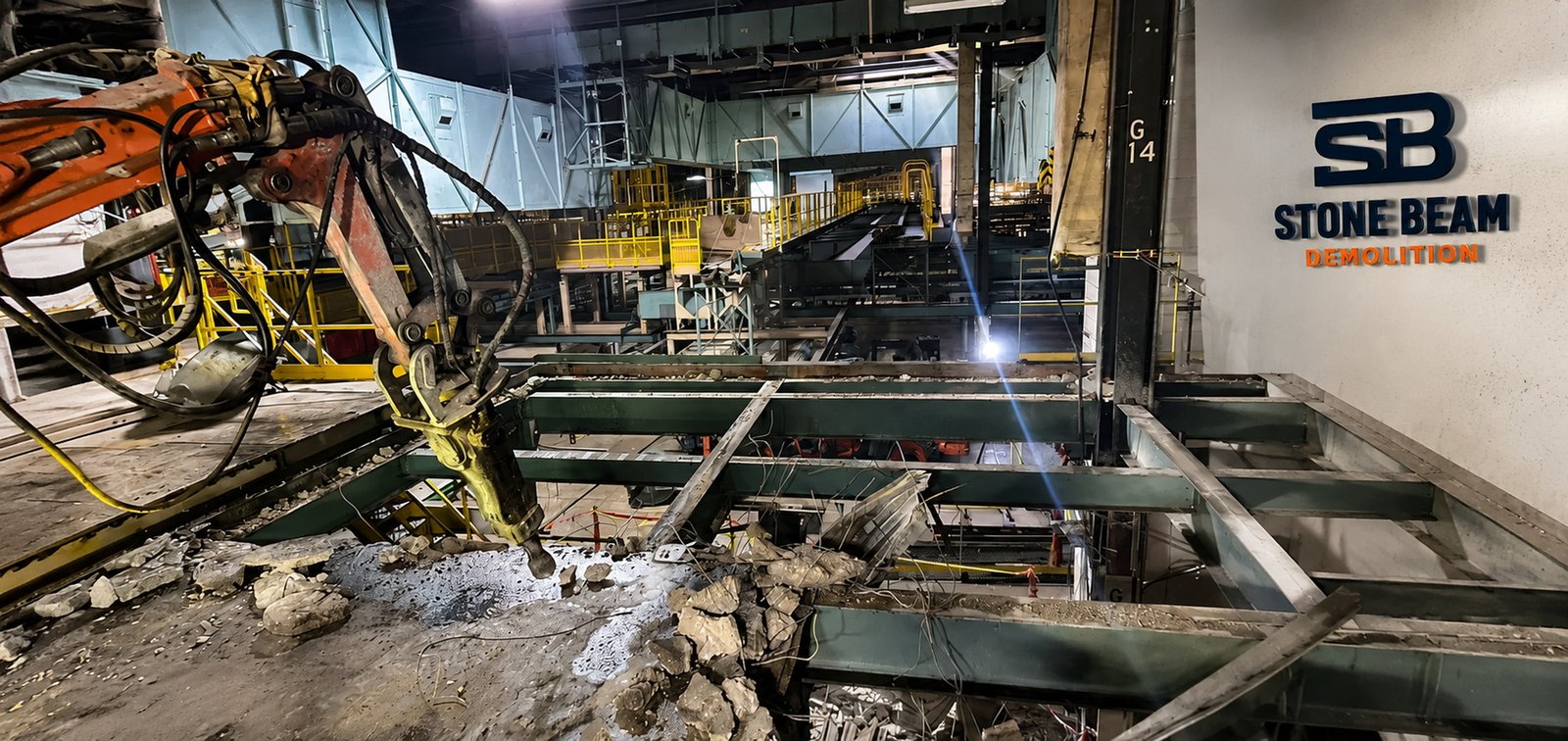
    Why Stone Beam

    Common questions, answered straight

    What plant owners and operators ask before they call.

    Not automatically. "Empty" is a visual description — atmosphere testing, residue checks and a current gas-free certificate from the named competent party are needed before hot work.
    The certificate is issued by the designated competent person under the site's PTW system — Stone Beam's structural scope begins once that release evidence is recorded.
    Yes, once excavation, utility verification and readiness conditions are confirmed — the tank is lifted whole or removed sectionally depending on verified weight and condition.
    Where verified weight, geometry, structural condition, lifting points, crane radius and route all support it — otherwise sectional removal is used.
    Yes — primarily a reinforced-concrete removal problem, though confined-space and service-isolation controls still apply even without hydrocarbon history.
    No. Mechanical methods reduce one category of ignition risk but should never be described as universally spark-free or risk-free.
    Only when the demolition zone and live operations can be separated through approved SIMOPS, isolation and access controls — feasibility depends on the actual plant, never promised in advance.
    Ownership is contractual — retained by the client, transferred to the contractor, or credited on a measured basis. This is defined before removal, not assumed.
    The team stops disturbing the affected area and routes the condition to the appointed environmental specialist — demolition alone can't certify soil or groundwater is clean.

    Still have questions?