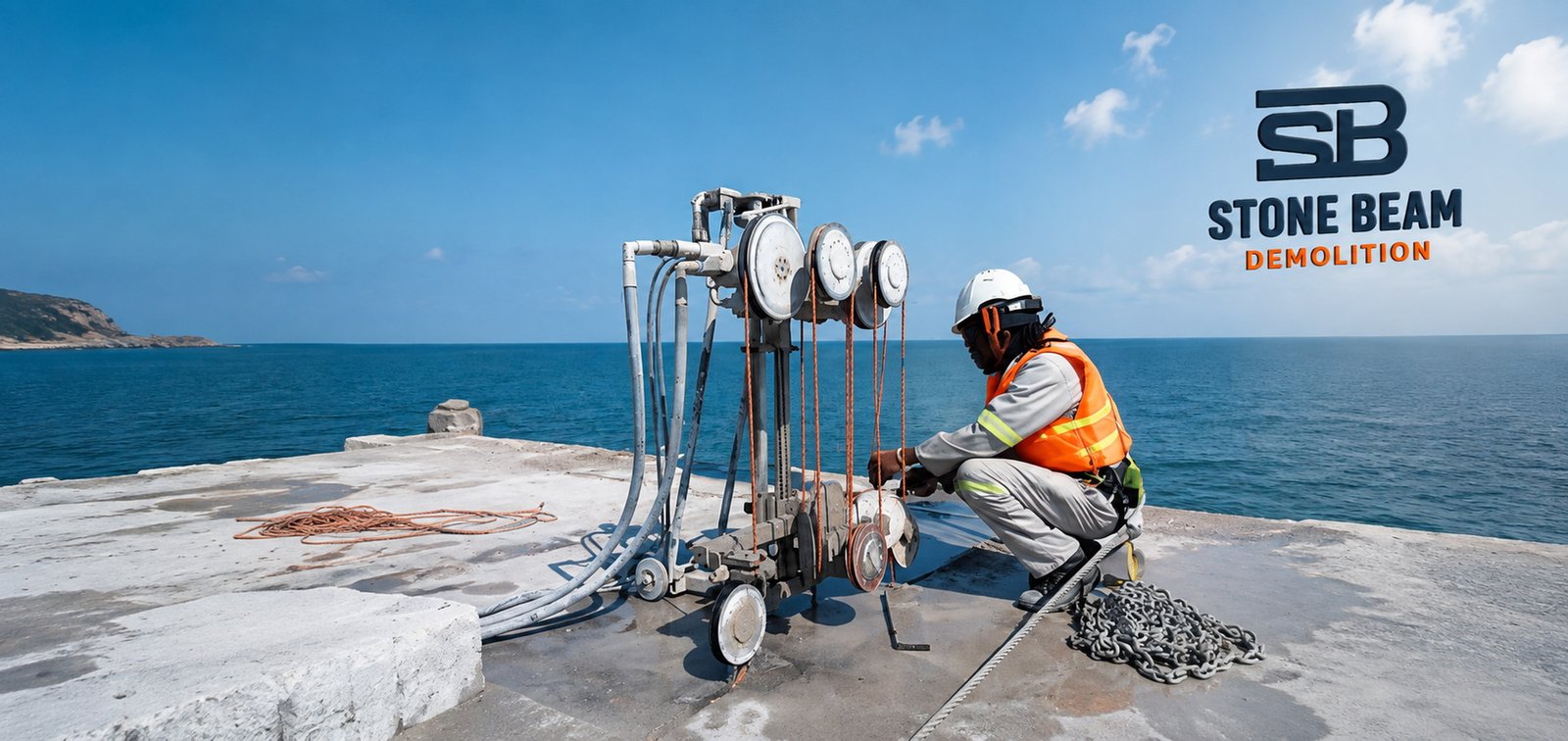
Diamond wire sawing, for cuts a blade can't reach
A continuous diamond-wire loop cutting rafts, transfer beams, foundations and heavily reinforced sections beyond the reach of a wall or floor saw.
Thick sections · irregular geometry

























Overview
Not radius-limited — not unlimited either
The wire isn't constrained by a circular blade's radius, which is what makes it useful for thick or irregular sections. That doesn't mean "unlimited depth."
The practical cut is controlled by access, wire routing, equipment power, wire storage, anchorage, pulley geometry, material, cooling, section support and the ability to safely remove the separated piece. Manufacturer-approved systems can support dry applications, but dry wire sawing needs its own thermal, dust and environmental assessment — not simply switching the water off.
Choose it because the geometry justifies it
Not because it sounds more advanced. Many projects are safest and most economical as a combination: core-drill the access holes, wire-saw the major separation, then lift or lower the released section under a controlled plan.
Request a demolition quote
Use this form layout on the live page to qualify leads before a call.
Fit decided by geometry, not by sounding advanced
Wire sawing earns its place on thick, heavily reinforced or irregular sections a circular blade can't reach.
Application
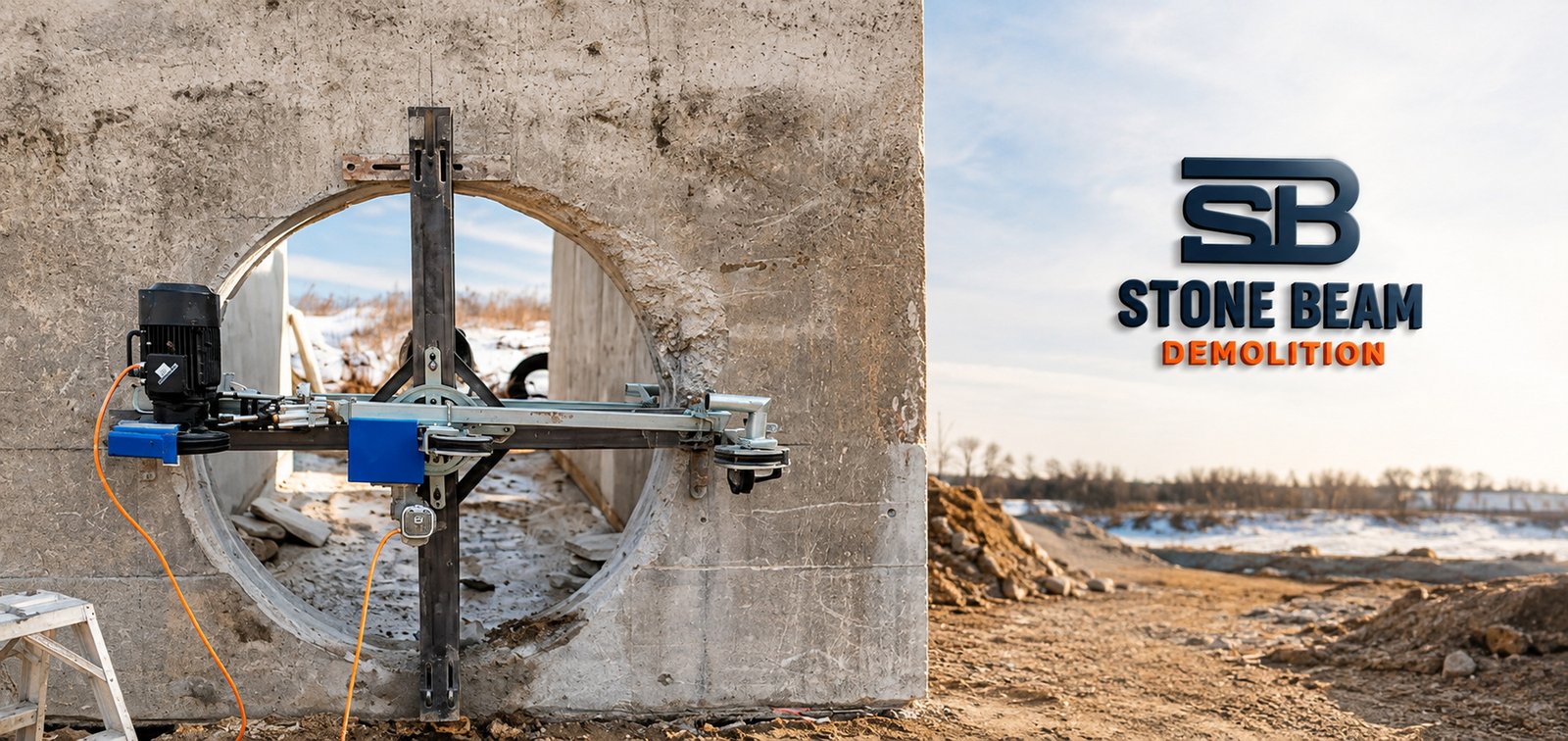
Very thick reinforced concrete
Large or irregular geometry
Heavily reinforced sections
Cut-and-lift demolition
Bridge / infrastructure components
Confined or awkward access
Wire capability isn't structural permission
A wire saw can physically cut reinforcement and, with the right system, steel and heavily reinforced concrete — that never means the project is structurally permitted to sever it. The appointed engineer establishes whether the cut is acceptable, what temporary works are needed, and what the retained structure must do afterward.
Post-tensioned or prestressed concrete is never treated as ordinary reinforced concrete — tendon position, anchorage, continuity and cutting consequence are resolved before work. Concrete scanning reduces uncertainty but doesn't provide structural approval and can't guarantee every concealed object is detected.
A clean cut can still be an unsafe operation
If the separated block is heavier, more eccentric or less stable than assumed, before final release the project establishes section size, a defensible weight basis, likely centre of gravity, lifting or support points, hidden attachments and the landing area's capacity.
Large blocks may need subdividing where crane radius, floor capacity or laydown space governs the maximum safe size.
Both the wire-saw system and the cut section contribute to temporary loading on elevated slabs.
If a section stays in place after cutting, the method defines how it's restrained against sliding, rotation or release.
System-specific — not a universal rate
Manufacturer data (Hilti DSW range, Husqvarna CS 10 — planning reference only, verified per project) shows why capability depends on the exact system, not a generic "wire saw."
Section thickness & reinforcement
Wire route & anchorage
Piece size & lifting
Structural review
Water/slurry or dry system
Access & power
Not a fixed rate
An itemised, project-specific quotation reflects the actual section, structure and removal plan.
An engineered service, not equipment for hir
The method is selected after reviewing the structure, access, and risk — not chosen because it's the tool on the truck that day.
The method, sequence and controls are confirmed from the actual site condition before any machine or tool is mobilised.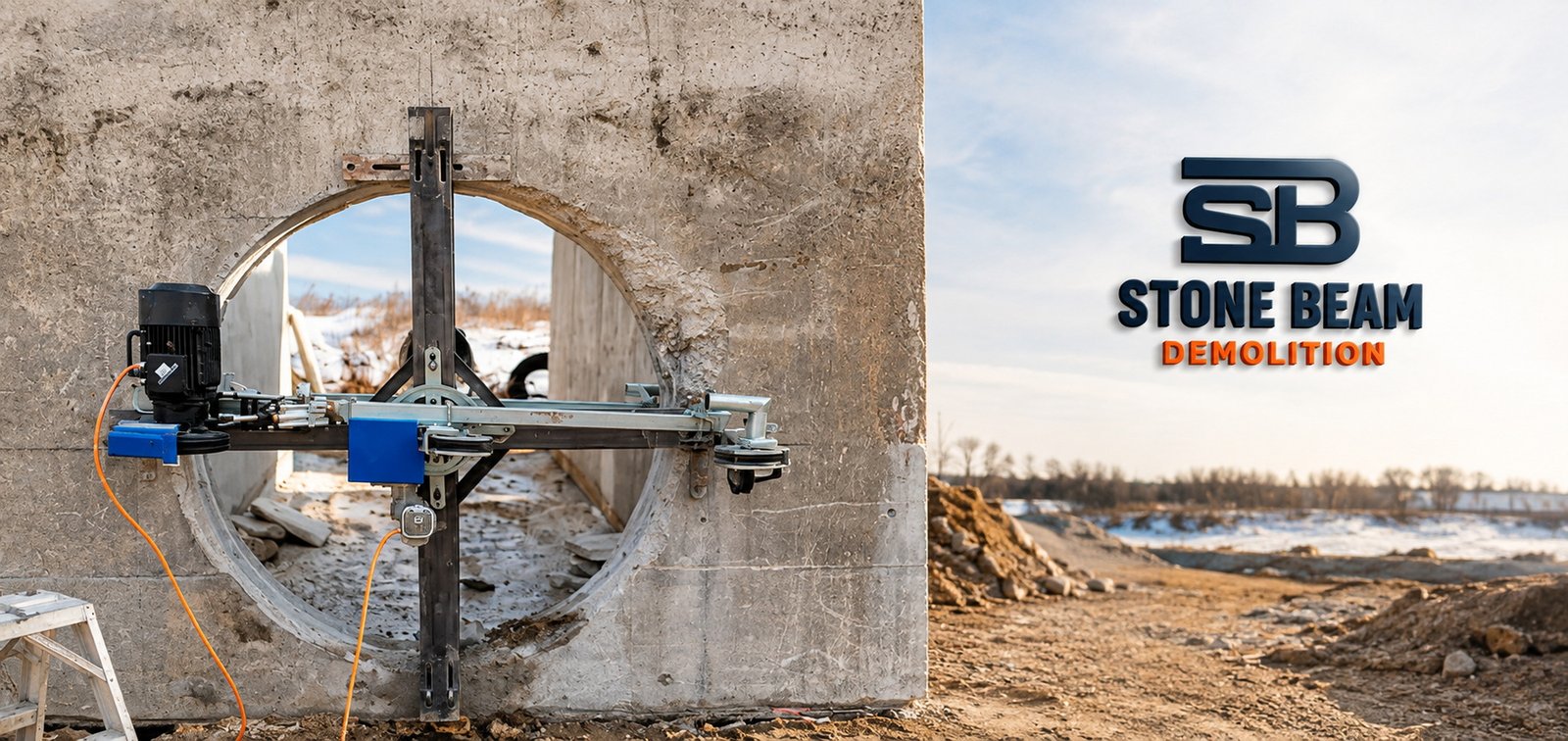
Cutting, scanning, temporary support, lifting and waste handling coordinated under one plan, not fragmented between separate contractors.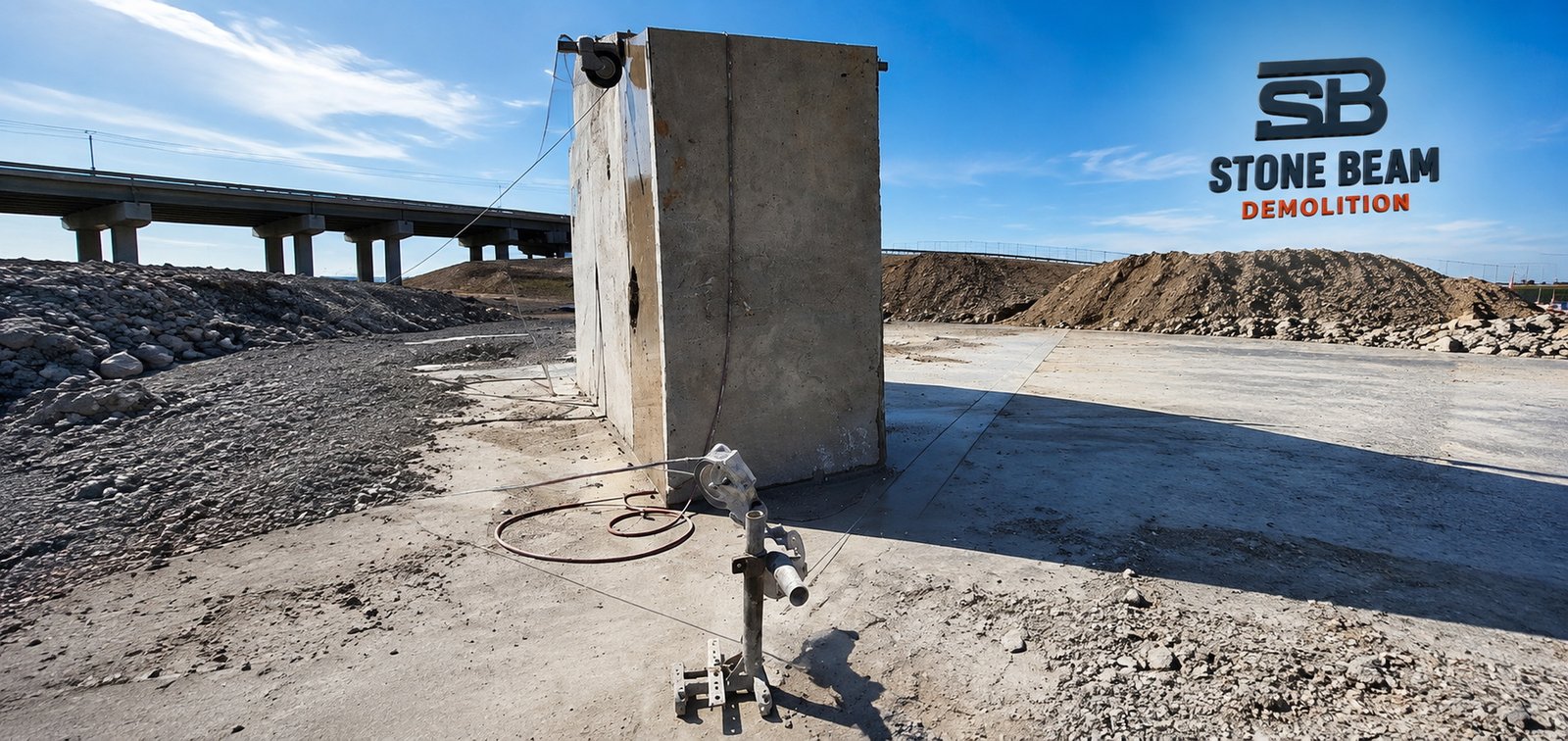
Scope, exclusions, assumptions and handover condition are stated in the quotation — not hidden inside a single lump-sum line.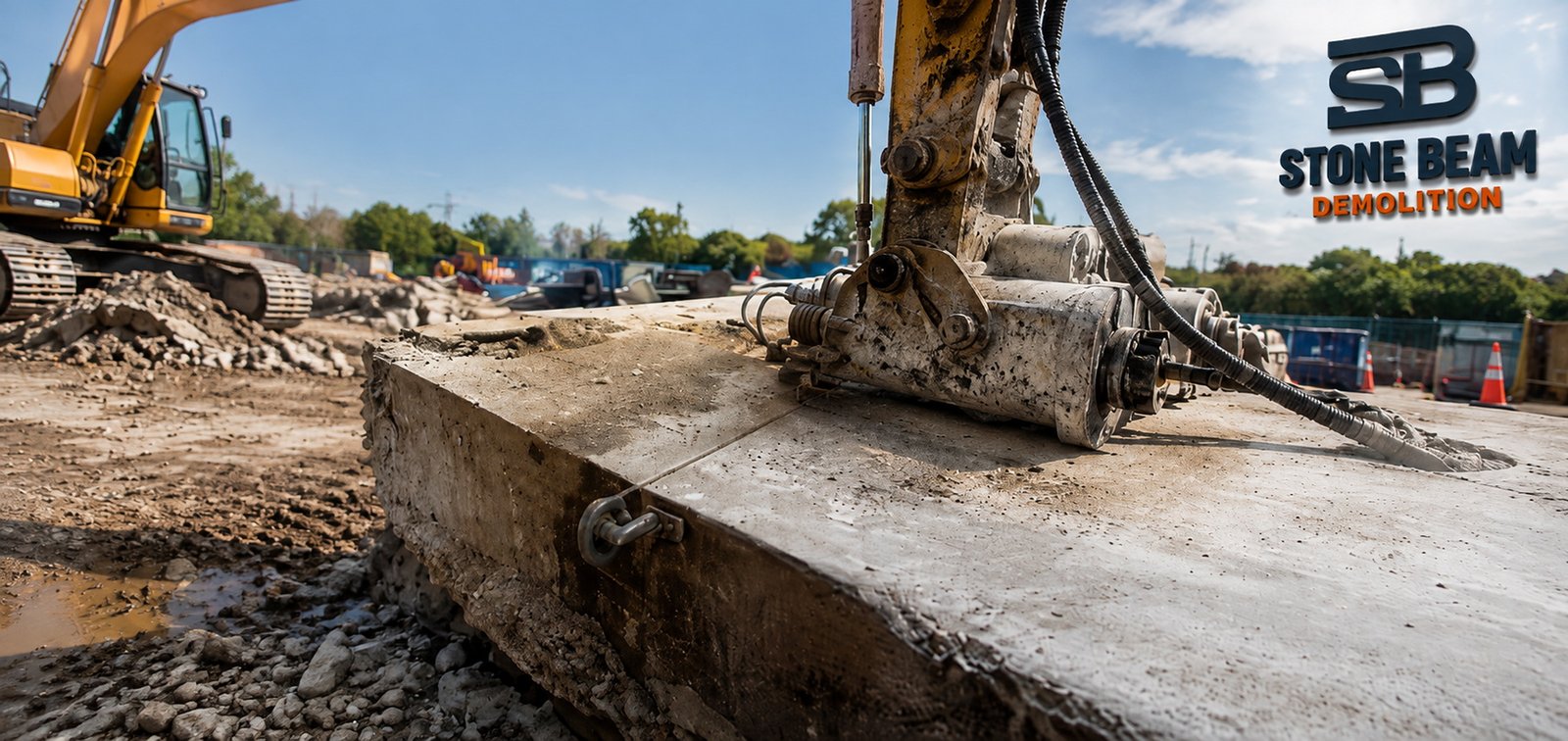
Common questions, answered straight
What contractors and consultants ask before they call.
Thick reinforced concrete, large or irregular sections, heavily reinforced elements, cut-and-lift demolition, bridge components and confined-access cuts a circular blade can't reach.
It avoids repeated percussive breaking, but shouldn't be marketed as vibration-free — equipment forces, wire tension and cutting still act on the structure.
No. The practical cut is controlled by access, wire routing, equipment power, anchorage, cooling and the ability to safely remove the separated piece.
Yes, with a suitable wire and system — but whether the cut is structurally permitted is a separate engineering decision, not a capability question.
Manufacturer-rated wires can cut steel and composite sections in suitable conditions, with specific heat, spark and support controls.
Yes, with a manufacturer-approved dry system and its own thermal, dust and environmental assessment — not simply the water switched off.
Scanning is used where concealed reinforcement, PT or services materially affect the cut — it reduces uncertainty but never replaces structural approval.
Still have questions?
