Robotic Demolition in Dubai
for restricted-access work
Robotic demolition in Dubai using compact, remote-controlled equipment for occupied, load-bearing and vibration-sensitive structures — where standard demolition equipment doesn't fit or isn't safe.
Remote-controlled concrete removal























Overview
Heavy plant, not a lighter alternative
The word "robotic" can make the method sound lighter or safer than it is. A demolition robot still applies concentrated loads, hydraulic forces, vibration, noise, and movement to the structure.
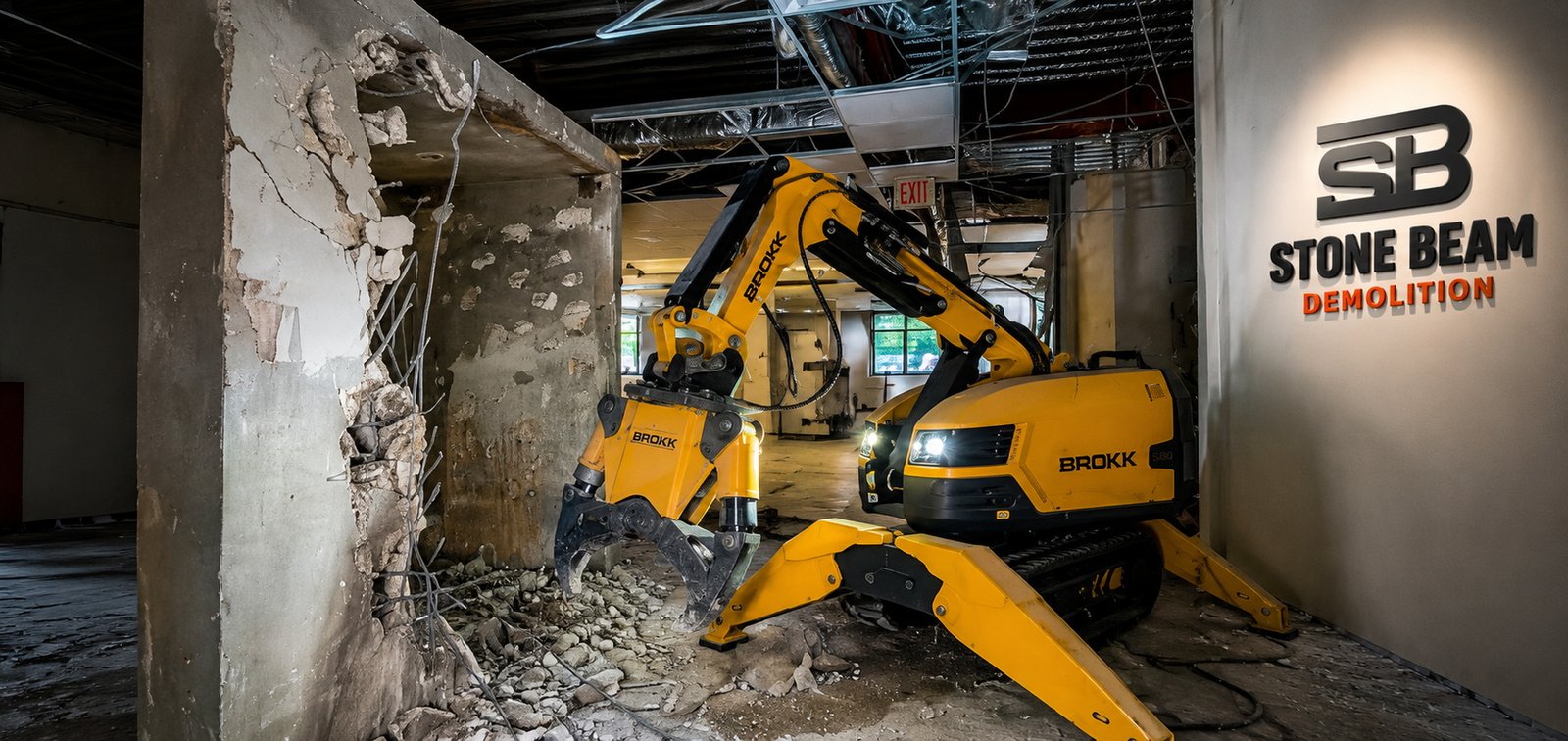
Robotic demolition is useful when a project needs the productivity of mechanised concrete removal but a full-size excavator can't safely reach the workface, and placing workers directly beside handheld breakers would create unnecessary exposure. On an upper floor, the machine's self-weight is only part of the load case; the route, local reactions, openings, temporary propping, and accumulating debris can control whether the machine may be used at all.
Demolition provides project-specific robotic demolition in Dubai and the UAE, coordinated with structural review, temporary support, concrete scanning, diamond cutting, controlled demolition, and waste handling. The machine class and attachment are selected only after the work area, access, floor capacity, and sequence are understood.
Request a technical assessment
Send marked demolition drawings, concrete thicknesses, floor level, structural information, doorway and lift dimensions, access route, available power, debris route, occupied-area restrictions, photographs and video.
Request a demolition quote
Use this form layout on the live page to qualify leads before a call.
An equipment technique, not a project category
A robot may be one tool inside a controlled demolition plan, a building alteration, or an internal concrete-removal package; the wider project still needs its own structural sequence and permits.
Page / method
Robotic demolition
Controlled demolition
Conventional demolition
Partial & selective demolition
Interior strip-out
Decided from site conditions, not a generic claim
Not from a claim that robotic equipment is always "low vibration", "silent," or suitable for any suspended slab.
Door width, corridor corners, ramps, openings, and lift dimensions are checked against the exact model, including machine recovery if a route changes.
Lighter than an excavator doesn't automatically mean it's adequate; dead load, reactions, debris load, and travel path need engineering review.
Keeps the operator away from the breaking face but doesn't solve the building-management problem; noise, dust, and egress still need planning.
Using a robot doesn't cancel confined-space controls; entry, ventilation, and rescue remain governed by the risk assessment.
After the demolition boundary is defined, saw cutting, coring, or propping may still be needed for clean separation.
"Fits through any 80cm door" or "climbs stairs" only holds for a named machine, manufacturer limits and the actual project route.
Dimensions decide what actually fits
A narrow machine isn't automatically correct; the project also needs enough reach, attachment capacity, and stability. Manufacturer-published examples checked 8 Aug 2026 (planning reference only, not a statement of owned fleet).
Example class
Brokk 70+ class
Brokk 170+ class
Brokk 200+ class
Access planning
The route matters as much as the workface
A survey measures the complete route, not only the final doorway.
Unloading & lifting point
Doors, corridors & turns
Ramps & thresholds
Lift access
Slab capacity along the route
Emergency recovery route
Low vibration" is too simple
No robotic attachment should be marketed as vibration-free, a crusher must grip the concrete, which generates its own reaction forces.
Attachment
Hydraulic breaker
Crusher / pulveriser
Drum cutter / milling
Shear / metal attachment
Bucket / grapple
Electric doesn't mean zero-impact
Electric operation removes diesel exhaust at the workface, but shouldn't be called "zero emissions", it doesn't remove dust, heat, noise or electrical risk.
Power confirmation
Structural sequence
Scanning + cutting + robotics
6. Define controls
Temporary support, load spreading, exclusion zones, power and environment.
7. Execute staged demolition
Debris quantities controlled so temporary floor loading stays within plan.
8. Inspect & remove waste
Retained structure inspected; material segregated and transported.
9. Handover
Records, photographs and outstanding interfaces closed out.
1. Define
boundary
Demolition boundary and retained elements from marked drawings.
2. Review
floor capacity
Structural behaviour and temporary states where the machine will travel.
3. Measure
the route
Doors, lifts, ramps, corners and floor transitions in full.
4.Confirm
isolations
Service isolation and scanning where concealed items affect the work.
5. Select
machine & attachment
From access, reach, concrete, reinforcement and required production.
Nine steps built around the constraints
Built around the specific project, not a standard machine deployment.
The machine is only one cost component
A small machine on a ground-floor wall is a different commercial problem from a robot crane working on an upper level over temporary propping.
Machine & attachment
Concrete & reinforcement
Access & lifting
Floor-load controls
Scanning & cutting
Power & environment
Working hours
Debris & handover
No day rate
There's no defensible universal square metre or hourly rate; Stone Beam issues a project-specific itemised quotation rather than a generic robot day rate.
A constraint-first approach, not an equipment catalogue
The project succeeds when the machine can reach the workface, the structure can support it, and the debris leaves the floor as fast as it's produced.
Access, floor capacity and power confirmed before a machine is proposed.
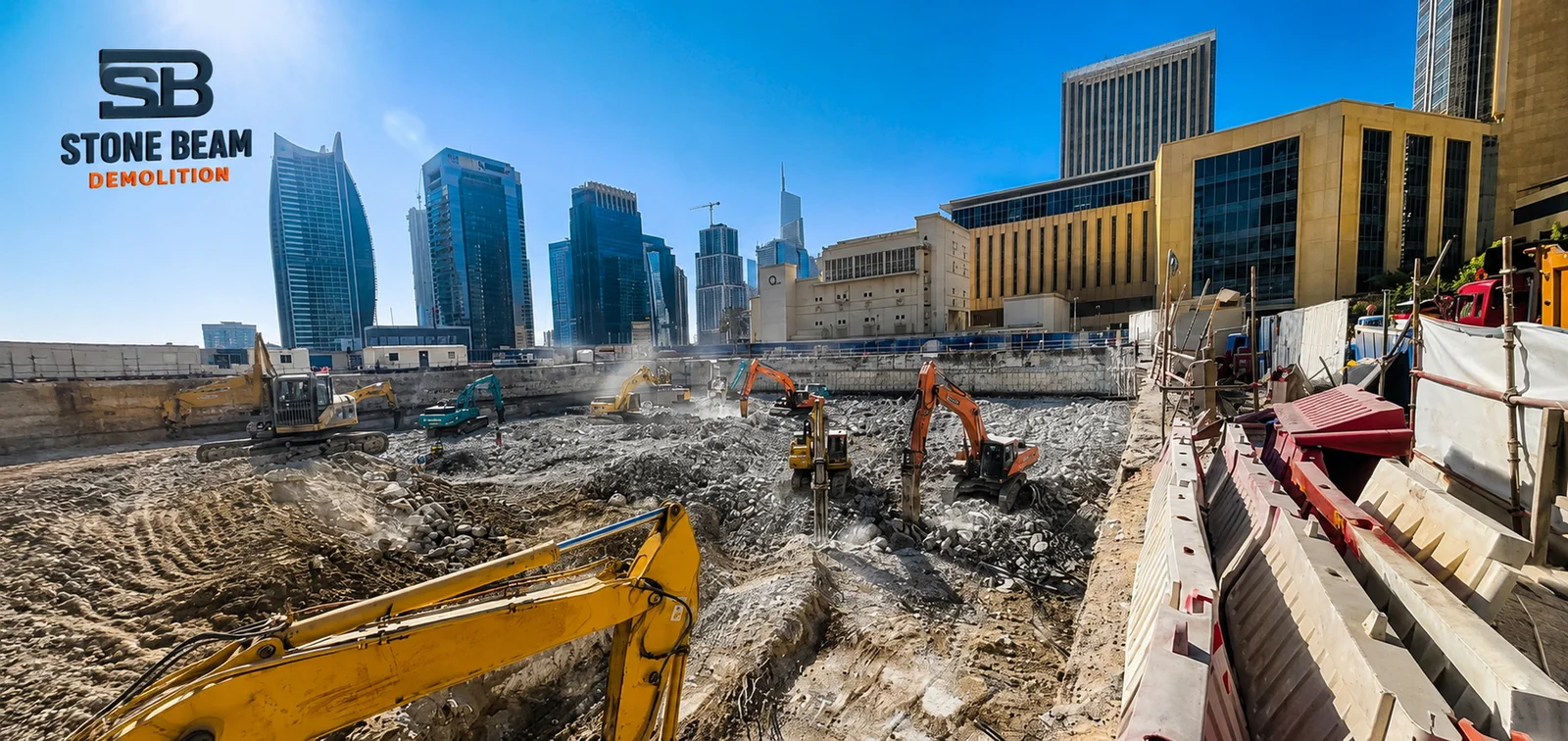
Concrete cutting, scanning, temporary support and lifting coordinated where required.
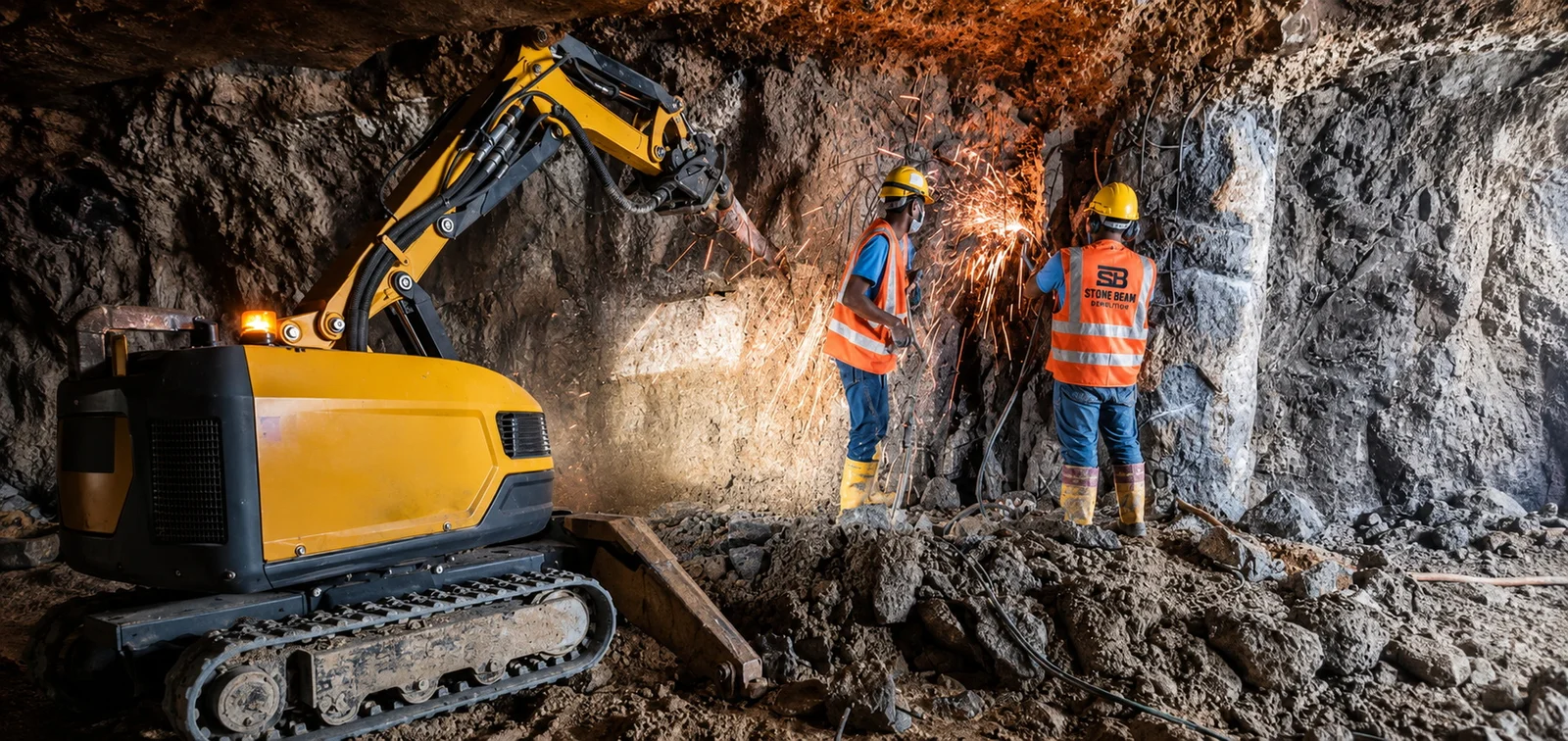
Access, floor-load review, power responsibility and handover named explicitly.
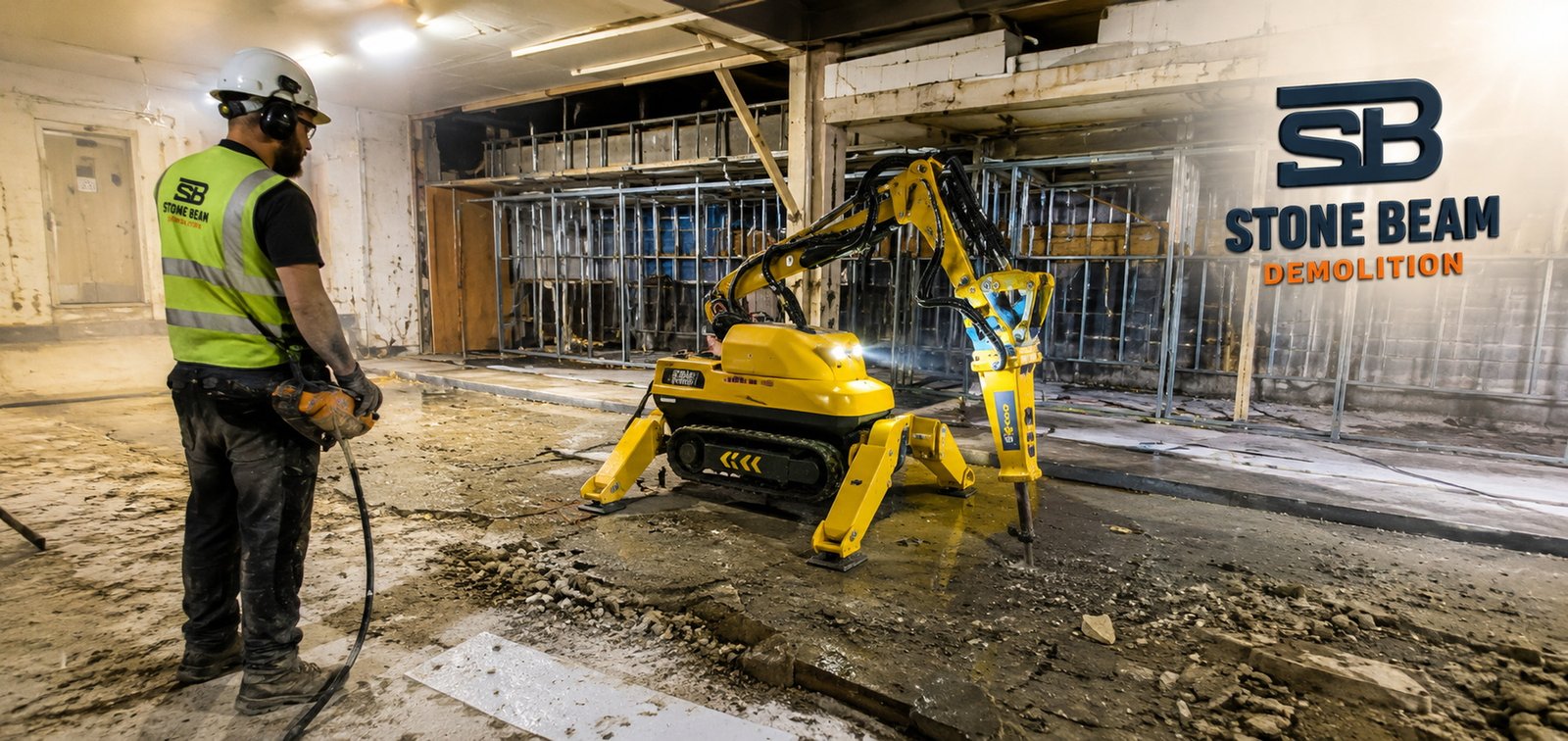
Machine class named only after availability and project suitability are verified.
Common questions, answered straight
What consultants and building managers ask before they call.
It can be, but only after the machine, attachment, local reactions, travel route, and debris have been checked against the structure. "Compact" doesn't mean automatically adequate.
Some models are very narrow, but there's no universal doorway rule; the exact machine width, corridor turns and complete access route must be measured
Potentially, if the lift owner approves it and the car dimensions, door opening, rated payload, and floor protection are verified. Never assume based on machine width alone.
Breakers, crushers and cutters transmit different forces to the structure; attachment and method are selected for project sensitivity, with monitoring where limits apply.
No. Concrete breaking can generate silica dust and significant noise. Remote operation changes the operator's position but doesn't remove the need for dust and noise controls.
Brokk is a well-known manufacturer of remote-controlled demolition robots. "Robotic demolition" is the broader service category; the actual machine is confirmed after availability and suitability checks.
Not always. Cutting may be required for a clean separation line or to protect retained concrete. Robotic demolition and diamond cutting often complement each other.
Scanning is used when concealed reinforcement, tendons, or services affect the work and when a risk assessment or a consultant requires verification.
Depends on machine class, concrete and reinforcement, access, floor-load controls, working hours, power, and debris route — an itemised, site-specific quotation is more reliable than a generic day rate.
Still have questions?
