What matters when choosing a demolition company in Dubai
Do not shortlist a contractor only because it publishes a long services list. The stronger test is whether it can show the right evidence for your project: legal identity and company qualification, project-specific permits or NOCs where applicable, insurance fit, documented completed work, and a clear technical and commercial scope.
Stone Beam Demolition is the operating brand of STONE BEAM TECHNICAL SERVICES L.L.C.
Stone Beam’s controlled records include a Dubai Municipality practice permit copy that records Wrecking & Demolition Works G+12 and Concrete Restoration, together with authority-backed completion records for a parking-block demolition and for demolition of a private villa, basement, and foundations. Those company and completion records do not replace the approvals, NOCs, engineering releases, or insurance review required for a particular project.
How to verify a demolition company in Dubai before award
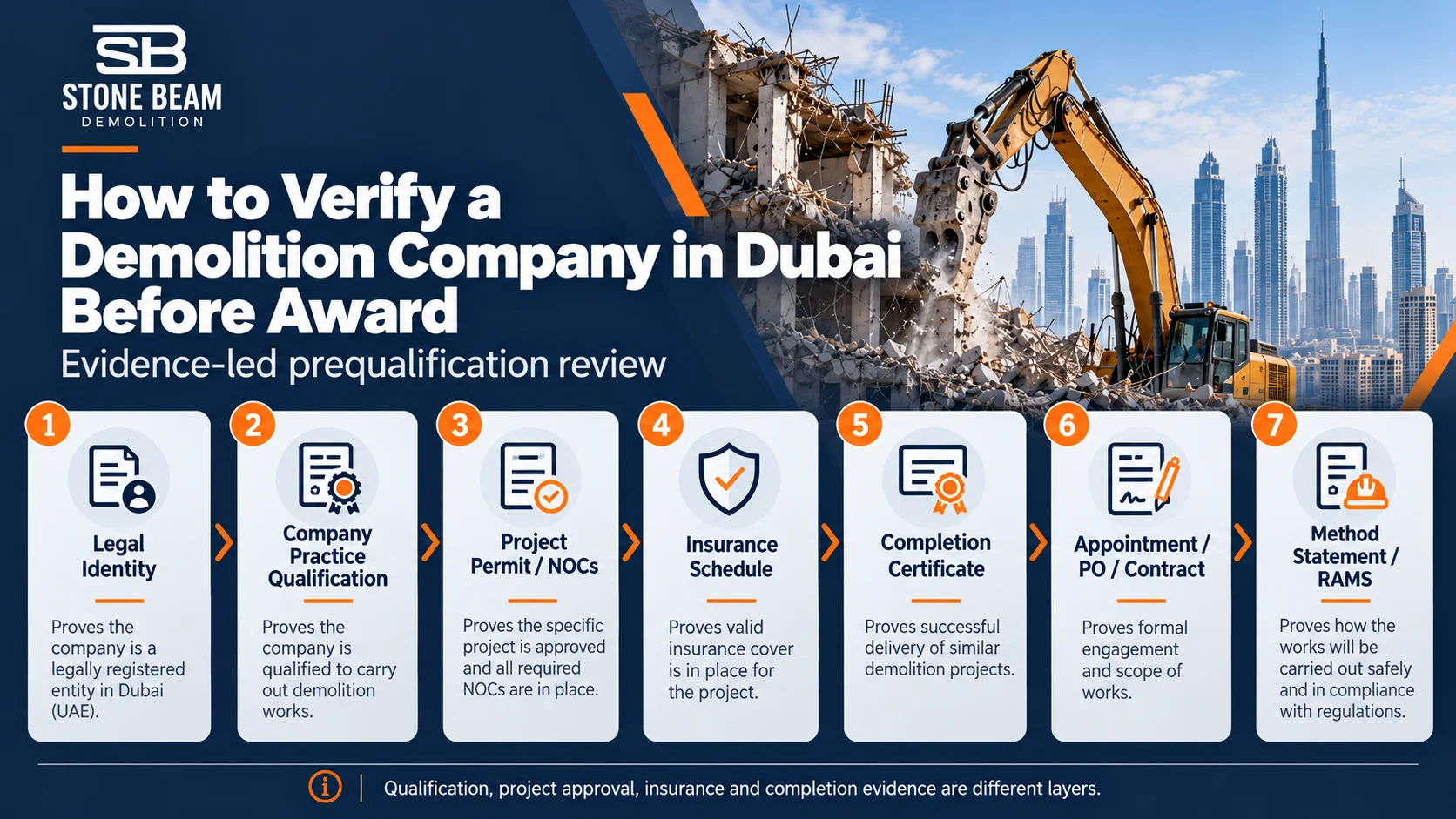
A credible prequalification review should follow an evidence chain instead of relying on marketing wording. The table below shows the most useful evidence layers and the common mistake to avoid with each one.
| Evidence layer | What it proves | What it does not prove |
|---|---|---|
| Legal identity | Confirms who is contracting and invoicing. | Does not prove technical competence or project approval. |
| Company practice qualification | Shows the activities/category recorded for the company in the reviewed authority document. | Does not authorise a specific site or replace project permits/NOCs. |
| Project permit / NOCs | Shows the relevant authority/operator has released a defined project or interface. | Does not prove the contractor completed the work. |
| Insurance schedule | Shows the policy, period, limit, and terms recorded in the insurance document. | Does not mean every demolition scope, method or height is automatically covered. |
| Completion certificate | Shows completion status for the work described in that authority record. | Does not prove unrelated scopes, quantities, programme or whole-development performance. |
| Appointment / PO / contract | Shows Stone Beam was engaged for the stated scope. | Must not be upgraded to ‘completed’ without close-out evidence. |
| Method statement / RAMS | Shows a planned project-specific approach and control framework. | Does not prove measured outcome or authority acceptance unless separately recorded. |
A practical six-point shortlist
- Confirm the exact legal entity that will contract for the work.
- Check the company activity/category recorded in the relevant current corporate practice or engineering register.
- Identify the project authority and the permit/NOC route that applies to that site.
- Review insurance against the actual demolition scope instead of relying on a headline limit alone.
- Ask for completion evidence that is comparable to the proposed work, not just appointments or quotations.
- Define the technical and commercial boundary clearly enough that competing quotations are comparable.
What Stone Beam can verify and what each record proves
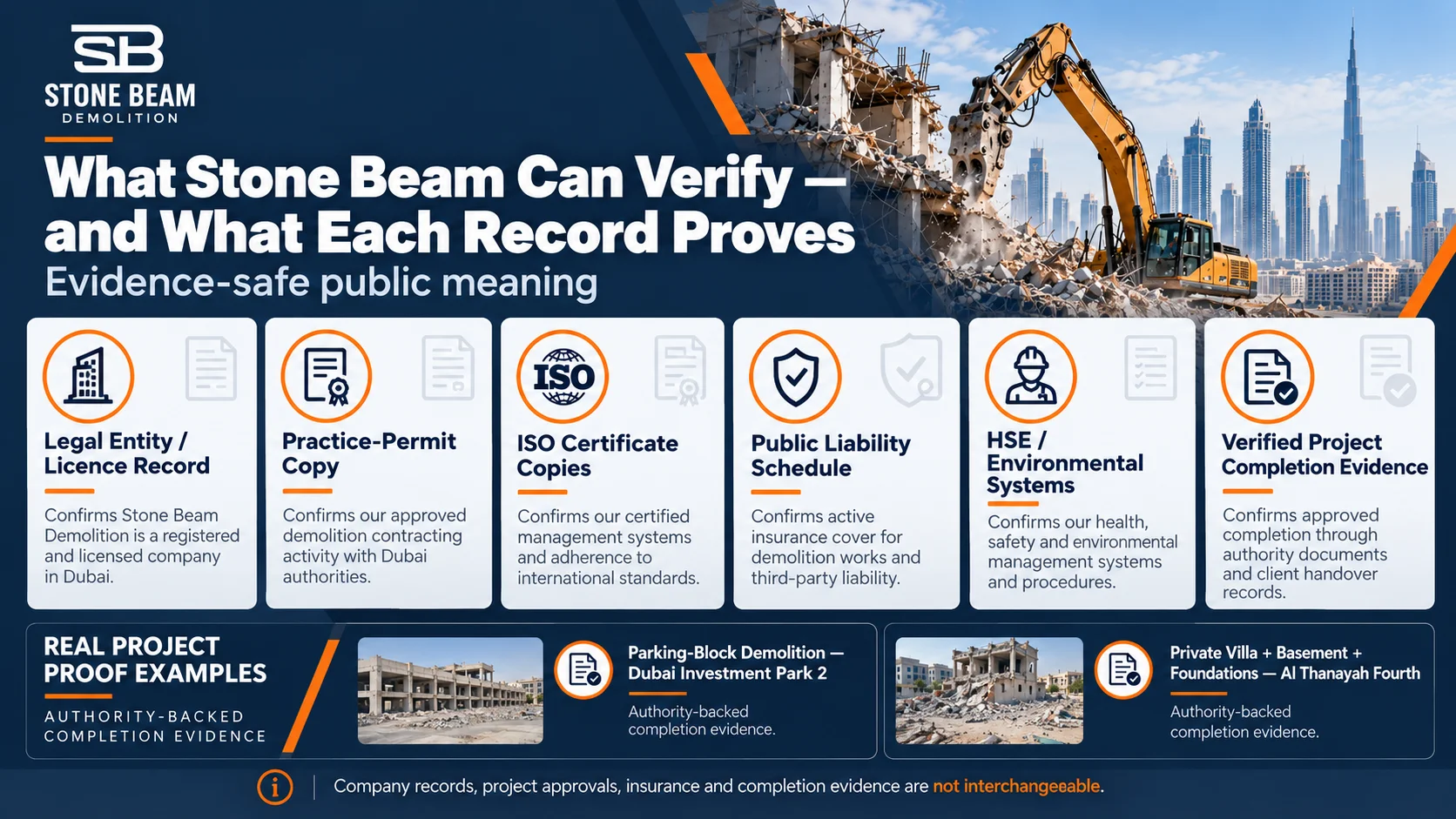
Stone Beam’s public claims on this page are deliberately limited to the level supported by the controlled evidence set. That makes the evidence more useful in procurement because qualification, management systems, insurance and project completion are not treated as interchangeable.
| Stone Beam record | Evidence-safe public meaning | Boundary |
|---|---|---|
| Legal entity / licence record | STONE BEAM TECHNICAL SERVICES L.L.C.; trade licence number 1563419 appears in the reviewed corporate records. | Licence identity is not a project permit. |
| Practice-permit copy | The reviewed copy records Wrecking & Demolition Works — G+12 and Concrete Restoration, with expiry printed as 13 November 2026. | The current status is time-sensitive and should be rechecked when relied on for procurement. |
| ISO certificate copies | Reviewed copies cover ISO 9001:2015, ISO 14001:2015 and ISO 45001:2018, with scope including Wrecking & Demolition Works and a printed certificate period ending 2 April 2029. | Certificate copies do not prove every project outcome, service capability or incident/recycling result. |
| Public liability schedule | The reviewed schedule records AED 10 million any one occurrence for 30 March 2026–29 March 2027, subject to policy terms, exclusions and endorsements. | A policy headline must not be read as automatic cover for every height, method, hazard or project. |
| HSE / environmental systems | Stone Beam has controlled HSE and environmental policy/management documentation. | A policy or plan is not proof of a zero-incident result or a measured recycling percentage. |
| Important procurement distinction Corporate qualification answers “what category is the company recorded for?” Project approval answers “has this specific site/scope been released by the relevant authority or operator?” Insurance answers a third question: “does the policy respond to this actual scope under its terms?” These should be checked separately. |
What to request from Stone Beam before award
For a prequalification or tender review, ask for the current document set relevant to the actual scope. The purpose is to compare evidence at the right level, not to collect logos or generic marketing claims.
| Request | Why it matters |
|---|---|
| Current legal / company record relevant to the tender | Confirms the contracting entity and the corporate record being relied on. |
| Current demolition practice / activity qualification copy | Shows the recorded demolition category or activity; it is still separate from the project permit. |
| Current insurance schedule and applicable exclusions | Lets the buyer test the actual project scope against the policy terms instead of relying on a headline limit. |
| Comparable completion evidence where available | Separates completed comparable work from quotations, appointments, POs or method statements. |
| Project-specific proposal with assumptions and responsibility split | Makes price, programme and technical comparisons more meaningful and exposes exclusions before award. |
Verified Stone Beam demolition project evidence
For this page, project proof is limited to records that support the status stated. Two Stone Beam demolition projects have authority-backed completion evidence in the controlled project register.
| Verified proof node | What the completion record supports | Limitation |
|---|---|---|
| Parking-block demolition — Dubai Investment Park 2 | A Dubai Municipality completion certificate names Stone Beam as demolition contractor for a parking-block building, with completion dated 29 July 2026. | The record proves the described demolition completion; it does not establish unrelated quantities, programme or performance claims. |
| Private villa + basement + foundations — Al Thanayah Fourth | A Dubai Municipality completion certificate names Stone Beam as contractor for demolition of a private villa, basement and foundations, with completion dated 14 July 2026. | Private-owner details are not published here; the record is used only for the stated completed scope. |
Other Stone Beam records can show appointment, contract, purchase order, technical planning or execution documentation for additional scopes. They are not labelled “completed” on this page unless a completion/close-out record supports that status.
Demolition capabilities: route each scope to the right specialist page
This page is the broad commercial contractor-selection owner. It should not duplicate the technical depth of every specialist service. Use the most specific surviving service page when your scope is already known.
| Scope | When to use it |
|---|---|
| Villa demolition | Residential full-demolition scope and villa-specific planning. |
| Building demolition | General building-demolition scope where that page is the better specialist fit. |
| Commercial demolition | Commercial-property scope and interfaces. |
| Controlled demolition | Precision or constrained demolition requiring project-specific review. |
| Conventional demolition | Conventional demolition scope where appropriate. |
| Concrete cutting | Saw cutting, drilling and related controlled concrete-removal scope. |
| Concrete scanning | GPR / investigation support before intrusive work; scanning is not a stand-alone safe-to-cut certificate. |
| Bridge demolition | Bridge-specific demolition interfaces. |
| Steel dismantling | Steel-structure dismantling and salvage-oriented planning. |
| Facility decommissioning | Facility shutdown/decommissioning interfaces at decision level. |
| Demolition waste disposal | Waste-routing, carting and disposal-scope decisions. |
If the project combines several scopes, the commercial owner can coordinate the initial review while the relevant specialist owner carries the deeper technical information.
How a demolition project is screened before method, programme and price
A demolition quotation is only as reliable as the information used to define the work. Stone Beam’s initial review should resolve the following decision areas before a final method, programme or commercial offer is treated as project-specific.
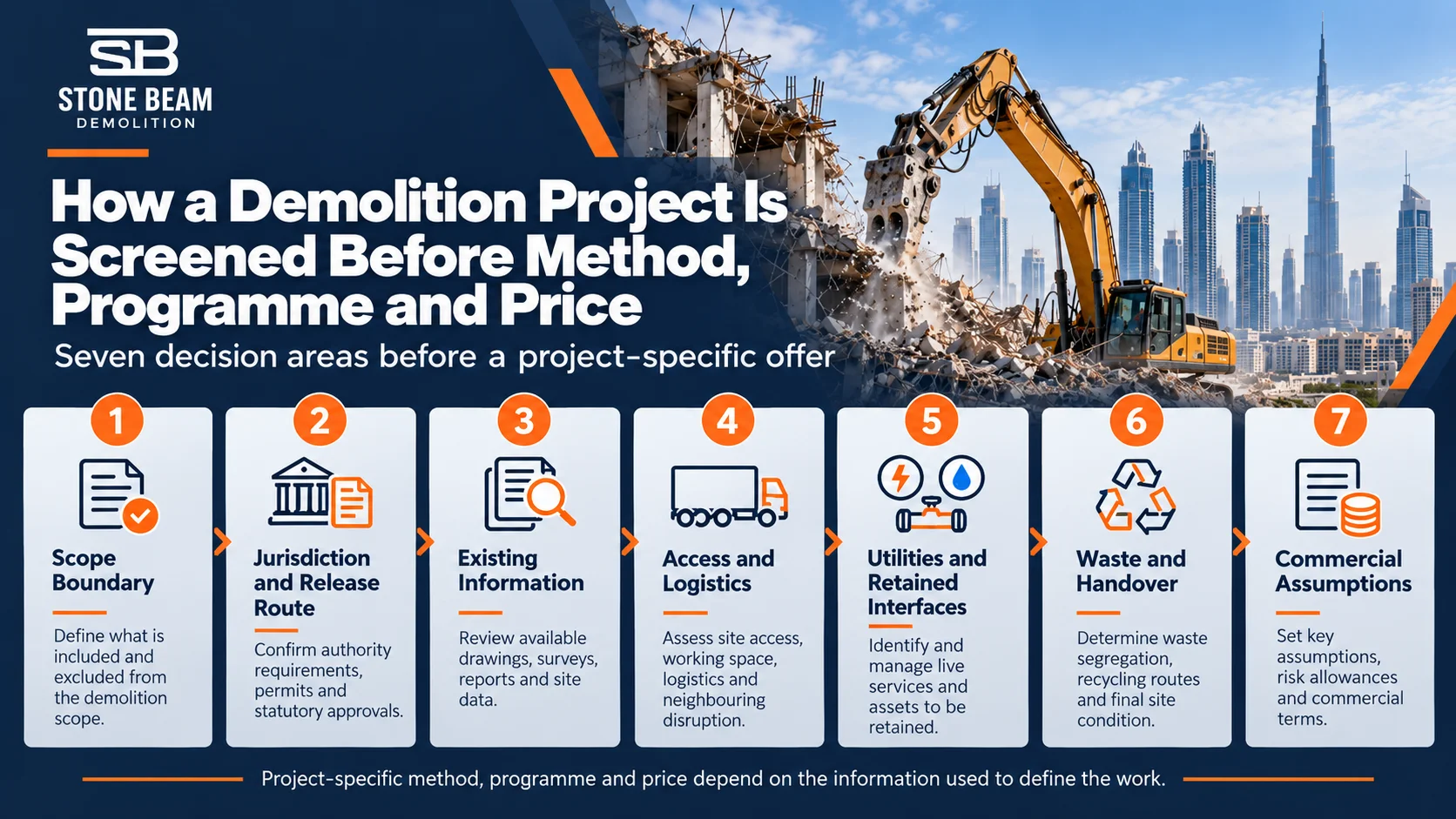
| Screening area | Decision question |
|---|---|
| 1. Scope boundary | What is removed, retained, protected and handed over? Are foundations, basements, slabs, façades or external works included? |
| 2. Jurisdiction and release route | Which authority, developer, landlord, or operator controls the demolition permit, NOCs, or access releases? |
| 3. Existing information | What drawings, surveys, scans, as-builts, condition information, and hazardous-material records are available? |
| 4. Access and logistics | What limits plant, trucks, lifting, staging, waste routes, vertical transport, or working hours? |
| 5. Utilities and retained interfaces | Which services/assets remain live, and who owns isolation, protection,n and release responsibilities? |
| 6. Waste and handover | Where does demolition scope end: debris point, carting, disposal, salvage, backfill, grade, cleaning or records? |
| 7. Commercial assumptions | Which unknowns could change the quotation, programme or responsibility split if later information changes? |
| Engineering boundary Public website content can explain the decisions, records and interfaces that must be resolved. It should not substitute for project-specific structural design, temporary-works design, lifting planning, process isolation, hazardous-material planning or authority approval. |
Permits and approvals: company qualification is not a project permit
The permit route depends on the site’s governing authority and development. Dubai Municipality currently lists a service to obtain a permit for full or partial building demolition and states that the demolition permit is valid for three months. Dubai Development Authority (DDA) publishes a separate demolition-permit route for projects under its jurisdiction.
Current official references (checked 4 October 2026): Dubai Municipality — Permit to Carry Out Demolition Works | Dubai Development Authority — Demolition Permit
For example, DDA’s published route identifies the contractor as the requester and lists project documents such as the demolition scope/site plan, applicable NOCs, hoarding layout, method statement, HSE/emergency information with risk assessments, an impact study for neighbouring buildings and site photographs. Those DDA requirements should not be generalised as the exact checklist for every Dubai site; the correct authority route must be confirmed for the project.
What to send for a useful technical and commercial proposal
The fastest way to improve quotation quality is to reduce ambiguity. Send the information below when it is available; it is a commercial/technical input list, not a universal legal checklist.
- Project location and the governing authority/development, if known.
- Latest architectural, structural,al and relevant as-built drawings available for review.
- A marked-up remove/retain boundary, including foundations and below-ground scope where applicable.
- Current site photographs and any known access, gate, loading, lift, basement or staging restrictions.
- Building use and whether adjacent or retained areas remain occupied or operational.
- Known utility/service status and who is responsible for isolation, release and reconnection interfaces.
- Required working hours, shutdown windows or community / landlord restrictions.
- Waste, carting, salvage and scrap-ownership responsibilities.
- Temporary works, scaffold, lifting and specialist interfaces that are by others or still to be defined.
- Required handover condition: retained elements, debris point, backfill/grade, cleaning and records.
- Target programme, tender deadline and any phased handover requirement.
- BOQ, tender clarifications and commercial inclusions/exclusions that the quotation must follow.
For the full RFQ information framework and like-for-like tender preparation, use What Information Is Needed for a Demolition Quotation?
What Stone Beam can do next?
With those inputs, Stone Beam can review the scope boundary, identify missing information, route specialist interfaces, state quotation assumptions,s and prepare a project-specific technical/commercial proposal. Final permits, engineering releases, programme and price remain subject to the actual project information and relevant approvals.
Common buyer questions
Is a company practice permit the same as a demolition permit for my project?
No. A company practice record supports corporate qualification for the activity/category shown in that document. A project demolition permit and required NOCs are separate project-level releases governed by the relevant authority or operator.
Does a G+12 company qualification mean every G+12 demolition project is automatically approved or insured?
No. Corporate qualification, project approval, and insurance are different evidence layers. Project-specific authority requirements, technical review, and insurance terms still need to be checked for the actual scope.
What should I compare when I receive demolition quotations?
Compare scope before price: remove/retain boundaries, foundations, access, protection, utilities, waste/carting, temporary works, lifting/scaffold interfaces, working hours, handover condition, and the assumptions that could become variations.
Can a demolition company price accurately from photos alone?
Photos can support an initial review, but a dependable technical and commercial proposal normally needs the defined scope plus available drawings, access information, utility status, responsibilities, and handover requirements.
How long does a demolition project take in Dubai?
There is no universal duration. Readiness and execution are separate clocks. Authority releases, utility interfaces, access, retained assets, waste logistics, temporary works, and scope certainty can affect when physical demolition can start and how the programme is built.
Request a project-specific review
| Send the project information that changes the decision Share the project location, drawings, current photos, remove/retain scope, access/work-window constraints, utility status, required handover, and tender/BOQ requirements. Stone Beam can use that information to define the review basis before issuing a technical and commercial proposal. |
Evidence and source note
Corporate, certificate, insurance and project statements on this page are limited to Stone Beam-controlled records reviewed for this content programme. Time-sensitive credential standing should be rechecked when relied on for procurement. Authority-process statements link to current official government sources and should be rechecked if the governing jurisdiction or service requirements change.
