
Tunnel demolition in Dubai is an underground-interface problem before it is a demolition-method problem. The feasible approach depends on the work-zone geometry, what must remain in service, nearby structures and utilities, ventilation and emergency access, the debris route, operational work windows, and the project-specific structural, geotechnical and monitoring criteria.
There is no universal tunnel-demolition method or monitoring threshold. Before a contractor selects equipment or a removal sequence, the project team should define the remove/retain boundary, obtain available structural and ground information, identify affected assets and services, confirm the competent authority or asset operator, and agree who owns monitoring criteria, temporary stability decisions and release evidence.
| Decision rule Do not choose the demolition method first. First define the underground constraints and evidence needed to prove that the work can be carried out within the project’s approved interfaces. |
|---|
What makes tunnel demolition different from conventional demolition?
The defining issue is constraint density. In a tunnel or underground asset, access may be limited to one portal or shaft; services may remain live nearby; the structure may be part of a larger retained system; ventilation and evacuation routes can limit how many people and machines can work at once; and debris may have to travel through the same restricted route used for labour and plant.
These conditions interact. A method that is practical in an open site may become unsuitable underground because it blocks egress, produces an unacceptable debris-handling problem, conflicts with retained services, or requires temporary support and monitoring that have not been designed or approved.
The result is a decision process rather than a universal recipe: define the environment, identify interfaces, obtain project criteria, compare feasible removal options, then issue the execution method through the project’s normal engineering and approval route.
Define the underground work zone before choosing a method
A useful demolition brief starts by separating three things: what will be removed, what must remain, and what can be affected even though it is outside the demolition boundary.
| Question | What the project team should establish | Why it changes the decision |
|---|---|---|
| What is removed? | Element type, location, extent and required final condition. | Defines the actual demolition scope rather than a generic “tunnel demolition” label. |
| What remains? | Retained lining, structure, waterproofing, services, tracks, road assets or adjacent occupied areas. | Determines protection, stability and acceptance requirements. |
| What surrounds the work? | Ground, neighbouring assets, utilities, operating systems, traffic/rail interfaces and access routes. | May control monitoring, work windows and method feasibility. |
| What information is missing? | Unavailable drawings, unknown modifications, inaccessible zones or unconfirmed services. | Creates investigation or specialist-review actions before intrusive work. |
Underground constraints that change demolition feasibility
1. Access and geometry
Record portal, shaft or internal access dimensions; turning and setup space; route restrictions; lifting or lowering interfaces; and whether plant, materials and removed sections can physically enter and leave the work zone. Access is not a logistics afterthought — it can eliminate otherwise attractive demolition options.
2. Retained and adjacent assets
Identify the elements that must remain serviceable and the assets that could be affected by demolition activity. Depending on the project, this may include adjacent structures, tunnel lining, road or rail systems, utilities, waterproofing, instrumentation, finishes or operational equipment. The relevant designer, operator or consultant should define the criteria that govern protection and acceptance.
3. Utilities and operational services
Do not assume that a service shown on a drawing is isolated or abandoned. The scope should distinguish known service locations, service status, the party authorised to isolate or release them, and the evidence required before the workfront is handed over. The demolition contractor can plan around documented interfaces; it should not invent utility status.
4. Ventilation, work environment and emergency access
Underground work can place ventilation, dust control, heat, lighting, egress and emergency-response constraints at the centre of the programme. The article does not prescribe confined-space or ventilation values: those belong to the project HSE plan, applicable authority/operator requirements and competent specialist review.
5. Debris route and work windows
A demolition method is incomplete until the removed material has a safe and practical route out. Confirm load-out points, handling restrictions, traffic or rail possessions where applicable, storage limits and the required handover condition. In constrained underground projects, the debris route can be as decisive as the breaking or cutting technique.
6. Structural, temporary-works and ground interfaces
If the work can affect load paths, temporary stability, ground response, dewatering, support systems or retained structural adequacy, those decisions must be treated as project-specific engineering interfaces. A public article can identify the questions and responsibilities; it should not publish a generic support arrangement, demolition sequence or settlement trigger.
Underground constraint / interface map
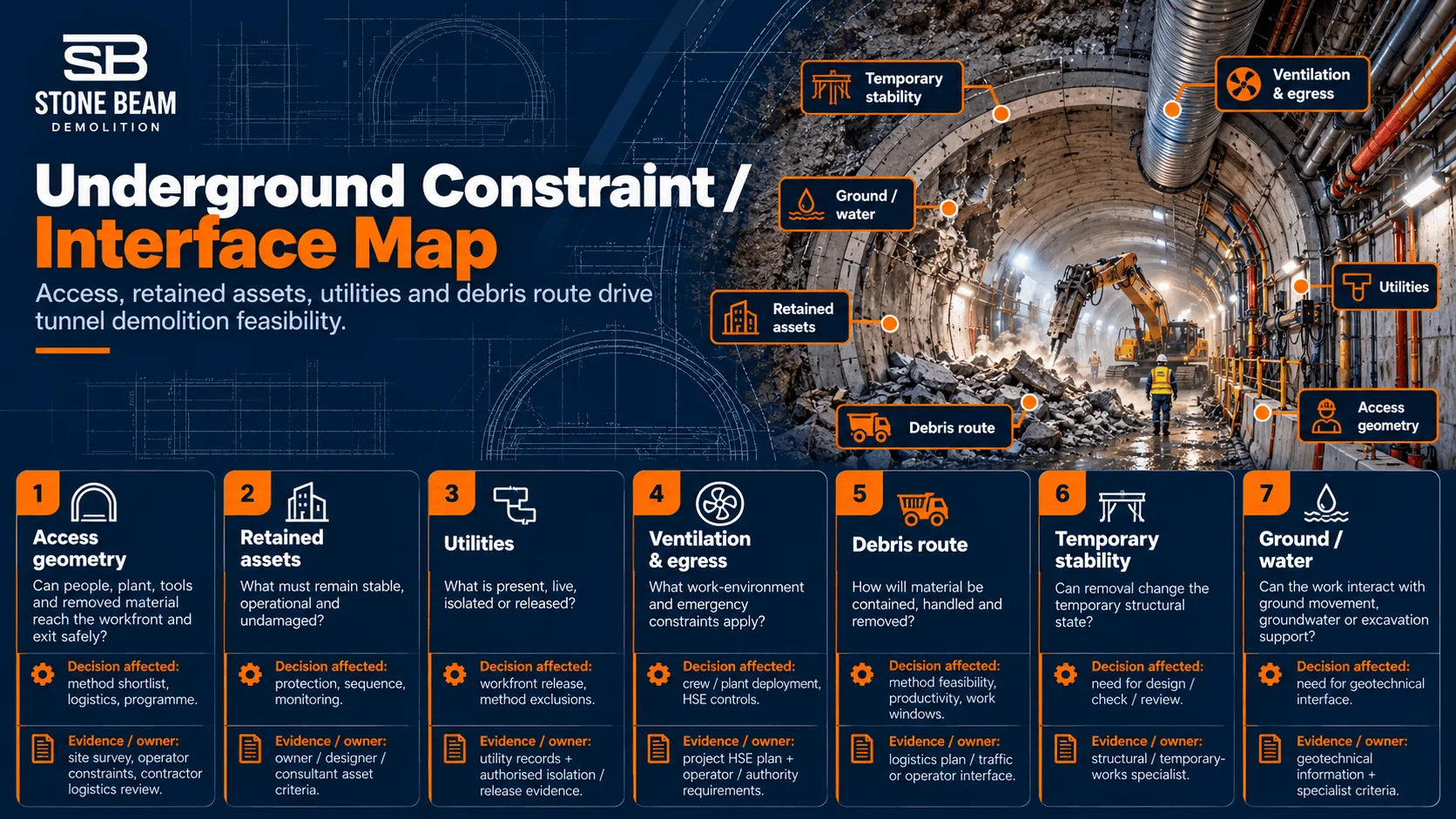
| Constraint | Question to resolve | Decision affected | Evidence / owner |
|---|---|---|---|
| Access geometry | Can people, plant, tools and removed material reach the workfront and exit safely? | Method shortlist; logistics; programme | Site survey / operator constraints / contractor logistics review |
| Retained assets | What must remain stable, operational and undamaged? | Protection; sequence; monitoring | Owner / designer / consultant asset criteria |
| Utilities | What is present, live, isolated or released? | Workfront release; method exclusions | Utility records + authorised isolation/release evidence |
| Ventilation & egress | What work-environment and emergency constraints apply? | Crew/plant deployment; HSE controls | Project HSE plan + operator/authority requirements |
| Debris route | How will material be contained, handled and removed? | Method feasibility; productivity; work windows | Logistics plan / traffic or operator interface |
| Temporary stability | Can removal change the temporary structural state? | Need for design/check/review | Structural / temporary-works specialist |
| Ground / water | Can the work interact with ground movement, groundwater or excavation support? | Need for geotechnical interface | Geotechnical information + specialist criteria |
How to specify monitoring without inventing a universal threshold
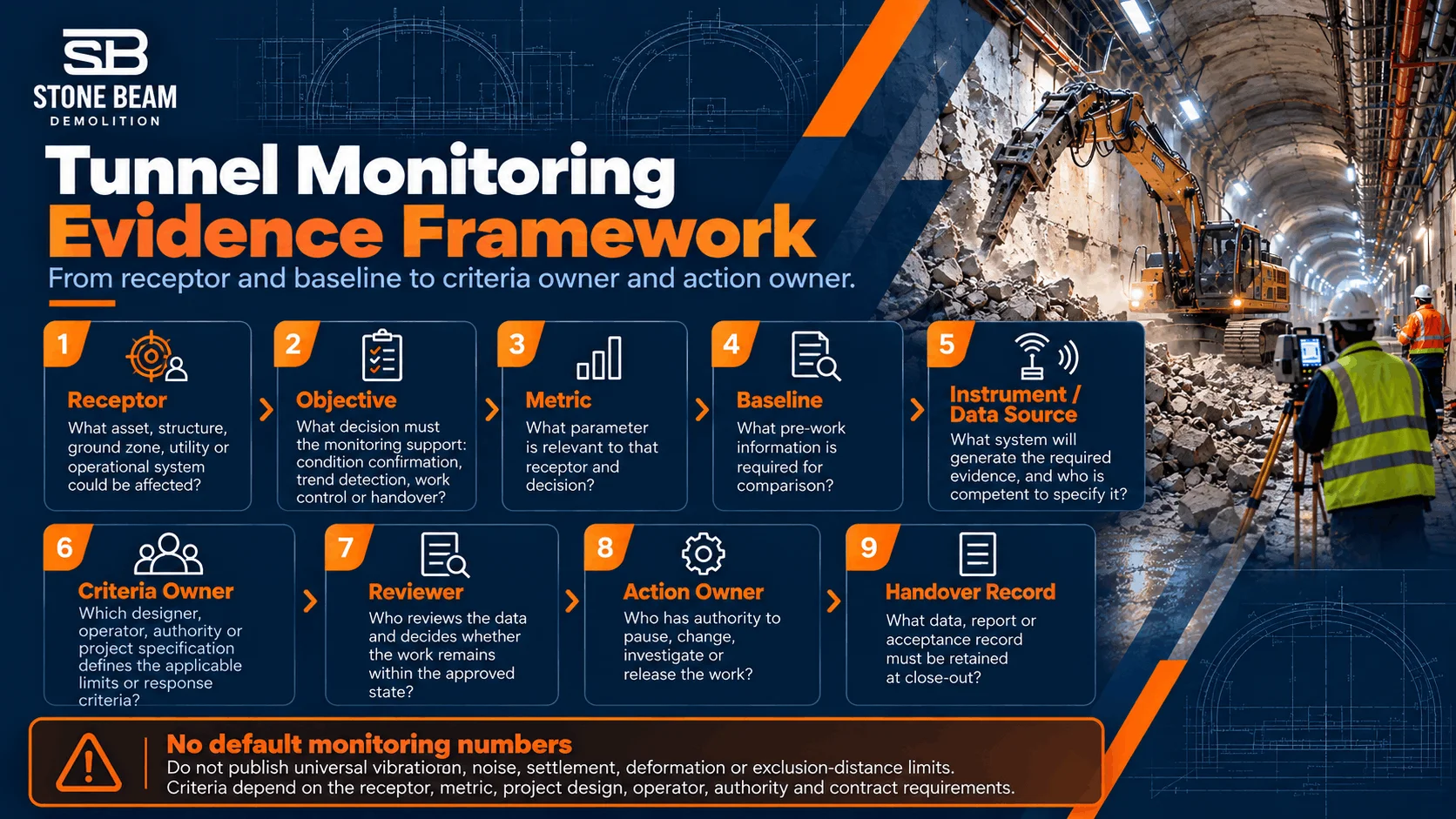
Monitoring should start with the asset or receptor and the decision the data must support — not with a generic number copied from another tunnel. The project should identify what could be affected, what parameter represents the concern, what baseline is needed, who sets the acceptance or action criteria, who reviews the data, and who is authorised to respond if the criteria are approached or exceeded.
| Monitoring field | Project question |
|---|---|
| Receptor | What asset, structure, ground zone, utility or operational system could be affected? |
| Objective | What decision must the monitoring support — condition confirmation, trend detection, work control or handover? |
| Metric | What parameter is relevant to that receptor and decision? |
| Baseline | What pre-work information is required for comparison? |
| Instrument / data source | What system will generate the required evidence, and who is competent to specify it? |
| Criteria owner | Which designer, operator, authority or project specification defines the applicable limits or response criteria? |
| Reviewer | Who reviews the data and decides whether the work remains within the approved state? |
| Action owner | Who has authority to pause, change, investigate or release the work? |
| Handover record | What data, report or acceptance record must be retained at close-out? |
| No default monitoring numbers This guide intentionally does not publish universal vibration, noise, settlement, deformation or exclusion-distance limits. Those values depend on the receptor, metric, project design, operator, authority and contract requirements. |
|---|
Authority and asset-operator route in Dubai
The correct approval route depends on the location, asset and jurisdiction. A company practice qualification is not a project demolition permit, and one authority’s document list should not be presented as a Dubai-wide rule.
Dubai Development Authority (DDA). For projects within DDA jurisdiction, the current demolition-permit service requires project documents that include a demolition method statement, project-specific HSE and emergency planning, risk assessments and a study of demolition impact on neighbouring buildings. Its NOC requirements also vary with the proposed method. DDA Demolition Permit
RTA Right-of-Way interfaces. Where proposed works fall within the road or infrastructure Right-of-Way, RTA provides dedicated construction-NOC routes. Projects within the Rail Right-of-Way have a separate RROW NOC route that calls for risk assessment and information on project sensitivity in relation to the railway. RTA Construction NOC for Infrastructure Work | RTA Rail Right-of-Way NOC
Dubai construction-safety framework. Decree No. 19 of 2025 established the emirate-wide framework, required a Safety Code for construction works and repealed Administrative Resolution No. 51 of 2008. Dubai Decree No. 19 of 2025 Administrative Resolution No. 112 of 2026 subsequently approved the “Safety Guide for Construction Works in the Emirate of Dubai” and provides for its publication by Dubai Municipality and the competent entities. Administrative Resolution No. 112 of 2026 (official Arabic) Project teams should apply the current published guide together with the competent entity’s project conditions; this page does not infer tunnel-specific numerical limits or procedures from the legislation alone. Dubai Municipality Safety Guide / legislation hub
How the project team should shortlist demolition methods
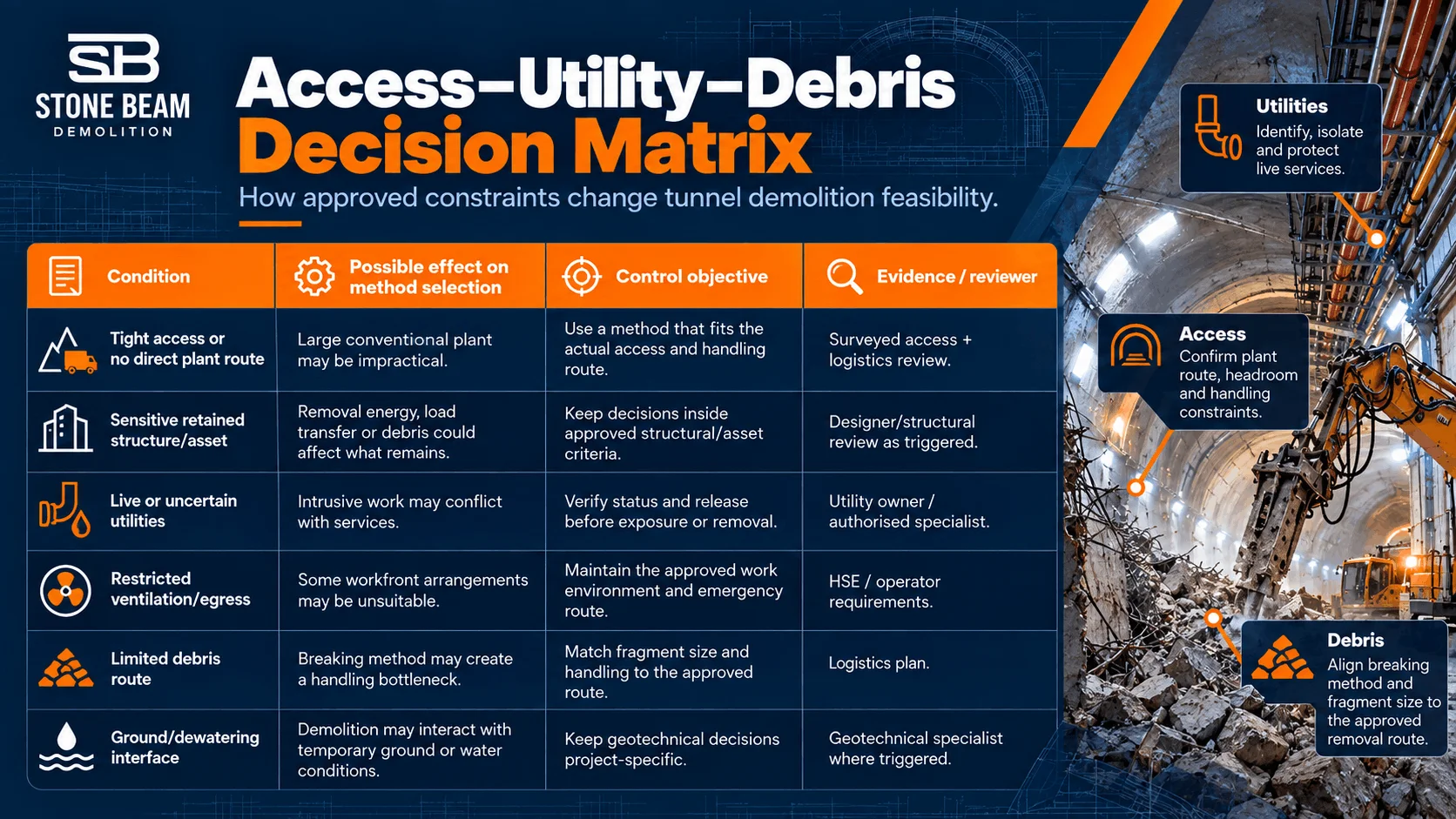
The purpose of method selection is to match a removal technique to the approved constraints — not to promote one technology as universally superior. The shortlist should compare what each option needs from access, temporary stability, services, debris handling, work environment, monitoring, plant setup, lifting or material handling, and final handover.
| Condition | Possible effect on method selection | Control objective | Evidence / reviewer |
|---|---|---|---|
| Tight access or no direct plant route | Large conventional plant may be impractical. | Use a method that fits the actual access and handling route. | Surveyed access + logistics review |
| Sensitive retained structure/asset | Removal energy, load transfer or debris could affect what remains. | Keep decisions inside approved structural/asset criteria. | Designer/structural review as triggered |
| Live or uncertain utilities | Intrusive work may conflict with services. | Verify status and release before exposure or removal. | Utility owner / authorised specialist |
| Restricted ventilation/egress | Some workfront arrangements may be unsuitable. | Maintain the approved work environment and emergency route. | HSE / operator requirements |
| Limited debris route | Breaking method may create a handling bottleneck. | Match fragment size and handling to the approved route. | Logistics plan |
| Ground/dewatering interface | Demolition may interact with temporary ground or water conditions. | Keep geotechnical decisions project-specific. | Geotechnical specialist where triggered |
Typical techniques may include selective saw or wire cutting, controlled mechanical removal, small or remote equipment, or other specialist methods where justified. The final choice, equipment model, sequence and temporary works belong in the project method statement and engineering review — not in a generic web article.
Who owns each evidence package?
Exact contractual duties vary, but the following responsibility map helps a buyer identify missing interfaces before tender or mobilisation. It is a coordination model, not a substitute for the project contract or authority conditions.
| Evidence / decision | Typical information owner or reviewer | What the demolition team needs before relying on it |
|---|---|---|
| Asset drawings and remove/retain boundary | Owner / designer / consultant | Controlled current information and marked-up scope |
| Service status and isolation | Utility owner / authorised specialist / operator | Location information plus documented isolation or release state |
| Structural / temporary stability criteria | Structural designer / temporary-works specialist | Approved criteria, design or release appropriate to the scope |
| Ground / groundwater criteria | Geotechnical designer / specialist | Relevant ground information and project-specific criteria |
| Monitoring criteria | Designer / operator / authority / project specification | Receptor, metric, baseline and response criteria with responsible reviewer |
| Workfront logistics | Demolition contractor within site/operator constraints | Access, plant, debris route, work windows and interfaces agreed |
| HSE / emergency controls | Project HSE route + operator / competent entity as applicable | Approved workfront controls, PTW interfaces and emergency arrangements |
| Close-out / handover | Contract/consultant/operator requirements | Required reports, records, condition evidence and acceptance route |
Handover evidence should be defined before demolition starts
A tunnel or underground demolition package is easier to close when the required records are agreed before mobilisation. Depending on the project, these can include approved drawings and revisions, isolation/release evidence, pre-work condition records, inspection and monitoring data, waste or disposal records, as-built or marked-up information, reinstatement records, photographs with permission, specialist reports, and consultant/operator acceptance.
The important point is not to collect documents for volume. Each record should prove a defined handover requirement or close a known project risk.
What Stone Beam evidence supports — and what it does not
Stone Beam Technical Services L.L.C. has supplied corporate evidence for wrecking and demolition activities, including a practice-permit copy that records Wrecking & Demolition Works — G+12 and Concrete Restoration with expiry shown as 13 November 2026. Corporate qualification does not, by itself, prove a tunnel-specific project approval, asset-operator NOC or completed tunnel case study.
For this page, Stone Beam therefore does not present a completed tunnel project, a universal monitoring system or a tunnel-specific performance claim unless exact project evidence and publication permission are available. The page is intended to help a buyer frame the scope and evidence needed for a project-specific review.
Buyer / RFQ input checklist for tunnel or underground demolition
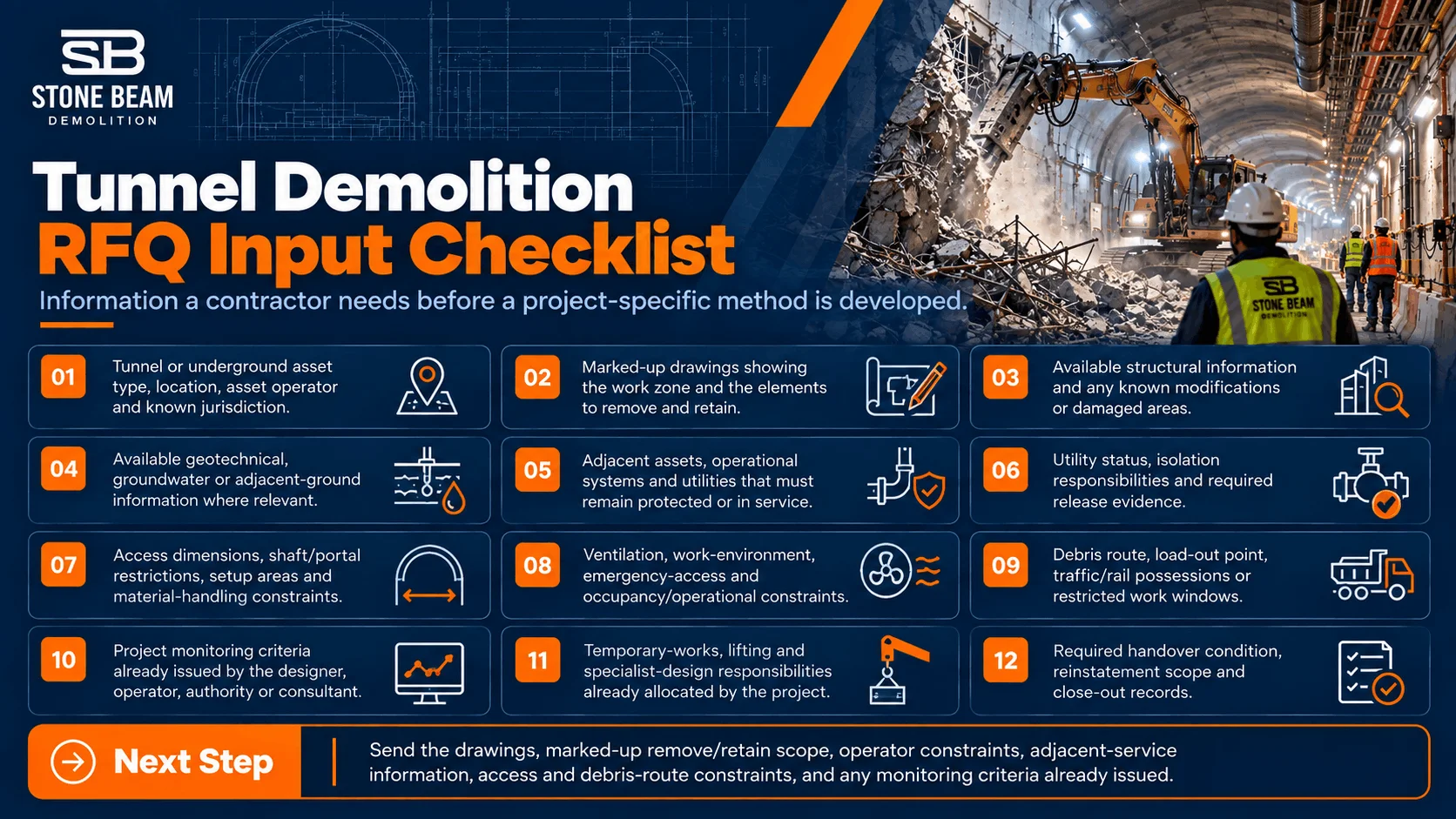
A useful enquiry should give enough information to test feasibility and identify missing interfaces. Send the following where available:
- Tunnel or underground asset type, location, asset operator and known jurisdiction.
- Marked-up drawings showing the work zone and the elements to remove and retain.
- Available structural information and any known modifications or damaged areas.
- Available geotechnical, groundwater or adjacent-ground information where relevant.
- Adjacent assets, operational systems and utilities that must remain protected or in service.
- Utility status, isolation responsibilities and required release evidence.
- Access dimensions, shaft/portal restrictions, setup areas and material-handling constraints.
- Ventilation, work-environment, emergency-access and occupancy/operational constraints.
- Debris route, load-out point, traffic/rail possessions or restricted work windows.
- Project monitoring criteria already issued by the designer, operator, authority or consultant.
- Temporary-works, lifting and specialist-design responsibilities already allocated by the project.
- Required handover condition, reinstatement scope and close-out records.
Next step
For a tunnel or underground demolition review, send the asset drawings, marked-up remove/retain scope, operator constraints, adjacent-service information, access and debris-route constraints, and any monitoring criteria already issued by the project designer, consultant or authority. Stone Beam can then review the demolition scope and identify the information, specialist interfaces and evidence still required before a project-specific method is developed.