

Marine and port demolition is the controlled removal, dismantling or modification of waterfront structures such as quay walls, berth structures, piled decks, jetties and dolphins. Unlike ordinary building demolition, the method is shaped by structural retention, underwater scope, navigation, live-port operations, marine access, environmental controls and the final edge or seabed condition required at handover.
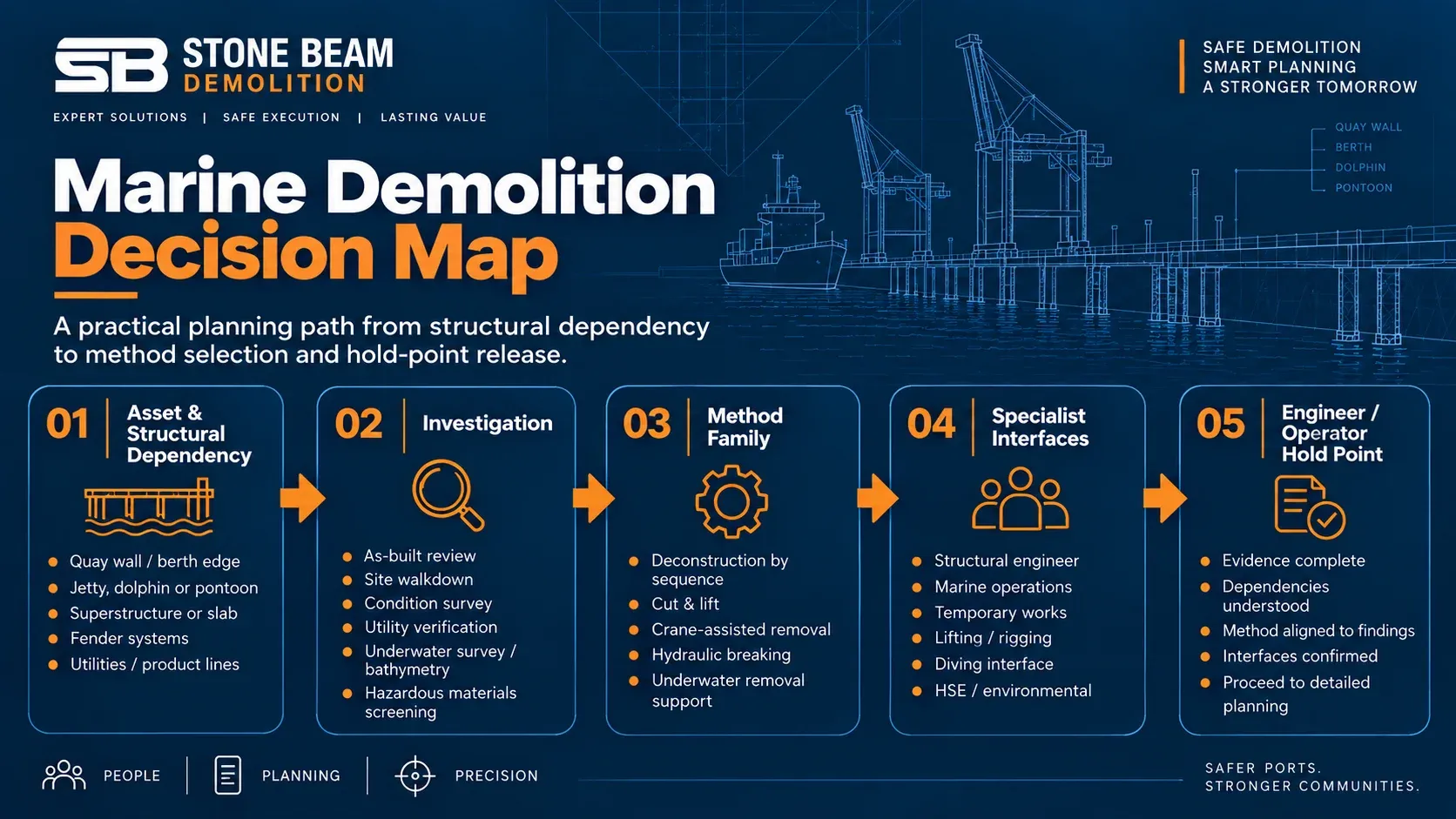
Method selection starts after the team resolves the structural system, retained elements, water-side geometry, access, lifting and recovery route, utilities, live operations, environmental constraints and required handover conditions. The evidence package also identifies the competent authorities, operator releases and specialist interfaces tied to that scope.
Practical rule: do not select a marine demolition method from an equipment list. Select it from structural dependency, verified investigation evidence, access and recovery constraints, live-port interfaces, environmental controls and the defined handover condition.
Last reviewed: 15 September 2026
What does marine and port demolition mean?
Marine demolition is an umbrella term. The scope description states what is removed, what remains, and what the owner expects at handover. Five terms matter because they lead to different engineering and commercial boundaries:
| Scope type | What it means | What must be defined |
|---|---|---|
| Full demolition | Removal of the defined marine or port asset within the agreed project boundary. | Retained interfaces, below-water scope, debris/end condition and handover limits. |
| Dismantling | Planned separation and recovery of components rather than treating the asset as one mass-removal operation. | Connection strategy, recovery route, lifting/interface requirements and retained elements. |
| Selective demolition | Removal of part of an asset while adjacent or connected elements remain. | Temporary state, load path, retained services, structural release conditions and protection requirements. |
| Structural modification | Removal or alteration of structural elements to enable a new arrangement. | Permanent-design responsibility, temporary stability and acceptance criteria. |
| Repair preparation | Localised removal to expose or prepare material for repair. | Repair design, substrate condition and repair specification; this is not automatically a demolition project. |
These scopes share some tools, but they create different structural, authority, lifting, environmental and handover problems. Use the scope name that matches the owner’s required end state. Land-based residential demolition is a separate intent; see Stone Beam’s villa demolition in Dubai service for that scope.
Which marine and port assets fall within demolition or dismantling?
- Quay walls and berth fronts, including gravity, sheet-pile/anchored and other retaining systems.
- Piled quay decks, deck slabs, beams, pile caps and supporting piles.
- Jetties, dolphins, mooring or fender-support structures and associated walkways.
- Marine bridges, ramps, link-spans and waterfront access structures where the marine interface changes the demolition plan. For bridge-led scope, see bridge demolition in the UAE.
- Seawalls and ancillary waterfront structures where removal affects retained ground, water, access or adjacent property.
- Local structural elements that need selective removal for an alteration, replacement or repair programme.
The asset label alone is not enough. Two quay walls require different demolition decisions when one relies on anchors and retained backfill while the other is a piled deck with open water beneath. The visible geometry does not reveal the full load path.
Why does quay-wall structural dependency control the demolition decision?
A quay wall does more than form a visible edge. It may retain soil, support a deck, transfer loads through piles, connect to tiebacks or anchors, carry services, support fenders or mooring equipment and define the operating edge of a live berth. The demolition decision begins with those dependencies, not with the exposed concrete or steel alone.
Piles
Pile type, geometry, material, condition, embedment and the required final cut-off or removal level affect both the demolition method and the recovery strategy. When work extends below water, the team defines the underwater investigation, access, separation, recovery and acceptance scope before method selection.
Anchors, tiebacks and retained ground
Anchors and tiebacks form part of the retaining system rather than secondary details on many quay structures. Understand their layout, condition, ownership and relationship with backfill or adjacent assets before any removal that changes restraint or continuity.
Retained earth and water pressure
The temporary condition during partial removal differs from the permanent condition before and after the work. For that reason, this page does not prescribe a universal quay-wall sequence. Structural assessment for the actual project governs temporary stability; geotechnical input is added when soil–structure interaction or retained ground controls the demolition state.
| Engineering hold point Do not treat a visible demolition line as proof that the structure behind it is independent. Before intrusive removal, the project team establishes the load path, retains restraints, temporary conditions and required engineer release for the actual workfront. |
What must be investigated before choosing a marine demolition method?
Method selection becomes more reliable as uncertainty is removed. Build the investigation around the following evidence categories:
- Available as-built drawings, structural drawings, pile records, anchor/tieback information and previous modification records.
- Condition information for the elements to be removed and the elements that must remain.
- Current site geometry, access limits, working levels and lifting/recovery routes.
- Bathymetry or water-depth information where the underwater workface or marine access depends on seabed conditions.
- Utility and service routes, including any product, fuel or hazardous-process lines associated with a port or industrial berth.
- Berth operating restrictions, vessel movements, navigation requirements, work windows and operator interfaces.
- Environmental constraints and specified requirements for debris containment, water-quality monitoring, discharge control or protected receptors.
- The required final condition: retained edge, pile cut-off/removal level, seabed/debris condition, reinstatement limits and acceptance evidence.
Concrete scanning supports selected land-side concrete interfaces where reinforcement, embedded items or service routes require verification. It does not replace underwater inspection, bathymetry or marine survey. For embedded-service verification on concrete workfaces, see concrete scanning in Dubai.
How does the Marine Demolition Decision Matrix work?
This matrix is a decision framework, not a demolition sequence. The actual method follows the verified project evidence and competent project review.
| Asset / interface | Structural dependency to resolve | Investigation evidence | Method families for consideration | Critical interface / hold point |
|---|---|---|---|---|
| Piled quay deck | Deck-beam-pile load path; retained adjacent deck or services | As-builts, condition, pile geometry, access and final cutoff | Sectional dismantling, cutting/separation, mechanical removal, lift-assisted recovery | Temporary-state stability, lifting/recovery and underwater cutoff when included |
| Anchored / tied quay wall | Wall, capping, anchors/tiebacks, backfill and retained ground | Anchor/tie records, ground/water condition, adjacent assets | Selective removal or engineered modification of defined components | Retaining-system stability and release of connected elements |
| Gravity quay / mass retaining edge | Mass, foundation, adjacent ground and final edge condition | Geometry, foundation/seabed information, condition and retained boundary | Mechanical or sectional removal, subject to project design | Retained edge/ground stability and debris/end-state acceptance |
| Jetty / dolphin | Pile-supported isolated or connected elements; utilities/fenders/mooring systems | Pile/cap geometry, condition, services, marine access | Dismantling, cutting/separation, lift-assisted or mechanical removal | Marine lifting, navigation and underwater interfaces |
| Local repair/removal zone | Connection to permanent structure and repair design | Repair drawings, substrate/condition information, embedded-item survey | Controlled local removal method selected for repair need | Permanent-design and repair acceptance interface |
How are marine demolition method families selected?
A useful method comparison starts with what the project must preserve and control. Treat the families below as options to test against the evidence, not as a universal sequence. For the wider planning workflow, see the advanced demolition guide.
Mechanical removal
Mechanical breaking or removal is practical only when the structure, access, recovery route and retained condition support it. Evaluate machine access, bearing/support conditions, debris containment, adjacent-asset protection and the route for recovered material before committing to the method.
Sawing, cutting and sectional dismantling
Cutting suits scopes that require separation at defined boundaries or smaller controlled sections for removal. Piece size, connection release, retained stability, lifting and water/slurry management are engineering inputs, not generic article rules. For land-side method capability, see concrete cutting in Dubai.
Lift-assisted dismantling
When components are deliberately separated for recovery, lifting becomes part of the demolition system. The lifting study, plant selection, pick points, rigging and temporary stability remain project design tasks and are not prescribed here.
Hydrodemolition and other specialist local-removal methods
Hydrodemolition is one specialist option for selective concrete removal in repair or modification scopes. It is not the default solution for quay walls, and this page does not claim Stone Beam operates marine hydrodemolition equipment.
Underwater specialist methods
Underwater cutting, diving support, ROV inspection and related marine specialist activities become necessary only when the defined workface cannot be investigated or executed from the dry side. These activities belong in a clearly scoped specialist interface rather than being implied as in-house Stone Beam capability.
When do temporary stability and engineering hold points control the work?
Partial demolition creates a temporary structural state that may not have existed in the original design. The project team identifies what keeps the retained structure stable, which elements remain, which loads or restraints change, and which engineered release is required before intrusive work advances.
- Confirm the structural system and the elements that provide restraint, continuity or retention.
- Define which elements and services remain and what loads or functions continue through the temporary condition.
- Identify the temporary-works or temporary-stability design requirements triggered by the scope.
- Define the inspection, acceptance or engineer release needed before moving to the next intrusive workfront.
- Keep lifting and recovery design separate from the public article; lift planning for the actual project is a competent-person task.
How do live berth, marina or port operations affect demolition?
A marine demolition programme is constrained by operations as well as physical production. A workface can be technically ready but unavailable because berth use, access routes, vessel movements or operator restrictions prevent release for that period.
| Interface | Why it matters | Evidence to resolve it | Typical responsible project role | Hold / release concept |
|---|---|---|---|---|
| Live berth or adjacent operation | Closure limits change access, plant position and production windows | Operator plan, agreed work zones and access windows | Owner/operator + main contractor | Workfront released for the defined window |
| Navigation / vessel movement | Plant, debris and exclusion zones can conflict with vessel movement | Navigation/traffic restrictions and marine-operation requirements | Marine authority/operator | Marine access/activity release for the defined work window |
| Utilities / product lines | Unknown or live services can make intrusive work unacceptable | Verified routes, isolation/diversion/release evidence | Asset owner / utility / process authority | Service condition confirmed before affected work |
| Retained quay / structure | Removal can change the temporary condition | Engineering assessment and approved temporary state | Structural/temporary-works engineer | Engineer release for defined workfront |
| Marine lifting / recovery | Separated elements need a controlled recovery path | Lift study, plant/access constraints and approved plan | Lifting team / appointed person / marine operator | Lift-specific release |
| Underwater work | Visibility, access and submerged geometry be uncertain | Survey/inspection and specialist method evidence | Marine/diving specialist + engineer | Specialist method/workface release |
| Environmental controls | Debris, discharge, noise or water-quality constraints apply | Authority/operator requirements and environmental plan | Environmental/HSE team | Environmental conditions confirmed |
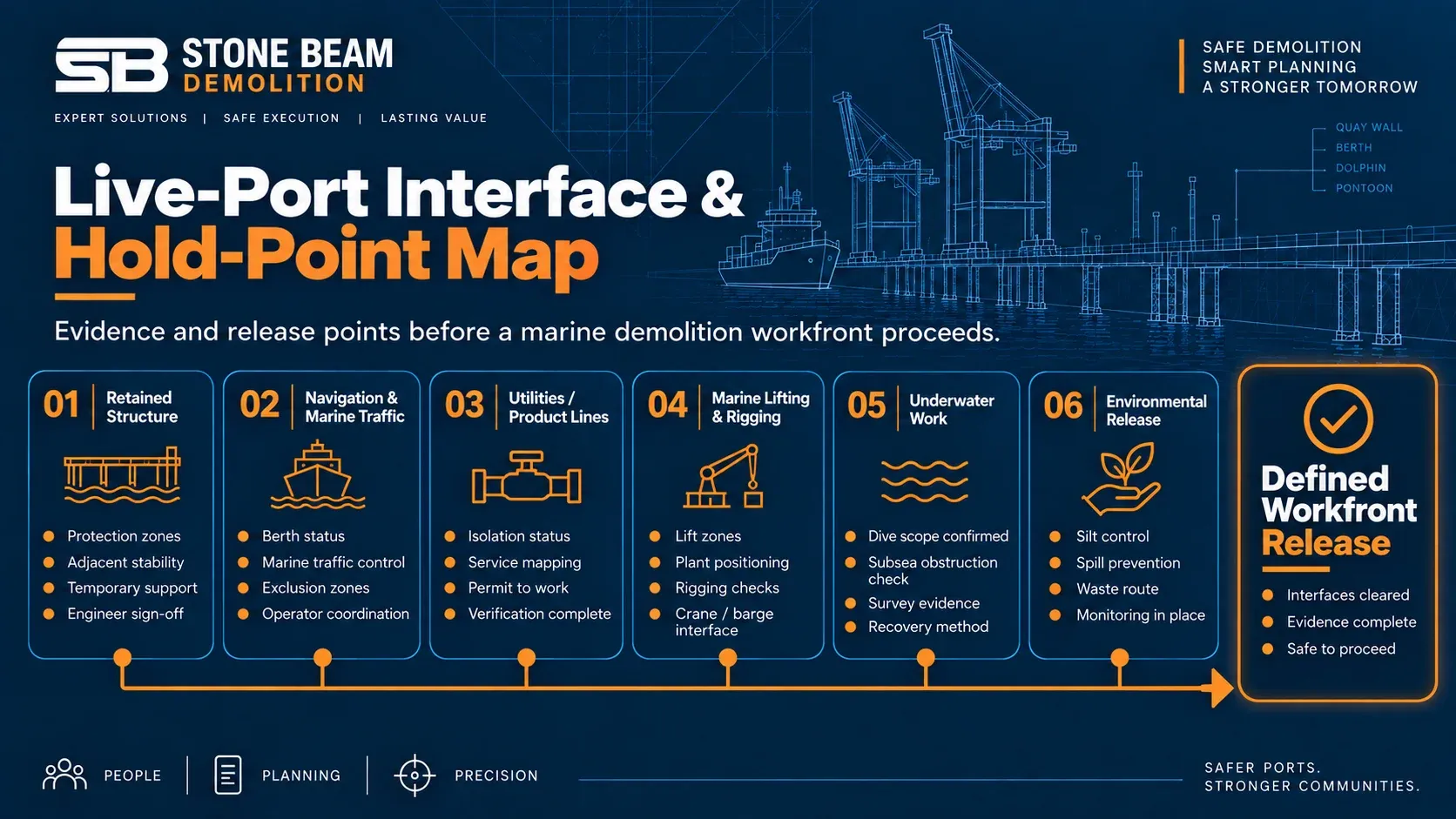
The table is intentionally role-based rather than prescriptive. The contract, operator and jurisdiction define the actual parties and permit-to-work system.
How do navigation, marine access and lifting affect the method?
Marine access is a design input. Land access, pontoons, barges, workboats and floating lifting equipment create different restrictions on draft, mooring, plant position, recovery, navigation and exclusion areas. The final arrangement belongs to the project marine/lifting plan, not to this article.
The recovery path changes a quotation materially even when the visible demolition quantity is unchanged. Direct removal to land is a different operation from cutting, securing, lifting, moving and landing a component through a marine recovery route.
When is specialist underwater support required?
Define underwater scope rather than implying it. The tender or method brief states whether submerged elements remain, are cut to a level, are fully removed, are inspected, or are recovered from the seabed.
- Underwater inspection or confirmation of submerged geometry.
- Diving support or ROV survey when submerged geometry, visibility or access prevents adequate dry-side confirmation.
- Underwater cutting or separation of piles or other elements.
- Recovery of submerged components or demolition debris.
- Confirmation of the final seabed, pile cut-off or clearance condition specified by the owner/operator.
| Capability boundary Do not present Stone Beam as an in-house diving, ROV, barge, underwater-cutting, marine-crane or hydrodemolition specialist without separate evidence. Treat those activities as specialist interfaces and verify the provider, equipment, competence and approvals for the actual project. |
How are environmental protection and marine debris controlled?
Environmental controls vary with the asset, location and approval route. The project addresses falling or floating debris, suspended material, spills, contaminated material, water discharge and sensitive receptors only to the extent they are triggered by the actual scope and competent environmental requirements.
Turbidity monitoring, barriers or other water-quality controls apply when they are specified by the competent environmental authority, port/operator requirements or the accepted environmental plan. This page does not present them as universal controls or as verified Stone Beam marine field capability.
How are waste, recovery and traceability managed?
Marine demolition adds a question beyond ordinary C&D waste handling: how will material be prevented from entering the water and how will recovered material be traced to its approved route? The waste plan separates recovered demolition material, submerged debris, contaminated material and any waste stream controlled under a different route.
Dubai Municipality publishes Waste and Sewerage Agency technical guidelines covering waste activities, including Construction & Demolition Waste Recycling guidance. For Stone Beam’s related content owner, see construction and demolition waste management in Dubai.
Official reference: Dubai Municipality – Waste and Sewerage Agency Technical Guidelines
Which Dubai authorities or operators apply to the scope?
There is no single universal permit route for every marine demolition project in Dubai. The route varies with the asset, plot/jurisdiction, marine activity, environmental category, port/operator control, utilities and the demolition scope. The table below keeps each authority statement tied to its trigger.
| Possible authority / operator route | Trigger | Safe wording for this page |
|---|---|---|
| Dubai Municipality — Permit to Carry Out Demolition Works | Building or building-related demolition within the applicable Dubai Municipality route | Dubai Municipality provides a permit service for full or partial demolition of buildings. Do not treat that building-demolition service as a universal approval for every marine asset. |
| Dubai Maritime Authority / PCFC — Marine Project NOC Issuance | Marine-project activity falling within the DMA/PCFC service route; the current service refers registered companies holding DM or Trakhees NOC to this NOC service | Confirm DMA/PCFC applicability for the actual marine demolition scope. The Marine Project NOC service must not be presented as the universal demolition permit for every waterfront asset. |
| Trakhees / PCFC — Demolition and Removal NOC procedure | Demolition/removal within PCFC-Trakhees jurisdiction | Trakhees lists a Demolition and Removal NOC service and publishes a procedure for its jurisdiction. Apply it only where that jurisdiction governs the project. |
| Port, free-zone, master-developer or asset operator | Asset/operator controls access, workfront release, navigation, berth use or permit-to-work conditions | Operator or developer releases are separate project controls when the asset sits within their operational or jurisdictional system. |
| PCFC Environment & Sustainability information | Environmental categorisation or the defined activity triggers environmental review, EIA, discharge, marine-area or other controls | Use the competent environmental authority and project category. Do not state that every marine demolition requires an EIA, discharge permit, dredging/reclamation NOC or marine-area NOC. |
| Utility / service owner | Live utilities, services or product lines cross or serve the demolition boundary | Obtain the release, isolation, diversion or protection evidence required by the actual service owner and project controls before intrusive work affects that interface. |
Current official references checked 15 September 2026: Dubai Municipality – Permit to Carry Out Demolition Works | PCFC/Dubai Maritime Authority – Marine Project NOC Issuance | PCFC Environment and Sustainability – EIA information
| Authority wording discipline State the trigger and jurisdiction for each route. When applicability is uncertain, instruct the reader to confirm the competent authority or operator for the actual scope. Do not generalise one authority’s service to every marine demolition project in Dubai. |
What changes the method, programme, cost and risk in marine demolition?
Marine demolition is not priced or programmed reliably from length, area or concrete volume alone. The same visible asset produces a different method, programme and commercial risk when structural dependency, underwater scope, access, operations or handover requirements change.
| Driver | Why it changes the decision |
|---|---|
| Structural system | Determines how deck, wall, piles, capping, anchors and backfill interact. |
| Pile / anchor condition | Unknown geometry, corrosion, access or anchor condition changes investigation, removal and temporary-state requirements. |
| Retained stability | Partial removal may create a temporary condition requiring engineering controls or temporary works. |
| Access | Land access, working platforms, restricted gates or over-water work changes plant, recovery and haulage strategy. |
| Live-port operation | Berth continuity, vessel movements, security and work windows controls when and where work is possible. |
| Navigation | Marine plant, exclusion zones or debris-control measures may need to coexist with vessel movement. |
| Water depth / bathymetry | Controls access to submerged workfaces and can affect marine plant or recovery options. |
| Underwater scope | Inspection, cutting, pile work, submerged recovery or seabed clearance can require specialist packages. |
| Marine lifting | Separated components need a verified recovery method; lifting design is actual-project. |
| Utilities / product lines | Live or uncertain services can require isolation, diversion, gas-freeing or other specialist releases before intrusive work. |
| Hazardous materials | Material identification and handling route changes permits, controls, packaging and disposal. |
| Temporary works | Support, restraint or access systems can become critical where the retained structure changes during removal. |
| Monitoring | Project-specific structural, vibration, movement, environmental or water-quality monitoring may be required by design or approval. |
| Environmental controls | Debris, discharge, turbidity, spill prevention, noise and sensitive receptors can affect method and work windows. |
| Waste route | Segregation, over-water recovery, transport, disposal/recycling and contaminated-material routes change logistics and cost. |
| Final condition | A retained edge, defined pile cut-off, clear seabed, reinstatement or inspection requirement changes the scope itself. |
Because these drivers vary by scope, this page does not publish a generic price per metre, a fixed production rate or a universal duration for quay-wall, berth or jetty demolition.
What information is needed before a marine demolition method or quotation is finalised?
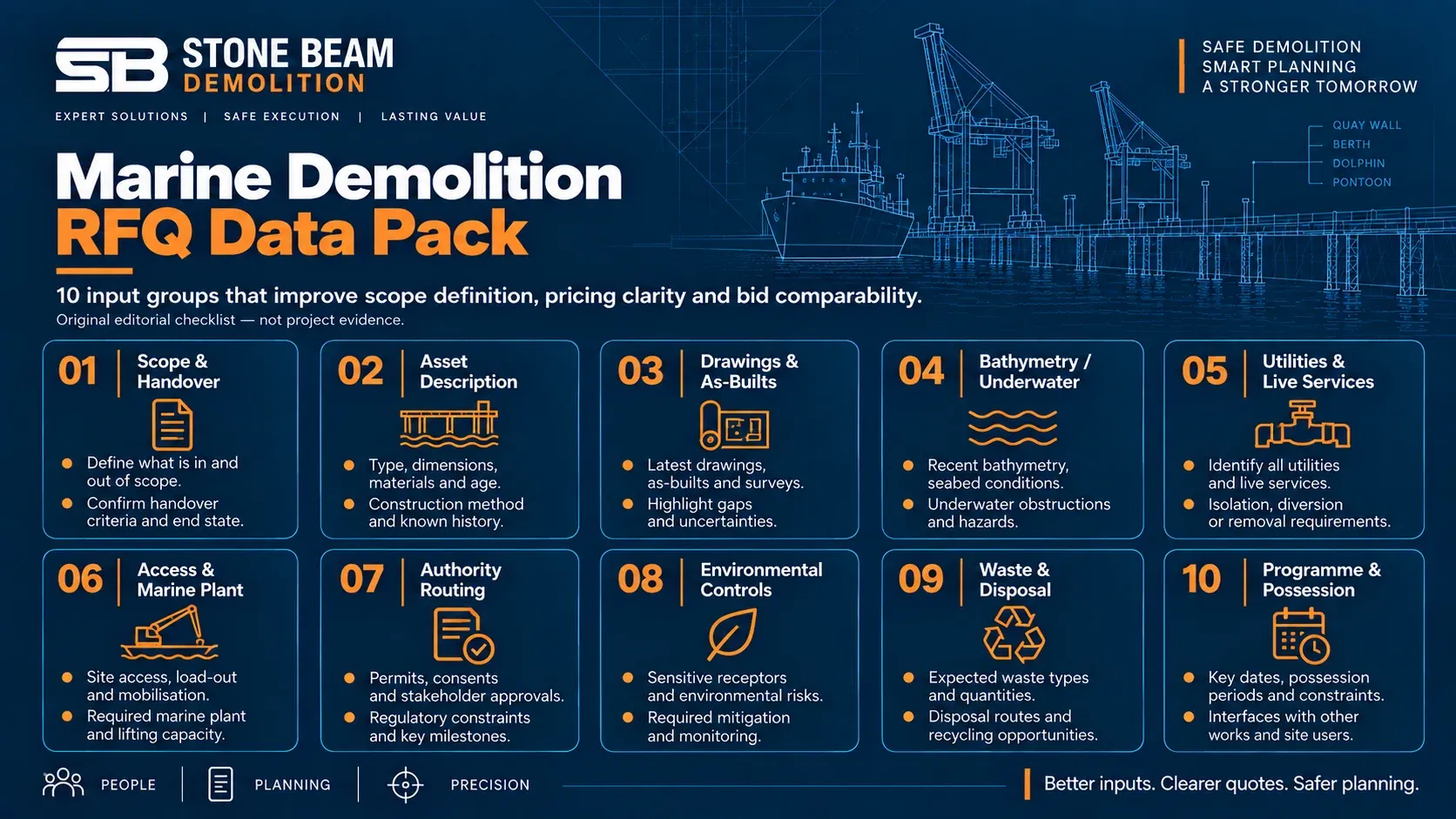
A useful marine demolition RFQ gives bidders enough information to define the structural, marine, authority and handover interfaces. The data pack below reduces hidden assumptions before method and price definition.
| RFQ data group | What to provide |
|---|---|
| 1. Scope and handover | Exact elements to remove, elements to retain, required final edge/seabed condition, reinstatement and acceptance evidence. |
| 2. Drawings and structure | As-built structural drawings, pile schedule/details, anchor/tieback information, previous modifications and available structural reports. |
| 3. Condition evidence | Recent inspections, damage/corrosion information, known defects and areas with uncertain construction. |
| 4. Marine geometry | Water depth/bathymetry when included, tidal/current or operator restrictions, underwater visibility/access constraints if known. |
| 5. Live operations | Berth use, vessel movements, marina/port operating windows, security/access rules, adjacent asset continuity and permissible closures. |
| 6. Utilities and hazardous interfaces | Utility routes, service status, fuel/product lines, isolation/decommissioning responsibility and hazardous-material information. |
| 7. Access and recovery | Land access, platform/working surface restrictions, crane or barge constraints, lifting/recovery routes, load-out and haulage restrictions. |
| 8. Authority/operator information | Known jurisdiction, existing NOCs/permits, operator requirements, environmental classification/correspondence and responsibility matrix. |
| 9. Waste and environmental route | Debris containment expectation, waste route, disposal/recycling constraints, water/discharge controls and any monitoring requirements. |
| 10. Programme information | Required access dates, shutdown/closure windows, interface milestones and handover date definitions – without assuming a universal production rate. |
| Better enquiry = better method and price definition Incomplete structural, underwater or operational information forces bidders to price uncertainty. A stronger RFQ separates known facts, unknowns, owner-supplied information and specialist investigations before commercial comparison. |
When does a marine demolition project need specialist support?
Specialist support follows the project conditions, not a marketing service list. Add the following roles when the trigger exists:
- A structural and/or temporary-works engineer for temporary-state stability, retained elements or support/release decisions.
- A geotechnical engineer when retained ground, foundations, backfill or quay-wall soil interaction controls the demolition state.
- A marine survey provider when bathymetry, submerged geometry or other marine survey information is needed for the defined workface.
- A commercial diving or ROV specialist when underwater inspection or work is part of the defined scope.
- A specialist underwater-cutting contractor when the defined scope includes submerged cutting.
- A lifting specialist and marine operator when separated components require crane or floating-plant recovery.
- An environmental specialist when the approval route or project categorisation requires EIA or other environmental documentation, water/discharge controls or monitoring.
- A process/hydrocarbon safety specialist when fuel, product, hazardous-atmosphere or decommissioning interfaces exist. See facility decommissioning in the UAE for the adjacent process-facility intent.
Record these boundaries explicitly in the responsibility matrix and method/submittal process. Do not assume that every specialist interface sits inside one contractor’s in-house capability.
Stone Beam’s role and evidence boundary
Stone Beam Technical Services L.L.C. is a Dubai demolition contractor. The reviewed Dubai Engineering Qualification / Dubai Municipality practice-permit certificate records an active Wrecking & Demolition Works G+12 practice permit with expiry shown as 13 November 2026. That corporate qualification is not a marine-project permit and does not replace project approvals or operator releases.
Stone Beam’s documented evidence also includes concrete-cutting and concrete-scanning/coring work in other project environments. Those records support the underlying methods only; they do not prove marine or underwater execution.
This article does not claim that Stone Beam operates in-house diving teams, ROVs, barges, underwater-cutting systems, marine cranes or hydrodemolition equipment. When a project includes one of those specialist interfaces, the scope identifies the required competent provider and supporting evidence before appointment.
TECHNICAL LIMITATION — This page is a decision and evidence framework, not a project-specific demolition sequence, structural design, temporary-works design, lift plan, isolation procedure, gas-freeing procedure, hot-work procedure or confined-space method. Those decisions remain with the competent project roles and applicable authority/client controls.
What do clients ask about marine demolition in Dubai?
Is quay wall demolition the same as ordinary building demolition?
No. A quay wall may retain soil and water, depend on piles or anchors, carry live services and sit beside an operating berth or navigation route. Those interfaces govern the decision. Building-demolition assumptions cannot simply be copied to a waterfront structure.
When is berth operation compatible with demolition?
Berth operation is compatible with demolition only when the owner/operator, engineering, access, navigation and safety constraints support a defined workfront without an unacceptable conflict. The decision belongs to the actual operating and permit framework, not to a generic promise of “no shutdown.”
Does every marine demolition project in Dubai need the same permits and NOCs?
No. The route varies with jurisdiction, asset type, marine activity, environmental category, operator requirements, utilities and scope. Confirm the competent authority and operator route before relying on a Marine Project NOC, building-demolition permit or port/free-zone approval.
When are divers, ROVs or underwater cutting required?
They are required when submerged geometry or the workface cannot be adequately investigated, accessed or executed from the dry side. Define whether the underwater package covers inspection, cutting, recovery or end-condition verification before procurement.
What information has the biggest effect on a marine demolition quotation?
The structural system, underwater scope, access and recovery route, live operations, lifting constraints, utilities or product lines, environmental requirements, waste route and final handover condition drive the quotation. Quantity alone does not define the job.
How can a client request a marine demolition scope review?
For an initial scope review, send the site and location, current drawings, elements to remove and retain, pile or anchor information, photos, water-depth or bathymetric information, utility or product-line information and berth operating constraints. Also include the required final edge or seabed condition and any authority or operator correspondence already issued.
Stone Beam uses that information to define the demolition scope questions, identify missing evidence before method selection and clarify the structural, marine, lifting, environmental and specialist interfaces that require separate review. For broader appointment enquiries, visit our demolition contractor in Dubai page.