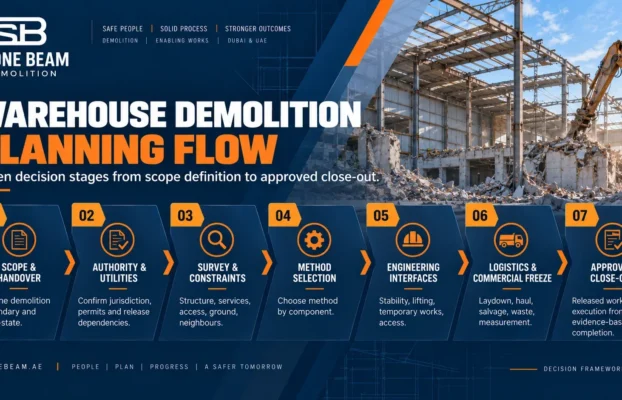



Demolition permit delays in Dubai usually happen when an approval dependency remains open: the wrong authority, an incomplete technical package, unresolved NOCs, utility actions, road interfaces, authority comments, or an expired approval. The fastest way to prevent delays is to identify the competent authority first, assign each action to an owner, and close dependencies before resubmission.
Dubai does not have one universal demolition approval route. Dubai Municipality, Dubai Development Authority, Trakhees, DEWA and RTA control different parts of the process according to jurisdiction and interface. A requirement published by one authority is not a universal Dubai requirement.
Last reviewed: 7 September 2026
Prepared by Stone Beam Technical Services L.L.C. (Stone Beam Demolition).
Why do demolition permit applications get delayed in Dubai?
A demolition approval stalls when one required input is missing, inconsistent, outside the correct authority route, or waiting on another party. The decisive question is not “How long does a demolition permit take?” It is “Which dependency is still open, who controls it, and what evidence closes it?”
The Dubai Municipality demolition permit service covers full or partial demolition in its jurisdiction. The DDA Demolition Permit service has its own requester, document and review route. DEWA’s demolishing-permit service and the RTA Building Construction or Demolition Permit add separate utility or Right-of-Way interfaces when their triggers apply. This is why one generic checklist does not diagnose every stalled application.
Is the approval delayed, incomplete, rejected, or not ready to start?
These states are not interchangeable. Use the authority’s current status wording first, then identify the action that changes that state.
| State | What it means | First diagnostic action |
| Pending / delayed | The application remains in a review or dependency state. | Read the latest status and identify the next action owner. |
| Incomplete / returned for revision | The submitted package has an error, omission or revision request. DEWA explicitly uses an “Incomplete” state for applications requiring correction. | Close the specific defect, then resubmit the corrected package. |
| Rejected | The authority has refused the current submission or route. RTA states that rejection reasons are issued to the applicant. | Use the stated reason as the correction basis; do not restart from a generic checklist. |
| Approved but not ready to start | One approval is closed, but another pre-start release, isolation, access condition or technical control remains open. | Complete the remaining readiness items before intrusive work begins. |
What are the 12 demolition permit failure modes to check?
Start with this ordered diagnostic list. The order follows dependency logic, not a claim about frequency in the Dubai market.
- The wrong authority or submission channel is used
- The demolition scope does not match the approval route
- The applicant and responsibility setup is incomplete
- Owner-controlled actions are still open
- The technical submission package is incomplete or inconsistent
- The demolition method changes the approval set
- Neighbour and retained-property impacts are unresolved
- A required NOC is missing or tied to the wrong scope
- Utility approval is confused with physical service readiness
- A road or Right-of-Way interface appears late
- Authority comments, technical discussions or payments remain open
- The validity or renewal window is missed

1. The wrong authority or submission channel is used
Dubai demolition approvals are jurisdiction-led. Dubai Municipality and DDA publish separate demolition-permit routes, while Trakhees publishes a Demolition and Removal NOC route. DEWA and RTA enter when utility or Right-of-Way interfaces apply. Starting in the wrong channel creates avoidable rework because the package was built for a different authority or interface.
Prevention: confirm the plot jurisdiction, competent authority and official service channel before preparing the document register.
2. The demolition scope does not match the approval route
Full and partial demolition do not always use the same supporting information. DEWA expressly lists an additional setting-out plan for partial demolition. DDA requires a setting-out plan that identifies the demolition area and method-related supporting NOCs. A mismatch between the actual demolition boundary and the submitted scope creates a revision risk.
Prevention: freeze the demolition boundary, retained elements and full-versus-partial scope before the application package is issued. For villa-specific scope, use the site and structure definition from the villa demolition in Dubai service rather than a generic building assumption.
3. The applicant and responsibility setup is incomplete
The responsible applicant is not identical across every authority. DDA identifies the contractor as the requester. DEWA requires an enrolled demolition contractor and also assigns actions to the project owner. A package stalls when an owner action is assumed to belong to the contractor, or the correct applicant has not been established.
Prevention: create a responsibility register at the start. Record the applicant, owner actions, consultant actions, contractor actions, utility actions and authority actions separately.
For coordinated demolition planning and execution support, see Stone Beam’s demolition company in Dubai. The article remains focused on diagnosis rather than commercial head-term intent.
4. Owner-controlled actions are still open
Utility deactivation and commercial account closure are not always contractor-only tasks. DEWA’s published demolition route includes owner actions around assignment, final billing and clearance. A permit package appears “stuck” when the contractor is waiting on an owner-controlled step that was never put on the critical-path register.
Prevention: identify owner-controlled actions before submission and track them beside contractor deliverables.
5. The technical submission package is incomplete or inconsistent
DDA publishes a demolition document set that includes the demolition-area setting-out plan, hoarding information, method statement, HSE and emergency information, risk assessment, site photographs and a neighbour-impact study. DEWA also returns applications for revision when errors remain. Conflicting drawings, scope notes or attachments create a predictable review loop.
Prevention: run one package-coordination check before submission. Confirm that drawings, method, demolition boundary, NOCs and supporting forms all describe the same scope.
6. The demolition method changes the approval set
The demolition method affects the evidence and interfaces that authorities request. DDA’s service page, for example, distinguishes method-related documents and NOCs. A package assembled before the method is frozen becomes incomplete when the execution approach changes.
Prevention: agree the demolition method at decision level before final submission. If the method changes, recheck the authority requirement register and the demolition methods guide instead of assuming the original package still applies.
7. Neighbour and retained-property impacts are unresolved
Partial demolition and works close to retained or neighbouring structures introduce questions that are not solved by a demolition plan alone. DDA lists an impact study for surrounding neighbouring buildings among its demolition-permit documents. Missing retained-property information leaves the reviewer without a clear basis for the interface.
Prevention: identify retained elements and adjacent properties early, then align the technical submission with the actual site boundary and obtain competent engineering review when retained or neighbouring structures create a structural interface.
8. A required NOC is missing or tied to the wrong scope
A demolition approval package depends on authority or utility NOCs when the official route requires them for the proposed method or site interface. DDA states that related-authority NOCs form part of the permit package. A NOC for a different scope, location or interface does not close the current dependency.
Prevention: maintain a NOC register with the authority, purpose, scope, application reference, current status and closure evidence.
9. Utility approval is confused with physical service readiness
DEWA’s demolition workflow separates application processing from owner billing, deactivation, clearance and service disconnection steps. Paper approval alone does not prove that every physical service condition for site execution has been closed.
Prevention: track documentary status and physical service status as separate lines. Do not mark the utility dependency complete until the required closure evidence is available.
10. A road or Right-of-Way interface appears late
The RTA Building Construction or Demolition Permit applies to projects that interface with the Right-of-Way or traffic. Discovering that interface after the main package has been prepared adds a separate review path, technical discussion and supporting requirements.
Prevention: inspect access, hoarding, loading, truck movement and road-interface constraints during the initial site review. Trigger the RTA route early when the official service applies.
11. Authority comments, technical discussions or payments remain open
Some delays are not document-production problems. They are open-response problems. RTA’s published service includes technical discussion, applicant responses and required payments, and it states cancellation conditions for unanswered discussion or unpaid fees.
Prevention: keep one comment-to-closure register with issue date, owner, response, evidence, resubmission date and current status.
12. The validity or renewal window is missed
Authority validity is not universal across Dubai. The Dubai Municipality demolition permit service currently states a three-month validity, while the RTA demolition permit service states a one-month renewable validity. Treating one authority’s period as a Dubai-wide rule creates false planning confidence.
Prevention: record the issue date, expiry date and renewal route for every approval and NOC. Review validity before mobilisation, not after a start date has already been committed.
Who owns each fix when a demolition approval stalls?
The fastest diagnostic is a responsibility matrix. Give each open issue one named action owner, even when several parties provide inputs.
| Open issue | Primary action owner | Evidence that closes it | Prevention control |
| Wrong jurisdiction or channel | Owner / consultant / contractor coordination | Confirmed competent authority and correct service route | Jurisdiction check before package build |
| Incomplete technical package | Contractor + consultant / engineer | Coordinated revised drawings and supporting documents | Single pre-submission package review |
| Owner-controlled utility action | Project owner | Owner-side submission, billing, clearance or assignment evidence | Responsibility register with deadlines |
| NOC dependency | Named applicant / authority liaison | NOC reference and closure evidence | NOC register tied to scope |
| Neighbour / retained-structure issue | Consultant / engineer | Accepted technical response or revised package | Early retained-element and adjacency review |
| Right-of-Way / traffic interface | Contractor + RTA interface owner | Applicable RTA permit / comments closure | Identify road interface during initial survey |
| Authority comments or payment | Named response owner | Closed comment, response record and payment evidence | Comment-to-closure tracker |
| Validity / renewal | Authority liaison / project controls | Current approval or renewal record | Expiry register linked to mobilisation |
Where do permit delays sit in the demolition programme?
The permit sits inside the first of two project clocks. Clock 1 covers pre-mobilisation readiness: jurisdiction, submissions, NOCs, utilities, engineering controls, access and other releases. Readiness Gate A is Stone Beam’s editorial name for the point where the applicable pre-start conditions are closed for the defined workface.
Clock 2 covers physical execution and handover after the released workface starts. Permit approval is one input to readiness, not the whole readiness decision. A short physical demolition period does not erase an open utility, access, technical or authority dependency.

For the wider sequence beyond permit troubleshooting, use the advanced demolition planning guide. For villa programme questions, keep the approval clock separate from the physical villa demolition timeline.
What changes the approval path, documents, timeline, or compliance risk?
The approval path changes when the project facts change. Recheck the authority requirement register after any material change to these inputs:
- Jurisdiction and competent authority.
- Full demolition, partial demolition or retained-structure scope.
- Demolition method and any method-specific supporting approvals.
- Utility condition, deactivation and physical isolation status.
- Neighbouring buildings and retained-property interfaces.
- Road, Right-of-Way, access, hoarding and truck-movement interfaces.
- Open authority comments, technical discussions, payments and approval validity.
How do you prevent demolition permit delays before submission?
Use a pre-submission closure sequence instead of a generic document checklist:
- Confirm the plot jurisdiction and official submission channel.
- Freeze the demolition boundary and identify every retained element.
- Assign applicant, owner, consultant, contractor, utility and authority responsibilities.
- Build the requirement register from current official authority pages.
- Map NOCs, utilities and extra interfaces to the exact scope.
- Reconcile drawings, method, hoarding, neighbour information and supporting forms.
- Close review comments, technical discussions and required payments with evidence.
- Run a final readiness review before resubmission or mobilisation.
What information is needed before diagnosing a delayed demolition approval?
A useful review starts with the information that identifies the real dependency:
- Plot location, community and governing authority.
- Full or partial demolition boundary and retained elements.
- Current application reference, status and latest authority comments.
- Applicant, owner, consultant and demolition-contractor roles.
- Latest drawings, demolition method and hoarding / logistics information.
- NOC register and utility deactivation / clearance status.
- Road, access, Right-of-Way, neighbour and retained-asset interfaces.
- Planned mobilisation point and intended handover condition.
What does Stone Beam’s current evidence prove?
Stone Beam’s evidence register includes Dubai Municipality completion evidence for completed demolition work. It does not yet contain a publishable multi-project dataset of permit lead times or rejection frequencies. This article therefore uses current authority rules plus a diagnostic framework rather than company-average timing or a ranking of the “most common” causes.
Frequently asked questions about demolition permit delays in Dubai
Does DDA’s five-working-day estimate mean the total demolition approval takes five days?
No. DDA publishes an estimated service time for its demolition-permit service. That figure is not a Dubai-wide project duration. Total readiness also depends on the application package and any external NOC, utility, access or interface dependency that remains open.
Is an incomplete DEWA demolition application the same as a rejection?
No. DEWA’s published FAQ describes an incomplete application as one that requires revision because errors remain. Treat the status message as a correction instruction and close the stated defect before resubmission.
Does every demolition project in Dubai need an RTA demolition permit?
No. RTA describes its Building Construction or Demolition Permit as the route for works affecting the Right-of-Way or traffic. Confirm the official trigger from the actual site interface instead of adding RTA to every demolition checklist.
What is the first check when a demolition approval appears stalled?
Read the current authority status, identify the unresolved dependency and assign the next action to one owner. This separates a real authority review from a missing document, owner action, utility step, NOC, payment or extra-interface issue.
Planning the next approval step
If a Dubai demolition approval is stalled, send Stone Beam the plot location, governing authority, demolition boundary, latest submitted drawings, current comments, NOC and utility status, site photos, access constraints, adjacent structures and intended handover condition. Stone Beam’s demolition planning and execution team reviews the supplied information and identifies the unresolved inputs for the next coordination step. Final permit route, method, programme and commercial proposal remain tied to the authority requirements and the site survey.