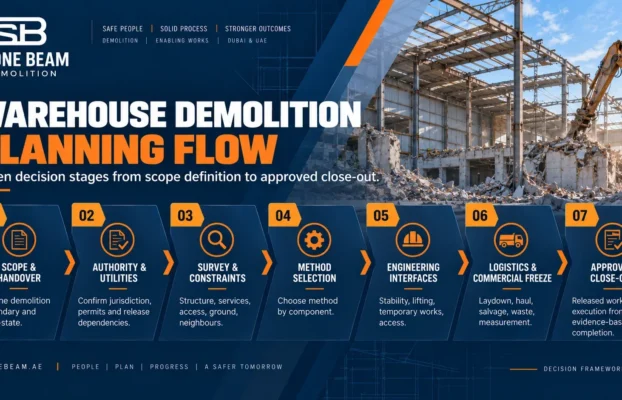


Industrial demolition in Dubai is planned around interfaces, not machine size. Before structural removal, the project team must define the demolition boundary, release utilities and process systems, decide what happens to machinery, understand steel and reinforced-concrete structures, confirm access and logistics, and agree on the required handover condition.
The approval route is jurisdiction-specific. DDA, Dubai Municipality, Trakhees/PCFC and other authorities operate different permit and NOC paths, while DEWA applies its own electricity and water demolition process. The project team must confirm the governing route before treating any workfront as released.
Practical rule: separate decommissioning, dismantling, structural demolition, foundation removal, and waste close-out before the final method, programme, and commercial proposal are fixed.
Last reviewed: 10 September 2026
By Stone Beam Technical Services L.L.C.
What does industrial demolition planning cover?
Industrial demolition planning defines the decisions that sit above the site method. It maps the demolition boundary, operational releases, asset disposition, structural dependencies, access, lifting interfaces, waste routes, and handover evidence. The purpose is to create a controlled workfront for a factory, plant, or heavy structure without turning a generic article into a project design.
Key takeaways
- Treat shutdown status and demolition workfront release as separate decisions.
- Split decommissioning, equipment or steel dismantling, structural demolition, foundation removal and waste close-out into distinct scope lines.
- Sequence the work by dependency, stability and access rather than by the largest machine available.
- Define authority, utility, retained-operation and waste interfaces before the final method and quotation are frozen.
- Write the handover condition before demolition starts so the tender boundary is measurable.
The two clocks that control industrial demolition readiness
Industrial work is easier to control when the programme is split into two clocks. Clock 1 is Pre-Mobilisation Readiness. It starts when the scope is defined well enough to begin surveys, records review and interface planning, and it closes when the applicable authority, utility, engineering, HSE, access and client-release conditions for the defined workfront are closed.
Readiness Gate A is Stone Beam’s editorial label for the point between those clocks. It is not the name of a government approval. The gate means the relevant pre-start conditions for the defined workfront have been closed sufficiently for released physical work to proceed under the accepted controls.
Clock 2 is Physical Execution & Handover. It starts at the released workfront, not at the first commercial enquiry or permit submission. It ends at the agreed completion condition: structural scope complete, materials handled, below-ground items addressed to the contracted boundary, records assembled and the site handed over to the defined standard.
Some preparation runs in parallel. Asset inventories, drawing review, haul-route planning and parts of the access study can progress together. An unresolved isolation, structural decision, specialist clearance or temporary-works acceptance still controls the release of the affected workfront.

What must be defined before industrial demolition planning starts?
Industrial demolition starts with an input map, not an equipment list. The map should identify what is known, who owns each missing decision, and which record closes it. The following eight input groups provide a practical planning structure.
- Jurisdiction and approval route-identify the authority, master developer, utility bodies, and site-specific permits or NOCs that govern the location.
- Demolition boundary and handover – define exactly what is removed, retained, protected, exposed, backfilled, or left for the next contractor.
- Utility and energy status – map electrical, water, gas, compressed air, steam, fuel, hydraulic, pneumatic and other energy sources with the responsible release owner.
- Process and machinery status – record which machines, tanks, lines, platforms and service systems remain, move, transfer to another contractor, recover as assets or enter the demolition scope.
- Hazard and material information – gather available surveys, process history, hazardous-material records and contamination information before intrusive work is planned.
- Structural information – assemble drawings, alterations, load paths, heavy bases, pits, mezzanines, cranes, pipe racks and known deterioration that affect sequence decisions.
- Access and retained operations – define gates, truck routes, crane positions, work windows, exclusion zones, adjacent assets and any operation that remains live.
- Waste and recovery route – define ownership of recovered assets, segregation categories, receiving routes, documentary records and the final site condition.
In DDA-controlled areas, the current DDA Demolition Permit service lists documents such as relevant NOCs, a method statement, HSE and emergency planning, risk assessments, an impact study for neighbouring buildings and site photographs. That is a DDA requirement within DDA jurisdiction, not a universal Dubai checklist.
DEWA’s demolishing NOC service addresses electricity and water demolition interfaces. Its current service distinguishes Dubai Municipality permit projects routed through Dubai BPS from projects governed by other authorities. Trakhees/PCFC publishes a separate Demolition and Removal NOC service for its jurisdiction. The planning team therefore confirms the authority route before freezing the submission package.
Where do decommissioning, dismantling, demolition and foundation removal split?
A factory or plant package becomes clearer when five workstreams are written as separate scope lines. The boundary between them affects engineering responsibility, commercial inclusions, release records and handover.

| Workstream | Starts when | Ends/handover | Primary planning question | Common scope error |
|---|---|---|---|---|
| Decommissioning | Operational/process systems enter an agreed make-safe or release process. | Defined release or handoff to the next workstream. | Who confirms the facility or subsystem is ready to hand over? | Assuming shutdown equals demolition release. |
| Asset/steel dismantling | Ownership and disposition of machines, platforms, steelwork, and recoverable assets are defined. | Assets removed, transferred, retained or handed to structural demolition. | What is retained, relocated, recovered, scrapped or demolished? | Mixing valuable/retained assets into structural demolition. |
| Structural demolition | The structural workfront and its dependencies are released. | Agreed steel/RC structural boundary is removed. | What remains stable and what interface changes after each removal stage? | Writing one sequence before the actual structure is reviewed. |
| Foundation / below-ground removal | Above-ground scope and below-ground boundary are confirmed. | Specified bases, pits, slabs, or buried scope reach the agreed condition. | What exactly is included below finished level? | Assuming “full demolition” automatically includes every buried item. |
| Waste/site close-out | Material ownership, segregation and receiving routes are defined. | Records and final site condition meet the contracted handover. | Which records prove disposal, recovery and completion? | Using “cart away” without defining records or receiving route. |
Which interfaces control when the demolition workfront is released?
The workfront release depends on interfaces outside the demolition crew’s direct production rate. Each interface needs a decision, an owner, and a record. The register below turns those dependencies into procurement questions before mobilisation.
| Interface | Decision before release | Evidence/record | What unresolved changes |
|---|---|---|---|
| Utility/energy | Define status and release owner for each relevant energy source. | Isolation/deactivation/release record from the responsible party. | Workfront cannot be treated as released. |
| Process/hazard | Define process status, residual hazards and specialist boundary. | Process-release record, survey, clearance or specialist report as applicable. | Method and access boundary remain open. |
| Machinery/asset | Define ownership and disposition for each retained or removable asset group. | Approved asset list/handover instruction. | Scope, lifting and commercial quantities change. |
| Structural | Define retained elements, load path, alterations and review triggers. | Reviewed drawings, survey outputs and accepted engineering controls. | Sequence and temporary-works decisions remain open. |
| Access/logistics | Define gates, haul route, lifting zones, work windows and exclusion areas. | Approved logistics/access plan and site release. | Plant selection and output assumptions change. |
| Retained operations / SIMOPS | Define live areas, interfaces, restrictions and workfront separation. | Operations/HSE release and agreed interface controls. | The physical workfront or working window changes. |
| Waste/receiving | Define material ownership, segregation, transport and receiving route. | Waste plan and required records. | Storage, truck flow and close-out cannot be priced consistently. |
The strongest procurement question is not “Which demolition machine will be used?” It is “Which unresolved interface could stop this workfront after mobilisation?” That question exposes owner actions, specialist inputs and design dependencies before they become delay claims.
How should factories, plants and heavy structures be sequenced at the planning stage?

Factories, plants and heavy structures need a dependency-led sequence. Planning starts with releases and retained assets, then follows structural stability, access, lifting constraints and the removal boundary. Connection details, temporary works, lift engineering and local stability remain design outputs for the actual facility.
Factories with mixed steel and reinforced concrete
Factories with mixed steel and reinforced concrete need separate workstream logic. Steel frames, cladding, platforms and equipment supports may interact with reinforced-concrete cores, slabs, walls and foundations. The planning task is to identify those interfaces before choosing connection-level dismantling or mechanical removal details.
Detailed steel-service intent belongs on Stone Beam’s steel structure dismantling page, while this guide keeps the higher-level sequence boundary.
Process plants and machinery interfaces
Process plants add another layer: equipment ownership and process isolation. A vessel or machine may be physically accessible yet unavailable for demolition because a process, utility, contamination, or asset-transfer release is still open. For planning purposes, treat decommissioning as the make-safe and operational-release workstream and demolition as the released structural workfront; the actual contractual boundary must be defined for the project.
When that boundary is not closed, use the facility decommissioning service as the commercial owner instead of forcing the unresolved scope into a demolition method.
Heavy reinforced-concrete structures and bases
Heavy reinforced-concrete structures and machine bases are treated as structural scope, not just debris volume. The planner records geometry, reinforcement uncertainty, retained connections, access, lifting constraints and the effect of removal on what stays. Detailed cutting, propping or lifting arrangements remain within engineering review.
Foundations, pits and buried scope
Foundations, pits and buried structures also need a separate handover definition. Above-ground demolition does not automatically answer whether heavy bases, underground chambers, slabs, services or contaminated material are included. The contract boundary must state what happens below the finished surface.
What changes the engineering, commercial or approval decision?
The engineering, commercial and approval routes shift when a project changes one of the drivers below. This matrix keeps the discussion at decision level instead of pretending one industrial sequence fits every site.
| Driver | Engineering effect | Commercial effect | Approval/interface effect |
|---|---|---|---|
| Live or retained operations | Raises interface, separation and release requirements. | Changes work windows, supervision, access and sequence assumptions. | Adds operations/HSE and owner release interfaces. |
| Unknown process or hazard history | Blocks intrusive assumptions until evidence is obtained. | Creates survey/specialist allowances and exclusions. | May trigger specialist or authority inputs. |
| Mixed steel / RC system | Adds connection and retained-structure dependencies. | Splits dismantling, lifting, cutting and demolition workstreams. | Engineering review route changes. |
| Restricted access | Constrains plant, lifting and removal routes. | Changes logistics, productivity assumptions and temporary access needs. | May add master-developer or traffic interfaces. |
| Lifting dependency | Introduces engineered lift and exclusion-zone requirements. | Adds crane/lifting resources and sequencing constraints. | Requires competent lifting review and site release. |
| Below-grade scope | Adds excavation, pit, base, and buried-service questions. | Changes quantities, haulage and final ground condition. | May add utility/geotechnical/authority interfaces. |
| Authority jurisdiction | Changes permit/NOC route and submission package. | Changes lead activities and responsibility matrix. | Determines which authority process applies. |
| Waste/recovery requirement | Changes segregation, storage, receiving, and documentation. | Changes trucks, skips, handling, and asset credits only when evidenced. | Environmental/receiving requirements must match the route. |
Which activities belong in parallel, and which must wait?
Parallel planning reduces idle time without bypassing release conditions. The practical distinction is between tasks that create information and tasks that change the physical state of a live or retained system.
- Build the asset and machinery inventory while structural drawings and alteration records are reviewed.
- Plan haul routes, receiving points and truck windows while the demolition boundary is being frozen.
- Run structural surveys alongside access, lifting and exclusion-zone planning where those activities do not depend on an unopened workfront.
- Progress authority submissions while owner records, specialist reports and consultant comments are being closed.
- Keep physical work behind any open isolation, specialist clearance, structural release or temporary-works hold point.
What information is needed before the final engineering, commercial or approval decision?
A reliable quotation and method depend on the same inputs. Missing information does not disappear inside a lump-sum price; it reappears as exclusions, provisional assumptions, change risk, or a delayed workfront.
- Project location, industrial zone, governing authority and master-developer context.
- Latest structural, architectural, MEP, process, and available as-built drawings.
- Exact demolition boundary and required handover condition.
- Utility, energy and process-isolation matrix, including the party responsible for each release.
- Machinery and asset list showing items to retain, relocate, recover, scrap or remove.
- Available hazardous-material, process-history and contamination information.
- Structural system, known alterations, heavy foundations, pits and retained structural elements.
- Adjacent and retained operations, occupied areas and sensitive assets.
- Access limits, gate sizes, haul routes, crane or lifting zones and working-hour constraints.
- Waste ownership, segregation plan, receiving route and required documentary records.
- Required programme, shutdown windows, workfront release dates and milestone dependencies.
- Client, consultant and authority deliverables required for completion and handover.
What should be defined for waste and handover before demolition begins?
Waste planning starts before demolition because storage, segregation, haulage and receiving constraints affect the workface. Dubai Municipality publishes dedicated technical guidance for construction and demolition waste collection and transport. The applicable receiving route and documentary requirements must be checked against the actual project and jurisdiction.
The close-out package also needs an early definition. Records can include the completed demolition boundary, asset disposition, waste documentation, photographs, retained-service status, exclusions, and the final condition of foundations, pits or ground where those items form part of the scope. Writing this boundary early makes quotations easier to compare.
For the waste topic owner, see construction and demolition waste in Dubai. For the broader demolition planning workflow, use the advanced demolition guide.
What are the common industrial demolition planning mistakes?
Seven industrial demolition planning mistakes to avoid:
- Treating a plant shutdown as proof that every demolition workfront is released.
- Bundling decommissioning, asset dismantling, structural demolition, foundations and waste into one undefined scope line.
- Letting available equipment dictate sequence before structural and access dependencies are understood.
- Leaving machinery ownership, embedded bases, pits and buried services undefined.
- Assuming one permit or NOC workflow applies across every Dubai jurisdiction.
- Using “cart away” without defining segregation, receiving route, ownership and required waste records.
- Defining “complete” only at the end, after different parties have priced different handover conditions.
What are the planning boundaries and limitations?
| Decision-process boundary
This guide does not provide a universal demolition sequence, temporary-works design, lift plan, safe cut zone, hazardous-material procedure or process-isolation instruction. Those outputs belong to competent project teams using the actual structure, plant condition, authority route and accepted site controls. |
BSI currently lists BS 6187:2011 as the current code of practice for full and partial demolition. BSI also lists BS 5975-1:2024 as the current temporary-works management standard. They are technical references, not UAE law. Local authority and project requirements govern the Dubai approval route.
How do you move from planning to a project-specific proposal?
Send the project location, authority or master-developer context, demolition boundary, drawings, machinery or asset list, utility status, available hazard information, access restrictions, retained operations, and required handover condition. Stone Beam’s demolition company page provides the commercial enquiry route for a project-specific review.
When decommissioning remains inside the unresolved boundary, review the facility decommissioning service before freezing the demolition package. When structural steel is a separate removal workstream, the steel structure dismantling page owns that detailed service intent.
Procurement teams reviewing contractor evidence may also use the testimonials page as a trust checkpoint, subject to the source verification shown on that page.