



To compare demolition quotations in Dubai fairly, first make every bidder price the same commercial boundary: the same demolition scope, quantities, access assumptions, authority and utility responsibilities, waste route, handover condition and pricing basis. Then separate confirmed price differences from unresolved exclusions. The lowest headline total is not automatically the lowest comparable project obligation.
Dubai context: authority and utility requirements depend on jurisdiction and project conditions. In DDA areas, for example, the published DDA Demolition Permit service lists project-specific drawings, NOCs, method/HSE documentation and other submission items. DEWA also publishes a separate Demolishing Permits – Electricity/Water service with routing that differs between Dubai Municipality permit projects and other authority scenarios. Those interfaces belong in the comparison sheet, not in a vague “by others” note.
Practical rule: normalise scope before price. If a commercial exposure cannot be evidenced or priced consistently, keep it visible as an open risk instead of inventing a number simply to force a winner.
By Stone Beam Technical Services L.L.C.
How should demolition quotations be compared before an award?
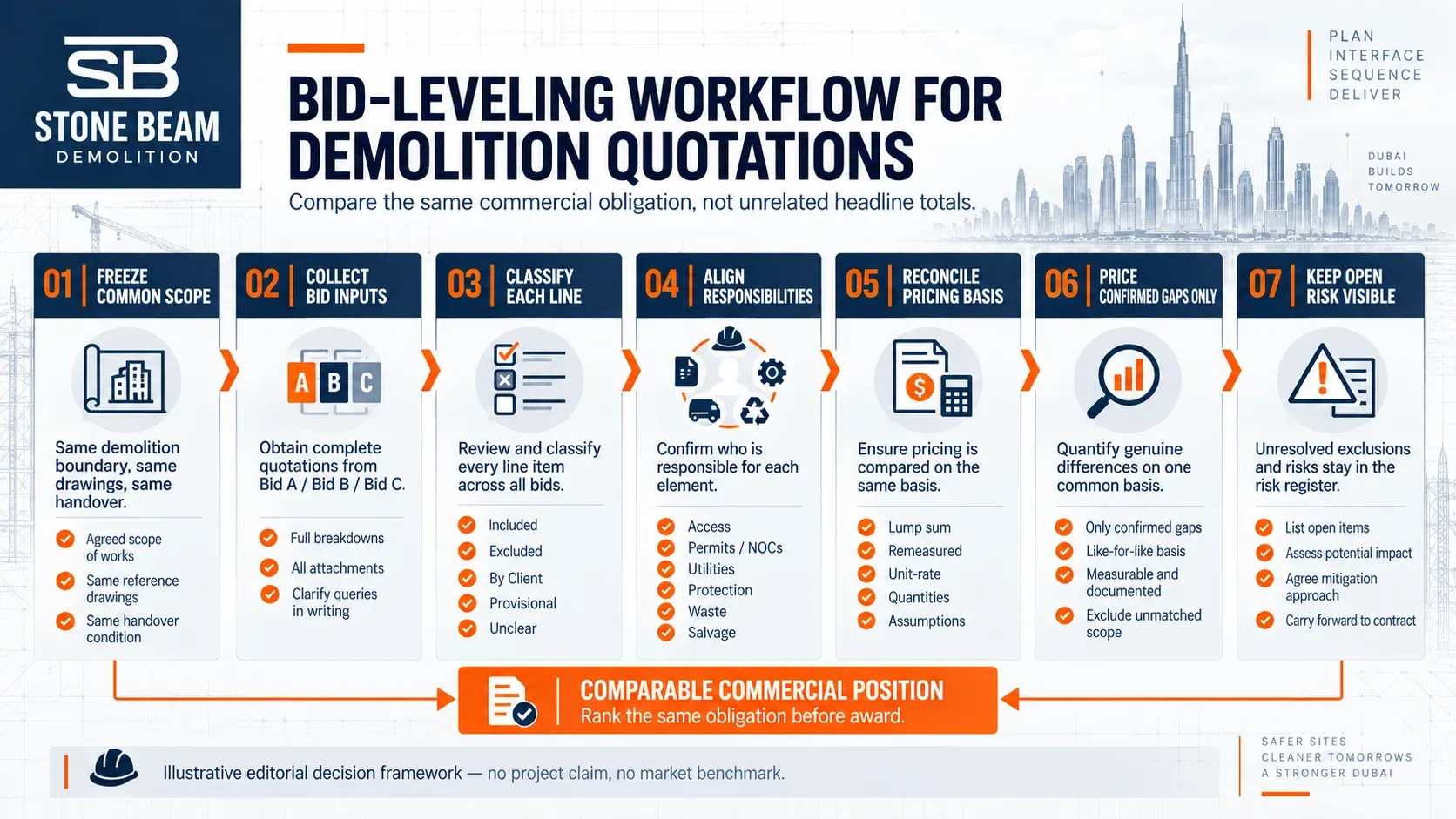
Use a bid-leveling process: freeze one comparison basis, classify what each bidder includes or excludes, align responsibility boundaries, price only measurable gaps on a consistent basis, and keep unresolved exposure visible. A fair comparison ranks the same commercial obligation rather than unrelated headline totals.
For the commercial service itself, see Stone Beam’s demolition contractor page in Dubai. This guide does not replace contractor qualification or project-specific tender documents; it focuses on comparing bids after they have been received.
Why can two demolition quotations for the same project be so different?
Two contractors inspecting the same site frequently price different obligations. One includes below-ground removal while another stops at ground level. One includes internal debris handling, protection, transport and disposal while another prices only demolition at the workface. The totals therefore describe different scopes until those boundaries are aligned.
Different demolition boundaries
The comparison boundary defines what is physically removed and what remains. Above-ground structure, basements, foundations, slabs, tanks, retaining elements, temporary partitions, services and external works all belong on the comparison sheet when they form part of the tendered scope.
Different quantity and measurement bases
One bidder prices a lump sum against drawings while another uses measured quantities or unit rates. Before comparing totals, confirm the same drawing revision, quantity basis and treatment of change. For uncertain quantities, show the uncertainty and the agreed measurement rule instead of hiding it in a nominal total.
Different responsibility and risk positions
Commercial gaps also sit outside the demolition method itself: access windows, protection, lifting or lowering routes, hoarding, utility isolation, permit coordination, temporary works, monitoring, loading, transport, disposal, salvage ownership and handover. A low headline total loses meaning when these responsibilities differ.
What does scope normalisation mean in a demolition tender?
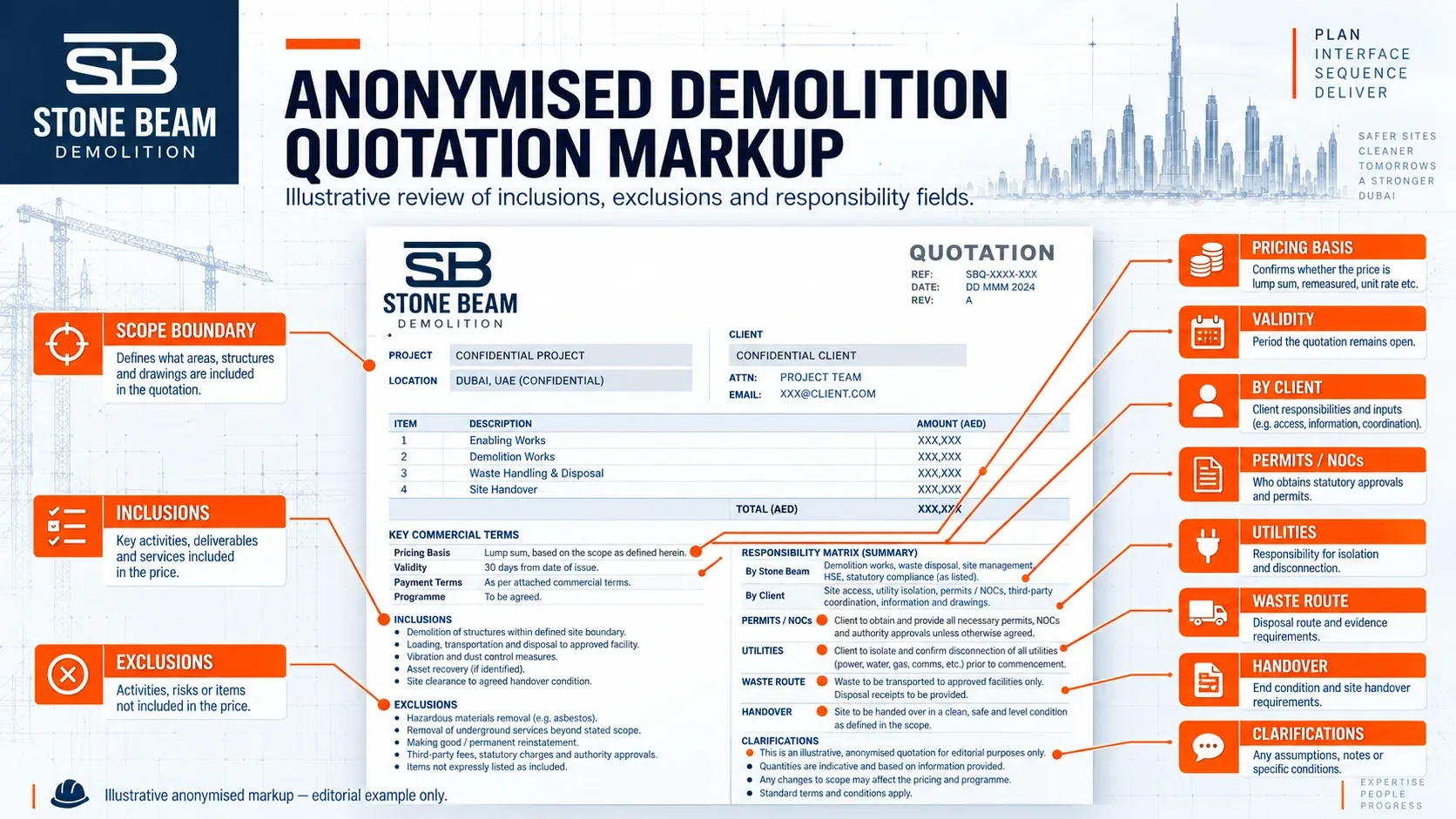
Scope normalisation means converting materially different offers into one common commercial language. Each bidder is checked against the same requirement, and each line is classified as included, excluded, by client, provisional, reimbursable or unclear. The objective is not to make the prices identical; it is to make the obligations visible enough to compare them.
ILLUSTRATIVE COMPARISON MATRIX — NOT A STONE BEAM PROJECT OR MARKET DATA. “Bid A/B/C” entries demonstrate the levelling method only.
| Commercial item | Common comparison basis | Bid A | Bid B | Bid C | Normalised position | Evidence needed | Open risk |
| Demolition boundary | Same removal and retained elements | Included | Included | Excludes foundations | Normalise B to the stated handover boundary | Approved drawings / scope schedule | Variation if foundations are later required |
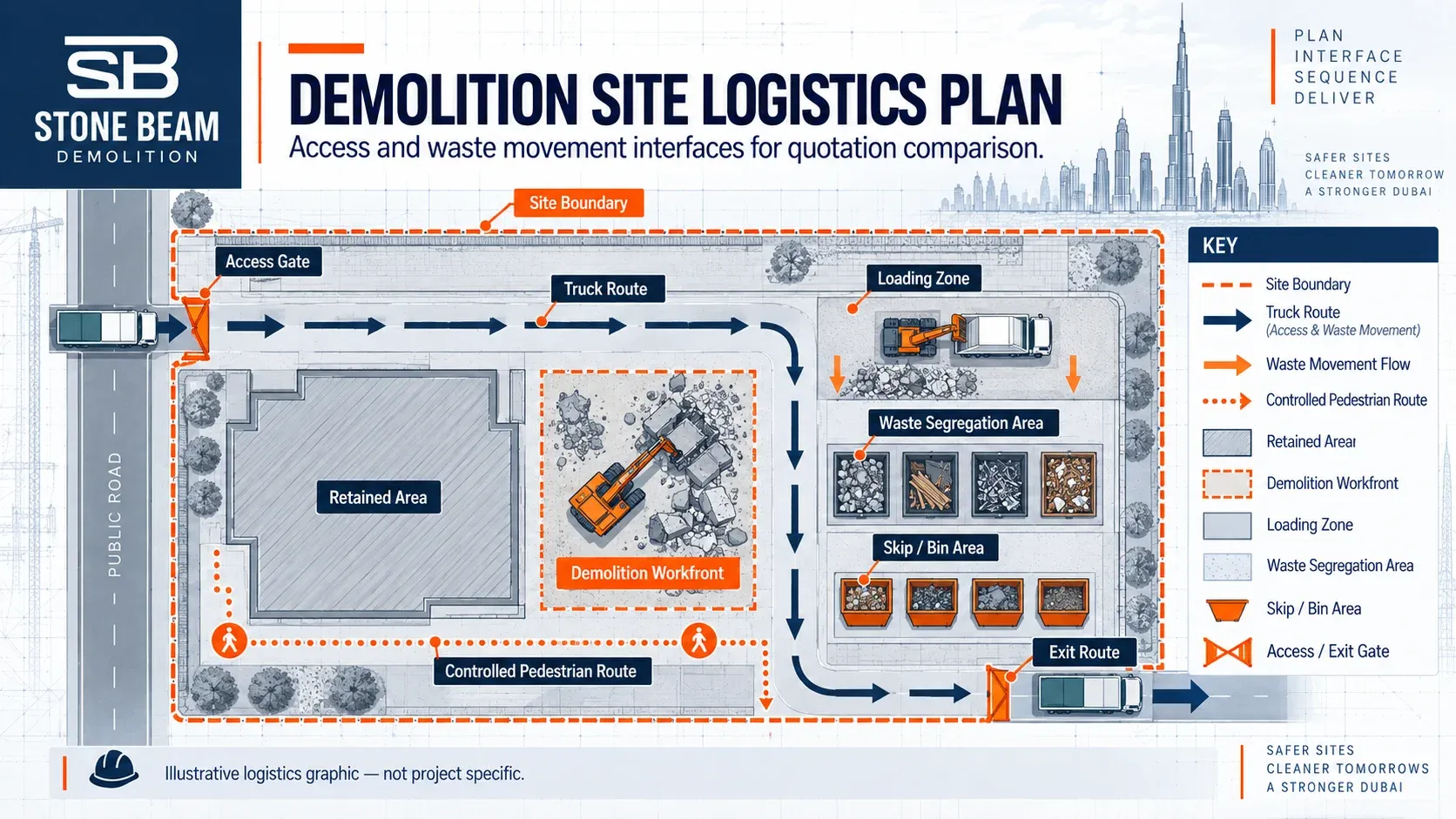
| Access & logistics | Same gates, work windows, plant position and vertical movement | Included | By client | Unclear | Clarify responsibilities before ranking | Site logistics plan / tender clarification | Idle time or additional handling |
| Protection / temporary works | Same retained-asset protection and design interfaces | Provisional | Included | Excluded | Separate priced obligation from project-specific design unknowns | Engineer/consultant requirements | Post-award design or supply exposure |
| Utilities / NOCs | Same applicant, isolation and release assumptions | By client | Included coordination | Unclear | Name who applies, pays and closes comments | Authority / utility requirements | Delay and third-party cost exposure |
| Waste & disposal | Same handling, transport, destination and records | Included | Transport excluded | Included | Align the complete waste route | Waste plan / receiving route | Additional haulage or disposal |
| Salvage | Same ownership and credit treatment | Contractor keeps scrap | Owner keeps scrap | Credit offered | State title/credit basis explicitly | Tender condition / clarification | Hidden offset to headline price |
| Handover | Same endpoint and close-out records | Clear site | Ground-level only | Unclear | Freeze one handover definition | Scope / completion requirements | Extra finishing or close-out work |
| Pricing basis | Comparable contract mechanism | Lump sum | Remeasurement | Unit rates | Do not rank totals without basis alignment | BOQ / quotation terms | Quantity-growth exposure |
| Decision rule If a gap can be measured and priced consistently, normalise it. If it cannot be verified, do not hide it inside an invented allowance. Keep it as an open commercial risk for clarification, negotiation or tender qualification. |
Which inclusions and exclusions must be aligned before comparing price?
- Exact demolition and retained-work boundary, including below-ground scope included in the tender.
- Quantity source, drawing revision, BOQ basis and rules for remeasurement.
- Access, gate restrictions, delivery and truck windows, working hours, vertical movement and internal shifting.
- Protection to retained structures, finishes, neighbouring assets and live interfaces.
- Engineering interfaces such as temporary works, lifting plans, specialist surveys, monitoring or structural review where the project requires them.
- Authority, NOC, utility-isolation and comment-closeout responsibilities, separated from the fees themselves.
- Waste segregation, handling, loading, transport, disposal/recycling destination and documentary records.
- Scrap or salvage ownership, credit mechanism and any assumptions behind it.
- Mobilisation, demobilisation, supervision, permits-to-work and site preliminaries relevant to the package.
- Handover condition, making-good limits, backfilling/grading if included, and close-out documentation.
For a project where the scope includes a villa, basement or foundations, the comparison should match the full physical boundary. The villa demolition in Dubai page is the commercial owner for that service; this article only explains how to compare competing offers for the defined scope.
How do lump-sum, remeasured and unit-rate quotations compare?
Do not rank lump-sum, remeasured and unit-rate offers by headline total until the pricing mechanism is understood. The contract terms decide how quantity and scope risk is allocated. Remeasurement moves final value with measured quantities; unit-rate schedules expose value to the final quantity mix; provisional allowances remain open until their basis is closed.
| Pricing basis | Useful when | Main comparison question | Risk to keep visible |
|---|---|---|---|
| Lump sum | Scope is defined enough to price one obligation | What assumptions or exclusions sit behind the fixed total? | Scope gaps and change-definition risk |
| Remeasurement | Quantities may change but measurement rules are clear | Are the quantities and unit rates comparable across bidders? | Final quantity growth |
| Unit-rate schedule | Work fronts are uncertain or phased | Are all likely items priced and measured on the same unit basis? | Unpriced items and quantity mix |
| Provisional allowance | A defined element cannot yet be finally quantified | What triggers adjustment and what evidence will close the allowance? | Allowance becoming a larger actual cost |
Which exclusions create the greatest post-award commercial risk?
The highest-risk exclusions are not necessarily the largest-looking line items. Focus on exclusions tied to a required project interface: workfront release, retained-asset protection, utility isolation, temporary works, authority comments, access, waste receiving, or handover. Record each unresolved interface as commercial exposure before award.
| Assumption / exclusion | Evidence needed | Why it matters | Comparison treatment |
|---|---|---|---|
| “Permits by client” | Authority route, applicant role, submission scope and fee responsibility | Approval and resubmission responsibilities can sit outside the contractor price | Split applicant/coordination/fees; do not use one vague line |
| “Utilities by others” | Isolation status, NOC route and physical release condition | A paper approval and an actual safe workfront are different interfaces | Clarify documentary and physical responsibilities |
| “Disposal excluded” | Waste classification, loading route, carrier/destination responsibility | Haulage and receiving conditions can change the owner’s total exposure | Normalise the complete waste chain |
| “Temporary works if required” | Consultant/engineer requirements and design responsibility | A required support/protection measure can materially change method and cost | Keep project-specific design exposure visible |
| “Quantities approximate” | Survey, drawings, measurement rules and remeasurement mechanism | Final value can move even if unit rates are competitive | Compare rate basis and quantity risk separately |
| “Making good excluded” | Defined handover condition | The owner may still need follow-on work to reach usable handover | Add a separate handover gap, not a hidden contingency |
How should authority, utility and third-party costs be treated in Dubai?
Separate four things: who submits, who prepares supporting documents, who pays the authority or third party, and who carries the cost of comments or resubmission work. Do not collapse all four into “permit included” or “permit excluded.” The applicable route depends on the project jurisdiction and service interface.
For DDA jurisdiction, the current published demolition-permit service identifies the contractor as requester and lists project documents such as demolition-area drawings, relevant NOCs, hoarding layout, method/HSE material and a neighbouring-building impact study. That is a DDA service requirement, not a universal rule for every Dubai project.
DEWA’s current demolition service also distinguishes Dubai Municipality permit projects, which route through the Dubai Building Permit System, from scenarios under other authorities that use DEWA channels. A quotation comparison should therefore state the project’s actual authority route and the bidder’s role within it, rather than assume one citywide workflow.
Where sequencing, releases and planning dependencies are the main problem, use the advanced demolition planning guide instead of expanding this commercial article into a permit or method-statement guide.
How should waste, scrap and salvage be treated when leveling bids?
Treat waste and salvage as separate commercial boundaries rather than one net number. Identify who segregates, handles, loads and transports each stream; who controls the receiving or recycling route; what close-out evidence is required; and who owns recoverable material or receives any agreed credit. Do not offset an uncertain scrap credit against a known contractor price.
Dubai Municipality maintains Waste Department technical guidelines. The tender should reference the applicable project waste route and records instead of assuming that “carting away” means the same obligation in every quotation.
For the environmental and documentary side of demolition waste, see construction and demolition waste in Dubai and the related demolition waste disposal guide. Those pages own the waste topic; this article only normalises waste responsibility inside bid comparison.
What changes the price, programme, commercial risk or comparison outcome?
| Driver | What can change | How to compare it without inventing a benchmark |
|---|---|---|
| Measurable quantity | Volume, area, element count, thickness, below-ground extent | Use one drawing/survey basis and show any remeasurement mechanism. |
| Access & logistics | Plant position, lifts, gates, work windows, truck route, internal handling | Compare the same logistics scenario and identify client-provided interfaces. |
| Method / engineering | Selective removal, retained assets, temporary works, monitoring, specialist surveys | Compare responsibility and evidence requirements; do not publish generic design values. |
| Waste / salvage | Material mix, handling, haulage, destination, recoverable steel or other materials | Separate disposal obligation from salvage ownership and credit. |
| Programme | Workfront availability, approval dependencies, restricted hours, sequencing | Compare assumptions and dependencies, not an unsupported “typical duration.” |
| Commercial terms | Lump sum vs remeasurement, provisional items, payment, validity, tax/third-party treatment | Normalise the contract mechanism before ranking totals. |
| Unknown conditions | Hidden services, undocumented structure, inaccessible areas, quantity uncertainty | Keep the unknown as a defined risk/clarification item until evidence closes it. |
Figure 2. ILLUSTRATIVE EDITORIAL FRAMEWORK — separate the comparable priced position from unresolved commercial risk; no project price or market benchmark is shown.
What evidence should support each commercial assumption?
A bid comparison is only as reliable as the documents behind it. Ask each bidder to tie major assumptions to evidence available before award. The objective is simple: close a real uncertainty or keep it visible in the risk register.
- Current scope drawings, demolition boundaries and retained-element mark-ups.
- BOQ or measurement schedule with revision and unit definitions.
- Site logistics constraints, access windows and owner-provided facilities.
- Authority/utility route and responsibility matrix for the actual jurisdiction.
- Waste route, transport responsibility and required close-out records.
- Engineering or specialist inputs where the tender requires them.
- Clarification register recording each accepted assumption, exclusion and commercial amendment.
- Defined handover condition and the documents or inspections that confirm completion.
What information is needed before a final commercial or procurement decision?
Before awarding, the evaluator needs clear answers to five questions: what is being removed; what remains; which documents and quantities define the scope; which responsibilities sit with each party; and which risks remain unresolved. Then confirm that the preferred bidder accepts the same basis in the final quotation or tender clarification. A low number is not a decision until its boundaries are known.
- A frozen comparison scope and handover definition.
- A bidder-by-bidder inclusions/exclusions matrix.
- A quantity and pricing-basis reconciliation.
- A responsibility matrix for access, utilities, permits/NOCs, protection, temporary works, waste and salvage.
- A list of unresolved commercial risks with an owner and closure action.
- Clarified tender amendments incorporated into the final offer, not left only in email traffic.
- A final comparable commercial position plus a separate open-risk register.
Common mistakes when comparing demolition quotations
- Ranking the headline total before normalising the scope.
- Adding an invented contingency to every unclear exclusion and calling the result “like for like.”
- Comparing lump-sum and re-measured bids as though they transfer the same quantity risk.
- Treating “permit included” as proof that every authority, NOC, fee and supporting document is included.
- Ignoring the difference between waste handling, transport, disposal/recycling and salvage ownership.
- Assuming the same handover endpoint when one bid excludes foundations, making good, backfilling or close-out records.
- Using a single contractor rate or one past project as a Dubai market benchmark.
- Letting commercial comparison drift into contractor prequalification; qualification and bid leveling are separate decisions.
Practical quotation-comparison checklist before award
- Confirm one scope, one drawing revision and one handover condition.
- Mark each requirement Included / Excluded / By Client / Provisional / Unclear.
- Align the pricing mechanism and measurement basis.
- Separate authority/utility responsibility from third-party fees.
- Align access, logistics, protection and engineering interfaces.
- Align the full waste route and salvage ownership.
- Price only confirmed gaps on a consistent basis.
- Keep unpriced unknowns visible in a commercial-risk register.
- Close clarifications in the final quotation or tender addendum.
- Rank the comparable obligation, not the headline total.
| Need a project-specific comparison? Send the project location, current drawings or BOQ, demolition boundary, access constraints, required handover condition and the quotations you want compared. Stone Beam can review the scope interfaces before a demolition appointment is finalised. |