



Demolition waste disposal in Dubai should be agreed before rubble leaves the site. The practical test is straightforward: identify the waste, confirm who loads it, verify the authorised carrier and receiving facility, and match each removal trip to a transport record and facility weight receipt. The demolition contractor owns the demolition workfront; an independently authorised carrier owns the road-transport operation.
Stone Beam Demolition (Stone Beam Technical Services L.L.C., trade licence 1563419) holds a Dubai Municipality practice permit for Wrecking & Demolition Works (G+12), valid to 13 November 2027. We manage the demolition workfront, segregate and load debris under control, and coordinate off-site removal through an authorised waste carrier.
For a building or villa demolition package, send the scope, drawings and site constraints to Stone Beam’s project enquiry team. See our building demolition service for the demolition work itself.
The disposal decision: five checks before the first truck

| Check | What the buyer should request | Why it changes the decision |
|---|---|---|
| 1. Material | Separate expected concrete, masonry, metal, timber, mixed fit-out and suspect hazardous streams. | The material classification controls the permitted handling and destination. |
| 2. Scope | Written allocation of sorting, stockpiling, loading, containers, transport, gate charges and final clearance. | Clarifies how loading, transport and disposal charges are allocated. |
| 3. Carrier | Trade activity and relevant waste collection/transport permit, vehicle details, and the applicable authority route. | Carrier authorisation is checked as a separate credential. |
| 4. Destination | Receiving-facility name and confirmation that it accepts the particular waste stream. | A facility receipt documents destination and acceptance. |
| 5. Evidence | Transport manifest or equivalent record, trip identifier and facility weight receipt, with a handover procedure. | Each departed load needs an auditable destination and quantity. |
A useful procurement rule: make the carrier records and facility acceptance receipts part of the agreed cart-away completion criteria, alongside physical site clearance.
Who does what between the demolition site and the receiving facility?
This contract responsibility matrix allocates tasks for tender and site coordination. Name the accountable organisation for each deliverable; statutory responsibilities also follow the plot authority and relevant waste-management legislation.
| Interface | Project owner / developer | Consultant and main contractor | Stone Beam demolition scope | Authorised waste carrier / facility |
|---|---|---|---|---|
| Work definition | States required clearance and handover conditions. | Confirms demolition boundary, protection and site-access rules. | Plans demolition workfronts, controlled debris removal and loading. | Confirms accepted streams and collection terms. |
| Segregation | Sets project requirements and reporting expectations. | Provides or approves the site allocation and interfaces. | Separates demolition debris at the workfront and loads under control. | Specifies container/acceptance rules for its service. |
| Road transport | Checks contractual appointments and proof expectations. | Coordinates access windows and traffic interfaces. | Coordinates the licensed carrier with the demolition programme. | Holds the relevant transport authorisations and operates the permitted vehicles. |
| Destination and evidence | Defines the handover record required. | Reviews any gaps or nonconforming loads. | Coordinates the authorised-carrier interface and confirms the agreed document handover requirements. | Delivers to an appropriate designated/authorised facility; carrier and facility originate transport and gate records. |
Where Stone Beam fits: Our demolition planning typically includes a site visit, structural and services review, method statement, risk assessment, phased workfronts and controlled debris removal. We work under a documented HSE and environmental management framework. We coordinate the licensed carrier so transport windows, designated destinations and receipt handover form part of the agreed demolition programme.
For the wider site-wide policy, responsibilities and tender structure, see demolition waste management. This page focuses on off-site collection, traceability and disposal handover.
Which demolition waste streams need separate decisions?
Concrete is not the same procurement problem as mixed strip-out debris. The material schedule should distinguish at least the following streams before the carrier proposes containers or trips.

| Waste stream | Typical examples | Acceptance and procurement question | Route evidence to request |
|---|---|---|---|
| Inert aggregates | Concrete, blocks, bricks and clean masonry | Can the receiving facility accept it as a clean inert/recycling stream, or is it mixed with finishes or soil? | Facility acceptance category; weighbridge receipt and, if recycled, processor evidence. |
| Metals | Reinforcement, structural steel, frames and aluminium | Is metal recovery in scope, and who owns any scrap-credit arrangement? | Authorised scrap buyer / receiving record and quantities. |
| Untreated timber | Timber and uncontaminated packaging | Will the carrier collect this separately from contaminated or treated materials? | Authorised facility acceptance and material separation evidence. |
| Dry recyclables | Cardboard, paper and some plastics | Are containers provided and is this a viable facility stream for the project volume? | Documented receiving route and facility acceptance. |
| Mixed/general waste | Mixed renovation debris, treated wood and contaminated packaging | Which receiving route will accept the actual composition? | Receiving facility confirmation for the actual mixed composition. |
| Potentially hazardous material | Suspect asbestos-containing products, coatings, chemicals and contaminated residues | Stop the ordinary C&D route for that material and obtain a specialist assessment and authorised handling route. | Specialist clearance and authorised hazardous-waste record, separate from ordinary C&D loads. |
For projects following Dubai Municipality’s C&D collection requirements, the waste schedule should distinguish inert material, metals, timber, dry recyclables, mixed waste and suspect hazardous material. Agree the container type and receiving route for each identified stream. The Dubai Municipality C&D waste collection and transport technical guideline provides the specialist reference for the relevant carrier and container requirements.
Hazardous materials need a separately authorised specialist route. Where suspect asbestos-containing materials or contamination are present, obtain the relevant specialist survey and authorised clearance before incorporating those materials into the demolition waste schedule.
How can you verify a C&D waste carrier in Dubai?
The Dubai Municipality C&D collection and transportation guideline, the RTA activity description card, and the plot authority’s requirements are different checks. Ask the carrier to show the current trade activity, applicable waste permit, and vehicle authorisation for its actual route. An activity label or licence number alone does not establish authorisation for every site or waste stream.

For the carrier and route, ask for confirmation of:
- The legal carrier’s name, business activity and valid waste authorisation for the relevant jurisdiction.
- Which company the collection vehicle is registered to, and the vehicle identification to be recorded against the job.
- How the carrier meets applicable RASID tracking requirements. Dubai Municipality explains RASID GPS tracking.
- The named receiving facility and the waste categories it accepts. Under the DM guideline, transport vehicles must use facilities designated by DM.
- How the carrier provides a waste manifest or equivalent movement record and the vehicle weight receipt for each trip.
The authorised carrier must comply with applicable load-containment and vehicle-tracking requirements. For transport monitored through RASID, check the operator’s and vehicle’s applicable registration or tracking evidence. For a DM-operated disposal facility, obtain the facility-issued weighbridge or entry receipt that applies to the vehicle and material stream. Other authorised facilities may use different receipt formats: name the expected documents in the RFQ, then reconcile them to the site dispatch record.
What changes in a Trakhees-regulated area?
The correct permit and collection route depend on the plot and competent authority. The current Trakhees C&D waste collection permit service page lists AED 350 for its Construction & Demolition Waste Collection Permit and links to a procedure document labelled June 2026 (service listing checked 29 October 2026). This is an authority collection-permit fee, not a contractor’s demolition or transport price; additional charges, if applicable, must be confirmed in the current application.
For a Trakhees plot, ask the carrier and project team to confirm the current CED permit/NOC, whether the contractor/client must name the appointed waste transporter in a separate NOC, the carrier’s prequalification and the collection vehicle’s approval. An older official Trakhees procedure includes these checks, but the June 2026 procedure is the version to verify at application. Do not treat an older vehicle-pass procedure or a Trakhees permit as a universal requirement for every Dubai plot.
Which records actually prove the debris reached the correct place?
The handover file needs a connected site record → carrier movement record → receiving-facility receipt for each dispatched load. The following evidence matrix shows how to reconcile the chain.
| Record | Key matching fields | What it establishes | What completes the evidence chain |
|---|---|---|---|
| Site load entry | Project reference, date, waste stream, load or trip ID, vehicle ID | The material logged as leaving the workfront. | Carrier movement reference linked to this load. |
| Carrier movement record / manifest | Carrier, vehicle, collection date, waste category, route and destination | The movement declared by the authorised carrier. | Facility name and matching trip identifier. |
| Receiving-facility weight receipt | Facility, vehicle/trip reference, date, material type and net weight, where recorded | The waste is accepted or weighed at the receiving facility. | A direct match to the site load entry. |
| Reconciliation sheet | One row per trip, matching fields, exceptions and resolution | An auditable summary of site departures and receiving evidence. | Named person responsible for closing exceptions. |
| Recycling or treatment evidence, when contracted | Material type, accepted quantity and processor statement | The processing outcome for the specified material stream. | Totals reconciled across all claimed recycled loads. |
The three-way match: compare the site load ID, carrier vehicle and collection date, and receiving-facility receipt for each dispatched load. Mark the record MATCHED when the supporting entries agree; EXCEPTION OPEN when evidence is missing or disputed; or CLOSED WITH EXPLANATION when a documented resolution has been reviewed and accepted under the project handover rules. An explained exception is not proof that the original records matched.
Illustrative reconciliation example — these entries demonstrate the method, not a Stone Beam project record:
| Site load | Carrier and receipt check | Close-out status |
|---|---|---|
| LOAD-A01 | Vehicle, material, date and receiving receipt agree. | MATCHED |
| LOAD-A02 | Carrier trip recorded; facility receipt has not arrived. | EXCEPTION OPEN |
| LOAD-A03 | Vehicle reference corrected and documented; reviewer accepts correction. | CLOSED WITH EXPLANATION |
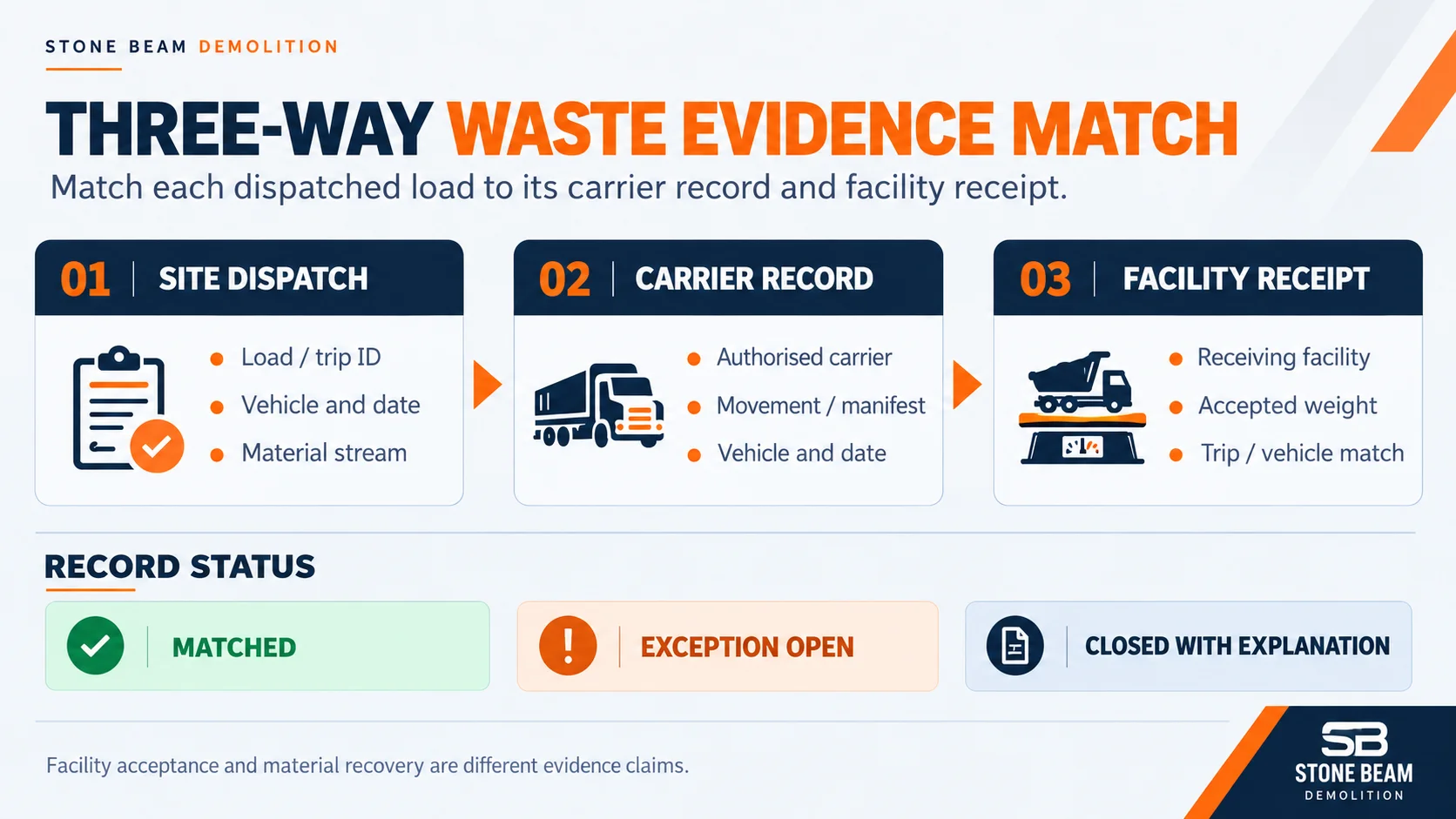
A facility receipt proves recorded acceptance; it does not alone prove that the material was recycled. A recycling claim needs separate processor or recovery evidence.
Dubai Municipality’s Technical Guideline No. 3 addresses manifests and vehicle weight receipts. Specify which carrier-supplied records are copied into the project file, who checks them, and the deadline for submitting the final trip register.
How do you reconcile demolition quantities with disposal receipts?
A demolition BOQ may measure an in-situ volume in m³; site logistics count vehicle trips; facilities record accepted mass in tonnes. These numbers represent different measurement bases and should be compared through traceable assumptions, not treated as interchangeable totals.
| Record | Typical unit | What to reconcile |
|---|---|---|
| Demolition measurement / BOQ | m³ | Material and measured scope; estimated volume only. |
| Site dispatch register | Loads / trips | Load IDs, materials, vehicles and dates. |
| Facility weighbridge tickets | Tonnes | Accepted net mass by material and vehicle. |
| Recovery report, if required | Tonnes | Verified processed/recovered quantity by stream. |
Broken concrete can bulk differently from in-situ concrete. Do not convert every demolition m³ into tonnes using one assumed density and present that estimate as a verified disposal weight.
How should collection be planned around a live demolition site?
Waste logistics are part of the engineering scope, not an afterthought. An occupied property, constrained basement access or a retained structure can change the feasible loading area and collection window even when the material quantities look similar.
A practical planning discussion should settle the accessible workfronts; segregated stockpile locations; restrictions on ground or slab loading set by the responsible engineer; safe vehicle and pedestrian interfaces; truck/container access; site-specific environmental controls; and the point at which a load may leave. The structural engineer releases any loading assumptions or changes affecting retained elements before the workfront and collection arrangements are agreed.
We plan controlled workfronts and debris handling within the building demolition scope; for occupied refurbishments, our interior strip-out planning covers protected routes and retained services. See advanced demolition planning in Dubai for wider access, sequencing and stakeholder interfaces. We coordinate collection windows and receipt handover with the authorised carrier.
What affects a demolition-waste disposal quotation?
Compare waste-collection quotations against the same scope, quantities and units. The right rate basis depends on the material stream, loading responsibility, vehicle type and receiving charges:

| Pricing factor | Clarification to request |
|---|---|
| Material and contamination | Clean concrete versus mixed loads; handling of excluded or suspect hazardous materials. |
| Quantity basis | Estimated m³, measured tonnes, number of skips, or per-trip vehicle charges; conversion assumptions if both units appear. |
| Vehicle/container | Capacity, load limits, container supply, standby, exchange and removal terms. |
| Loading responsibilities | Who provides labour/equipment and who loads; waiting time and rejected-load costs. |
| Access and programme | Collection windows, permitted route, restricted access and traffic interface. |
| Receiving charges | Whether facility charges are included, pass-through, or separately invoiced. |
| Close-out | Number and format of trip records, weight receipts and the deadline for the final waste register. |
What are the published Dubai C&D disposal fees?
Executive Council Resolution No. 58 of 2017, Schedule 1 publishes different Dubai Municipality waste-disposal fee categories. The table specifies the following schedule values; eligibility, current application, facility acceptance, and later instructions must be confirmed with the competent authority or receiving facility.
| Published category | Method | Published schedule | Scope of the figure |
|---|---|---|---|
| Construction and demolition waste | Landfilling | AED 20 per tonne (2020 onwards column) | Schedule 1, item 6; the earlier columns were AED 10 (2018) and AED 15 (2019). |
| C&D waste: concrete, asphalt and waste wood | Waste treatment plant | AED 2 per tonne | Schedule 1, item 7; subject to the receiving facility accepting the specified material. |
The resolution states that a fraction of a tonne is charged as a full tonne for the applicable scheduled fee. These published authority fees are not a contractor’s haulage, loading, container or demolition rate. Ask the facility to confirm the present charge, accepted waste category, applicable exemptions, and whether the carrier’s quotation includes the gate fee. Trakhees separately lists AED 350 for its C&D Waste Collection Permit within that service’s jurisdiction.
For a comparable bid, require each tenderer to state inclusions, exclusions, units, assumptions, and the responsible party. A quoted “per truck” rate should state the truck capacity, permitted load, loading and standby terms, facility charges and document handover so bids can be compared on equivalent conditions.
How should you compare two cart-away quotations?
Evaluate each carrier’s inclusions before comparing a price per truck or tonne. Use the same scope and attach the required evidence to the procurement schedule.
| Commercial item | Carrier A — check | Carrier B — check |
|---|---|---|
| Pricing unit | Per trip / load? | Per tonne? |
| Vehicle and capacity | Capacity and legal load stated? | Capacity and legal load stated? |
| Loading and containers | Included / excluded? | Included / excluded? |
| Gate fees | Included / separately invoiced? | Included / separately invoiced? |
| Waiting and rejected loads | Who pays and when? | Who pays and when? |
| Trip and weighbridge evidence | Format and submission date? | Format and submission date? |
| Final handover register | Included and reviewed? | Included and reviewed? |
For the wider tender scope, see how to compare demolition quotations in Dubai.
What does Dubai waste law require for carriers and waste records?
Dubai Law No. 18 of 2024 sets the principal waste-management obligations in the emirate. Article 8 requires waste producers to use authorised vehicles and, under Article 8(4), to prepare a Dubai Municipality-approved waste-management plan for high-volume activities designated by the relevant authority decision. Article 13 addresses carrier duties, including suitable vehicle authorisations, covering loads and approved tracking systems. The correct permits and procedures must be established for the plot and operating entity.
What belongs in a C&D waste-management plan? For a project requiring one, set out the material inventory, estimated quantities, segregation areas, collection and vehicle interfaces, authorised receiving destinations, environmental controls, assigned responsibilities, records and handover requirements. The owner, consultant and contractor should agree who submits any authority-required plan and who approves changes when the material schedule evolves.
Waste record-keeping depends on the legally responsible waste producer. Article 8(5) of the Law sets retention periods of at least two years for non-hazardous waste and five years for hazardous waste. Administrative Resolution No. 34 of 2026, Article 2 specifies register data and identifies covered categories: hazardous-waste producers; persons with operational control over residential or commercial complexes and hotel or industrial establishments; and further categories designated by the competent authority. The register includes the material category, daily quantity, generation and segregation/processing description, and details of authorised carriers and disposal sites. Article 3’s daily transport duty applies to the producer categories identified in Article 2(c), rather than automatically to every demolition project. The parties should identify the actual waste producer and applicable statutory and contractual record owners.
The legal penalty framework distinguishes fines from service charges. Article 20 of Law No. 18 of 2024 provides a fine capped at AED 500,000 under that article; repetition of the same violation within one year can double the fine imposed subject to the same cap. The applicable violation schedule and other legislation may affect the actual enforcement outcome. Article 21 provides for separate administrative measures. Official legal provisions were checked on 29 October 2026; the implementing bylaw’s Article 2 was checked on the same date.
Clean concrete can be assessed for treatment and reuse when a permitted facility accepts the material. Evidence of acceptance is different from evidence of processing: ask for the processor’s material and quantity record before reporting recycling. See our guidance on recycled concrete aggregate in Dubai and the broader C&D recycling route.
What Stone Beam can demonstrate
Stone Beam completed the demolition of a parking building in Dubai Investment Park 2, closed out with a Dubai Municipality completion certificate dated 29 July 2026. The completion certificate verifies the demolition work; waste tonnage, recycling outcomes, and transport authorisations require their own records.
Our demolition contractor information explains the company’s demolition credentials. The licence can be checked through the issuing authority’s QR verification, and the DM practice permit through Dubai Municipality’s engineering qualification portal using licence 1563419.
Send these details for a demolition and waste-cart-away quotation
For a demolition and debris-removal scope review, send:
- Project location and plot authority (Dubai Municipality, DDA, Trakhees, or other applicable route).
- Drawings and demolition boundaries, including what stays in place.
- Structure type and scope (building, villa, interior strip-out, basement or foundations).
- Expected waste streams, including suspected hazardous material identified for specialist review.
- Estimated quantities and units (m³ or tonnes, with the measurement basis).
- Access and loading conditions, vehicle restrictions and proposed collection windows.
- Responsibility split for segregation, loading, transport, facility charges and final clearance.
- Required records and handover conditions, including trip receipts, processing evidence and consultant requirements.
Send your demolition and debris-removal RFQ to Stone Beam. We plan the demolition workfront, manage controlled debris removal and coordinate the licensed carrier interface for the agreed scope.
Frequently asked questions
Does a Dubai demolition contractor’s permit also authorise waste transport?
No. A demolition practice permit and a waste carrier’s relevant trade activity and authorisations cover different functions. Check the carrier separately against the applicable authority requirements.
Is a weighbridge receipt enough to close out the disposal?
Not on its own. Match the facility receipt to the site’s trip or load reference, the carrier’s vehicle and the recorded material stream. Agree who supplies the full set of records.
Can concrete, metal and interior strip-out waste go in one container?
Not as a default planning assumption. Separate streams where the receiving route and project requirements call for it; mixed material changes facility acceptance and quotation terms. A carrier should confirm its accepted mix before collection.
How can a project prove that demolition waste was recycled?
Use the receiving facility’s and processor’s records. Reconcile actual accepted quantities by material stream and confirm the processed output. Record the evidence supporting any diversion or recycling target in the project handover file. Read more about recycled concrete aggregate.
Who pays for a rejected load or missing receipt?
The contract should decide. State responsibility for contamination, misclassification, carrier documentation, facility rejection, reloading, waiting, and re-delivery before the first collection.
How should demolition debris collection control dust, noise and access risks?
Plan the loading interface before dispatch. Identify segregated stockpiles, covered vehicles, pedestrian and vehicle separation, access windows, dust control, equipment noise restrictions and monitoring agreed for sensitive neighbours. Our HSE and environmental framework addresses workfront readiness, supervision and environmental controls; actual measures follow the approved project plan.
Why appoint a specialist demolition contractor as well as a waste carrier?
Demolition engineering and road transport are separate scopes. We develop the demolition method statement and risk assessment, plan controlled debris removal and coordinate the permitted carrier. The consultant and owner can compare demolition qualifications and waste-transport authorisations independently.
What information belongs in a waste-management ESG report?
Report actual recorded outcomes by material stream. Useful entries include quantities sent to each facility, accepted quantities, verified material recovery, and resolved exceptions. Any carbon-savings estimate needs a documented calculation method and supporting inputs.
Author: Eng. Awad Ashour, Founder & CEO, Stone Beam Demolition.
Eng. Awad Ashour is the founder and CEO of Stone Beam Demolition, a Dubai-based demolition, concrete cutting, and rldc-rzukilvy contractor. A civil engineer with more than 15 years of demolition experience in the UAE, he has led villa, building, basement, and enabling-works demolition, and now oversees Stone Beam’s engineering, method planning, and HSE delivery.