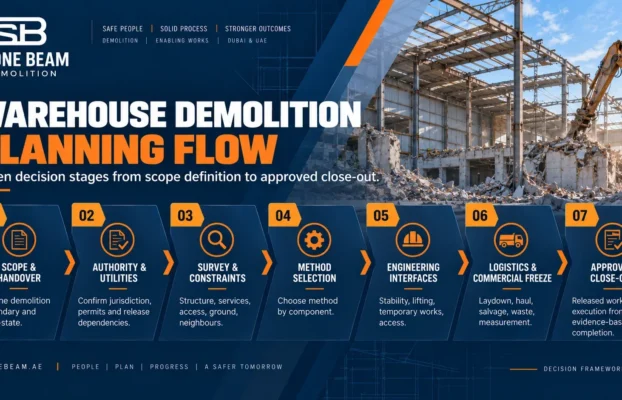



A demolition permit in Dubai is the project approval that authorises a defined full or partial demolition scope under the competent building authority. The correct route starts with jurisdiction, then the applicant assembles authority-specific documents, closes triggered NOCs and utility interfaces, responds to comments, receives the permit, and completes any remaining start-work releases.
Dubai does not use one universal demolition-permit checklist for every plot. Dubai Municipality, Dubai Development Authority (DDA), and Trakhees/PCFC operate separate approval routes in their jurisdictions, while DEWA, telecom providers, RTA, and community or master-developer controls enter the workflow when the project triggers them.
Practical rule: identify the competent building authority before preparing the submission. Then build the permit package from the actual demolition scope, method, utilities, adjacent assets, and site interfaces rather than copying a generic NOC list.
Prepared by Stone Beam Technical Services L.L.C.
Last reviewed: 5 September 2026
| The approval route is jurisdiction-first. Start with the competent building authority, then close only the NOCs and interfaces triggered by the actual demolition scope, method, utilities, and surrounding assets. |
Who actually issues a demolition permit in Dubai?
The first decision is not which form to upload. It is which authority controls the building approval for the plot. Dubai Municipality’s current service catalogue lists a Permit to Carry Out Demolition Works for full or partial demolition and states a three-month permit validity.
DDA publishes its own Demolition Permit service. Its current page identifies the contractor as the requester, lists an estimated five-working-day service target, and publishes a detailed document and NOC package. Trakhees/PCFC publishes a Demolition and Removal NOC route for its jurisdiction. RTA becomes an additional interface when the work affects the Right-of-Way or traffic; its service requires the underlying building or demolition permit from the competent building authority.
| Authority / interface | When it owns the route | Primary output | Current decision note |
| Dubai Municipality | DM-jurisdiction building permit | Permit for full or partial demolition | Current catalogue confirms 3-month permit validity; use the live transaction for submission fields. |
| Dubai Development Authority (DDA) | DDA-governed development | Demolition Permit | Requester: contractor; DDA publishes documents, NOCs, fees, and a 5-working-day service target. |
| Trakhees / PCFC | PCFC-Trakhees jurisdiction | Demolition and Removal NOC | Current service page publishes new NOC fee and links to the official procedure. |
| RTA | Only when ROW / traffic interface is triggered | Additional demolition / construction permit | Not a substitute for the competent building authority permit. |
| DEWA | Electricity and water interface | Demolition NOC / billing-service workflow | DM projects route through Dubai BPS; other authority projects use DEWA channels. |

Who applies, and who is responsible for each approval?
Responsibility has two layers: regulatory responsibility in the authority service and contractual responsibility inside the project team. DDA explicitly lists the contractor as requester. DEWA states that a DEWA-enrolled demolition contractor submits the demolition application, while the owner remains involved in deactivation, final-bill settlement, and clearance. RTA lists building and demolition contractors as eligible applicants for its ROW-related permit.
The commercial contract still needs to state who prepares documents, pays authority charges, follows comments, obtains owner signatures and carries the programme risk. Stone Beam’s reviewed contract records show different allocations: one subcontract included permit and clearance fees in the subcontract price, while another appointment placed the relevant authority permit action with the client. This is a contract-allocation insight, not a regulatory rule.
| Party | Responsibility to define before submission |
| Owner / developer | Ownership letters, account actions, approvals or signatures required by the route; define commercial responsibility. |
| Demolition contractor | Submission role where the authority identifies the contractor; method/HSE and technical package coordination. |
| Consultant / designer | Project drawings, retained-structure decisions, design inputs and responses assigned by the project appointment. |
| Utility / asset owner | NOC, deactivation, protection, clearance or ROW interface for the asset it controls. |
| Building authority | Approves the demolition scope within its jurisdiction and issues the applicable permit/NOC output. |
| Stone Beam operating insight — Reviewed contracts show that permit cost and submission responsibility do not sit with the same party on every project. Put the allocation in the contract before submission; do not assume “the contractor always pays” or “the client always handles permits.” |
What documents belong in a Dubai demolition permit package?
A permit package is a coordinated set of project records, not one method statement. The exact list belongs to the competent authority and the actual project. DDA provides a useful official example because its current Demolition Permit page publishes the submission set in detail.
- A site setting-out plan that identifies the area to be demolished.
- Authority-specific NOCs triggered by the demolition method.
- A fence or hoarding layout.
- A demolition method statement with specific HSE, emergency, and risk-assessment material.
- A study of demolition impact on surrounding neighbouring buildings.
- A current site photograph.
- For controlled explosion only, the engineering survey identified by DDA for seismic or vibration testing.
DDA’s current Demolition Permit page is the source for the example above. It is an authority-specific list, not a universal Dubai checklist.
Dubai Municipality’s public catalogue confirms the demolition-permit service but does not expose an equally detailed current document list in the accessible catalogue text reviewed for this article. For a DM-jurisdiction project, the live Dubai Building Permit System transaction remains the controlling submission interface. Do not import DDA’s list into a DM application and label it a Municipality requirement.
The method statement remains important, but this page does not reproduce a method-statement template. Its job here is to show where that document sits inside the permit package and how other approvals connect to it.
Which NOCs are required before demolition, and what triggers each one?
NOCs are dependency controls. They answer different questions: whether utilities are released, whether a road or ROW interface is accepted, whether telecom assets are addressed, or whether a community condition has been closed. The project should only request the NOCs triggered by its jurisdiction, method, and affected assets.
| NOC / interface | Purpose | Trigger evidence | Decision rule |
| DEWA electricity / water | Electricity or water demolition interface | DDA mechanical demolition lists DEWA; DEWA also operates its own combined demolition service. | Do not equate approval with physical disconnection. DEWA’s journey separates deactivation, final bill, clearance, and disconnection. |
| Telecom service provider | Telecom network interface | DDA lists telecom NOC for mechanical demolition. | Provider and asset status must match the site. |
| Civil Defence + Police + RTA | Additional controls for controlled explosion | DDA explicitly adds these NOCs for controlled explosion. | This is not the NOC set for ordinary mechanical demolition. |
| RTA / ROW | Work affecting public ROW or traffic | RTA service is triggered by ROW/traffic impact. | RTA requires the competent building-authority permit as part of its supporting route. |
| Community / master developer | Local access, disturbance, property or development controls | Triggered by the property/development arrangement. | Conditions are development- and project-specific, not universal Dubai law. |
DEWA’s current demolition service separates combined approval from the owner’s deactivation, final-bill, clearance, and service-disconnection journey. That distinction matters because “NOC approved” and “service physically disconnected” are not the same fact.
Step-by-step: how the demolition approval workflow fits together
The workflow below keeps authority ownership and dependency order clear. Some actions overlap, but no team should treat a parallel activity as permission to bypass an open approval or release.
- Confirm the plot jurisdiction and competent building authority.
- Define the demolition boundary: full, partial, retained elements, below-ground scope, and handover condition.
- Confirm the applicant and responsibility matrix for contractor, owner, consultant, and affected asset owners.
- Assemble the authority-specific permit documents and technical package.
- Start the NOCs, utility actions, and community or ROW interfaces triggered by the project.
- Submit through the correct authority channel: DBPS, DDA portal, Trakhees/PCFC service, or another competent route.
- Close authority comments, revised documents, and applicable fees without changing the demolition scope silently.
- Receive the building-authority permit and the NOCs or service outputs required by the defined route.
- Confirm the remaining start-work releases: actual utility condition, access, accepted project controls, and other open dependencies.
- After execution, complete the inspection, completion certificate, or close-out records required by the competent authority and contract.
For a live project, the Dubai demolition contractor service is the correct next step for scope, site assessment, and project delivery. The permit article remains the regulatory workflow owner rather than becoming a broad service page.
Why a demolition permit is not the same as readiness to start work
Permit approval is a major milestone, not a universal “start now” command. Utility status, access, temporary or retained-structure decisions, project HSE controls, community conditions and consultant or client releases remain separate project controls when they apply to the workface.
Stone Beam uses a Two-Clocks editorial model to keep this distinction visible. Clock 1 covers pre-mobilisation readiness. Readiness Gate A marks the point where the defined workface has the applicable releases. Clock 2 covers physical execution and handover. “Readiness Gate A” is Stone Beam terminology, not an authority procedure name.

This separation also prevents a common scheduling error: adding DDA’s five-working-day target to DEWA’s ten-working-day target and calling the sum a Dubai demolition timeline. Authority services can run on different tracks, comments can interrupt a track, and the physical service condition may follow a different journey from documentary approval.
For the wider survey, engineering, sequencing, and readiness user job, read the advanced demolition planning guide. For method selection rather than permit ownership, use the demolition methods guide.
What changes the approval path, documents, timeline or compliance risk?
Approval effort changes when the project changes. A partial demolition with retained structure, a controlled-explosion proposal, a plot beside a road corridor, or a property inside a master-developed community creates different interfaces from a straightforward full mechanical demolition on an isolated site.
| Driver | What it changes | Control objective |
| Jurisdiction | Changes the building authority, channel, forms, documents, fees and close-out route. | Confirm plot authority before document production. |
| Full vs partial demolition | Changes the demolition boundary and utility/setting-out information. | Mark retained and demolished areas unambiguously. |
| Demolition method | Changes technical studies and NOC triggers. | Use the method selected for the real structure; DDA adds NOCs for controlled explosion. |
| Retained / adjacent structures | Adds impact, protection and engineering interfaces. | Keep structural design decisions with competent project professionals. |
| Live utilities / assets | Adds clearance, deactivation, protection and access dependencies. | Distinguish approval paperwork from verified physical condition. |
| Community / master developer | Adds local access, hours, disturbance or property-control conditions. | Record the actual NOC conditions; do not generalise one project’s rules. |
| ROW / traffic interface | Adds RTA coordination and permit requirements. | Confirm the affected ROW and supporting building-authority permit. |
| Scope change after submission | Creates mismatch between the approved package and planned work. | Update the authority and project records before execution. |
For residential work, the villa demolition service page is the better commercial destination for property-specific scope, access and neighbour constraints. When the programme is the main question, the villa demolition timeline guide explains how authority and utility dependencies interact with site execution.

What can be verified today about fees, review times and validity?
Published numbers need labels. An authority service target describes that authority’s service, not the whole project. A permit-validity period describes how long an issued approval remains valid; it is not the review duration. A fee published by one authority does not become a Dubai-wide permit price.
| Authority | Service | Published time / validity | Published fee / note |
| Dubai Municipality | Permit to Carry Out Demolition Works | Validity: 3 months. | Detailed fee and processing target not stated in the accessible catalogue text reviewed; use the live transaction. |
| DDA | Demolition Permit | Estimated delivery: 5 working days. | AED 1,000 per unit per floor + AED 10 Knowledge Dirham + AED 10 Innovation Dirham per transaction. |
| DEWA | Demolishing Permits – Electricity/Water | Combined approval: 10 working days. | Service fee: Free. Physical deactivation/clearance/disconnection remains a separate customer journey. |
| Trakhees / PCFC | Demolition and Removal NOC – New | No universal duration relied on in this article. | AED 2,500 per plot + AED 500 facility-permit fee per application if applicable. |
| RTA | Building Construction or Demolition Permit | Demolition permit: renewable, valid for 1 month. | Triggered by ROW/traffic interface; verify the live transaction for current fee details. |
| Do not add service targets together — DDA’s five-working-day target and DEWA’s ten-working-day target describe separate services. They do not create a 15-working-day Dubai demolition programme. |
Do not add these service times mechanically. Different authorities, utilities and project controls own different dependencies, and the critical path changes with the plot, method, comments and physical release status.
What happens after demolition is complete?
Permit management does not end when the last wall is down. The contract and competent authority define the close-out requirement. DDA publishes a separate Demolition Completion service. The requester is the contractor; the output is a Demolition Completion Certificate; the current page lists an owner NOC, site photograph and an estimated three-working-day service target.
That DDA completion route belongs to DDA jurisdiction. Other authorities use their own completion, inspection or closure process. Define the required handover record at the beginning of the job so demolition completion, authority close-out and client handover do not become three undocumented dates.
What information is needed before a final approval decision?
A final approval decision needs enough project information to identify the authority, triggers and responsibility boundaries. The permit team should collect the following inputs before promising a submission route or date.
- Exact plot location, development and competent building authority.
- Full or partial demolition boundary, including retained and below-ground elements.
- Current architectural, structural and site information available to the project team.
- Owner, contractor and consultant appointments and who carries permit/NOC charges and submissions.
- Proposed demolition method and any specialist method under consideration.
- Electricity, water, telecom and other asset status.
- Community or master-developer requirements attached to the property.
- Road, ROW, traffic or public-interface constraints.
- Adjacent and retained structures that affect technical review or protection planning.
- Target mobilisation date and the exact handover condition required after demolition.
A one-page generic permit checklist cannot replace these inputs. Once the project data is known, the authority route becomes a traceable dependency map rather than a collection of copied forms.
Frequently asked questions
Who issues a demolition permit in Dubai?
The competent building authority for the plot issues the core demolition approval in its jurisdiction. Dubai Municipality, DDA and Trakhees/PCFC publish separate demolition routes. RTA, DEWA, telecom providers and community bodies enter as additional interfaces when the project triggers them.
Is a DEWA NOC always required?
No universal statement is safe for every Dubai project. DDA currently lists DEWA NOC for mechanical demolition, and DEWA operates a demolition electricity/water service. The actual requirement follows the competent authority route and the utilities affected by the project.
Does every demolition project need the same NOCs?
No. DDA’s own current service page proves that the NOC set changes with the demolition method: mechanical demolition lists DEWA and telecom, while controlled explosion adds Civil Defence, Police and RTA.
How long is a demolition permit valid?
Validity depends on the issuing authority. Dubai Municipality’s current catalogue states three months for its demolition permit. RTA states one month for its ROW-related demolition permit. Do not transfer one authority’s validity to another.
Does permit approval mean demolition can start immediately?
Not automatically. The workface still needs the applicable utility condition, access, accepted project controls and other releases required by the project. Stone Beam’s Readiness Gate A is an editorial way to show that boundary; it is not an official authority gate.
Who pays permit and NOC fees?
The authority sets the fee, while the contract allocates commercial responsibility. Stone Beam’s reviewed contract records show different allocations across projects, so the project agreement should state who pays, submits and carries the programme risk.
Planning a demolition project after the permit research stage?
Send the plot or community, demolition boundary, available drawings, utility status, access constraints, adjacent structures, target mobilisation date and required handover condition. Stone Beam’s Dubai demolition contractor team can use those inputs to define the project route without turning a generic checklist into a project promise. Authority interfaces, portal fields, fees and project requirements change, so recheck the live authority transaction before submission. This guide explains the verified public framework reviewed on 5 September 2026; it does not replace an authority decision for a specific project.