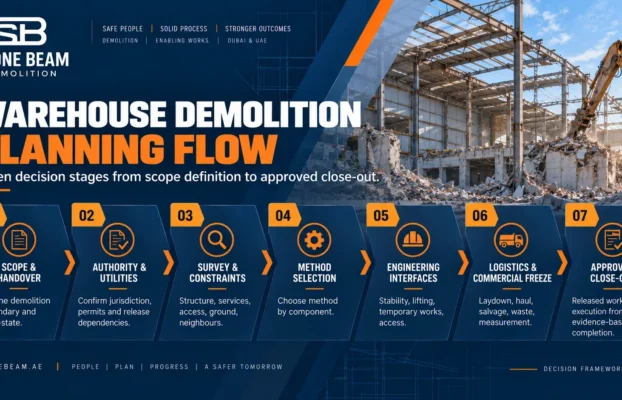




Villa strip-out in Dubai removes agreed non-structural finishes, partitions, fittings, and selected services before renovation, while preserving the building and designated retained elements. A reliable quotation defines what is removed, retained, or protected; which approvals and specialist releases apply; who handles waste; and the handover condition. Structural changes require separate engineering decisions.
Stone Beam Demolition is a Dubai-based contractor specialising in demolition, concrete cutting, and site-enabling works. Our villa strip-out planning considers removal boundaries, retained assets, site access and debris logistics. Structural design and specialist service releases remain with the responsible appointed professionals.
Where the proposed scope includes structural walls, slabs or reinforced concrete openings, see our internal villa demolition and alteration services. For a defined removal package, you can request a scope review.
When Is Villa Strip-Out the Right Service?
Villa strip-out is appropriate when a property needs selected interior elements removed before renovation, but its main structure will remain. It may cover individual bathrooms, kitchens, or larger areas. The agreed scope must distinguish ordinary finishes removal from structural alterations, specialist service modifications, and work needed to prepare the next trade.
Villa strip-out is sometimes called soft strip or interior strip-out. These terms describe selective interior removal, not permission to alter the building structure.

| Your intended work | Appropriate scope |
|---|---|
| Remove kitchens, wardrobes, finishes and specified fixtures | Villa strip-out |
| Remove confirmed non-structural partitions | Defined strip-out or selective removal with the required releases |
| Alter a beam, slab or structural wall | Separately designed structural alteration |
| Remove the building and specified substructure | Full villa demolition in Dubai |
| Repair or replace finishes with little removal | Renovation or maintenance work |
What Is Included in Villa Strip-Out?
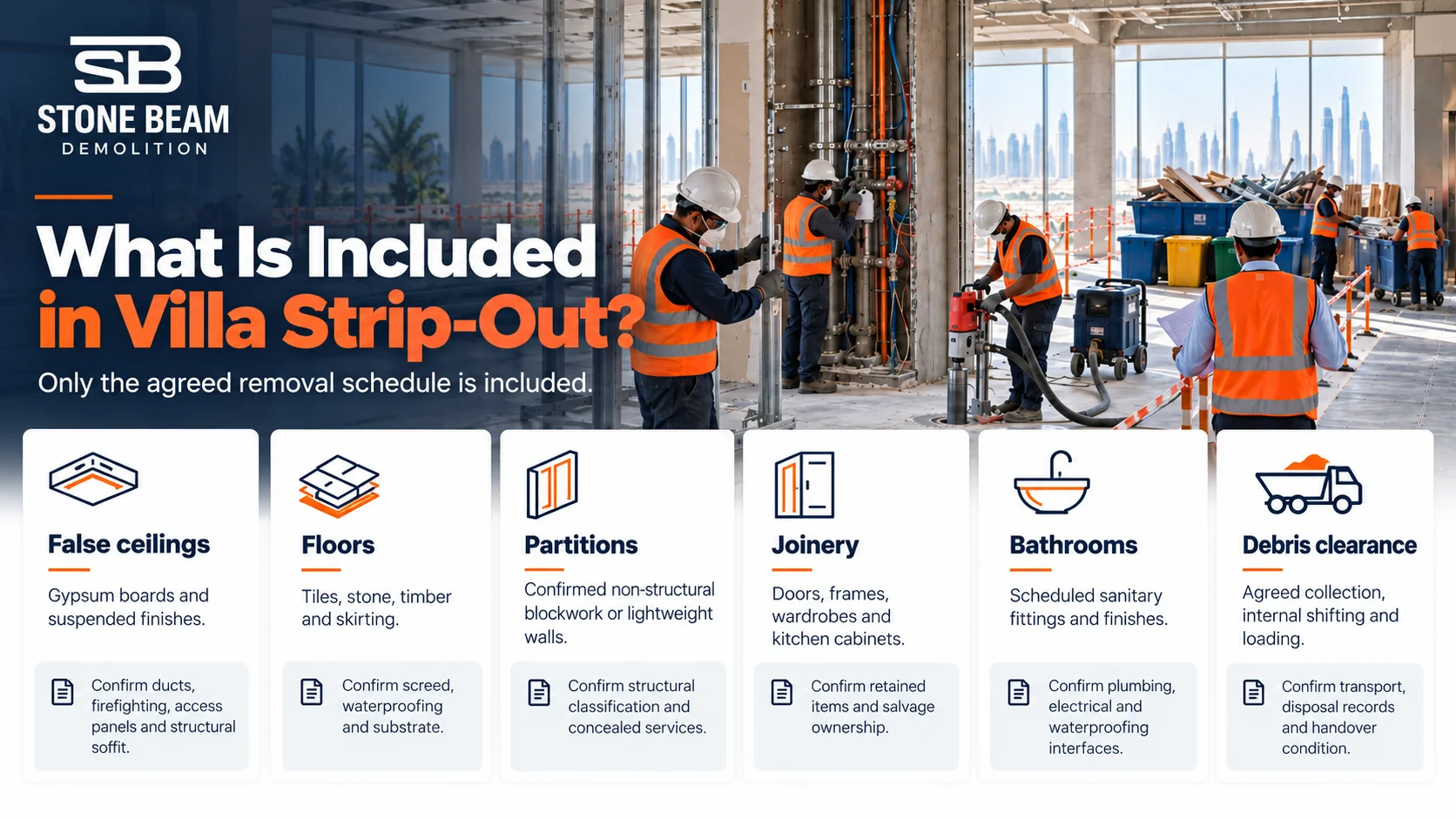
A villa strip-out includes only the elements identified in the agreed removal schedule. Typical items include false ceilings, floor and wall finishes, non-structural partitions, doors, joinery and sanitary fittings. The quotation should also define affected services, protection, debris handling and final clearance, rather than treating every item inside the villa as removable.
| Villa element | Possible removal |
Scope boundary to confirm |
|---|---|---|
| False ceilings | Gypsum boards and nominated suspended finishes | Ducts, firefighting systems, access panels and structural soffit |
| Floors | Tiles, stone, timber, skirting and specified adhesives | Screed, waterproofing and underlying substrate |
| Partitions | Confirmed non-structural blockwork or lightweight walls | Structural classification, approval status and concealed services |
| Wall finishes | Decorative cladding, plaster and specified finishes | Retained substrate and adjacent finishes |
| Joinery | Doors, frames, wardrobes and kitchen cabinets | Items retained for reuse, salvage ownership and removal extent |
| Bathrooms | Scheduled sanitary fittings and finishes | Plumbing, electrical and waterproofing interfaces |
| Selected MEP items | Expressly included and released components | Retained operating systems and specialist responsibilities |
| Debris clearance | Agreed collection, internal shifting and loading | External transport, disposal records and handover condition |
What is not automatically included?
Removing floor tiles does not establish that screed or waterproofing will also be removed. Likewise, removing kitchen units does not authorise changes to the services concealed behind them.
Structural concrete removal, substantial MEP alterations, swimming pool demolition, external structures, backfilling, reinstatement and new finishes need their own defined scope. Waste transport and disposal must also be included expressly rather than assumed.
How Do You Define What Is Removed, Retained and Protected?
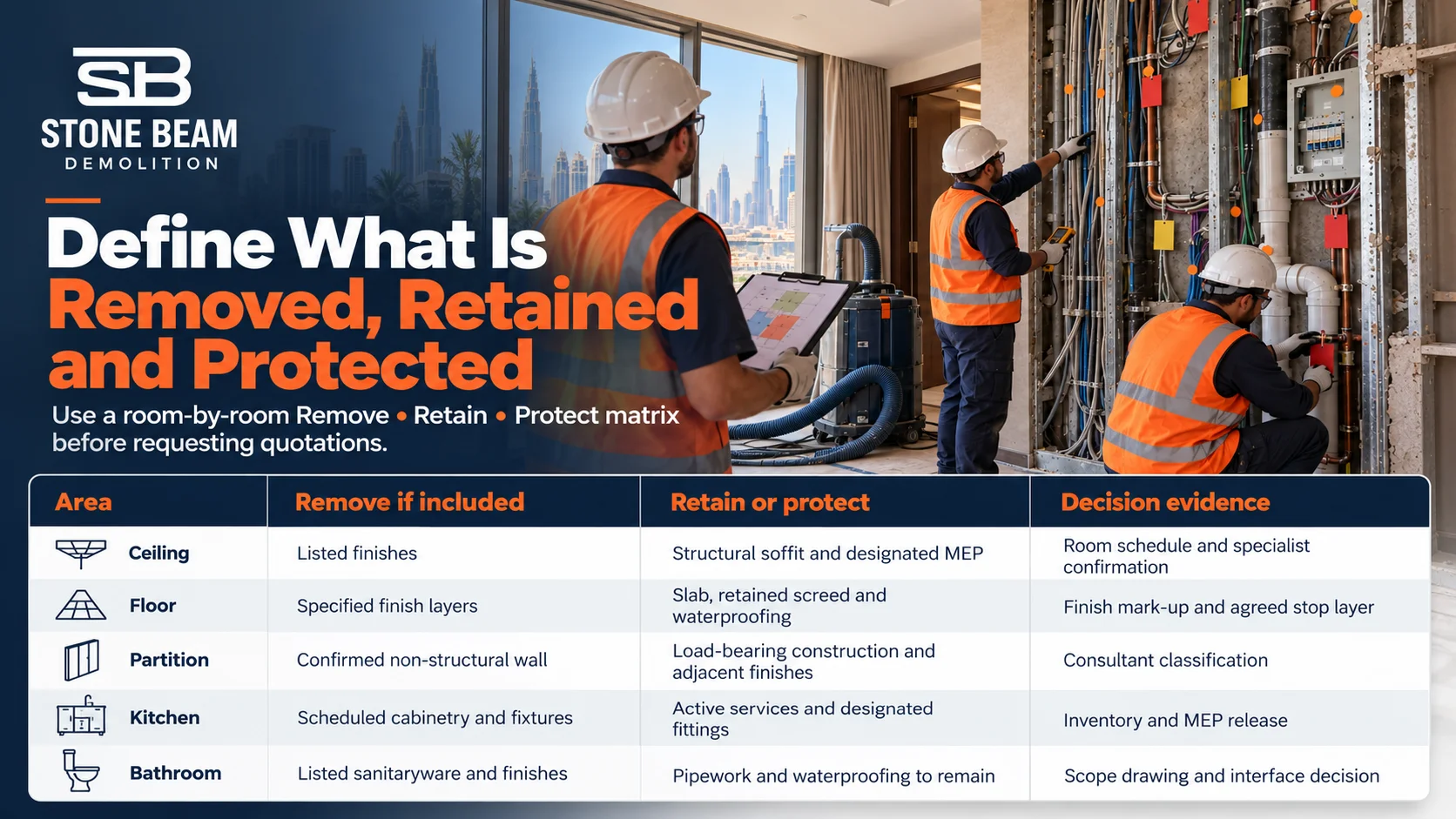
Use a room-by-room Remove/Retain/Protect matrix before requesting competing quotations. Each entry should identify the proposed removal, the elements that stay, the person responsible for deciding the boundary, and the supporting drawing or release. Unknown structural or service conditions remain on hold until the appropriate specialist resolves them.
Villa Strip-Out Scope and Release Matrix
|
Area |
Remove if included | Retain or protect |
Decision evidence |
|---|---|---|---|
| Ceiling | Listed finishes | Structural soffit and designated MEP | Room schedule and specialist confirmation |
| Floor | Specified finish layers | Slab, retained screed and waterproofing | Finish mark-up and agreed stop layer |
| Partition | Confirmed non-structural wall | Load-bearing construction and adjacent finishes | Consultant classification and approved mark-up where applicable |
| Kitchen | Scheduled cabinetry and fixtures | Active services and designated fittings | Inventory and relevant MEP release |
| Bathroom | Listed sanitaryware and finishes | Pipework and waterproofing designated to remain | Scope drawing and specialist interface decision |
| Air-conditioning | Expressly authorised components | Retained equipment, ducts and controls | MEP responsibility schedule |
| Fire protection | Only separately authorised items | Systems required to remain operational | Relevant specialist’s decision |
| External or pool area | Separately defined removal | Pool structure, buried services and landscaping | Separate assessment and authority route |
| Reusable materials | Scheduled recovered items | Owner-retained assets | Ownership and salvage register |
What should happen when the scope is uncertain?
An uncertain wall, concealed service or unidentified removal layer can affect engineering decisions, measurement and price. The project team should record the unknown condition, identify the responsible decision-maker and establish how the revised information changes the authorised scope.
A practical document chain is:
Marked-up scope → Unresolved interface → Responsible specialist decision → Comparable quotation → Workfront acceptance → Handover evidence
The chain defines responsibilities and records. The method of carrying out the physical work remains specific to the approved project.
When Is an Engineer Needed for Wall or Slab Removal?
A structural engineer is required when proposed removal could affect load-bearing elements, reinforced concrete, or the stability of retained construction. A wall’s appearance or an old drawing label is not sufficient structural clearance. The appointed engineer assesses the relevant information and establishes the necessary design and release before the affected work proceeds.
| Proposed change |
Decision required |
|---|---|
| Remove fitted wardrobes or cabinets | Confirm ownership, removal extent and nearby services |
| Remove non-structural ceiling finishes | Confirm retained equipment and protection |
| Remove a wall of uncertain function | Obtain structural classification and applicable approvals |
| Form an opening in reinforced concrete | Obtain project-specific structural design and authority approval |
| Alter a post-tensioned element | Refer to the responsible structural engineer and competent PT specialist |
| Remove a swimming pool structure | Separate assessment of structure, connected services and future site condition |
Concrete scanning and post-tensioned slabs
Concrete scanning can provide information about embedded features within the surveyed area, subject to the detection and interpretation limits of the method used. A scanning report does not authorise cutting or establish the structural suitability of an opening.
Where post-tensioned concrete is involved, the responsible structural engineer and competent PT specialist determine the necessary assessment, design and release documentation. See our concrete scanning service for the survey-related scope.
Swimming pool demolition
Swimming pool removal requires its own definition of the structure being removed, connected services, retained construction, and intended future use. Pool demolition, filling, and reinstatement must be assessed separately from ordinary interior strip-out.
Which Approvals Are Needed for Villa Strip-Out in Dubai?
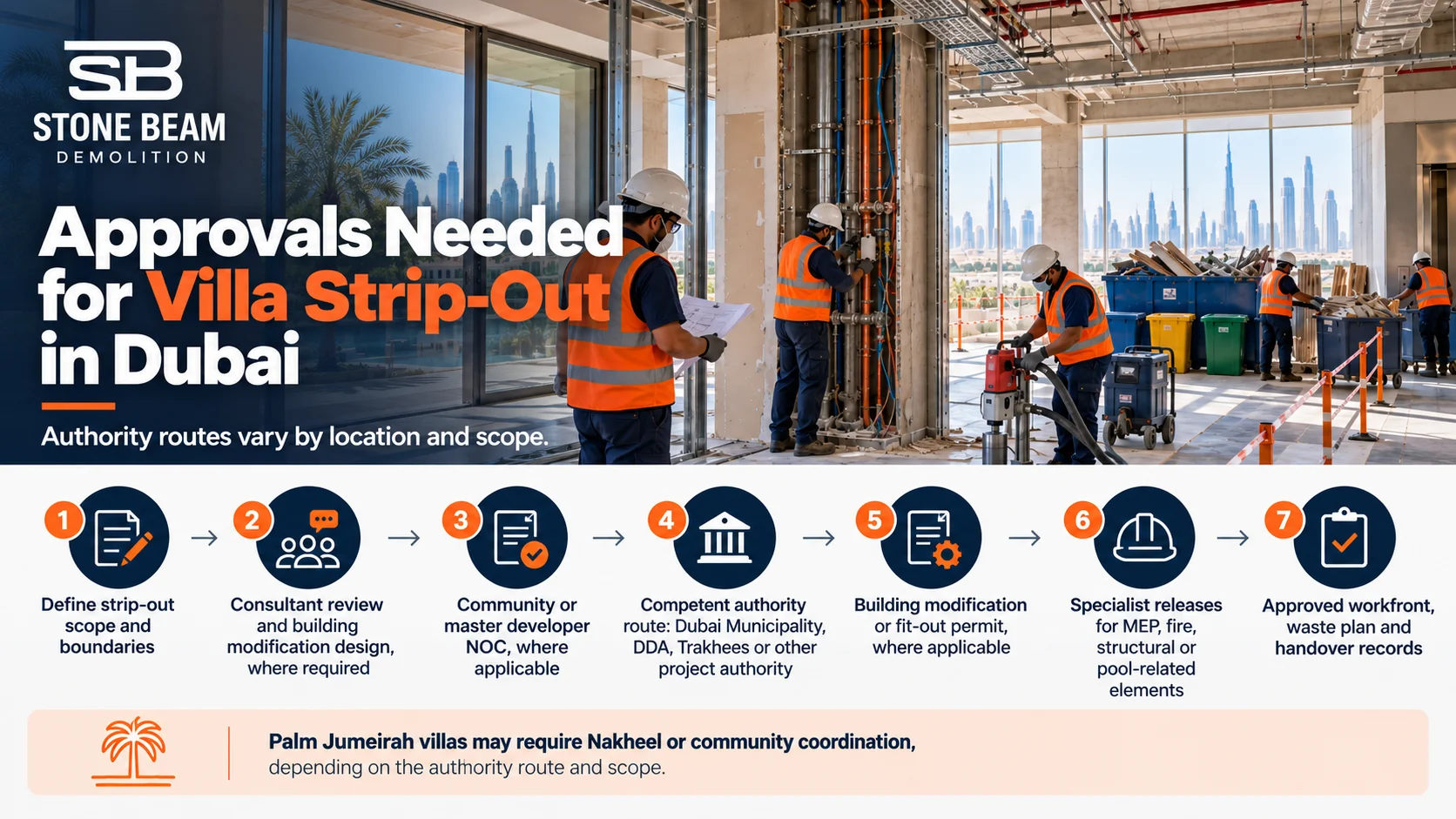
Approval requirements depend on the property’s jurisdiction, community conditions, and extent of alteration. A developer or community NOC, an authority modification permit, a structural engineer’s release, and permission to enter the site are separate decisions. The owner and appointed consultant must establish which apply to the proposed scope before work is released.
|
Document or release |
What it addresses |
Responsible project party |
|---|---|---|
| Community or developer NOC | Consent to specified property modifications | Owner or authorised representative |
| Authority design review | Submitted drawings and relevant design changes | Appointed consultant |
| Modification or fit-out permit | Permission for the applicable category of work | Applicant prescribed by the authority |
| Structural release | Engineering decision for affected structure | Structural engineer |
| MEP or fire-system clearance | Affected services and retained operational systems | Relevant specialist |
| Gate pass or site-access permission | Entry, access and community controls | Party designated by community and contract |
What changes for Palm Jumeirah villas?
Nakheel’s Palm Jumeirah Villa Design Control and Modification Submission Procedures distinguish certain like-for-like refurbishment works from changes to internal wall layouts.
The guidelines identify bathroom and kitchen refurbishment without wall-layout changes among works that may not require a modification NOC under the stated conditions. Security access requirements still apply.
Changes to internal wall layouts, including proposed wall demolition, fall within the modification-review route described in the guidelines.
For relevant modifications, the documented process distinguishes:
|
Approval or access stage |
Purpose |
|---|---|
| Nakheel modification NOC | Master-developer consent to proposed modifications |
| Trakhees modification permit | Relevant building-authority permission |
| Contractor site-access NOC | Access and mobilisation under the community’s conditions |
| Security gate pass | Authorised entry to the property |
| Applicable inspection or completion process | Confirmation of relevant modification requirements |
These distinctions apply to the Palm Jumeirah document and the particular work proposed. They should not be treated as an exemption for every renovation in Dubai.
Reference: Nakheel Palm Jumeirah Villa Design and Modification Guidelines, Sections 04, 06 and 08 (guideline reviewed 21 October 2026).
What if DDA is the competent authority?
Dubai Development Authority (DDA) identifies separate routes for modification design, modification permits and fit-out permits in completed buildings under its jurisdiction.
|
DDA service |
Requester identified by DDA |
Deliverable |
|---|---|---|
| Building Modification – Design | Consultant | Stamped drawings |
| Building Modification – Permit | Contractor | Building Modification Permit |
| Fit-Out Permit | Contractor | Fit-Out Permit |
The responsible consultant determines the relevant design and approval route. A stamped drawing, community NOC, and work permit do not automatically replace one another.
DDA official service descriptions checked 22 October 2026.
What if Trakhees or another authority applies?
Trakhees (PCFC) lists a General Modification service with its own application documents and procedures.
For villas falling under another building authority, the consultant must confirm the applicable requirements for that plot. The consultant must consider the relevant community, design approval, and work-permit conditions together.
Trakhees official service listing checked on 22 October 2026.
How Much Does a Villa Strip-Out Cost in Dubai?
Villa strip-out cost depends on measured quantities, finish types, access, protection, specialist interfaces, waste responsibilities, and the handover condition. Gross floor area alone is not a reliable description of the work. Two villas of similar size may require different removal packages and therefore different quotations.
|
Cost driver |
Clarification needed |
|---|---|
| Removal extent | All internal areas or selected rooms? |
| Finish type | Tile, marble, timber, gypsum, cladding or layered finishes? |
| Screed and waterproofing | Finish only or removal into underlying layers? |
| Partitions | Material, area and structural classification? |
| Retained services | Specialist attendance, protection and responsibility? |
| Access and occupation | Loading routes, community requirements and occupied spaces? |
| Waste and salvage | Who bags, shifts, loads, transports and disposes of materials? |
| Handover | Broom-clean clearance or additional preparation and reinstatement? |
Illustrative BOQ — measurement units only
The following table illustrates how a strip-out package can be divided for measurement. It contains no rates or project-specific quantities.
|
Item |
Possible unit |
Measurement boundary |
|---|---|---|
| Ceiling finish removal | m² | Specified ceiling finish and area |
| Tile or stone removal | m² | Finish only or screed included |
| Non-structural partitions | m² | Identified type and approved extent |
| Joinery and cabinets | Item / room / lump sum | Inventory, salvage and ownership |
| Sanitary fittings | Item | Listed fixtures and service boundary |
| Screed removal, if included | m² | Area and specified layer depth |
| Debris handling and disposal | m³ / tonne / defined quantity | Collection, loading, transport and destination |
| Temporary protection | Lump sum | Assets and areas requiring protection |
| Final clearance | Lump sum | Agreed handover condition |
Agree the units and measurement boundaries before comparing quotations. For related cost considerations across interior removal projects, see our Dubai strip-out cost guide.
How Should You Compare Villa Strip-Out Quotations?
Compare quotations against the same marked-up scope, measurement rules, approval assumptions and responsibility schedule. A lower total may exclude screed removal, waste transport, specialist attendance or protection that another quotation includes. Request written clarification of provisional quantities, exclusions and variation conditions before deciding which offer provides the required work.

Villa Strip-Out Quotation Comparison
| Comparison point | What both offers should state |
|---|---|
| Scope | Removed, retained and protected elements by room |
| Exclusions | Screed, waterproofing, structural work, MEP changes and reinstatement |
| Measurement | Quantities, units, allowances and lump-sum boundaries |
| Approvals | Party responsible for each NOC, permit and specialist release |
| Access | Gate passes, loading space and permitted working arrangements |
| Protection | Retained surfaces, installations and adjacent occupied spaces |
| Waste | Collection, shifting, loading, transport, destination and records |
| Scrap and salvage | Ownership of recoverable materials |
| Variations | Procedure for concealed conditions or changed instructions |
| Handover | Required condition, inspection and acceptance records |
What should trigger a variation?
Additional concealed screed, unidentified services, revised removal boundaries or a changed access route can alter the agreed package.
A structural reclassification may also require an engineering decision beyond a commercial variation. The contract should provide a documented process for agreeing changed work and its implications.
Who Is Responsible for Access, Protection and Waste?
The project team should allocate access, retained-property protection, waste movement and acceptance responsibilities before the workfront is released. The owner confirms the intended scope and retained assets, designers and specialists establish technical boundaries, and the contractor undertakes the defined removal package. Transport and disposal obligations depend on the agreed contract.
|
Role |
What needs to be agreed |
|---|---|
| Owner or representative | Access information, occupancy, items retained and salvage ownership |
| Appointed consultant | Approved scope, drawings and unresolved design interfaces |
| Structural, MEP or fire specialist | Relevant design decisions and specialist releases |
| Strip-out contractor | Released workfront, protection and agreed removal and debris handling |
| Transport or disposal party | Collection, carriage, authorised destination and relevant records |
| Client representative |
Inspection, outstanding items and acceptance |
What waste records should be requested?
Waste handling is more than clearing bags from the villa. The contract needs to identify the party responsible for each movement, the authorised carrier and destination where applicable, and the documentation available at handover.
Dubai’s Law No. 18 of 2024 establishes the waste-management framework.
Administrative Resolution No. 34 of 2026, Article 2, addresses waste-producer registers. It identifies specified categories, including hazardous-waste producers and persons with operational control over residential or commercial complexes, hotels, and industrial establishments.
The project team must confirm the register requirements applicable to its actual activity and category.
|
Waste stage |
Clarification required | Possible supporting evidence |
|---|---|---|
| Collection and segregation | Agreed streams and responsible party | Waste-management arrangements |
| Internal movement | Route from work area to loading point | Defined contractor scope |
| Vehicle loading | Labour, equipment and loading location | Loading responsibilities |
| Off-site carriage | Appointed authorised carrier | Carrier and movement records |
| Disposal | Authorised destination | Applicable acceptance or disposal tickets |
| Salvage | Ownership and transfer arrangement |
Written salvage register |
Official waste-law and implementing-bylaw passages reviewed 22 October 2026.
If potentially hazardous materials are identified, a competent specialist assessment and the applicable specialist arrangements are required separately from ordinary villa strip-out.
How Is a Villa Strip-Out Package Planned?
A villa strip-out package is planned around the removal schedule, retained construction, approvals, access and waste responsibilities. Stone Beam’s demolition planning typically covers a site visit and structural assessment, scanning and services review, a method statement and risk assessment, engineered sequencing and phasing, monitoring where the project requires it, and controlled debris removal and handover.
The responsible project parties should identify unresolved structural or service conditions before treating an affected work area as released.
Any changes arising from concealed conditions or revised design instructions need to be recorded and assessed through the relevant technical and contractual process.
What Is an Acceptable Villa Strip-Out Handover?
Villa strip-out handover confirms that the agreed items have been removed and the site has reached the contracted condition. Empty rooms alone do not establish that retained surfaces are undamaged or that substrate preparation is complete. The client or appointed representative checks the result against the scope and records any outstanding items.
Handover evidence
|
Item to confirm |
Evidence to agree |
|---|---|
| Removal boundary | Room-by-room check against marked drawings |
| Retained construction and finishes | Condition inspection and recorded exceptions |
| Substrate | Agreed stop layer and exposed-surface condition |
| Waste | Relevant transport or disposal records |
| Outstanding items | Dated snag list and assigned responsibilities |
| Acceptance | Agreed photographs, inspections and acceptance record |
Three possible handover conditions
| Condition | What it means | What may follow |
|---|---|---|
| Broom-clean | Contracted items removed, loose debris cleared, and areas swept | Inspection and separate preparation |
| Exposed substrate | Finishes removed to the agreed underlying surface | Substrate assessment and further work by agreement |
| Prepared or reinstated | Specified repair, levelling, waterproofing or making-good completed | Subsequent finishes or construction activities |
A rough-clearance package does not automatically include grinding, substrate repair, replacement waterproofing or full reinstatement. Agree the next contractor’s required starting condition before the removal scope is priced.
What Evidence Can You Check About Stone Beam?
A contractor’s credentials and project records help buyers understand different aspects of capability. The practice permit identifies an authorised activity and category; a project appointment establishes a contracted scope. Stone Beam’s relevant strip-out evidence illustrates occupied-building planning considerations, rather than a claim of completed villa strip-out work.
Company credentials
Stone Beam Technical Services L.L.C. holds a Dubai Municipality practice permit for Wrecking & Demolition Works (G+12) and Concrete Restoration, and is licensed in Dubai under trade licence no. 1563419, with Wrecking & Demolition Works among its licensed activities.
Documented scope — occupied residential tower
A scope we have been appointed for: non-structural strip-out of partitions, ceilings, floor finishes and wet areas inside an occupied residential tower, with fan coil units, air handling, firefighting systems and the façade retained. The method plan bags debris at source and moves it through the service lift in agreed windows.
This appointment concerns a residential tower, not a completed villa project. It demonstrates the importance of clearly defining retained building services, protection and debris routes.
For further company information, see Stone Beam Demolition in Dubai.
Prepared by Stone Beam Engineering Team.
What Should You Send for a Villa Strip-Out Quotation?
A useful enquiry includes the drawings, removal schedule, retained-property requirements, and site constraints. This lets the engineering team identify unknown conditions, approval responsibilities, and measurement boundaries before preparing a defined offer. If critical design or specialist information is missing, the relevant decision can be requested rather than assumed in the quotation.
Please send:
- Location and community: Villa location and relevant master-developer or community.
- Plans and photographs: Available drawings and room-by-room removal mark-ups.
- Retain and protect: Structural elements, finishes, equipment and services that remain.
- Approvals and access: Available NOCs, permits, occupation conditions and loading restrictions.
- Waste and salvage: Disposal responsibilities and ownership of recoverable materials.
- Handover and programme: Required final condition and intended project schedule.
Villa Strip-Out Questions Owners Ask
Owners often need to resolve the same scope questions before comparing quotations. Cost, Nakheel requirements, internal walls, screed, occupation and waste transport each affect what is actually being purchased. These answers establish useful questions for the contract and design team, while the project-specific drawings and approvals determine the final scope.
How much does a villa strip-out cost in Dubai?
The cost depends on quantities, finish layers, access, protection, waste responsibilities, and handover requirements. Quotations are comparable when they use the same marked-up scope, removal boundaries, and measurement units. Ask each contractor to identify exclusions and explain which services, disposal activities, and final preparation tasks are included in the offered total.
Is a Nakheel NOC required to strip out a Palm Jumeirah villa?
It depends on the proposed work. Nakheel’s Palm Jumeirah guidance distinguishes certain bathroom and kitchen refurbishments without wall-layout changes from modifications involving internal walls. Site-access requirements can still apply. Confirm the classification, any necessary modification NOC, and the subsequent applicable authority and access requirements before arranging the work.
Does villa strip-out include removing internal walls?
It can include walls identified for removal and confirmed as non-structural by the responsible professional, subject to the applicable approvals. A wall of uncertain function needs assessment before removal. Changing the villa’s internal layout can also trigger community or authority requirements that do not apply to ordinary finish removal.
Does removing floor tiles include the screed?
Not unless the quotation includes screed removal. Tile finishes, adhesives, screed, and waterproofing can form different layers with different removal and protection requirements. The scope should specify the agreed stop layer, the measurement basis, and the condition required when the floor is handed over for subsequent works.
Can rooms remain occupied while other areas are stripped out?
Possibly, depending on the layout, retained services, access, segregation, and the project’s safety assessment. The owner and responsible project professionals must establish which rooms can remain occupied and the conditions for releasing adjacent work areas. An occupied villa needs specific access and protection arrangements rather than an assumption that normal use can continue unchanged.
Does the price include waste transport and disposal?
Only if the contract expressly includes those activities. Bagging, internal movement, vehicle loading, external transport and disposal are separate tasks that can be allocated to different parties. Ask who supplies the carrier, arranges the authorised destination, handles loading, and provides the applicable movement or disposal records.
Request a Villa Strip-Out Scope Review
Planning a demolition, strip-out or cutting package in Dubai? Send us your drawings, the scope you want removed and retained, site access details, and your target handover condition. Our engineering team will review the inputs and come back with the questions and information needed to price the defined scope.